Advertisers use a mix of media forms and vehicles to maximize the exposure of the
message to the target audience while at the same time minimizing
a. reach.
b. frequency.
c. costs.
d. ratings.
e. cost per share point.
Answer:
Once a consumer has completed the alternative evaluation stage of the consumer
purchase decision process, two choices remain, which are
a. to use credit or to pay cash.
b. to buy one or buy several if a deal is offered.
c. from whom to buy and when to buy.
d. to buy immediately or wait for it to go on sale.
e. to buy in person or to buy online.
Answer:
As marketing vice president of Health Care Services, Inc., you are in charge of
developing an experiment to test the hypothesis that increasing the number of
salespeople assigned to a territory will increase sales of health care services in the
territory. Which experiment will do this best?
a. Create an incentive program for our sales force based upon individual performance.
Use increases in customer satisfaction as your dependent variable and increases in sales
performance as your independent variable.
b. Select three degrees of service health care (poor, good, average) as your independent
variable and measure customer responses for each grade using the same number of sales
representatives in each territory as your dependent variable.
c. Create an incentive program for your salesforce based upon individual performance.
Use increases in customer satisfaction as your independent variable and increases in
sales performance as your dependent variable.
d. Use a different number of salespeople in three different sales territories as your
independent variable and changes in sales of health care services as the dependent
variable.
e. Create an incentive program for your salesforce based upon team performance. Use
increases in customer satisfaction as your independent variable and increases in sales
performance for the team as your dependent variable.
Answer:

Usage rate refers to
a. the percentage of total possible users divided by the total number of consumers who
actually use a product or service.
b. the average number of times a customer uses a product or service.
c. quantity consumed or patronage (store visits) during a specific period.
d. the maximum number of times a customer uses a product or service.
e. the profits a firm earns from customers who consume a particular product or service.
Answer:
A term used when someone is given the option to receive e-mail and advertising based
on personal data supplied by the consumer is referred to as
a. consent-in.
b. choose-in.
c. agreement-in.
d. opt-in.
e. permission-in.
Answer:
Generally, the U.S. population is becoming
a. smaller, younger, and more diverse.
b. smaller, older, and more diverse.
c. larger, older, and less diverse.
d. larger, younger, and more diverse.
e. larger, older, and more diverse.
Answer:
Washburn Guitars markets its guitars to four distinct market segments. The firm’s mass
customization instruments are targeted at
a. first-time buyers.
b. professional musicians.
c. stars and famous musicians.
d. large institutional buyers such as band programs.
e. intermediate-skill players who may become professional musicians.
Answer:
Which of the following characterizes organizational buyer-seller relationships?
a. Purchases are often made after brief negotiations.
b. Purchases are usually of large dollar values.
c. Short-term contracts are often prevalent.
d. Reciprocal arrangements rarely exist.
e. Delivery schedules are less important than production capacity.
Answer:
Washburn Guitars markets its guitars to four distinct market segments. The firm’s
mass-produced instruments are targeted at
a. first-time buyers.
b. professional musicians.
c. stars and famous musicians.
d. guitar collectors and music aficionados.
e. intermediate-skill players who may become professional musicians.
Answer:
All of the following are organizational buyers EXCEPT:
a. industrial firms.
b. government units.
c. ultimate consumers.
d. resellers.
e. wholesalers.
Answer:
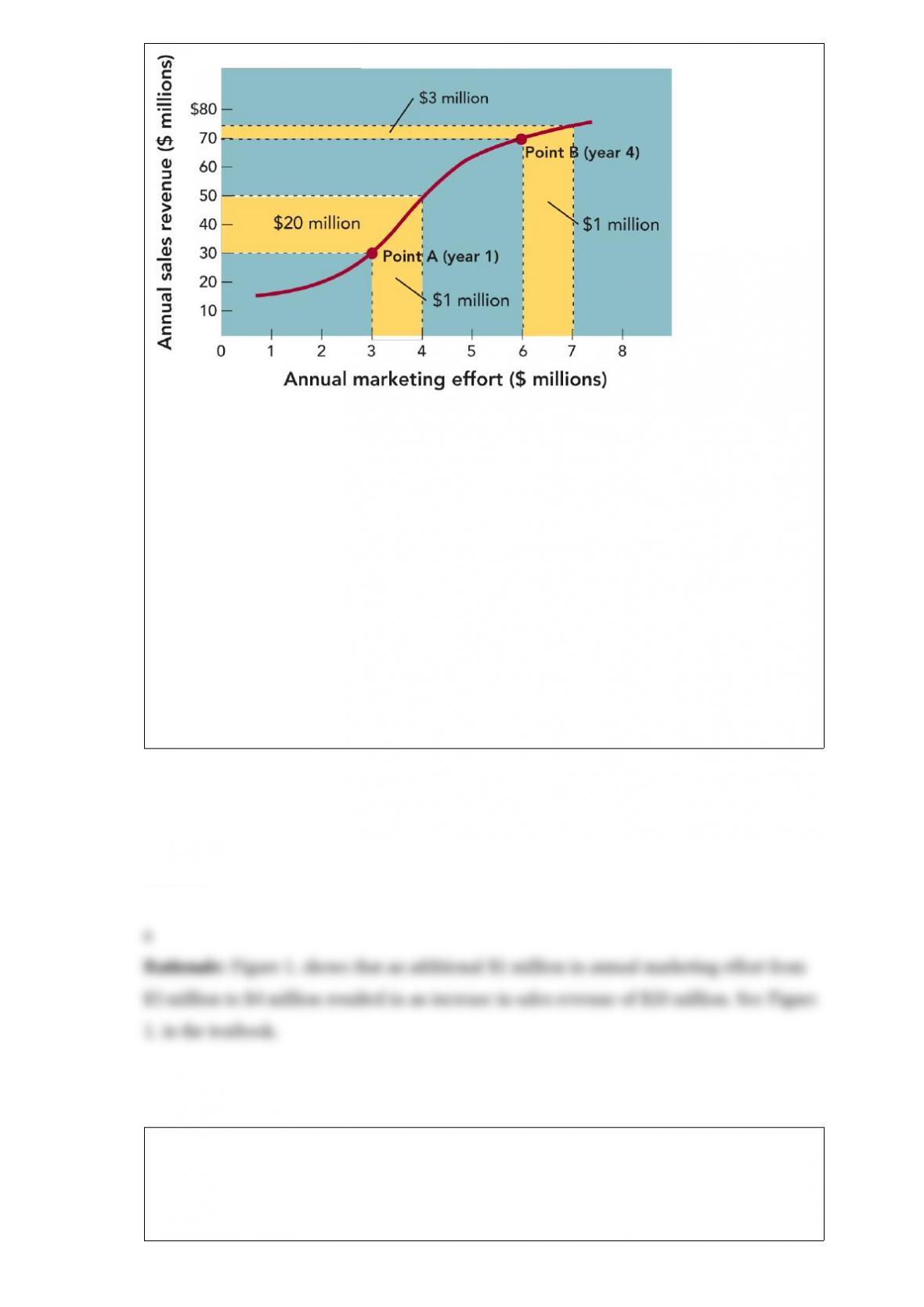
Figure 1.
According to Figure 1. above, the result of spending an additional $1 million in annual
marketing effort from $3 million to $4 million resulted in increased revenues of
__________.
a. $20 million
b. $40 million
c. $50 million
d. $70 million
e. $80 million
Answer:
Your local Safeway grocery store is likely to be categorized according to what form of
ownership, level of service, or merchandise line?
a. form of ownership
b. level of service
c. merchandise line
d. method of operation
e. revenue generated
Answer:
There are four commonly used forms of institutional advertising: advocacy,
__________, competitive, and reminder.
a. differentiation
b. pioneering
c. persuasive
d. philanthropic
e. informational
Answer:
An organization that focuses its efforts on: (1) continuously collecting information
about customers’ needs; (2) sharing this information across departments; and (3) using it
to create customer value is said to have a
a. product orientation.
b. customer orientation.
c. market orientation.
d. industry orientation.
e. societal orientation.
Answer:
Items consumed in one or a few uses, such as food and fuel, are referred to as
________.
a. services
b. perishable goods
c. durable goods
d. disposable goods
e. nondurable goods
Answer:
Rather than compete with large greeting card companies for shelf space in
supermarkets, several smaller card companies place their cards in pack-and-ship stores
where the customer can mail a card on the spur of the moment, or in carwashes where
customers are waiting and appreciate having something amusing to read. This would be
an example of which type of marketing channel strategy?
a. a strategic channel alliance
b. multichannel distribution
c. parallel distribution
d. dual distribution
e. direct distribution
Answer:
When setting prices for merchandise, retailers must decide on the markup, markdown,
and the __________ for markdowns.
a. relevance
b. necessity
c. percentage
d. timing
e. consequence
Answer:
Based on a market-product grid framework, which marketing strategy involves
developing a single product for a single market?
a. full coverage
b. market-product concentration
c. market specialization
d. product specialization
e. selective specialization
Answer:
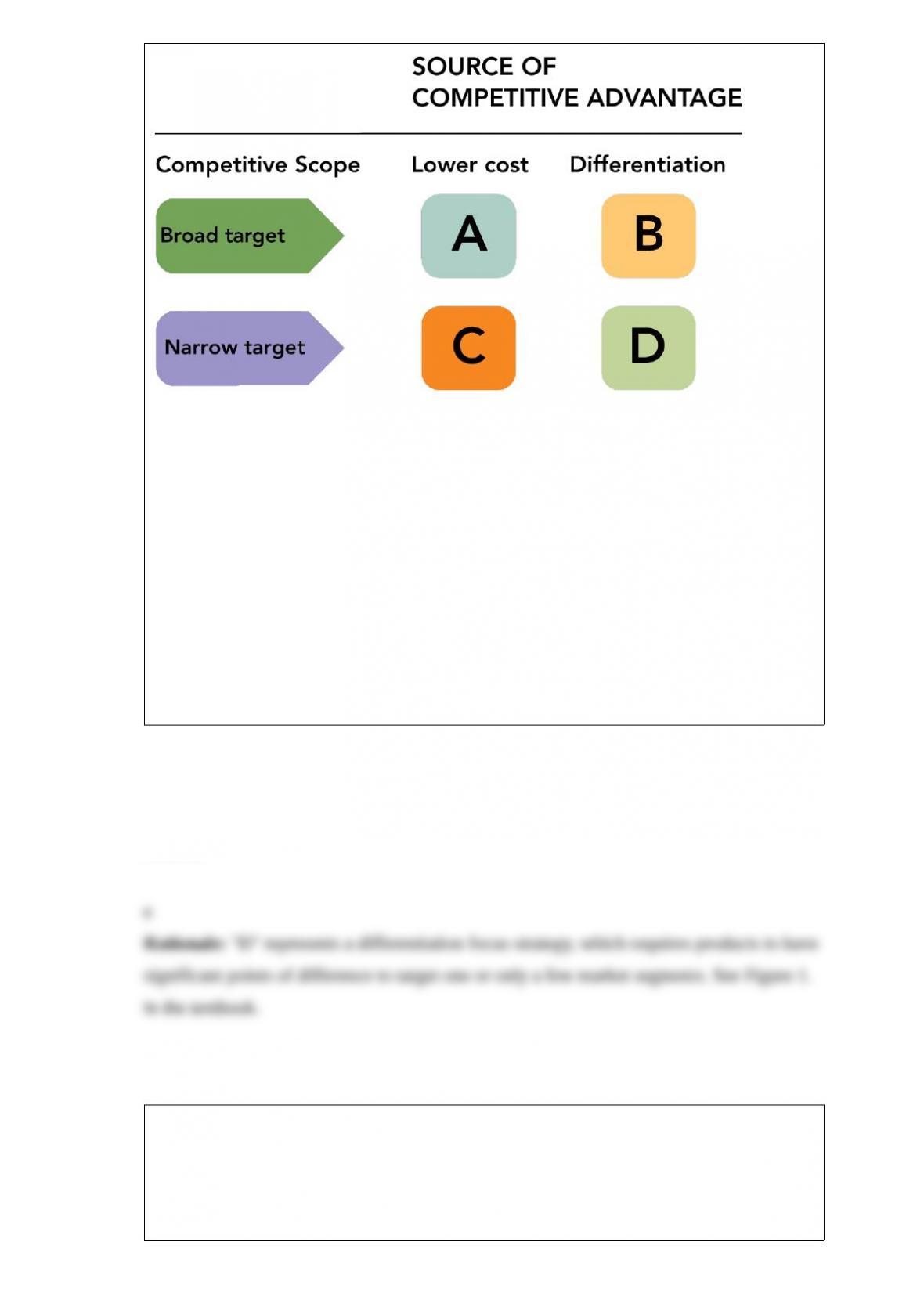
Figure 1.
Porter’s generic business strategies shown in Figure 1. above, “D” refers to a
__________ strategy.
a. quality focus
b. cost leadership
c. differentiation
d. cost focus
e. differentiation focus
Answer:
Many companies subscribe to being “green” because they feel that consumers value
this. Yet, in many of these same firms, office computers are left on 24 hours a day and
office paper is not recycled. This example indicates it is not always easy for firms to act
in accordance with the
a. marketing concept.
b. customer relationship management concept.
c. consumerism.
d. social entrepreneurship.
e. cause marketing.
Answer:
At which stage of the product life cycle is a company likely to have its most complete
product line?
a. introduction
b. growth
c. maturity
d. decline
e. accelerated development
Answer:
When you redeem a 50-cents-off coupon for Crest toothpaste at your local supermarket,
you are being influenced primarily by __________.
a. advertising
b. sales promotion
c. public relations
d. publicity
e. personal selling
Answer:
The level of service that requires that the customers perform many functions during the
purchase process is __________.
a. full-service
b. limited-service
c. self-service
d. customized-service
e. automated-service
Answer:
Facebook and Twitter are examples of __________.
a. Internet portals
b. social media
c. wikis
d. virtual focus groups
e. e-journals
Answer:
When using share points to make marketing resource allocation decisions, marketing
managers must estimate: (1) the market share for the product, (2) __________, (3) the
contribution to overhead and profit (or gross margin) of each share point, and (4)
possible cannibalization effects on other products in the line.
a. total production costs
b. number of market segments
c. stage of the product in its product life cycle
d. the total financial resources available for a sustained marketing effort
e. the revenues associated with each point of market share
Answer:
Marriott, Lands’ End, and Home Depot deliver customer value by providing its
customers with the best
a. assortment.
b. products/services.
c. price.
d. customer service.
e. availability.
Answer:
Three closing techniques are used when a salesperson believes a buyer is about ready to
make a purchase. They are __________ closes.
a. assumptive, trial, and presumptive
b. trial, assumptive, and urgency
c. presumptive, trial, and final
d. trial, final, and urgency
e. assumptive, presumptive, and final
Answer:
Why are inventory of services different from that of goods?
a. time is less important to customers of services than customers of goods
b. many times, the service provider is unavailable when there is a demand for the
service
c. there are costs associated with the handling of service inventory
d. service inventory can be reduced through a straight salary compensation system
e. with goods, many items are perishable
Answer:
With __________ selling, problem solutions are not simply a matter of choosing from
an array of existing products or services. Rather, novel solutions often arise, thereby
creating unique value for the customer.
a. adaptive
b. formula
c. consultative
d. suggestive
e. relationship
Answer:
Direct marketing currently accounts for about _________ of the total U.S. gross
domestic product.
a. 8 percent
b. 10 percent
c. 16 percent
d. 20 percent
e. 23 percent
Answer:
All of the following are true about marketing EXCEPT:
a. Marketing is a broader activity than advertising.
b. Marketing stresses the importance of delivering genuine benefits in the offerings of
products, services, and ideas.
c. Marketing persuades people to buy the “wrong” things.
d. When an organization engages in marketing, all stakeholders should benefit.
e. Marketing is a broader activity than personal selling.
Answer:
Cultural symbols refer to
a. ideas that can be protected by international copyrights.
b. ideas that cannot be expressed by words or characters.
c. things that represent values that exist solely within a nation.
d. things that represent ideas and concepts.
e. words that represent pictures or designs.
Answer:
When people outside the target market for the product see a firm’s advertisement, it is
referred to as __________.
a. wasted coverage
b. media divergence
c. dual exposure
d. over-exposure
e. advertising spill-over
Answer: