
A time of declining economic activity when businesses decrease production,
unemployment rises, and many consumers have less money to spend is referred to as
a. deflation.
b. inflation.
c. prosperity.
d. a recession.
e. a depression.
Answer:
Cross-functional teams refer to
a. members of an organization who have been trained in multiple disciplines so they can
easily move from one job to another as needed.
b. situations where two departments within the same company have opposing views
about how a product should be developed and managed.
c. departments within an organization that carry out multiple functions due to financial
constraints within the company.
d. a small number of people from different departments in an organization who are
mutually accountable to accomplish a task or a common set of performance goals.
e. departments within an organization who manage the same product with distinctly
different marketing programs to reach different target markets.
Answer:

The key elements of future services include __________, mobility, and convergence.
a. automation
b. transglobalization
c. cooperation
d. personalization
e. convenience
Answer:
In terms of the diffusion of innovation, late majority accounts for __________ of
product adopters.
a. 2.5%
b. 13.5%
c. 16%
d. 34%
e. 50%

Answer:
Which of the following statements about social responsibility is most accurate?
a. The three concepts of social responsibility are economic responsibility, internal social
responsibility, and external social responsibility.
b. Organizations are part of a larger society and are accountable to that society for their
actions.
c. Societal responsibility focuses on the obligations an organization has to its customers,
employees, suppliers, and distributors.
d. The duty of an organization is most easily understood at the societal responsibility
level.
e. Social responsibility cannot be taught; it is an innate outgrowth of a person’s moral
and ethical belief system.
Answer:

Mark wanted to make some extra money, so he went door-to-door in his neighborhood
asking residents if they had any small jobs that they could hire him to perform. Mark
had no idea of whether anyone had any jobs for him, so he picked the houses randomly
and knocked on the doors to see if anyone was home and perhaps interested in his
services. In terms of the personal selling process, Mark was engaged in __________
when he knocked on a door.
a. stimulus-response selling
b. “handshaking”
c. cold canvassing
d. closing
e. traffic generation
Answer:
Many forward-looking companies have discovered that their own organization does not
generate enough useful new-product ideas. This has caused them to find new product
ideas by developing strategic relationships with outside individuals and organizations.
This practice is referred to as __________.
a. innovation alliances
b. open innovation
c. open collaboration
d. “piggy-back thinking”
e. stakeholder cooperation

Answer:
Throughout the past 50 years, the Mountain Dew experience has had three dimensions:
a do-it-yourself ethic, an operating-outside-the-mainstream perspective, and
__________.
a. global citizenship style
b. a remain-true-to-yourself attitude
c. a bring-it-on attitude
d. an aggressive personal philosophy
e. a just-do-it mantra
Answer:
When Jason called the toll-free number to order two children’s books from the
Chinaberry catalog, the firm was using __________.
a. social networking
b. interactive marketing
c. multichannel selling
d. inbound telemarketing
e. outbound telemarketing
Answer:
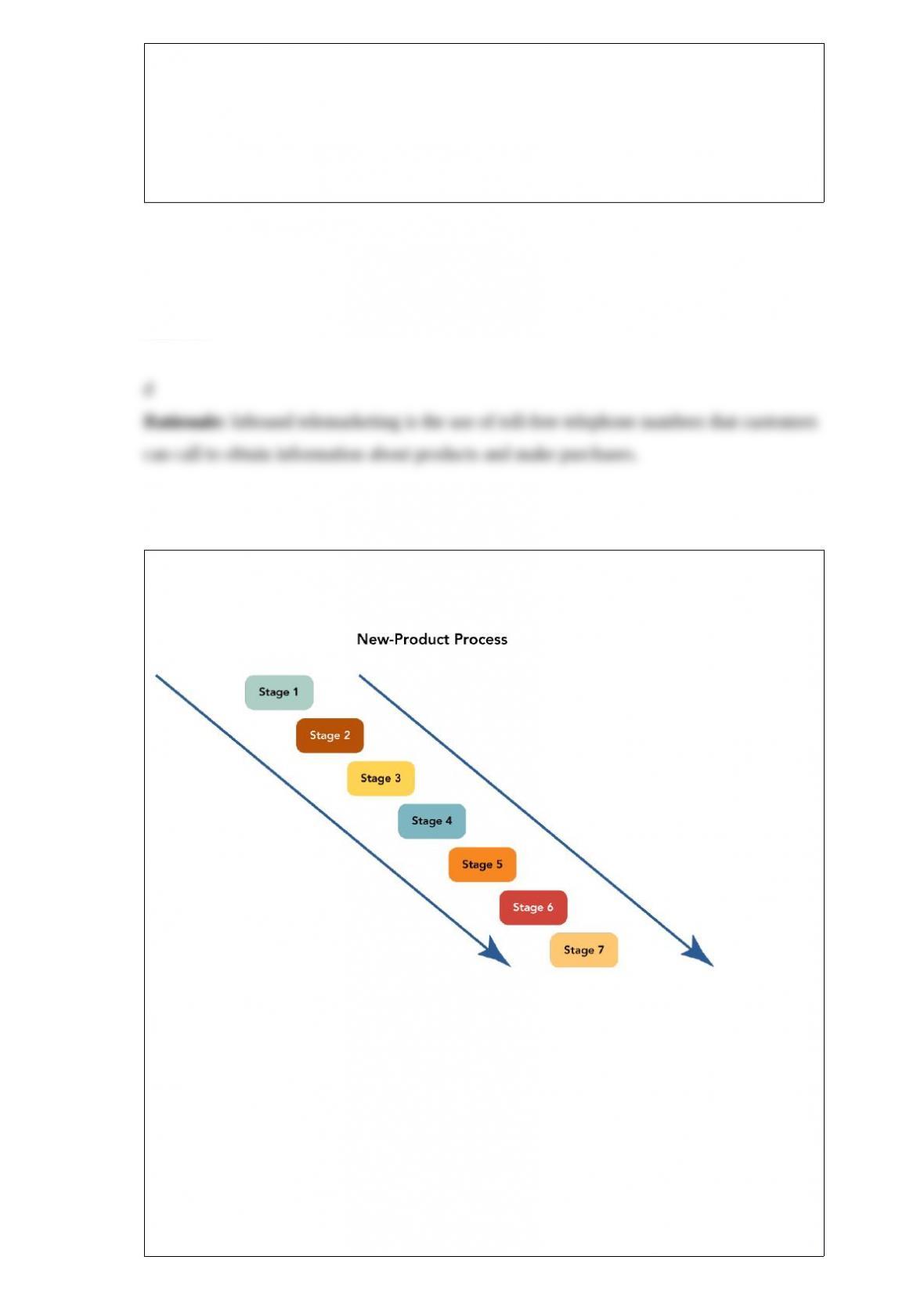
Figure 1.
Figure 1. above represents the seven stages of the new-product development process.
Stage 4 is the __________ stage.
a. idea generation
b. screening and evaluation
c. business analysis
d. new-product strategy development

e. market testing
Answer:
Two general applications of websites exist based on their intended purpose: (1)
__________ websites and (2) promotional websites.
a. transactional
b. financial
c. service-oriented
d. informational
e. cross-functional
Answer:
Web 2.0 is a term that describes

a. a technical update of the World Wide Web.
b. the highly interactive web content created by users.
c. the second generation of Internet browsers.
d. the decreased interactivity of user generated content.
e. the second revision of interactive web content.
Answer:
A product is a good, service, or idea consisting of a __________ that satisfy consumers’
needs and is received in exchange for money or something else of value.
a. promise or commitment exchanged between a seller and a buyer
b. bundle of tangible and intangible attributes
c. bundle of tangible attributes
d. bundle of intangible attributes
e. bundle of tangible and intangible experiences
Answer:
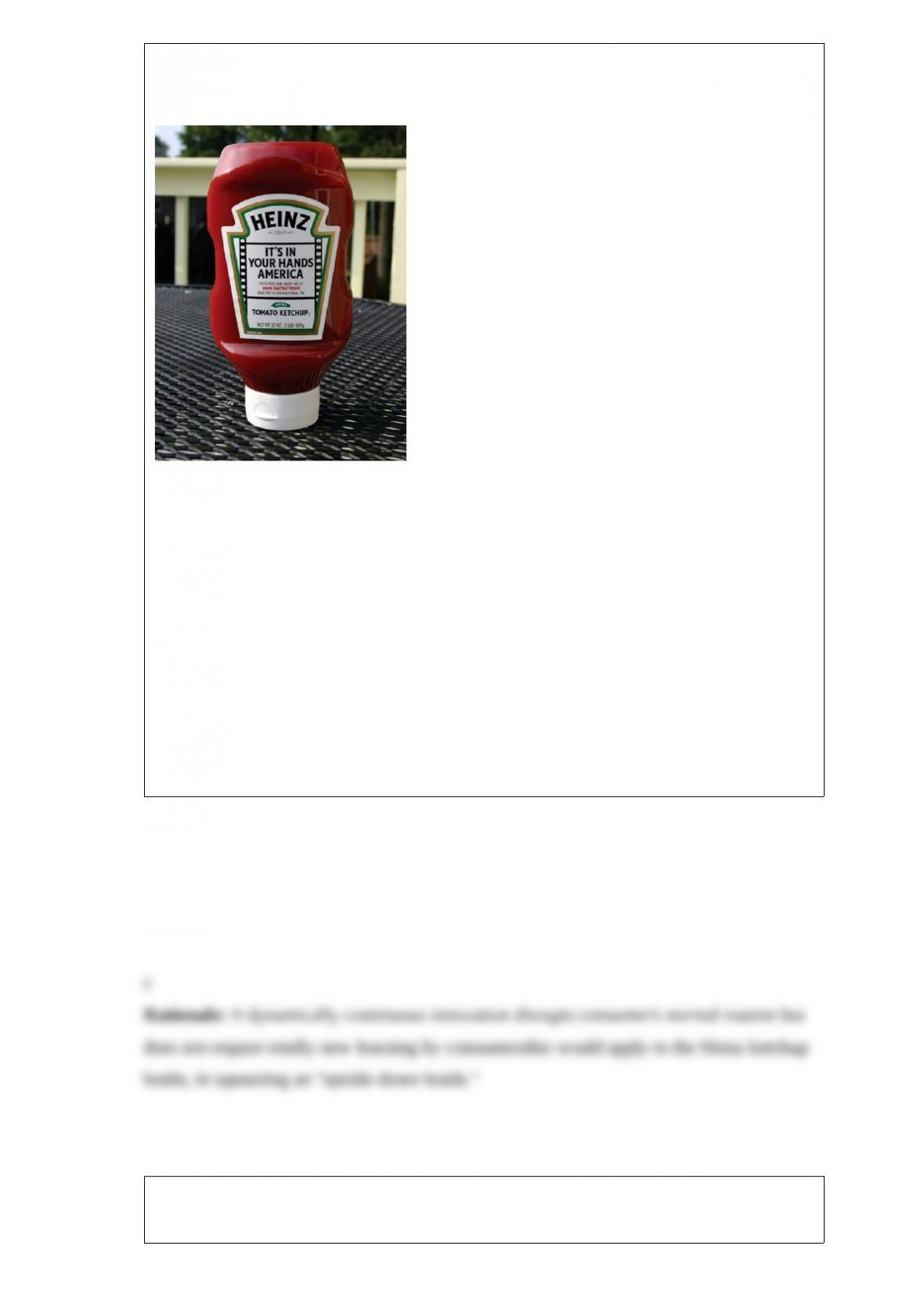
Heinz EZ Squirt Photo
When Heinz introduced its new EZ Squirt Ketchup bottle (see the photo above), what
degree of learning was required by the consumer in terms of its effect on consumption?
a. continuous innovation
b. discontinuous innovation
c. dynamically continuous innovation
d. spontaneous innovation
e. continuous invention
Answer:
The marketing mix refers to

a. the selection of product benefits and attributes that are to be added to or subtracted
from a given product to create variations within a product line.
b. the specific ratio within a budget that divides resources between advertising, sales
promotion, and personal selling.
c. the marketing manager’s controllable factorsproduct, price, promotion, and placethat
can be used to solve a marketing problem.
d. the allocation of resources within a firm towards individual marketing programs.
e. the environmental forcessocial, economic, technological, competitive, and
regulatorythat impact the marketing decisions for a particular product at any given time.
Answer:
At the time of its introduction, which of the following products was the BEST example
of a continuous innovation?
a. home security system
b. disposable lighter
c. microwave oven
d. electric toothbrush
e. video camera
Answer:

A study conducted by C&R Research on behalf of Disney Online has identified four
segments of mothers based on their Internet usage. The Yes Mom segment represents
__________ of online moms.
a. 12 percent
b. 14 percent
c. 24 percent
d. 31 percent
e. 32 percent
Answer:
Napster was the first software that allowed an individual to easily search for and
exchange MP3 music files with other individuals (in some cases illegally). When it was
introduced, Napster would have been an example of a
a. continuous innovation.
b. dynamically continuous innovation.
c. regulatory innovation.
d. discontinuous innovation.
e. disruptive improvement.

Answer:
The process of conveying a message to others that requires six elementsa source, a
message, a channel of communication, a receiver, and the processes of encoding and
decodingis referred to as __________.
a. exchange
b. dialogue
c. communication
d. advertising
e. feedback
Answer:
A company paying a set amount to Facebook for every time a user clicks on its ad is
known as __________, whereas a company that pays pennies for every 1,000 times its
ad loads on a Facebook Page and people may see it is referred to as __________.
a. set rate; fixed amount
b. cost per click; cost per thousand
c. fixed amount; set rate

d. cost per thousand; cost per click
e. traditional cost; standard cost
Answer:
An efficient consumer response system refers to
a. an order replenishment system that maintains a 10 percent inventory rate at all times
in order to guarantee there will never be stockouts.
b. an online virtual inventory storage program that allows firms to enter in
minute-by-minute information in order to avoid stockouts due to unforeseen
environmental forces.
c. a computer program that allows even the smallest manufacturer to manage its
inventory system.
d. an inventory management system that is designed to reduce the retailer’s lead time for
receiving merchandise, which then lowers its inventory investment, improves customer
service levels, and reduces logistics expense.
e. an exclusive contractual agreement between delivery services such as FedEx or UPS
to deliver expedited orders at a special low rate, regardless of the day and time.
Answer:

Commercialization refers to
a. the point at which a new product has diffused throughout the marketplace.
b. the introduction of an offering to sequential geographic areas of the U.S.
c. exposing actual products to prospective consumers under realistic purchase
conditions.
d. the stage of the new-product process that positions and launches a new product in
full-scale production and sales.
e. the point where new-product concepts are transformed into prototypes.
Answer:
The stage of the new-product process that develops a pool of concepts as candidates for
new-products is referred to as __________.
a. idea generation
b. product development
c. open innovation assessment
d. screening and evaluation
e. new-product strategy development
Answer:

Cost per click is a measure in which
a. a fixed amount of money paid to the site for every visitor who clicks on an ad and
goes from the website to the advertiser’s site.
b. a fixed amount of money paid to the site for every sale that originated from an ad
posted on that site.
c. a fixed amount of money is paid to a site for posting an ad for a finite amount of
time.
d. a fixed amount of money is paid for every 1,000 times an ad loads, up to $100 a
month.
e. a fixed discount given to a visitor for clicking on an ad.
Answer:
When using a price lining strategy, a marketer will
a. set the price of a line of products at a number of different specific pricing points.
b. set the price slightly higher than necessary to protect against losses from
environmental factors.
c. adjust the price of a product so it is “in line” with the price of its largest competitor.
d. set a low initial price on a new product to appeal immediately to the mass market.
e. set a market price for product or product class based on a subjective feel for the
competitors’ price or market price.

Answer:
Since global marketing is affected by economic considerations, a scan of the global
marketplace should include this factor:
a. an analysis of cultural diversity within the country under consideration.
b. regulatory constraints regarding contracts, mergers, and partnerships.
c. measurement of consumer income in different countries.
d. an assessment of language differences including dialect variation.
e. political and ideological differences between the countries involved.
Answer:
What are the three steps involved in the planning phase of the strategic marketing
process?
a. Step 1: situation (SWOT) analysis; Step 2: market-product focus and goal setting;
and Step 3: the marketing program

b. Step 1: planning; Step 2: implementation; and Step 3: evaluation
c. Step 1: set market and product goals; Step 2: select target markets and find points of
difference; and Step 3: position the product
d. Step 1: identify industry trends; Step 2: analyze competitors; and Step 3: assess own
organization
e. Step 1: Why do we exist?; Step 2: What will we do?; and Step 3: How will we do it?
Answer:
All of the following are downsides to data mining EXCEPT:
a. much of the information found on the Internet is factually incorrect.
b. personal, private data on most Americans is available on the Internet.
c. it is easy for almost anyone to find out your personal information through both online
and offline sources.
d. you can also use the Internet to find out which companies are obtaining your personal
data.
e. many firms obtain personal, private data by placing “cookies” on a person’s computer
or use tracking “apps” to forward location information from a user’s mobile phone.
Answer:

The price of tickets to a Los Angeles Lakers game can be attributed to
a. the scalping of tickets on StubHub.
b. sales taxes charged by online ticket sellers like Ticketmaster.
c. the popularity of players like Candace Parker of the Los Angeles Sparks.
d. the rise of online pricing in resold tickets and the supply”demand interaction for
high-interest sporting events.
e. losses due to declines in sales of television rights.
Answer:
A method of pricing where the price the seller quotes includes all transportations costs
and the seller retains title to the goods until delivered to the buyer, thereby assuming
responsibility for any damage that may occur, is referred to as
a. FOB destination pricing.
b. FOB origin pricing.
c. geographical allowance.
d. uniform delivered pricing.
e. transportation allowance.

Answer:
Perhaps the most well-known component of Xerox’s sales management process is its
__________.
a. stellar business reputation
b. sustainability programs
c. sales representatives training program
d. challenging and dynamic environment
e. use of information technology
Answer:
Target recently introduced its Target REDcard, where cardholders receive 5% back for
each purchase. Target also allows customers to return merchandise within 30 days but
still does not offer alteration services. Target offers what level of service to its
customers?
a. full-service
b. self-service

c. automated-service
d. limited-service
e. customized service
Answer:
A reference group to which a person actually belongs is referred to as a(n) __________
group.
a. primary
b. membership
c. aspiration
d. dissociative
e. integrated
Answer:

Florida Power & Light, an electric power company, is the only source of electricity for
consumers in most parts of the Florida panhandle. As a(n) __________, the company
receives approval from the state utility commission for the rates it can charge.
a. free enterprise firm
b. oligopoly
c. monopolistic competitor
d. competitor in a pure competition
e. pure monopoly
Answer:
The term that pertains to the income, expenditures, and resources that affect the cost of
running a business or household is referred to as (the) __________.
a. banking
b. economy
c. finances
d. budgeting
e. money management
Answer: