
The type of good for which the consumer compares several alternatives on such criteria
as price, quality, or style is a(n)
a. shopping product.
b. convenience product.
c. specialty product.
d. unsought product.
e. B2B product.
Answer:
In the 1980s, a lapse in production quality and an increase in Japanese imports drove
the Harley-Davidson motorcycle company to the brink of bankruptcy. The company’s
share of the U.S. super heavy-weight market segmentmotorcycles with engine capacity
of 850 cubic centimeters or morecollapsed from more than 40 percent in the mid 1970s
to 23 percent in 1983. However, by 1989, Harley-Davidson controlled some 65 percent
of this market segment. From a marketing perspective, what was the MOST LIKELY
first step in Harley-Davidson’s resurgence?
a. developing a new mission statement
b. repositioning their product in the minds of super heavy-weight motorcycle buyers
c. performing a SWOT analysis to assess where the firm has been
d. selling new models of super heavy-weight motorcycles in both the U.S. (current) and
foreign (new) markets
e. improving the quality of its product and communicating this to motorcycle buyers
Answer:
Which of these promotional elements has the highest cost-per-contact or exposure?
a. advertising
b. personal selling
c. sales promotion
d. publicity
e. public service announcements
Answer:
Todd Harris and Associates, a New York sales promotion agency, discovered from an
analysis of its files that one-quarter (or 25 percent) of its clients generated more than
three-quarters (or 75 percent) of its fees and commissions. This is an example of what
classic concept?
a. the 10/90 gap
b. the 80/20 rule
c. the 20/80 rule
d. the 75/25 rule
e. Parkinson’s Law
Answer:
To reward wholesalers and retailers for having supplies in stock at the time customers
want, manufacturers offer
a. noncumulative discounts.
b. seasonal discounts.
c. trade discounts.
d. cumulative discounts.
e. functional discounts.
Answer:
The purpose of Nielsen’s A2/M2 Initiative is to
a. expand its scope to include the effectiveness of online college courses.
b. expand its scope to include satellite radio programming.
c. measure all types of TV viewing behavior from a variety of video sources.
d. expand its business to a global market.
e. gain access to every American home that owns a television, mobile phone, or
computer.
Answer:
George Santayana, Spanish philosopher once said, “Those who cannot remember the
past are condemned to repeat it.” Applied to the organizational problems in new-product
failure, this is really an example of
a. not listening to the “voice of the consumer.”
b. encountering “groupthink” in meetings.
c. skipping stages in the new-product process.
d. not learning critical takeaway lessons from past failures.
e. avoiding the “NIH problem.”
Answer:
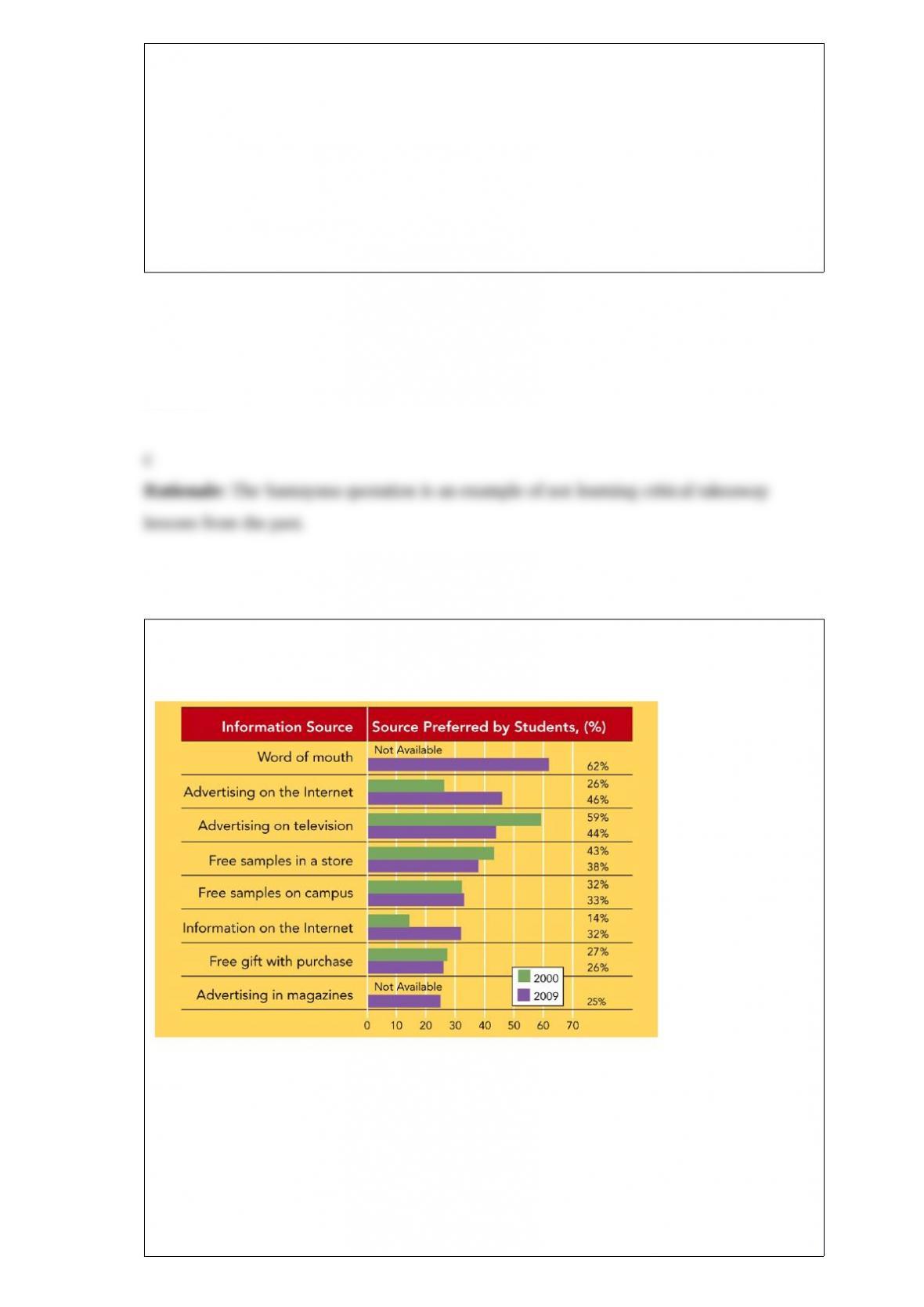
Figure 1.
According to Figure 1. above, which information source showed the biggest decrease in
college student preference from 2000 to 2009?
a. free samples in a store
b. information on the Internet

c. advertising on television
d. advertising on the Internet
e. word of mouth
Answer:
Business products refer to
a. products organizations buy that assist in providing other products for resale.
b. supplies necessary for the day-to-day operations of a business.
c. ancillary services necessary for the operation of a business.
d. products that are sold exclusively to businesses.
e. prototypes that won”t actually be constructed until a sale has been made.
Answer:

Organizational buying criteria refer to
a. the restrictions placed on potential solutions to a problem in a purchase decision.
b. the specific qualifications of a potential customer based upon past performance,
reliability, and consistency regarding the purchase of an organization’s offerings.
c. the subjective attributes of the supplier’s products and services and the capabilities of
the supplier itself.
d. the objective attributes of the supplier’s products and services and the capabilities of
the supplier itself.
e. the factors that an ultimate consumer would consider that represent both the objective
attributes of a brand and the subjective ones to compare different products and brands.
Answer:
As the director of marketing for Littleton Hospital, you must conduct an environmental
scan to help create a five-year marketing plan for the hospital. Which of the following
environmental trends should you consider to be the MOST IMPORTANT?
a. The number of people in the geographic area who are 65 years or older will increase
by 23 percent during the next five years.
b. By the year 2015, baby boomers will control more than 50 percent of all consumer
expenditures in the United States.
c. The Littleton community has seen a rise in dual-income households.
d. By the year 2025, robotics will play a major role in surgical procedures.
e. Twenty percent of the local population is of Hispanic origin.
Answer:
Online buyers of consumer electronics can shop individual manufacturers, such as
QVC.com, a general merchant that offers more than 100,000 products. This is an
example of the second reason why consumers buy online, which is ___________.
a. convenience
b. choice
c. cost
d. control
e. customization
Answer:

Dragon, a speech recognition software program that allows you to use your voice
instead of a keyboard to input text into a word processing program, is an example of
a(n)
a. continuous innovation.
b. discontinuous innovation.
c. dynamically continuous innovation.
d. disruptive improvement.
e. evolutionary innovation.
Answer:
The categories for people-based services include __________.
a. volunteers, skilled operators, and professionals
b. unskilled labor, skilled labor, and professionals
c. those operated by skilled operators, unskilled labor and skilled labor
d. those operated by relatively unskilled operators, those operated by skilled operators,
and unskilled labor
e. automated, those operated by skilled operators, and professionals
Answer:
In the VALS framework, consumers who enjoy the new, the offbeat, and the risky as
well as find outlets in exercise, sports, outdoor recreation, and social activities are
referred to as __________.
a. Believers
b. Strivers
c. Achievers
d. Makers
e. Experiencers
Answer:
Observing people and asking them questions are the two principal ways to obtain
a. external secondary data.
b. internal secondary data.
c. primary data.
d. experimental independent variables.

e. nonprobability data.
Answer:
The three primary types of product advertisements are __________, competitive, and
reminder.
a. goodwill
b. industrial
c. persuasive
d. pioneering
e. subliminal
Answer:
All of the following people are part of the Trek buying center EXCEPT:
a. the Trek product managers.
b. representatives from production.
c. representatives from research and development (R&D).
d. representatives from quality control.
e. a purchasing manager.
Answer:
In terms of brand loyalty, consumers who are very brand loyal and will not accept
substitutes for which type of consumer product?
a. shopping product
b. convenience product
c. specialty product
d. unsought product

e. discretionary product
Answer:
The practice of using a group of professionals in selling to and servicing major
customers refers to __________.
a. cooperative selling
b. missionary sales
c. sales engineering
d. team selling
e. partnership selling
Answer:
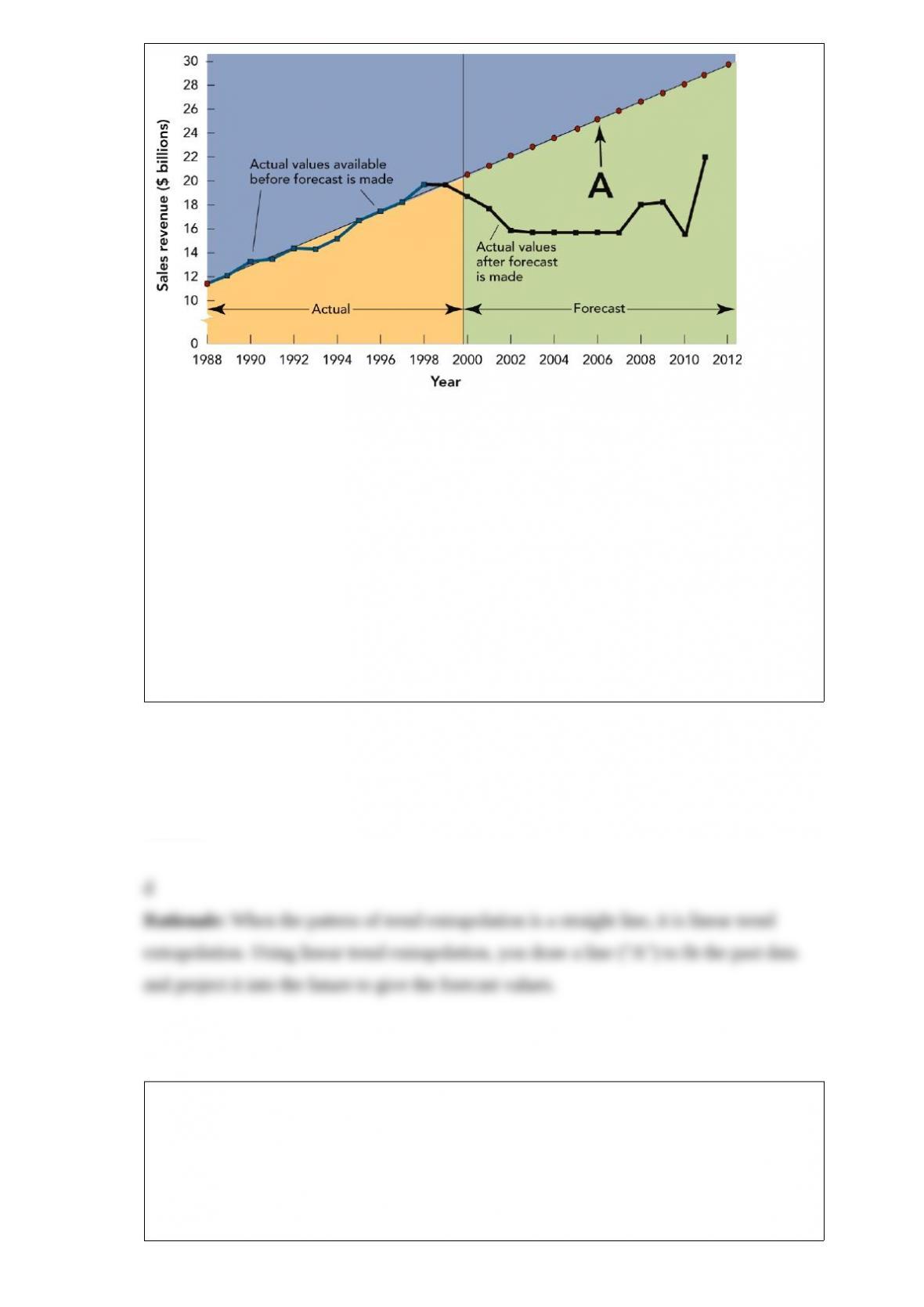
Figure 1.
In Figure 1. above, the line identified as “A” indicates a(n)
a. causal analysis.
b. non-parametric regression.
c. curvilinear extrapolation.
d. linear trend extrapolation forecast.
e. sales regression.
Answer:
The distribution intensity associated with shopping products such as electronics,
clothing, and costume jewelry is referred to as __________.
a. intensive distribution

b. selective distribution
c. extensive distribution
d. exclusive distribution
e. concentrated distribution
Answer:
Which of the following would be an example of a constraint in Step 1 of the
price-setting process?
a. “We can rely on our reputation for our other products in the line.”
b. “Experts are predicting a surge in global demand.”
c. “We need to make allowances for large quantity orders.”
d. “We should increase the price during the holiday shopping season.”
e. “Remember, we don”t know what the selective demand for this new product will be.”
Answer:

Subliminal perception refers to
a. the process of seeing or hearing messages without being aware of them.
b. a person’s innate ability to read non-verbal cues such as body language and facial
expressions.
c. the ability of a person to understand the allegorical meanings behind words,
sentences, or paragraphs communicated in writing or speech.
d. the process of being brainwashed to the point of acting in a way that is contrary to or
inconsistent with ones normal behavior.
e. the inability of a person to fully understand what is being said through a lack of
background knowledge or experience.
Answer:
Which of the following statements should the salesperson use to accept the objection?
a. “I think I might be able to explain that better to you after showing you this diagram.”
b. “Yes, you”re right, it is lighter but that is done intentionally to make your work
easier.”
c. “That’s true. It does have a shorter shelf life, but that really hasn”t been a problem. It
is so popular it never stays on the shelf that long anyway.”
d. “Where did you hear that? Your source must have erroneous information.”
e. “As I was saying, .”
Answer:

Which of the following is a sales element of an operating statement?
a. cost of goods sold
b. inventory
c. direct labor
d. allowances
e. selling expenses
Answer:
The inventory costs of services include
a. equipment and training costs.
b. management and material costs.
c. service delivery and spoilage costs.
d. salary of service provider and equipment costs.
e. salary of service provider and training costs.
Answer:
A flighting schedule combined with a steady schedule because of increases in demand,
heavy periods of promotion, or introduction of a new product is referred to as a
__________.
a. continuous schedule
b. phased schedule
c. pulse schedule
d. turnover schedule
e. intermittent schedule
Answer:
Product advertisements focus on selling __________.
a. an idea or a concept
b. an emotion or a feeling
c. a sense of well-being
d. goodwill
e. a product or service
Answer:
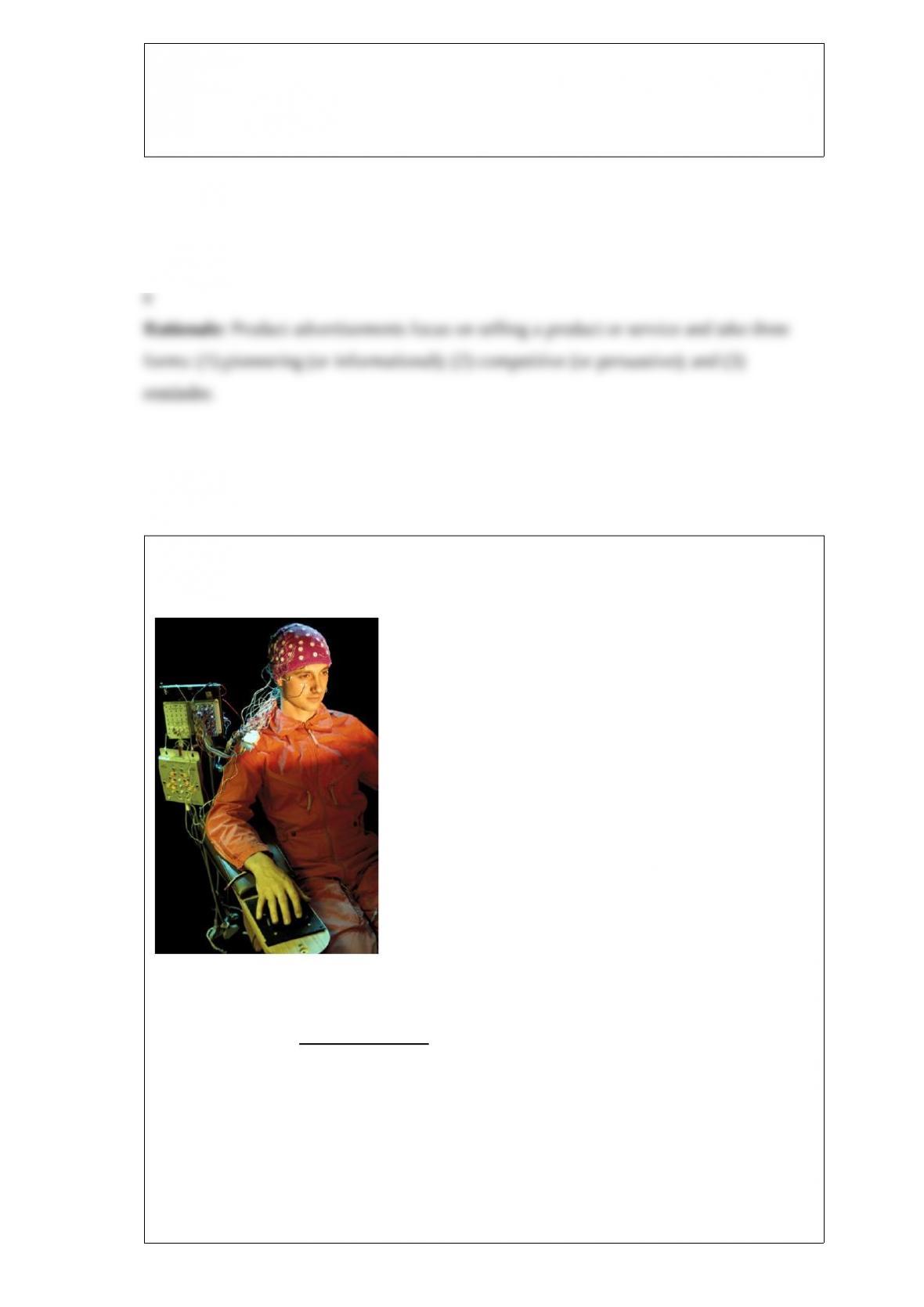
Marketing Research Method Photo A
Consider the Marketing Research Method Photo A above. What type of primary
research method is MOST LIKELY being used?
a. extrapolation
b. hypothesizing
c. neuromarketing
d. deduction
e. conjecture
Answer:
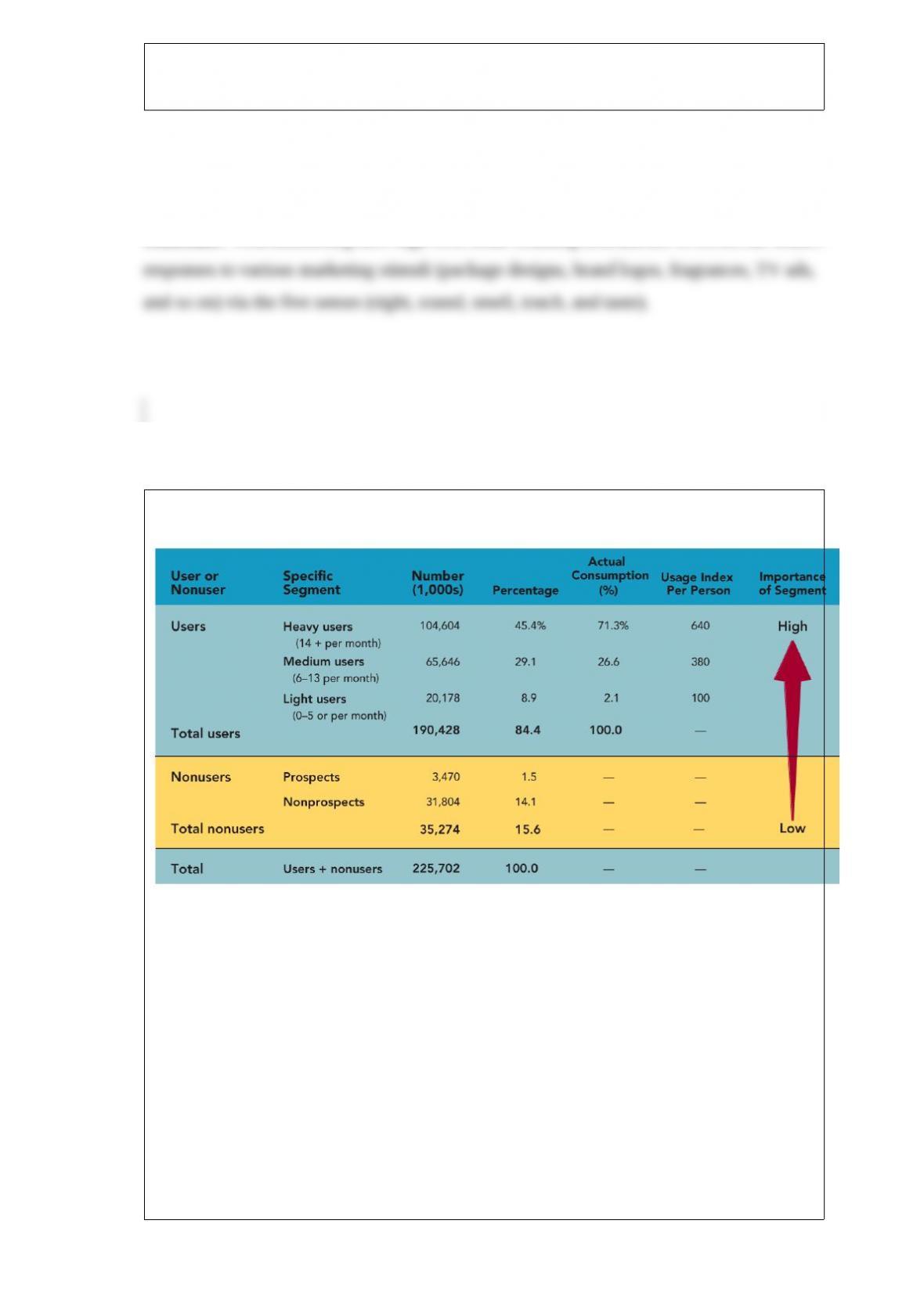
Figure 1.
According to Figure 1. above, people who ate at fast-food restaurants about twice a
week would most likely be considered a
a. light user.
b. medium user.
c. heavy user.
d. uncommitted user.
e. potential prospect.
Answer: