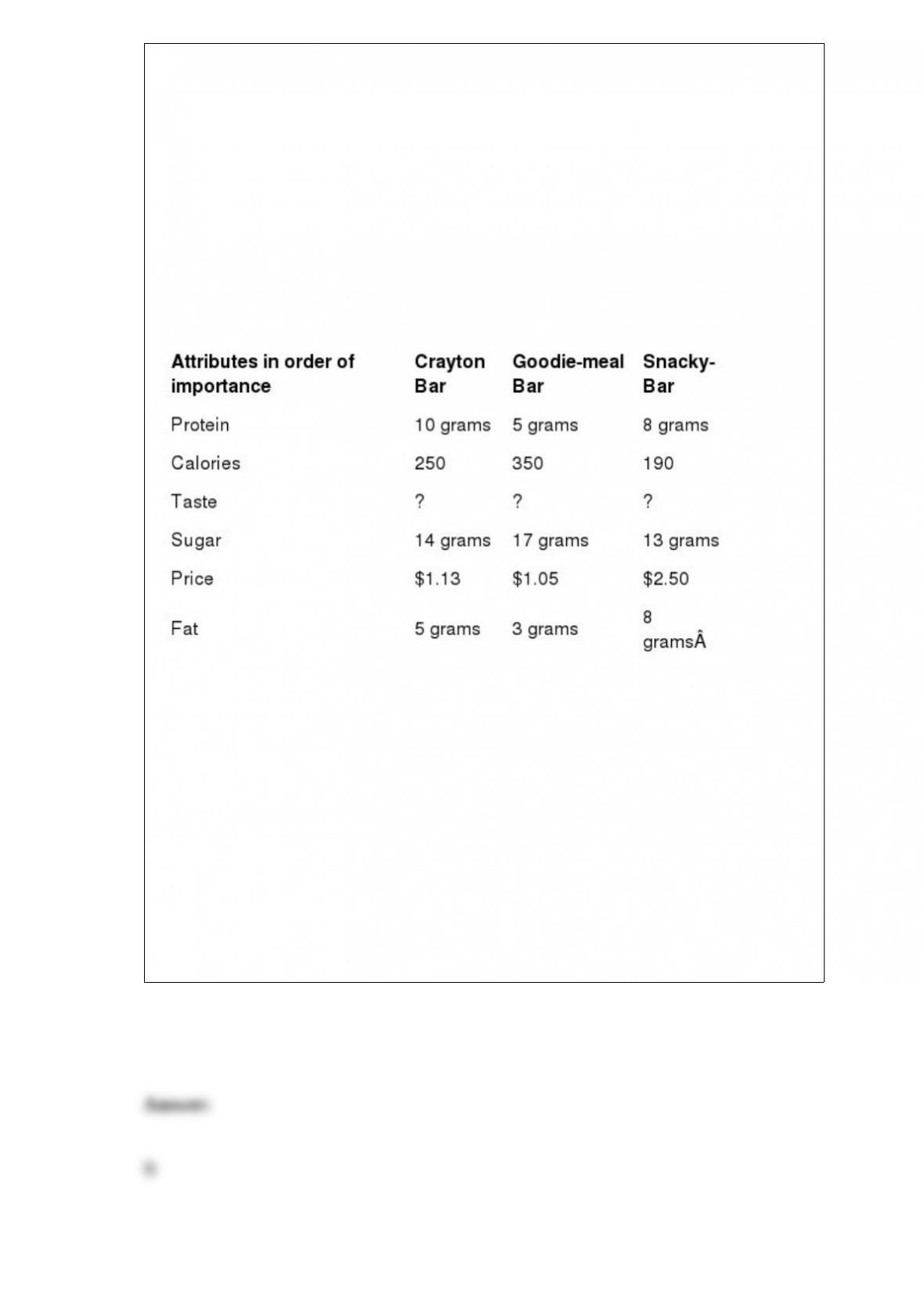
ENERGY BAR SCENARIO
Nutrition labels on products provide considerable information for consumers. For
example, a consumer deciding among the many brands of energy bars might compare
three offerings: Crayton Bar, Goodie-meal Bar, and Snacky-Bar. The most important
attribute for this consumer is protein content, followed by calories, taste, sugar, price
and fat content. This consumer would like an energy bar with high-protein content but
low in calories, sugar, fat, and price, and also one that tastes good. Information for all
the attributes is found on the product nutrition label except for the taste attribute. This
information is summarized in the following table:
Refer to Energy Bar Scenario. This consumer is evaluating the three brands across a set
of features or characteristics for each different brand of the energy bar. In doing so, the
consumer is employing a(n) _____ evaluation.
a. affect-based
b. attribute-based
c. belief-based
d. satisfaction-based
e. benefit-based

LAWN SPRINKLER SCENARIO
Mathew recently installed a new water sprinkler for his lawn. He had to purchase a new
sprinkler to replace the old, broken one. The new sprinkler came with an automated
sensor that controlled the amount of water as well as pressure depending on the
humidity and temperature on a given day. This saved Mathew the hassle of putting on a
timer. He no longer worried on his way to work over whether he turned the sprinkler on
or not. The sprinkler did the needful automatically.
Refer to Lawn Sprinkler Scenario. The new sprinkler came with an automated sensor
that could detect the humidity as well as temperature in the environment. This
automated sensor is a(n) _____ of the sprinkler.
a. feature
b. benefit
c. criterion
d. objective
e. goal
Stan is a marketing intern who has been asked to conduct a consumer behavior research
for a fashion designer. The designer wants him to focus on a few selected customers
who only buy customized products from the designer. Stan goes about his research by
interacting with each customer to know more about their psychological makeup. In this
instance, which of the following perspectives is Stan embracing?
a. Utilitarian perspective
b. Self-congruency perspective
c. Nomothetic perspective
d. Idiographic perspective

e. Universal perspective
Which of the following self-report measures asks respondents to rate feelings using a
number of semantic differential items or bipolar opposites?
a. Likert scale
b. PANAS
c. Discan scale
d. PAD
e. Thurstone scale
GIRLS” DAY OUT SCENARIO
Janice and her girlfriends generally reserve the last Saturday of every month for a
girls-only day out. Most of the girls in the group are her friends from school who like to
hang out together and they all share a passion for shopping. When Janice shops with the
group, she restrains herself from her bargaining-prone habit and ends up buying
expensive luxury brands as the group is very conscious of purchasing only high-end
brands. Janice’s best friend Maeve is considered the most informational among the
group. She knows everything about handbags and has an enviable collection of her
own. Everyone seeks her opinion before buying one. Once, a friend hired her to put
together an entire collection of handbags to go with an ensemble. Some designers were

even prompted to use Maeve’s expertise on handbags to promote their new handbag
collections in her social circle. They gave her a few handbags to carry around at parties
and other social events. Mauve also used a few social networking sites to write about
the brand and thus created excitement about the brand among her friends. Refer to Girls’
Day Out Scenario. When Maeve was hired by a friend to put together an entire
collection of handbags to go with an ensemble, she was assuming the role of a(n)
_____.
a. laggard
b. universal purchaser
c. market maven
d. surrogate consumer
e. late majority consumer
Carla was unhappy with her haircut. The next time she wanted a haircut, she went to a
different hairstylist who Carla thought was more competent than her previous stylist.
From a consumer behavior perspective, which of the following terms best describe
Carla’s behavior?
a. Infiltrating
b. Hoarding
c. Shilling
d. Switching
e. Referencing

The market segment a company will serve with a specific marketing mix is referred to
as the _____ market.
a. target
b. primary
c. elementary
d. capital
e. dominant
Which of the following theories consists of the three elementslocus, control, and
stability?
a. Attribution theory
b. Expectancy/disconfirmation theory
c. Equity theory
d. Balance theory
e. Self-perception theory

Ed had been long thinking of exchanging his old car for a new convertible and so he
recently bought himself a Volvo C70. Ed’s purchasing activity is most likely driven by
_____.
a. preventive motivation
b. physiological motivation
c. homeorhesis
d. homeostasis
e. self-improvement motivation
REAL ESTATE BROKER SCENARIO
Jane, a consumer researcher, worked with a real estate broker as part of her research on
consumer decision-making behavior. During the course of her research, she found that
young couples, mostly professionals, look out for a space they can call their own.
Although young, they seldom make spontaneous and impulsive decisions while buying
a house. All of them arrive at a decision after an exhaustive effort of finding more
information, talking to different people, and checking out neighborhoods through
various sources. This strengthens Jane’s hypothesis that people tend to make wise and
informed decisions while buying a house. In her experience of working with the real
estate broker, Jane has had a successful run, except for the time when an elderly man
left disappointed after weeks of continuous search. After his retirement, he had wanted
to invest in a “dream house,” but sadly he could not find what he was looking for.
Whatever he liked exceeded his budget. Jane also met a young couple who spent most
of their weekends house hunting. After being out with them week after week, they
finally admitted that they never intended to buy a house and that they were mostly
interested in gathering information and being updated about the real estate
industry. Refer to Real Estate Broker Scenario. Jane’s observation on the job working
with the real estate broker strengthens her hypothesis that people tend to make wise and
informed decisions while buying a house. According to Jane, which of the following
decision-making perspectives most likely contributes to consumers’ decisions?

a. Rational decision-making perspective
b. Experiential decision-making perspective
c. Behavioral influence decision-making perspective
d. Functional decision-making perspective
e. Implemental decision-making perspective
A product is defined as _____.
a. a potentially valuable bundle of benefits
b. the physical effort required in the purchase
c. the attributes of an item a customer buys
d. the resource allocated toward satisfying a felt need
e. the cost associated with buying the physical parts of a product
Which of the following statements is true about the social class microculture in the
U.S.?
a. Every consumer in the social class will exhibit the exact same behaviors and
opinions.

b. Consumers born into a social class have an achieved status.
c. Social class tends to be a better predictor of purchases that involve symbolic
products.
d. All consumers in a social class will strive to move up the social ladder.
e. Consumers who work their way into a class have an ascribed status.
When a consumer selects a product that he or she believes performs best on the most
important feature, the consumer is employing the _____ rule.
a. conjunctive
b. disjunctive
c. lexicographic
d. subordinate
e. compensatory rule
Which of the following types of evaluation do consumers use to evaluate products
based on the overall feeling that is evoked by the alternative?
a. Attribute-based evaluation

b. Content-based evaluation
c. Benefit-based evaluation
d. Affect-based evaluation
e. Cognition-based evaluation
Thirst, a beverage manufacturer, markets its products using the same strategy
worldwide. However, changes are made when implementing the strategy to reflect an
essence of the local culture, such as the ethnicity of the people in their ads and the
music used in jingles. This is an example of _____.
a. enculturation
b. acculturation
c. glocalization
d. acclimatization
e. accommodation
SCHOOL COUNSELOR SCENARIO

Clarence works as a school counselor in a high school. She finds her job very
challenging as she has to help teenagers deal with a variety of problems. Her years on
the job have given Clarence startling insight on teen behavior. Many high school
seniors with a binge drinking problem perceive nothing wrong with their behavior,
viewing it more as a requisite for acceptance in what is considered “adult behavior.”
Teenagers with a history of cyberbullying acknowledge that the act gives them a feeling
of dominance and power, with some even comparing it to the high they get with
substance abuse. Some go about destroying school property because they believe that
the education system has done them more harm than good. These teenagers believe that
destroying school property is a way to get back at the education system. Most students
report that they experience a high amount of peer pressure. Many students suffer from
eating disorders brought about by the pressure to comply with a certain body type.
Many girls feel the need to eat frequent huge meals and make themselves throw up
afterward. Clarence believes that growing up is troublesome for many but she is always
hopeful that most problems can be tackled. Once, her school organized an interstate
workshop on drunk driving. It was sponsored by a huge corporate house with the
intention of helping the student community. Clarence was happy that it was a big
success. Refer to School Counselor Scenario. Many girls feel the need to eat frequent
huge meals and make themselves throw up afterward. These girls are most likely
suffering from _____.
a. bulimia
b. anorexia
c. orthorexia nervosa
d. pica
e. rumination disorder
If a consumer develops thoughts that contradict a marketing message, then he/she is
said to have developed _____ arguments toward the message.
a. futile
b. practical
c. fallible

d. parallel
e. counter
Susan has an extensive collection of dolls from all over the world. She has had an
interest in them for as long as she can remember. Susan finds it personally gratifying
whenever she acquires a new one for her collection. Which of the following types of
involvement is exemplified by Susan’s involvement with dolls?
a. Enduring involvement
b. Contextual involvement
c. Monetary involvement
d. Momentary involvement
e. Situational involvement
Consumers from high-uncertainty-avoidance cultures tend to:
a. be faster in adopting product and service innovations than in other cultures.
b. be slower in buying a product because of its perceived scarcity than in other cultures.
c. perceive stronger price-quality relationships than in other cultures.

d. demand greater amount of product information than in other cultures.
e. rely less on commonly held beliefs to decide on a purchase than in other cultures.
Which of the following represents the extent to which an emotional display by one
person influences the emotional state of a bystander?
a. Emotional involvement
b. Emotional labor
c. Emotional flow
d. Emotional activation
e. Emotional contagion
Niche marketing differs from one-to-one marketing in that niche marketing:
a. offers a unique product to each individual customer.
b. treats each customer as a segment of one.
c. offers the same basic product to all customers.
d. focuses on serving very large segments in which consumers do not have specific

desires.
e. serves one market segment with particularly unique demand characteristics.
Sara gets information on different competing products and their prices on the Internet
and utilizes the data gathered to settle for the best product in the market. In this
example, the data gathered by Sara is most likely to be stored in _____ memory.
a. explicit
b. buffer
c. semantic
d. declarative
e. implicit
Which of the following types of social power is based on a group’s power to sanction
group members for breaking rules or failing to follow expectations?
a. Reward power
b. Expert power
c. Coercive power

d. Referent power
e. Associative power
Mr. Robert Smith is the United States Speaker of the House of Representatives. He
couldn”t help showing his emotion when he was sworn in. He often has trouble hiding
his emotions and sometimes breaks out in tears when he is talking about something he
is passionate about. Mr. Smith can be said to have high emotional _____.
a. contagion
b. expressiveness
c. intelligence
d. focus
e. flow
ENERGY BAR SCENARIO
Nutrition labels on products provide considerable information for consumers. For
example, a consumer deciding among the many brands of energy bars might compare
three offerings: Crayton Bar, Goodie-meal Bar, and Snacky-Bar. The most important
attribute for this consumer is protein content, followed by calories, taste, sugar, price
and fat content. This consumer would like an energy bar with high-protein content but
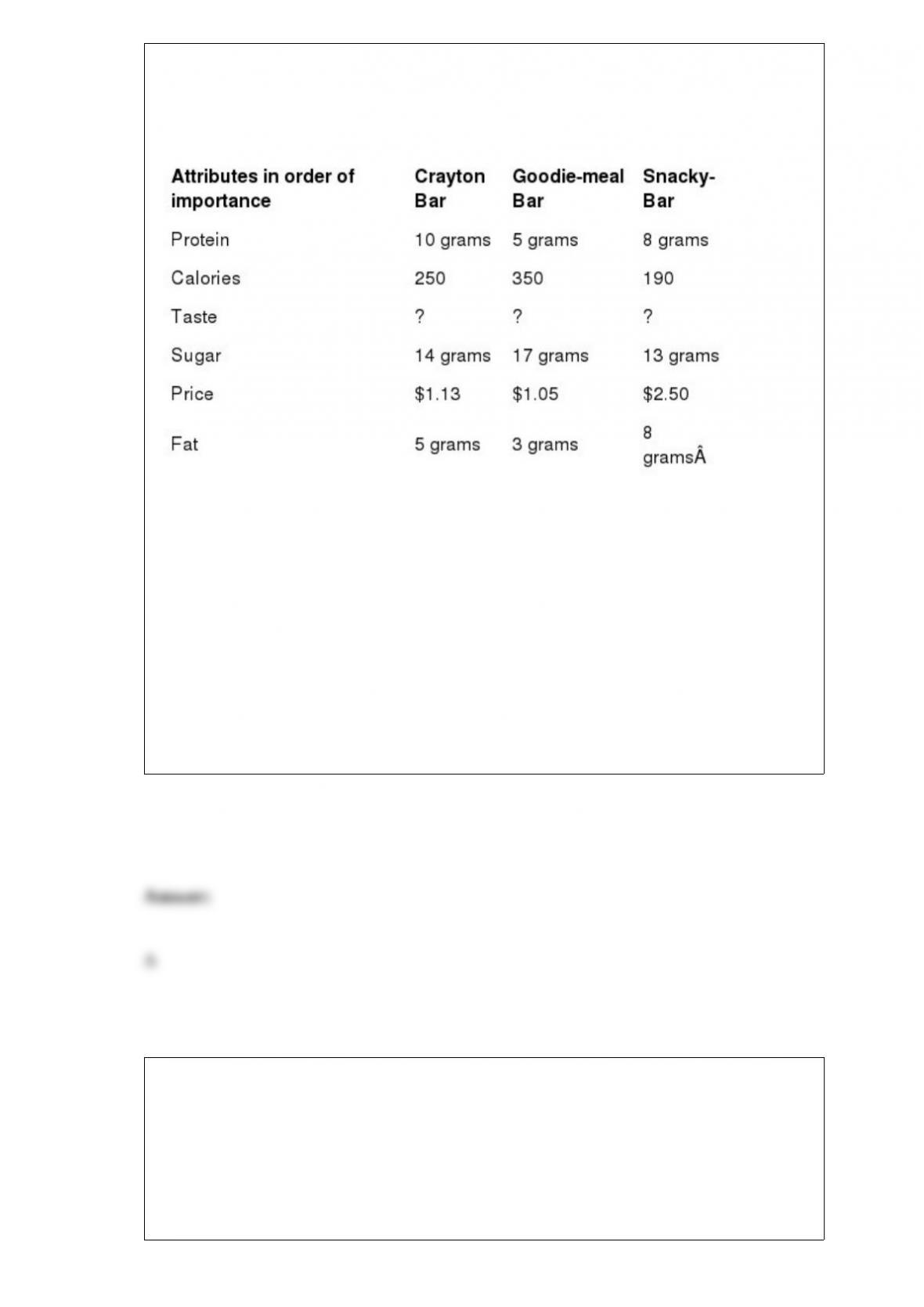
low in calories, sugar, fat, and price, and also one that tastes good. Information for all
the attributes is found on the product nutrition label except for the taste attribute. This
information is summarized in the following table:
Refer to Energy Bar Scenario. Using the lexicographic rule, the consumer is most likely
to select _____.
a. Crayton Bar as it has the highest protein content
b. Goodie-meal Bar as it has the lowest fat content
c. Snacky-Bar as it has the lowest sugar content
d. Goodie-meal Bar as it has the highest sugar content
e. Snacky-Bar as it has the lowest calorie count
Every year The Sprinters’ Club, a group for athletes, declares one of its members as the
“most outstanding athlete of the year.” The title is based solely on performance, and all
members vie for it. The power of the club to bestow this title to one of its members is an
example of _____ power.
a. referent

b. legitimate
c. expert
d. reward
e. coercive
Ruth has taken up the responsibility of maintaining her joint family’s expenses. She
keeps track of the entire family’s needs and discusses with the other family members
about the purchases to be made. Ruth plays the role of a(n) _____ in her household
purchase process.
a. decision maker
b. user
c. gatekeeper
d. purchaser
e. influencer
In which of the following approaches are behaviors and tendencies assessed over time?
a. Utilitarian approach

b. Aggregation approach
c. Capability approach
d. Perceptual mapping approach
e. Factor analysis approach
The physical characteristics that describe the physical environment and habitat of a
particular place are known as _____ factors.
a. intrinsic
b. physiological
c. demographic
d. evolutionary
e. ecological
A consumer chooses a competing choice, rather than a previously purchased choice, on
the next purchase occasion. This behavior is called _____.
a. infiltrating
b. switching
c. hoarding
d. shilling
e. culture jamming
When expectations lack a strong degree of confidence, satisfaction is less strongly
influenced by perceived performance.
Restaurateurs who serve markets with a heterogeneity of religious groups need to be
well aware of the dietary restrictions and the sensitivity of these different groups to
violations of the restrictions.

Attribution theory focuses on explaining why a certain event has occurred.
According to Maslow’s theory, consumers first seek value by satisfying the most basic
needs.
Social stratification can be defined as the division of society into classes that have
unequal access to scarce and valuable resources.
Epistemic shopping includes activities oriented toward a specific, intended purchase or
purchases.
The economic resources a consumer brings to a particular purchase setting refer to the
consumer’s buying power.
Decision-making processes always involve a tangible product.
In consumer misbehavior, consumers seek to maximize the benefits they receive from
an action while maximizing their own costs.
Late majority consumers and laggards, tend to be more cautious about buying new
products.
Self-awareness refers to the positivity of an individual’s self-concept.
Jane lives in a place where an individual is primarily identified as belonging to a
“particular family.” Jane lives in a highly individualistic society.
A high degree of crowding produces the most positive outcomes in terms of shopping
affect, purchase behavior, consumer satisfaction, and shopping value.
Both marketing and shopping make purchase more likely, but one involves activities of
marketing people and the other involves activities of shoppers.
The difference between ongoing searches and browsing behavior is that an ongoing
search is performed when consumers have an enduring interest or involvement with the
product, not simply when information is being gathered for a specific purchase.
Initiatives that increase customer satisfaction always improve top-line performance.
Self-concept refers to the totality of thoughts and feelings that an individual has about
him- or herself.
The term critical incident refers to exchanges between consumers and business that the
consumer views as unusually negative.

Altruistic duties include giving back to communities through philanthropic activities.
Epistemic activities include finding information on some imminent purchase.