The unique combination of benefits received by targeted buyers that includes quality,
convenience, on-time delivery, and both before-sale and after-sale service at a specific
price is called
a. customer value.
b. target marketing.
c. benefit segmentation.
d. value-based marketing.
e. a customer value proposition.
Answer:
Data obtained by manipulating factors under tightly controlled conditions to test cause
and effect is an example of
a. questionnaire data.
b. virtual modeling.
c. an experiment.
d. a panel.
e. nonprobability sampling.
Answer:
Messages on the interior and exterior of buses, subway cars, and taxis are referred to as
a. transportation messages.
b. public service announcements.
c. transit advertising.
d. public advertising.
e. transport advertising.
Answer:
Amy Smith has just completed measuring the results of her firm’s product performance.
Her next step will be to
a. do a profitability analysis.
b. take necessary corrective actions.
c. bring these to the marketing auditor.
d. proceed regardless of deviations from original plans.
e. compare the results against the goals specified in the marketing plan.
Answer:
In a __________ organizational structure, a different salesforce calls on each separate
type of buyer or market channel.
a. multi-reseller organization
b. geographical organization
c. customer sales organization
d. market segmentation organization
e. multi-level marketing organization
Answer:
Harley-Davidson is admired by its suppliers for involving them in future product
development, referring to them as stakeholders, using quality benchmarks, and
a. building long-term relationships.
b. signing lifetime contracts to demonstrate loyalty.
c. offering discounts for all key supplier personnel.
d. listing the names of key suppliers in its Harley-Davidson promotional material.
e. extending Harley-Davidson health care benefits to its suppliers’ employees.
Answer:
Services can be classified according to whether they are __________, they are profit or
nonprofit organizations, or they are government sponsored.
a. national or global
b. use independent contractors
c. privately owned or publicly owned
d. delivered by people or equipment
e. owned by individuals or corporations
Answer:
An advertising agency that assists clients by both developing and placing
advertisements may receive payment according to an incentive plan based on
performance. These plans typically pay for agency costs and a 5 to 10 percent profit,
plus bonuses if specific goals are met. This type of agency is referred to as a(n)
_________.
a. full-service agency
b. in-house agency
c. modified-service agency
d. promotional firm
e. limited-service agency
Answer:
When the state of Virginia touts the slogan “Virginia is for Lovers,” it is trying to appeal
to people’s __________ in order to attract them as potential residents and/or part of its
workforce.
a. self-concept
b. self-evaluation
c. self-actualization
d. individualized perception
e. personal perception
Answer:
According to the textbook, all of the following terms can be used interchangeably to
refer to entities that engage in business and nonprofit operations EXCEPT:
a. an organization.
b. a company.
c. a firm.
d. a corporation.
e. an enterprise.
Answer:
Which of the following statements regarding quantity discounts is most accurate?
a. Cumulative quantity discounts encourage repeat buying by a single customer to a far
greater degree than do noncumulative quantity discounts.
b. Noncumulative quantity discounts encourage repeat buying by a single customer to a
far greater degree than do cumulative quantity discounts.
c. Quantity discounts are primarily used to undercut competitors’ prices.
d. Noncumulative quantity discounts encourage smaller, long-term repeat purchases
rather than less-frequent, large-quantity purchases.
e. Quantity discounts can basically be used only once with each reseller or the price will
become too customary.
Answer:
Buzz is a particularly influential force. According to Jeff Bezos, president of
Amazon.com, “If you have an unhappy customer on the Internet, he doesn”t tell his six
friends, he tells his __________ friends!”
a. 60
b. 600
c. 6,000
d. 6 million
e. 6 billion
Answer:

Learning refers to
a. one’s education that has been transferred from short-term to long-term memory.
b. those behaviors that result from (1) repeated experience and (2) reasoning.
c. the process by which an individual selects, organizes, and interprets information to
create a meaningful picture of the world.
d. a consumer’s subjective perception of how a product or brand performs on different
attributes based on personal experience, advertising, and discussions with other people.
e. a learned predisposition to respond to an object or class of objects in a consistently
favorable or unfavorable way.
Answer:
A micropolitan statistical area refers to
a. a statistical area of 2.5 million people or more.
b. a highly urbanized area with a centrally located population of at least 1,000,000
people.
c. a cluster of exurbs that function as a single unit due to the proximity of their
geographic locations to an urbanized area.
d. a statistical area that has at least one urban cluster of at least 10,000 but less than
50,000 people and adjacent territory that has a high degree of social and economic
integration.
e. a statistical area of at least one urbanized area of 50,000 or more people and adjacent
territory that has a high degree of social and economic integration.
Answer:
A(n) __________ in the consumer purchase decision process occurs when consumers
scan their memory for previous experiences with products or brands.
a. problem recognition
b. internal search
c. external search
d. purchase task
e. antecedent state
Answer:
Online trading communities that bring together buyers and supplier organizations to
make possible the real time exchange of information, money, products, and services are
referred to as
a. Webfronts.
b. iCommerce.
c. e-commerce marketspaces.
d. e-marketplaces.
e. X-changes.
Answer:
A(n) ___________ is an advertising agency that provides the most complete range of
services, including market research, media selection, copy development, artwork, and
production.
a. limited-service agency
b. full spectrum agency
c. multi-service agency
d. in-house agency
e. full-service agency
Answer:
Packaging __________.
a. is any box, bottle, jar, can, carton, or bag that can be used for transporting services
b. is any container in which a product is offered for sale and on which information is
communicated
c. is that part of a product that is not recycled
d. identifies the product or brand, who made it, where and when it was made, how it is
to be used, and the contents and ingredients
e. is any container used in the preservation of ideas
Answer:
The unit variable cost (UVC) equals variable cost (VC) divided by __________.
a. quantity (Q)
b. fixed costs (FC)
c. total cost (TC)
d. total revenue (TR)
e. price per unit of the product (P)
Answer:
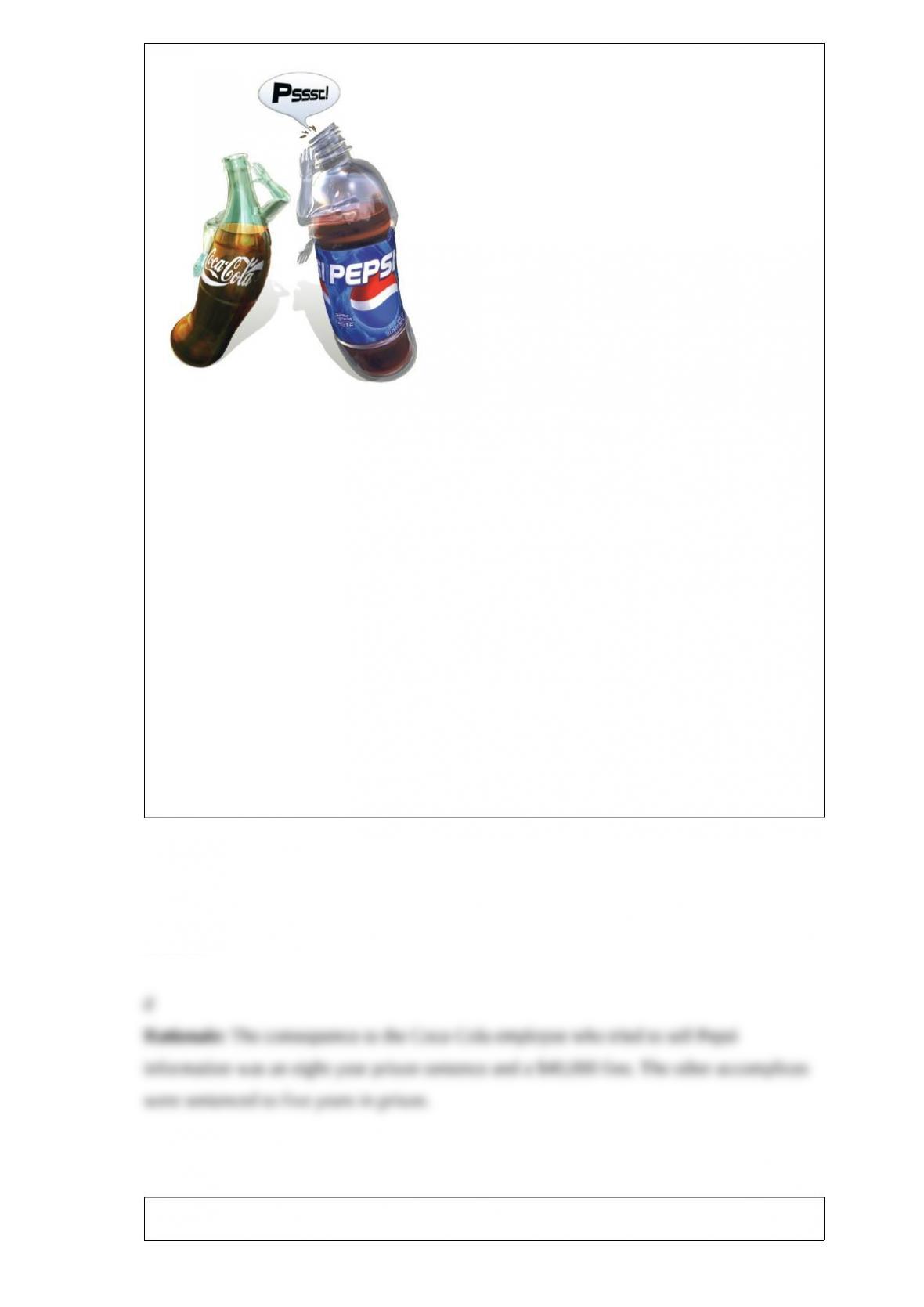
Coke-Pepsi Photo
Consider the Coke-Pepsi photo above. What was the consequence to the Coca-Cola
employee who tried to sell classified information to Pepsi?
a. The employee was fired and no other legal action was taken since the practice is
unfortunately too commonplace.
b. The employee was given the choice of quitting or being demoted to a minimum wage
job.
c. The employee was arrested for bribery and sentenced to five years house arrest.
d. The employee was sentenced to eight years in prison and ordered to pay $40,000 in
restitution.
e. The employee was permitted to keep her original job (minus any bonuses), but had to
undergo personal psychiatric counseling and attend a seminar on ethical behavior.
Answer:
Trade discounts are offered to resellers in the marketing channel on the basis of where
they are in the channel and
a. the marketing activities they are expected to perform in the future.
b. the frequency of the order.
c. when orders are placed during the year.
d. the length of the relationship with the manufacturer.
e. the size of the order.
Answer:
Andrea Arenas is the owner of 2 Places at 1 Time, a concierge company. She and her
staff of 60 perform everyday services such as walking the dog, picking up cleaning,
waiting for the repairman, and going to the post office for people who are too busy to
perform these simple acts. She has often been hired by major corporations to perform
services for their harried executives, and now many of her major clients are providing
perks like her service to their employees. Her staff is overworked and she is hiring more
employees to fill demand. Arenas is not experiencing __________; in fact, all of her
employees are providing the maximum level of services to customers.
a. off-peak pricing
b. idle production capacity
c. static demand
d. capacity marketing
e. capacity inventory
Answer:
Ben & Jerry’s Homemade, Inc. is a profitable company that has a reputation for quality.
The company is committed to treating its employees fairly and acting ethically in all
transactions. It seeks to purchase all of its supplies from socially responsible suppliers.
It is a leader in protecting the environment and corporate philanthropy. Ben & Jerry’s
uses __________.
a. a value-driven strategy
b. marketing ROI
c. value analyses
d. value-based planning
e. value-added marketing
Answer:
Market segmentation refers to
a. identifying small groups of customers with dissimilar needs.
b. aggregating prospective buyers into groups and selecting only those whose needs
cannot be met by competitors’ products.
c. aggregating prospective buyers into groups that have common needs and will respond
similarly to a marketing action.
d. aggregating different products into more reasonable product groupings to better serve
consumers’ needs.
e. those characteristics of a product that make it superior to competitive substitutes.
Answer:
Nordstrom stores typically have 50 percent more salespeople on the floor than similarly
sized stores, and the salespeople are renowned for their professional and personalized
attention to customers. Nordstrom would be considered a(n) __________.
a. exclusive-service retailer
b. limited-service retailer
c. full-service retailer
d. upscale-retailer
e. limited-domain retailer
Answer:
Economic espionage is the clandestine collection of trade secrets or __________.
a. government economic information
b. industrial intelligence
c. proprietary information about competitors
d. government weapons information
e. banking lists
Answer:
Beth gives her daughter Megan an allowance of $5 a week. On Friday, Beth takes
Megan shopping to select whatever item she wants to buy. If the desired item costs
more than $5, Megan’s mother suggests she save her money until she has enough saved
to pay for the desired item. When Megan is finally able to purchase the item of her
choice, she is allowed to pay for it herself, including engaging with the sales clerk to
complete the purchase experience. In this way, Beth encourages the development of
Megan’s
a. consumer assimilation.
b. consumer acculturation.
c. purchasing socialization.
d. consumer socialization.
e. purchasing enculturation.
Answer:
A business hoping to generate large online sales through posting ads on social
networking sites but only pay when an ad actually generates a sale should use a
performance measure of
a. “cost per action,” and pay $50 for every purchase that originated from an ad on the
site.
b. “cost per thousand,” and pay $0.50 for every time an ad loads, up to $100 per month.
c. a “negotiated measure,” and pay $100 to post their ad for two weeks.
d. “cost per click,” and pay $0.50 for every visitor who clicks on the ad and goes to
their website.
e. “cost per liker,” and pay $1. for every visitor who likes the advertised product.
Answer:
Inside order takers are also referred to as __________.
a. managers
b. directors
c. missionaries
d. salesclerks
e. go-getters
Answer:
Anheuser-Busch established its Corporate Social Responsibility (CSR) Department to
a. promote the positive aspects of moderate beer consumption.
b. promote responsible drinking and deter underage drinking and alcohol abuse.
c. encourage recycling of both aluminum cans and glass bottles by ultimate consumers
and suppliers.
d. educate employees about the importance of serving as role models by drinking
responsibly themselves.
e. promote Anheuser-Busch as more socially responsible than its competitors.
Answer:
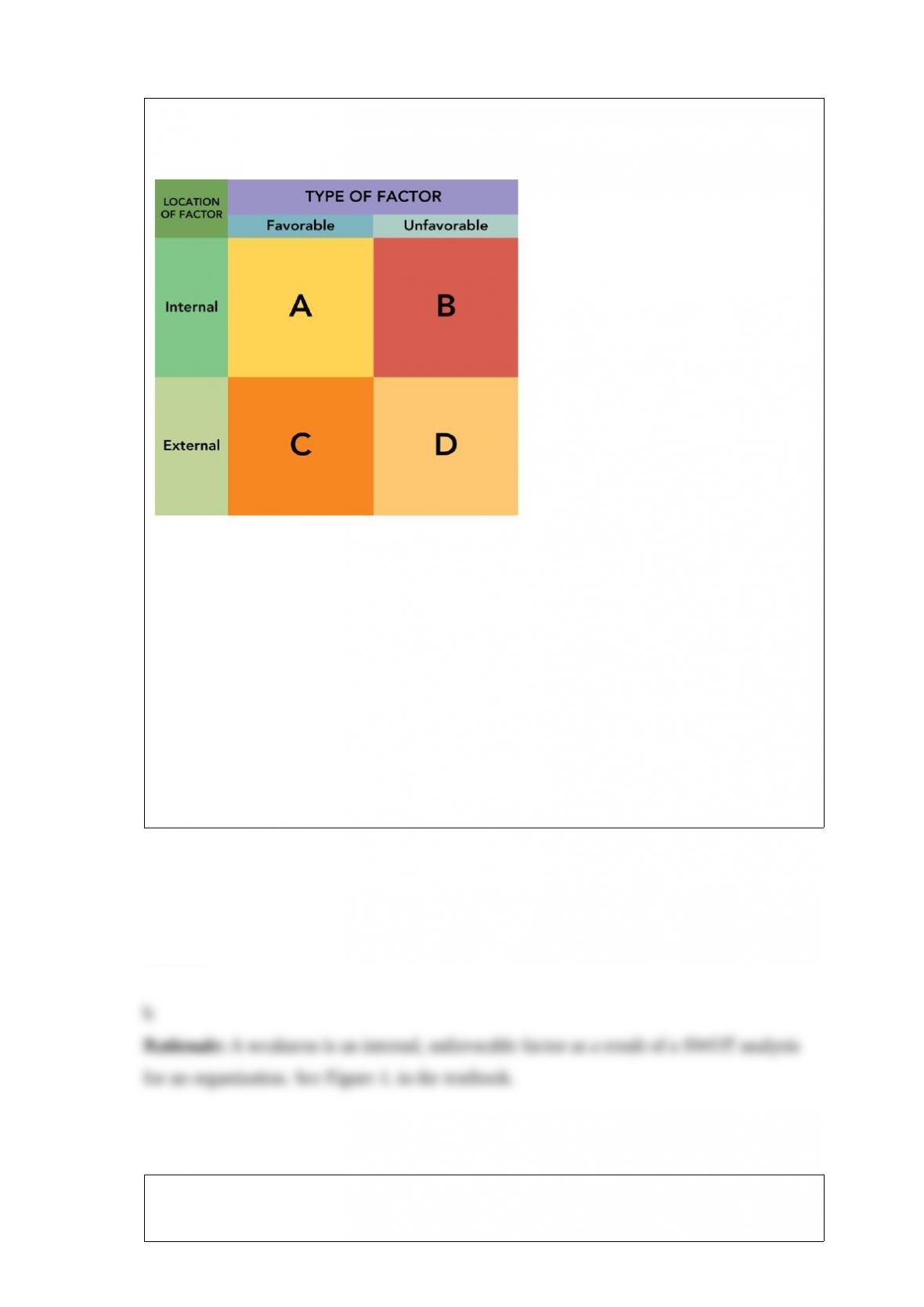
Figure 1.
Quadrant “B” in Figure 1. above represents a(n) __________ in a SWOT analysis.
a. Threat
b. Weakness
c. Strength
d. Opportunity
e. Market segment
Answer:
Cognitive dissonance refers to
a. feelings of guilt for purchasing a product or service that was not consistent with a
consumer’s moral or ethical beliefs.
b. feelings of discomfort associated with purchasing something purely for the sake of
prestige.
c. the feeling of postpurchase psychological tension or anxiety consumers may
experience when faced with two or more highly attractive alternatives.
d. feelings of discontent after a purchase has been made when the product fails to
perform up to expectations.
e. feelings of discontent before a purchase has been made when the customer finds out
that he or she paid more for the product than necessary.
Answer:
Jacob has developed a lawn care service that will revolutionize the lawn care industry.
However, Jacob has limited operating capital and yet he still wants a wide distribution
of his new product. Which of the following options would be the best choice for Jacob?
a. He should develop an administered vertical marketing system.
b. He should establish a corporate vertical marketing system.
c. He should open up branch offices around the country to provide the exposure he
needs.
d. He should establish a wholesaler-sponsored voluntary chain.
e. He should establish a service-sponsored retail franchise system.
Answer:
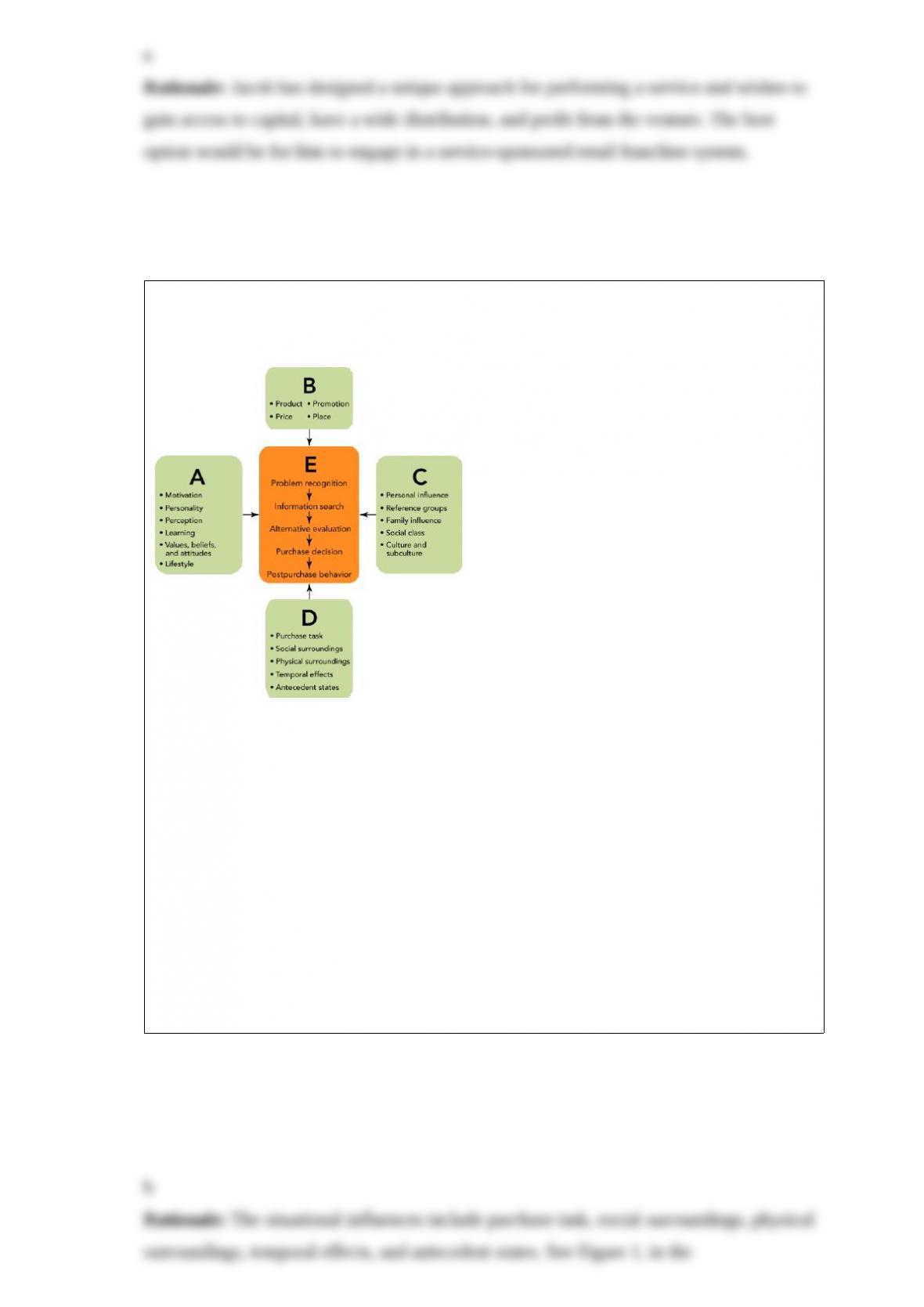
Figure 1.
In Figure 1. above, “D” represents the __________ influences that can affect the
consumer purchase decision process.
a. economic
b. situational
c. psychological
d. sociocultural
e. marketing mix
Answer: