Sales promotions cannot be the sole basis for a promotional campaign because
a. all sales promotions have legal time limit restrictions to prevent unfair trade
practices.
b. gains from the sales promotion are often temporary and sales drop off when it ends.
c. sales promotions are too costly and soon become a financial liability.
d. sales promotions are traditionally handled by outside firms and not the manufacturer,
which often results in a significant loss of profit.
e. consumers obtain an inflated impression of a product’s actual value or worth.
Answer:
Websites that are used primarily for advertising and promotion purposes emphasize the
__________ design element.
a. communication
b. context
c. community
d. content
e. connection
Answer:
To serve both buyers and sellers, marketing seeks to discover and __________ the
needs and wants of prospective customers.
a. change
b. satisfy
c. create
d. manipulate
e. weigh
Answer:
Ampro-Mag is a small company that makes materials for safely controlling hazardous
spills of all kinds. It sells these items as a neutralizing kit priced at $100. The costs of
the materials that go into each kit are $45. It costs $5 in labor to assemble a kit. The
company has monthly expenses of $1,000 for rent and insurance, $200 for heat and
electricity, $500 for advertising in trade journals, and $3,500 for the monthly salary of
its owner. What is Ampro-Mag’s monthly break-even point in terms of number of
neutralizing kits sold?
a. 40 kits
b. 52 kits
c. 104 kits
d. 116 kits
e. 520 kits
Answer:
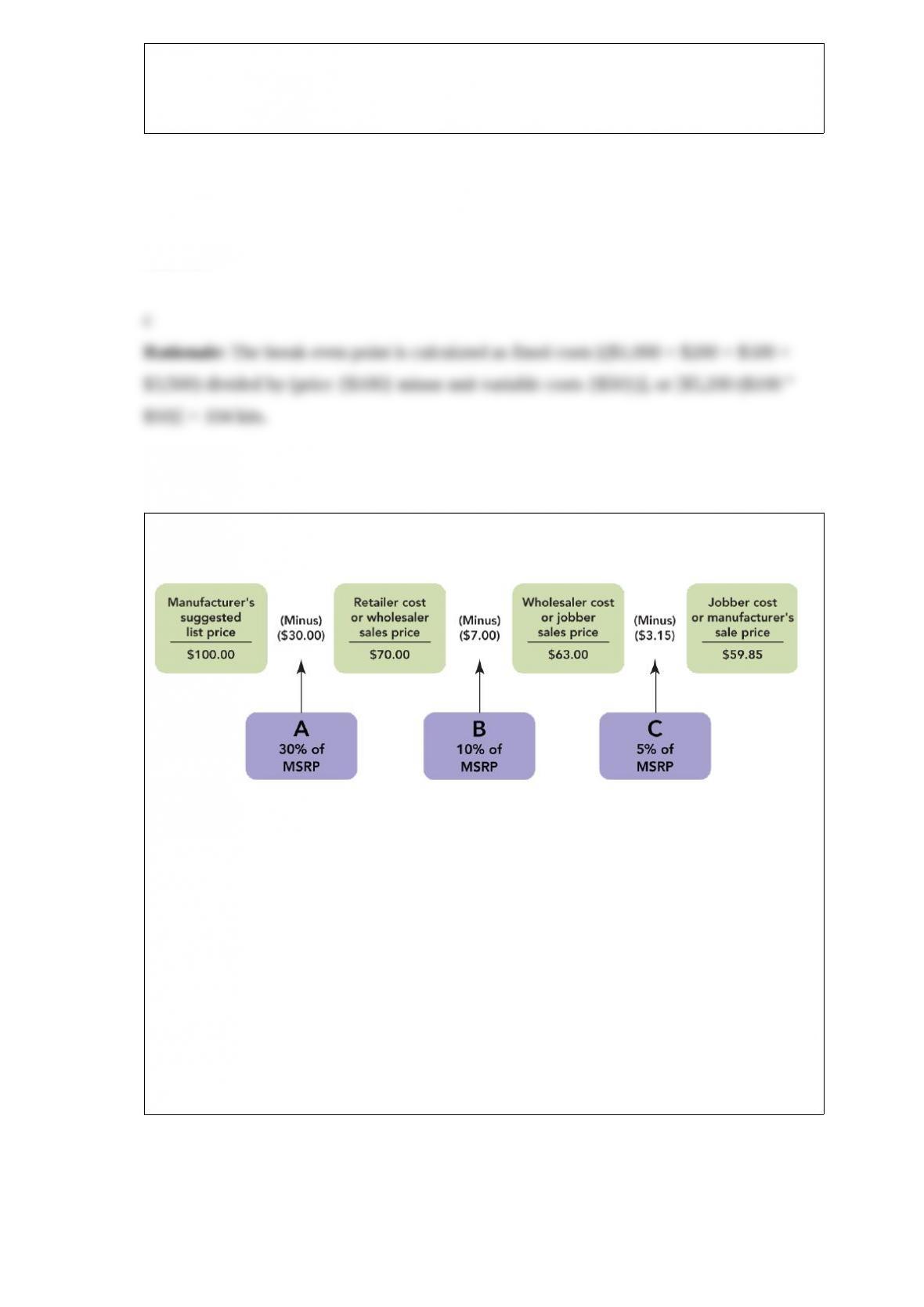
Figure 1.
Consider Figure 1. above. Suppose a manufacturer quotes price in the following form:
List price$100 less 30/10/5. What does “A” represent?
a. the wholesaler’s trade discount
b. the retailer’s trade discount
c. the jobber’s trade discount
d. the manufacturer’s trade discount
e. the manufacturer’s markup
Answer:
In terms of scheduling advertising, purchase frequency refers to
a. the number of times a buyer tries a product before becoming a brand loyal customer
of the firm’s product.
b. the number of times a buyer purchases a product during its life cycle.
c. how often a consumer will try competitive brands before becoming a brand loyal
customer of the firm’s product.
d. how frequently a product is purchased over a particular time period.
e. the idea that the more frequently the product is purchased, the less advertising
repetition is required.
Answer:
Which of the following is the simplest salesforce organizational structure?
a. profit
b. customer
c. product
d. geographical
e. market
Answer:
The concern for obtaining the best quality, features, and performance of a product or
service for a given price is called
a. customer value.
b. the value proposition.
c. buyer-centric excellence.
d. purchasing value.
e. value consciousness.
Answer:
All of the following are cost elements of an operating statement EXCEPT:
a. cost of goods sold
b. inventory
c. returns and allowances
d. direct labor
e. purchase discounts
Answer:
The retail mall owner told the marketing researcher, “We have the option of staying
open late twice a week or opening up an hour early every day. We need to know which
will be most profitable since we cannot do both. The decision must be made in 11
weeks and we only have $10,000 budgeted for this research project.” In which stage of
the marketing research process would this statement have been made?
a. define the problem
b. develop the research plan
c. collect relevant information
d. develop findings and recommendations
e. take marketing actions
Answer:
The sales manager instructed the salesperson to “Make five hundred customer contacts
between January 1st and July 1st.” The sales manager voiced a(n) __________ sales
objective.
a. output-related
b. input-related
c. behavior-related
d. comprehensive-related
e. market-related
Answer:
Team selling refers to the practice of __________.
a. using an entire team of professionals in selling to and servicing major customers
b. sending an entire team of a firm’s sales representatives into the field
c. combining the expertise and resources of buyers and sellers to create customized
solutions, commit to joint planning, and share customer, competitive, and company
information for their mutual benefit, and ultimately the customer
d. sending a group of sales representatives to concentrate on performing promotional
activities and introducing new products
e. assigning a team of sales representatives, each with his or her own unique product, to
the same geographic sales territory to ensure that the company can meet the needs of
these customers
Answer:
Two key types of synergies are __________.
a. supplier and distributor synergies
b. market and product synergies
c. industry-dominated and consumer-dominated
d. product and production synergies
e. consumer and market synergies
Answer:
A company’s gross sales may be reduced by
a. the size of the contribution margin.
b. the percentage of markdowns.
c. depreciation and amortization.
d. stockturn rate and the markup percentage.
e. returns or allowances.
Answer:
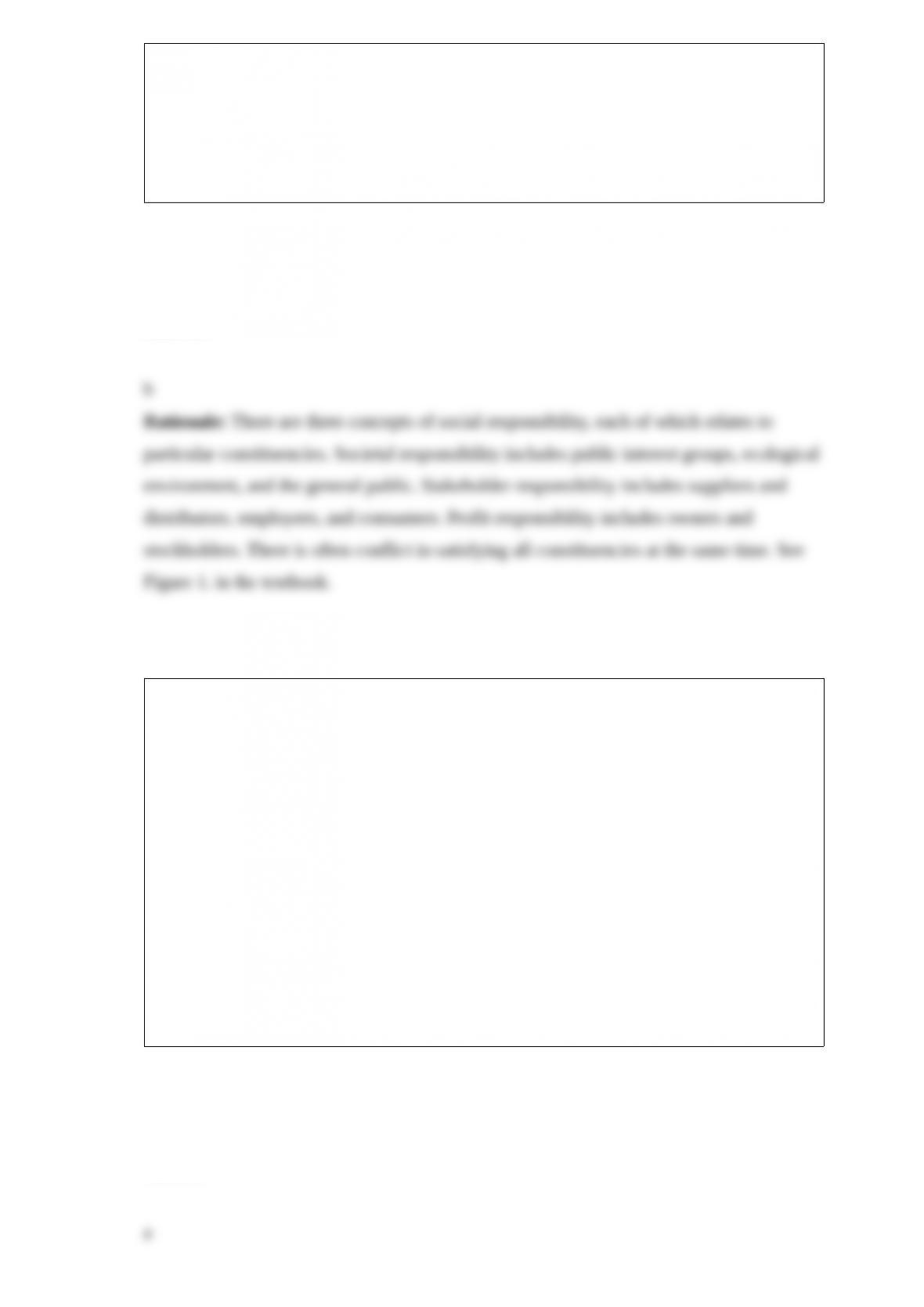
Figure 1.
There are three concepts of social responsibility, each relating to particular
constituencies. According to Figure 1. above, “B” represents __________ responsibility.
a. societal
b. stakeholder
c. profit
d. customer
e. seller
Answer:
Sellers view a solution as a customized and integrated combination of products and
services for meeting a customer’s business needs. Buyers think of a solution to a
business problem as one that meets their requirements, is designed to uniquely solve
their problem, can be implemented, and __________.
a. ensures follow-up
b. can be evaluated
c. is financially equitable
d. is easy to use
e. is sustainable
Answer:
Cost-plus pricing refers to
a. summing the total unit cost of providing a product or service and adding a specific
amount to the cost to arrive at the price.
b. setting the price of a line of products at a number of different price points.
c. adding a fixed percentage to the cost of all items in a specific product class.
d. setting prices to achieve a profit that is a specified percentage of the sales volume.
e. increasing the price slightly to protect against undue profit losses from unforeseen
environmental factors.
Answer:
Line positions refer to
a. managers who have the authority and responsibility to issue orders to people who
report to them.
b. people who have the authority and responsibility to advise people in staff positions
but cannot issue direct orders to them.
c. the senior executives responsible for a firm’s marketing strategies and activities.
d. members of the board of directors who are responsible for implementing the firm’s
marketing strategies and tactics.
e. middle management with the responsibility of assuring that tasks are completed on
time but who do not actually have the authority to issue orders.
Answer:
Another name for a one-price policy is
a. customary pricing.
b. fixed pricing.
c. flexible pricing.
d. standard markup pricing.
e. uniform pricing.
Answer:
An ad for Conseco Insurance asks the question, “How long will you wait to start
planning for long-term care?” The ad shows an elderly women being assisted by a nurse
as she tries to win money on a game show. The idea that she will not have the care she
needs because she failed to plan her finances for the future when she was younger is an
example of a __________.
a. rhetorical appeal
b. baby boomer appeal
c. humorous appeal
d. fear appeal
e. security appeal
Answer:
Based on a market-product grid framework, which marketing strategy would most
likely offer the greatest marketing synergies or efficiencies?
a. market-product concentration
b. product specialization
c. market specialization
d. selective specialization
e. universal concentration
Answer:
One tool available for services when dealing with capacity management is to use
__________ to charge different prices during different times of the day or the week to
balance supply and demand.
a. off-peak pricing
b. variable hours of operationopening or closing a store at different times
c. sales promotion incentives such as coupons
d. build-to-order service delivery systems
e. rationing
Answer:
Baby boomers are an important target market because
a. their workforce participation has made them the wealthiest generation in U.S. history,
accounting for an estimated 50 percent of all consumer spending.
b. they include most of the important business leaders in the United States.
c. they represent a small proportion of the population but have large disposable
incomes.
d. they have the longest life expectancies, remaining an active participant in the
marketplace for a long time.
e. they will be able to pass along significant wealth to their children, the generation that
will succeed them.
Answer:
A skimming pricing policy is likely to be most effective when
a. consumers perceive your product to be similar to other products on the market.
b. a lower price will significantly lower fixed costs.
c. customers interpret high price as signifying high quality.
d. consumers tend to be price sensitive.
e. it will be easier to set measurable sales unit goals.
Answer:
It is predicted that the number of people in the United States over the age of 65 will
__________ by 2030.
a. almost double
b. be significantly less than the growth of children under 16 years old
c. increase at the same worldwide rate
d. decrease at the same worldwide rate
e. begin to decrease, relative to previous growth rates
Answer:
Which of the following statements about world trade flows is most accurate?
a. The United States is tied with China and Japan as the world’s leaders in exports.
b. The U.S. percentage share of world exports has shifted upwards over the past 30
years.
c. The United States has maintained a steady percentage share of world imports.
d. The relative position of the United States as a supplier to the world has diminished
despite an absolute growth in exports.
e. The United States’ relative role as an exporter has decreased in areas of aerospace,
chemical, pharmaceutical, and information technology industries within the past five
years.
Answer:
In which stage of the product life cycle do marginal competitors begin to leave the
market?
a. introduction
b. growth
c. maturity
d. decline
e. harvest
Answer:
GI Designs, a copper furniture manufacturer, increased the price on its copper tabletops
by 20 percent for three months to see what the effect would be on its sales. The change
in sales is the __________ in this three-month experiment.
a. constraint
b. dependent variable
c. independent variable
d. decision task
e. extraneous variable
Answer:
Which of the following statements best describes a service?
a. Services are physical objects.
b. Services are intangible items.
c. Services are intangible concepts and thoughts about ideas or causes.
d. Services are the benefits organizations receive in exchange for selling products.
e. Services comprise the subset of tangible features of products.
Answer:
A commonly used indirect channel moves product from producer to retailer to
consumer. This channel is used when
a. the retail outlets are regionally located.
b. the cost of maintaining inventory is low.
c. there is little if any seasonal demand.
d. the risk lies solely with the manufacturer.
e. the retailer is large and can buy in large quantities from a producer.
Answer:
Relationship selling refers to __________.
a. the assignment of a single salesperson to a single customer throughout the entire sales
process
b. buyers and sellers combining their expertise and resources to create customized
solutions; commit to joint planning; and share customer, competitive, and company
information for their mutual benefit, and ultimately the customer
c. the practice of building ties to customers based on a salesperson’s attention and
commitment to customer needs over time
d. the practice of using an entire team of professionals in selling to and servicing key
customers
e. the practice of maintaining contact with a customer on a regularly scheduled basis
following the initial sale of a product or service
Answer:
In keeping with its business mission, Ben & Jerry’s has
a. created a children’s TV program with cat and mouse cartoon characters “Ben” and
“Jerry” to teach them about the importance of good nutrition and Fair Trade sustainable
business practices.
b. offered to buy out any failing family-owned ice cream parlor and turn it into a
ScoopShop franchise.
c. invested in research to create genetically engineered cows that will produce more
hypoallergenic milk.
d. donated free ice cream coupons to all children who get good grades in school.
e. created “Goodbye Yellow Brickle Road” ice cream in partnership with Sir Elton John
to help his worldwide AIDS Foundation.
Answer:
In the prepurchase stage of the consumer purchase decision process,
a. trade promotions are more effective than personal selling.
b. publicity is the most effective promotion tool.
c. advertising is more helpful than personal selling.
d. personal selling is more effective than advertising.
e. personal selling is the most effective way to communicate with potential buyers.
Answer:
Which of the following statements about bribery is most accurate?
a. Bribes, kickbacks, and payoffs offered to entice someone to commit an illegal or
improper act are deemed corrupt in some cultures but not in others.
b. The world’s major exporting nations have agreed to treat bribery of foreign
government officials as a violation of trade agreements.
c. Bribery paid to foreign companies is in some cases a tax-deductible expense in the
United States.
d. It is a crime for U.S. corporations to bribe an official of a foreign government or
political party unless pre-approved by the Federal Trade Commission.
e. It is illegal for a U.S. corporation to bribe an official of a foreign government or
political party to obtain or retain business in a foreign country.
Answer:
Online retail purchases by consumers can be the result of several very different
approaches, which include: (1) paying dues to become a member of an online discount
service; (2) using a shopping “bot” to search for a product at the best price; (3) going
directly to online malls; and (4)
a. becoming a member of a research group that evaluates new products.
b. becoming a secret shopper.
c. participating in an online auction.
d. participating in a buying cooperative.
e. becoming a PURL.
Answer: