
The more a marketing plan is based on __________, the less uncertainty and fewer
risks are associated with executing it.
a. opinions
b. intuition
c. facts and valid assumptions
d. past historical data
e. alternative contingencies
Answer:
Multichannel marketing seeks to integrate a firm’s electronic and delivery channels.
Catalogs can serve as shopping tools for online purchasing, and websites can help
consumers do their homework before visiting a store. By blending different
communication and delivery channels,
a. multichannel marketing can leverage the value-adding capabilities of different
channels.
b. multichannel marketing creates greater elasticity of demand for a firm’s products.
c. multichannel marketing creates greater inelasticity of demand for a firm’s products.
d. multichannel marketing allows a firm to legally circumvent paying taxes on revenue
generated by online sales.
e. multichannel marketing allows customers to avoid shipping and handling charges.
Answer:

Sales of goods and services to consumers through personal interactions and
demonstrations in their home or office is referred to as direct selling, or __________.
a. person-to-person sales
b. interactive selling
c. door-to-door retailing
d. individual promotion
e. customized selling
Answer:
Communication is the process of conveying a message to others and it requires six
elements. These elements include: a source, a message, a channel of communication,
__________, and the processes of encoding and decoding.
a. a concept
b. a receiver

c. an offer
d. a brand
e. a slogan
Answer:
The term that links the employees, shareholders, board of directors, suppliers,
distributors, creditors, unions, government, local communities, and customers is
a. stakeholders.
b. stockholders.
c. competitors.
d. target audience.
e. organizational society.
Answer:
Quantity discounts refer to

a. price reductions in unit costs for placing a larger order.
b. price reductions for placing long-term pre-scheduled orders.
c. price reductions to encourage retailers to stock inventory earlier than their normal
demand would require.
d. reductions in unit costs for purchasing items that are nearing their expiration dates.
e. reductions in unit costs for taking merchandise that will soon be replaced by new and
improved versions of the original product.
Answer:
When Milk-Bone dog biscuits offered a ball toy for $8.99 and two proofs of purchase, it
was using a __________.
a. deal
b. rebate
c. coupon
d. sample
e. premium
Answer:
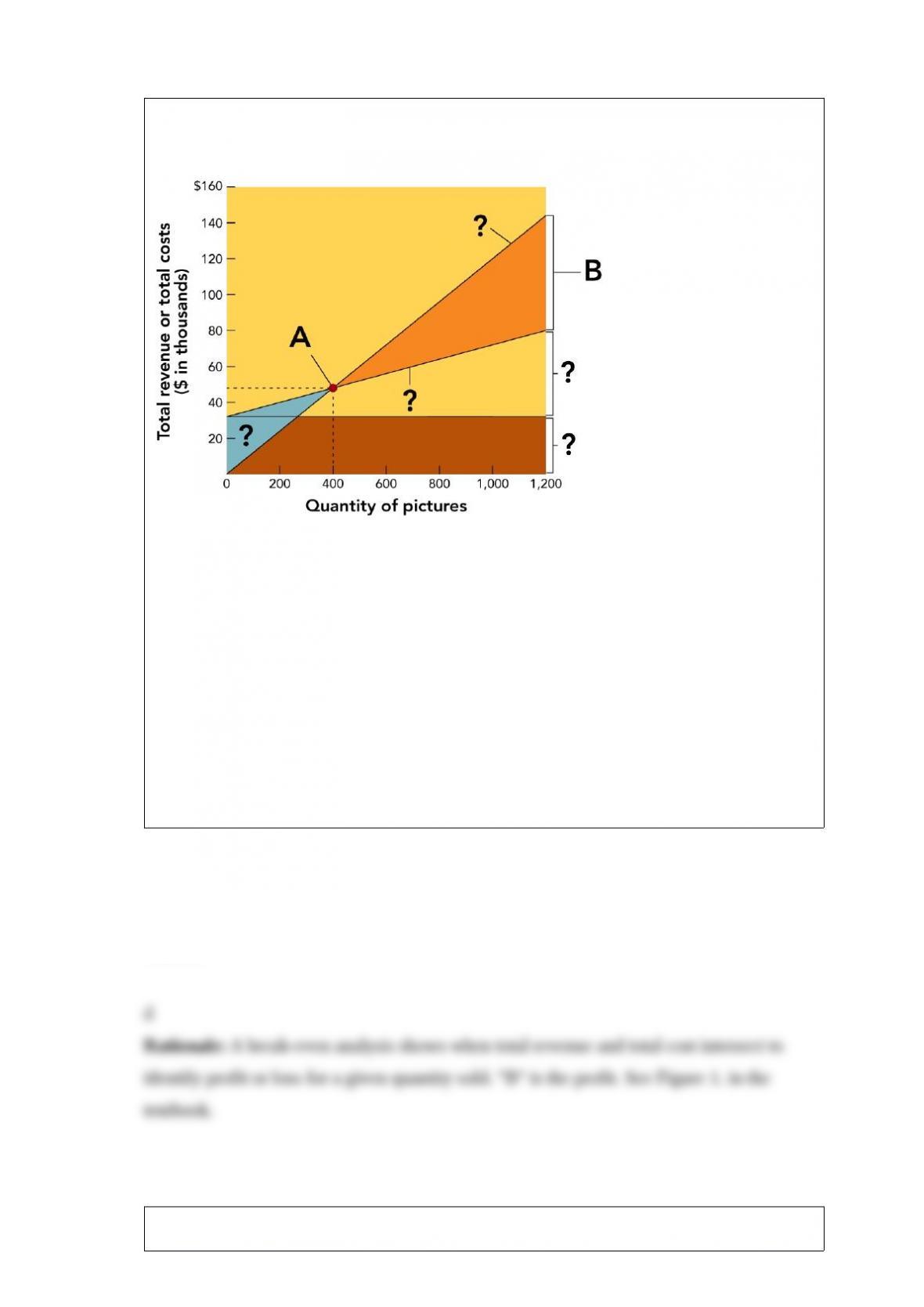
Figure 1.
In Figure 1. above, “B” identifies
a. fixed costs.
b. a break-even point.
c. variable costs.
d. a profit.
e. total revenue.
Answer:
Combinations of the marketing mix that reflect the unique attitudes, ancestry,
communication preferences, and lifestyles of different races are referred to as
__________ marketing programs.
a. panethnic
b. generational
c. cross-cultural
d. multicultural
e. regional
Answer:
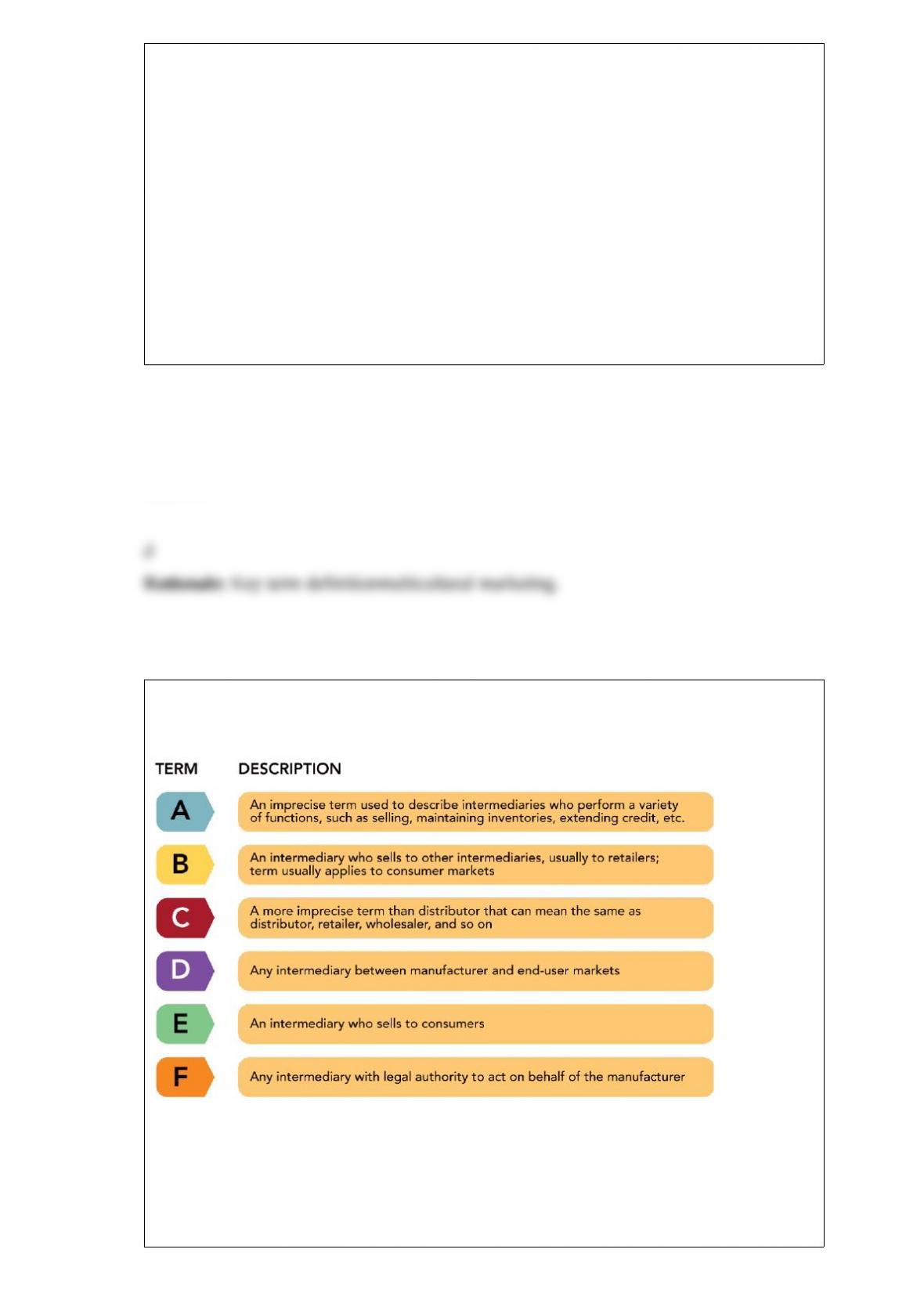
Figure 1.
A variety of terms are used for marketing intermediaries. According to Figure 1. above,
“D” represents a(n) __________.
a. retailer

b. wholesaler
c. distributor
d. agent or broker
e. middleman
Answer:
Today’s visionary organization uses three key elements: (1) specify its foundation; (2)
set a direction; and (3) __________.
a. set financial goals
b. assign job responsibilities
c. formulate its strategies
d. establish production parameters
e. establish detailed marketing tactics
Answer:

If Ben & Jerry’s starts selling its ice cream in China for the first time, it will be using a
__________ strategy.
a. product development
b. market development
c. diversification
d. market saturation
e. market penetration
Answer:
Profits tend to consume a disproportionate share of management and financial resources
relative to their worth throughout which stage of the product life cycle?
a. innovation
b. growth
c. maturity
d. decline
e. harvest
Answer:
Managers often use two special indexes to help identify strong and weak market
segments in order to provide direction for marketing efforts. The two indexes, CDI and
BDI, stand for __________.
a. comprehensive demographic inventory and brand designation information
b. consumer demographic index and buyer demographic inventory
c. category development index and brand development index
d. consumer development index and brand development inventory
e. category development index and buyer development inventory
Answer:
Using an existing brand name to introduce a product that is new to the company into a
totally new, unfamiliar market seems like a good idea. This is what Cosmopolitan
magazine did when it introduced __________, and it failed quickly.
a. aspirin

b. yogurt
c. disposable underwear
d. soda (soft drink)
e. perfume
Answer:
A program champion refers to
a. a person who is able and willing to cut red tape and move the program forward.
b. the person within an organization who is assigned the responsibility of taking a
program from conception to deletion.
c. a person in an organization who serves as the public representative or “face” for a
new product.
d. a public figurehead, usually a sports figure or celebrity, who serves as a company
spokesperson for a new product.
e. a single product within the product line that carries the other products in the line “on
its back.”
Answer:

There are many diet aids on the market. They promise immediate weight loss without
exercise or a change in diet. Each is accompanied by a testimonial from a satisfied user.
If you pay close attention, you will notice that each ad also contains the statement,
“Results may vary.” Most likely, this statement is included to prevent the FTC from
requiring the dietary aid distributor from having to
a. engage in self-regulation.
b. engage in comparative advertising.
c. issue an advertising injunction.
d. guarantee truth-in-advertising.
e. run corrective advertising.
Answer:
Elastic demand exists when
a. a small percentage decrease in price produces a smaller percentage increase in
quantity demanded and total revenue falls.
b. a small percentage decrease in price produces a larger percentage increase in quantity
demanded and total revenue increases.
c. an increase in price causes a larger increase in quantity demanded and total revenue
falls to zero.
d. the quantity demanded remains the same regardless of level of price and total
revenue is unchanged.
e. a small percentage decrease in price produces a smaller percentage decrease in
quantity demanded and total revenue increases.

Answer:
The William Morris Agency represents country singer Trace Adkins in negotiations
with various venues in which he could perform. Imagine that the agency decided the
singer would not perform at venues located in small town communities that have less
than 100,000 people. Thus, venues segmentation is a form of __________
segmentation.
a. entertainment
b. psychographic
c. geographic
d. usage rate
e. buying condition
Answer:
The pricing strategy that is almost the exact opposite of skimming pricing is
a. target pricing.
b. penetration pricing.

c. price lining.
d. odd-even pricing.
e. prestige pricing.
Answer:
The four largest exporters to the United States are
a. Canada, China, Japan, and Mexico.
b. Japan, Germany, Brazil, and Canada.
c. China, Brazil, Japan, and Germany.
d. Mexico, Argentina, Brazil, and Venezuela.
e. England, Canada, Australia, and New Zealand.
Answer:
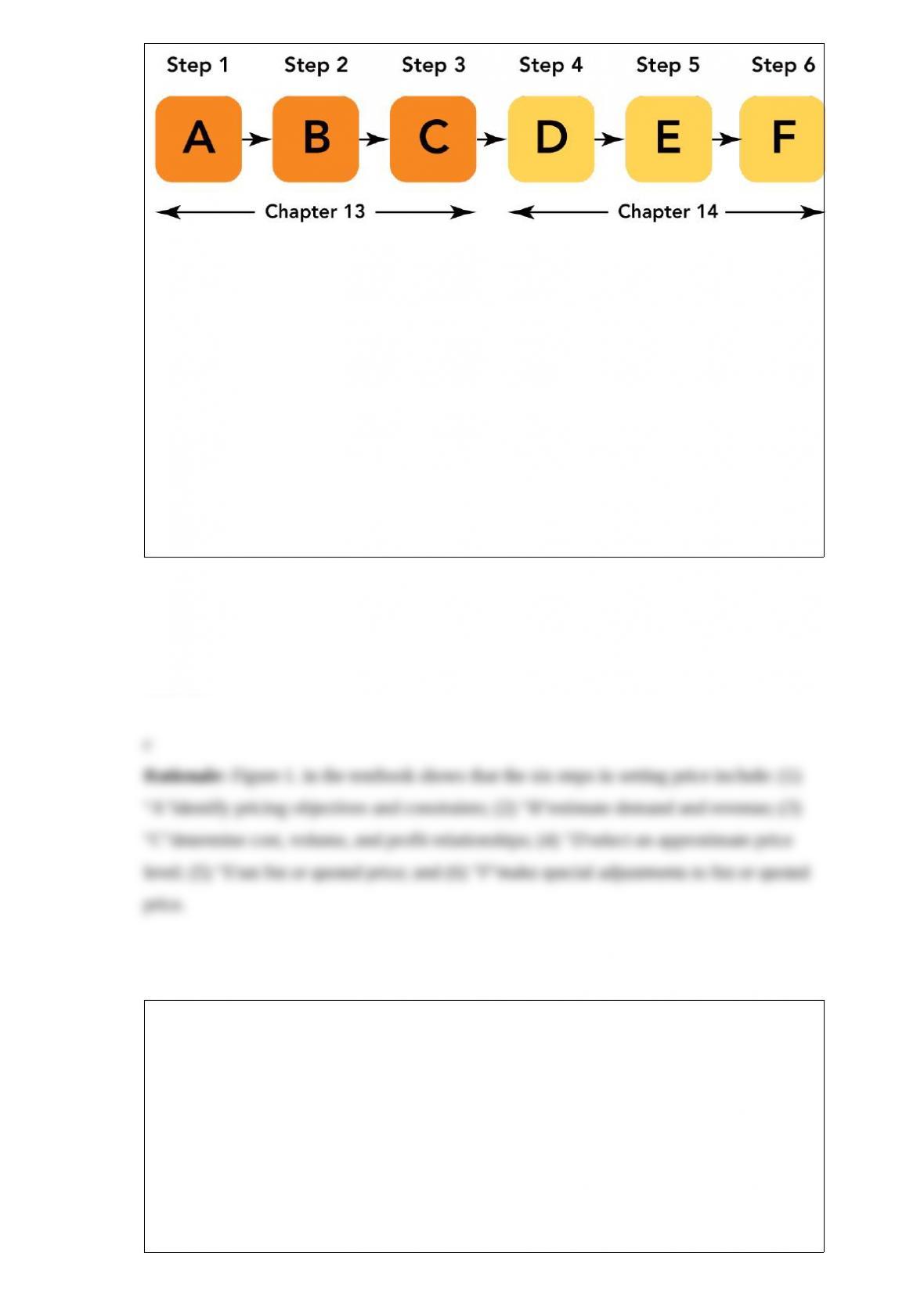
Figure 1.
Figure 1. above represents the six steps in setting price. “D” represents the step at which
a firm would
a. estimate demand and revenue.
b. scan competitors for prices of similar products or services.
c. select an approximate price level.
d. determine cost, volume, and profit relationships.
e. establish the price range.
Answer:
The __________ measure most closely ties the cost of the social media ad to the sales
revenues the ad generates.
a. cost per click.
b. cost per thousand.
c. negotiated measure.

d. cost per view.
e. cost per action.
Answer:
The information search stage clarifies the problem for the consumer by: (1) suggesting
criteria to use for the purchase; (2) yielding brand names that might meet the criteria;
and (3) __________.
a. developing consumer value perceptions.
b. determining appropriate price ranges.
c. selecting the type of retail outlet.
d. establishing a purchase timeline.
e. creating a hierarchy of needs.
Answer:
Competitive advantage for global firms grows out of __________, innovation, and
change.
a. product quality
b. continuous improvement
c. employment of a multicultural or multinational staff
d. membership in a formalized trade organization
e. market research
Answer:
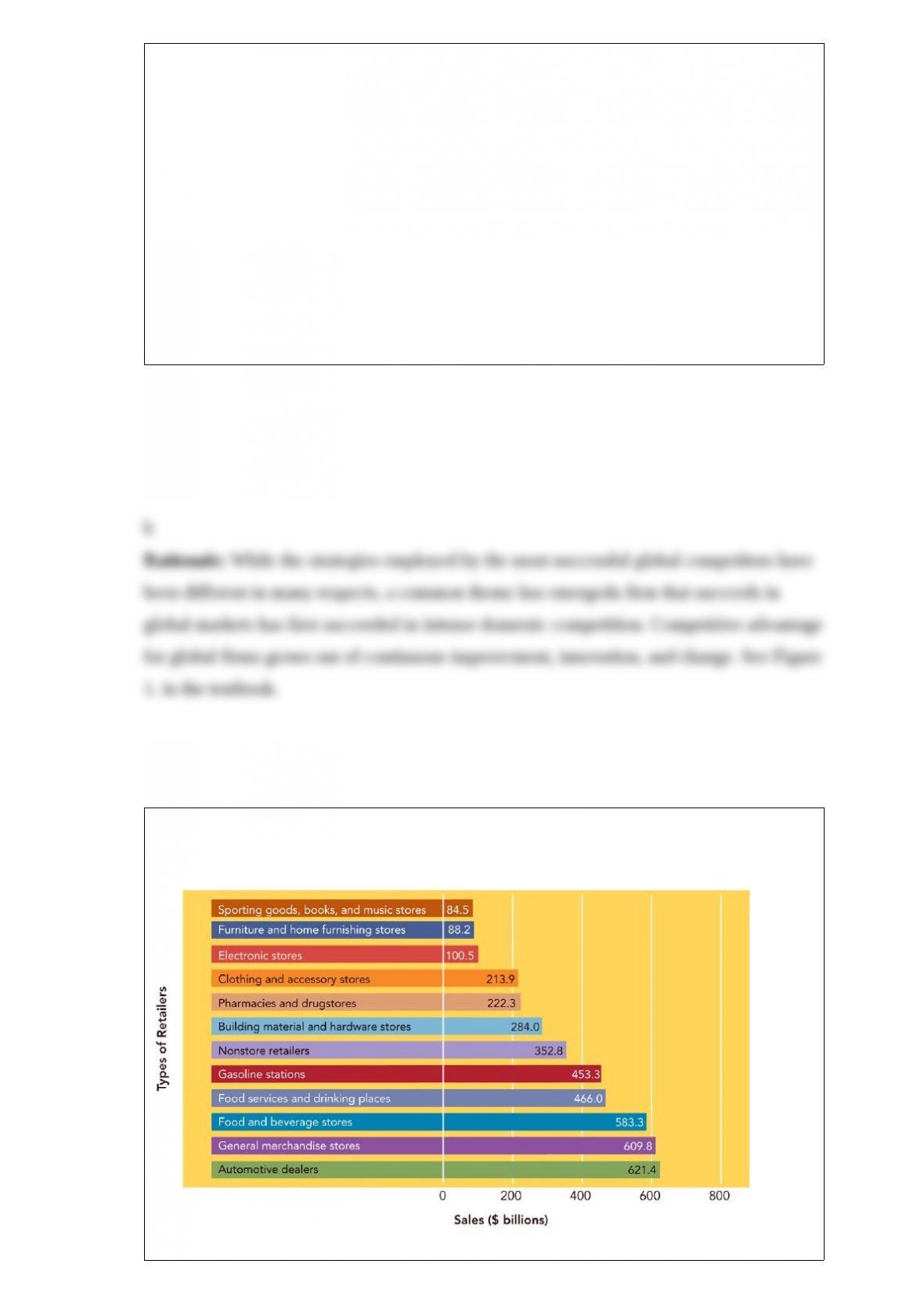
Figure 1.

As shown in Figure 1. above, the greatest dollar amount of retail sales in the United
States is generated by __________.
a. food and beverage stores
b. sporting goods, books, and music stores
c. electronic stores
d. automotive dealers
e. furniture and home furnishing stores
Answer:
National TV ratings, published by the Nielsen Company, are an example of
__________ data.
a. internal secondary data
b. interactive industry data
c. external secondary data
d. mechanical observational data
e. sensitivity data
Answer:

There are three major tasks involved in the implementation stage of the sales
management process: salesforce recruitment and selection; __________; and salesforce
motivation and compensation.
a. setting sales objectives
b. salesforce training
c. salesforce evaluation
d. assignment of territories and/or accounts
e. developing account management policies
Answer:
The combined American Marketing Association’s 2004/2007 definitions of marketing
used in the textbook defines marketing as
a. the activity for creating, communicating, delivering, and exchanging offerings solely
for the benefit of the organization’s stockholders.
b. the activity for creating, communicating, delivering, and exchanging solely for the
benefit of the organization’s customers.
c. the activity for creating, communicating, and delivering a product or service at the
highest possible price.
d. the activities of advertising, promoting, and selling products to the greatest number
of profitable customers.

e. the activity for creating, communicating, delivering, and exchanging offerings that
benefit its customers, the organization, its stakeholders, and society at large.
Answer:
Marilyn called the Butterball toll-free hotline to learn how to prepare her Thanksgiving
turkey and dressing. This telephone number is an example of __________.
a. interactive marketing
b. multichannel selling
c. outbound telemarketing
d. social networking
e. inbound telemarketing
Answer: