Outside the United States, large retailers include __________ in Japan, Carrefour in
France, Metro Group in Germany, and Tesco in Britain.
a. Aeon
b. Toshei
c. Seebi
d. Goshen
e. Toshi
Answer:
The set of environmental forces that consists of the demographic characteristics of the
population and its values is referred to as
a. social forces.
b. economic forces.
c. consumer forces.
d. cultural forces.
e. market forces.
Answer:
The Economic Research Service of the U.S. Department of Agriculture provides
information on topics from how many dairies there are in the U.S. to how much
broccoli was eaten per person in 2011. This service provides
a. internal primary data.
b. nonprobability sampling tools.
c. internal secondary data.
d. external secondary data.
e. external primary data.
Answer:
Consumers with credit cards
a. are less influenced by physical surrounding than those who pay by cash or check.
b. are influenced to a certain extent by a retailer’s physical surroundings to buy more
with their credits cards than with cash.
c. purchase more than those who purchase with cash or debit cards.
d. purchase less than those who purchase with cash or debit cards.
e. purchase less when accompanied by children than when in the company of other
adults.
Answer:
Both Honda and Toyota have plants in the United States that use American labor. This
example is an illustration of Honda and Toyota practicing
a. direct exporting.
b. direct investment.
c. joint venture.
d. licensing.
e. indirect exporting.
Answer:
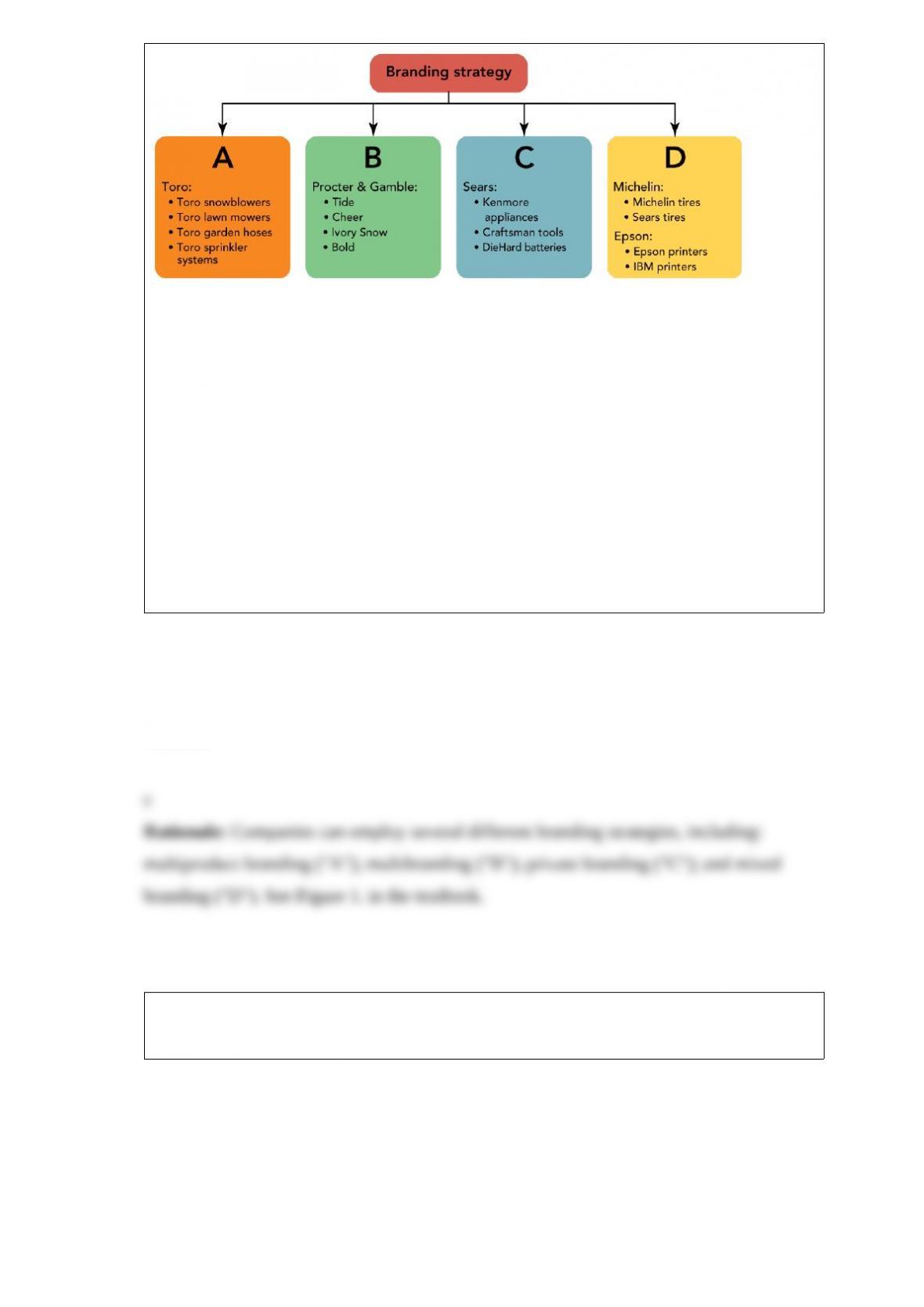
Figure 1.
Companies can employ several different branding strategies. In Figure 1. above, “B”
represents a __________ strategy.
a. retailer branding
b. multiproduct branding
c. multibranding
d. private branding
e. mixed branding
Answer:
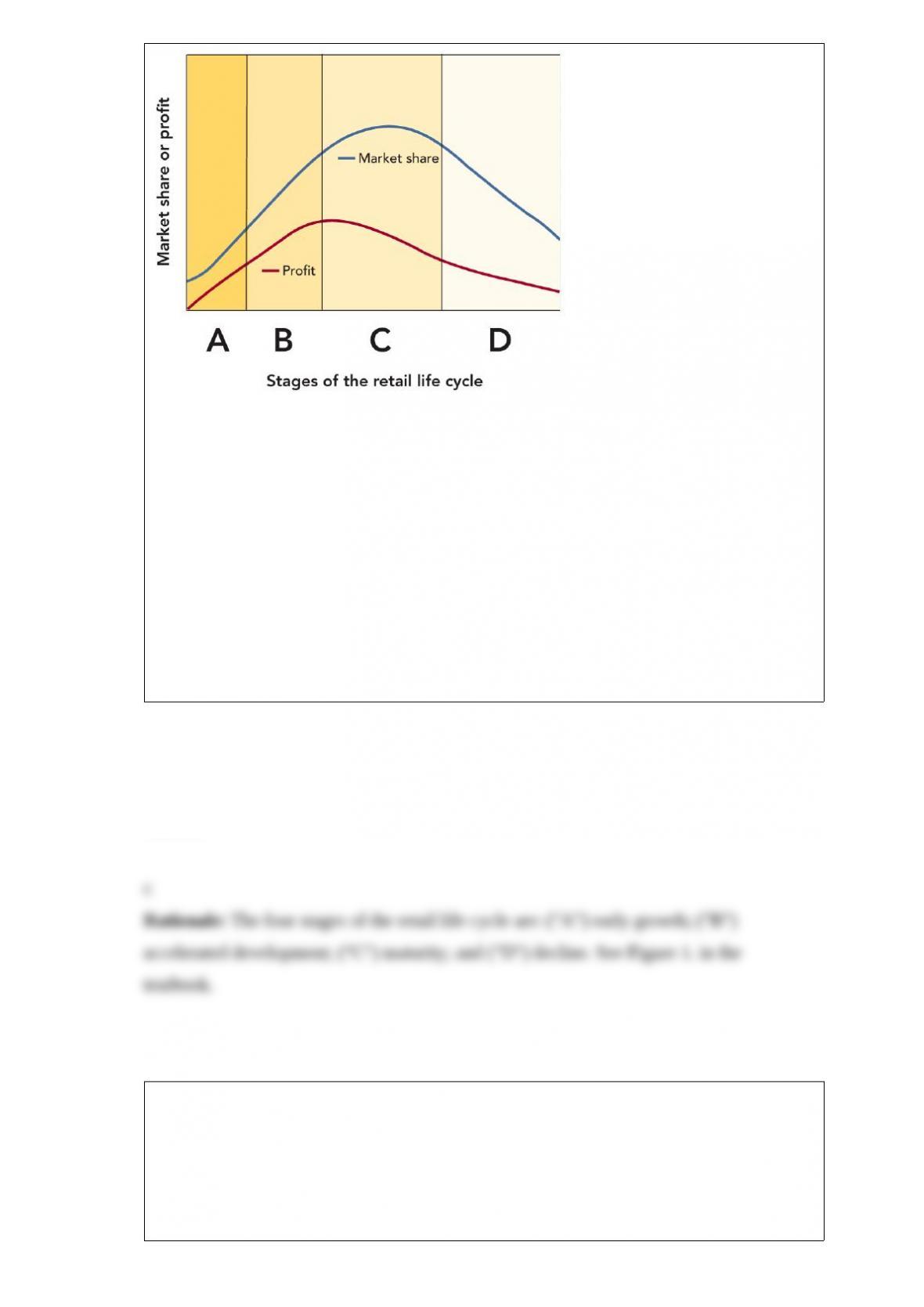
Figure 1.
According to Figure 1. above, “B” represents which stage of the retail life cycle?
a. introduction
b. early growth
c. accelerated development
d. maturity
e. decline
Answer:
Within DuPont’s textile fiber department, there is a separate product manager for rayon,
acetate, orlon, nylon, and Dacron. The product manager for DuPont nylon would be
responsible for
a. making long-range plans for nylon.
b. maintaining the divisional mission statement.
c. modifying DuPont’s organizational structure.
d. creating static marketing objectives.
e. implementing short-term actions for all fibers.
Answer:
A wholesaler that carries a narrow range of products and performs all channel functions
is referred to as a __________.
a. general merchandise wholesaler
b. truck jobber
c. specialty merchandise wholesaler
d. rack jobber
e. drop shipper
Answer:
When commenting about her challenges at General Mills, Vivian Milroy Callaway, says
that __________ when looking for new-product opportunities for building a consumer
packaged goods business like Big G.
a. “it is better to ask forgiveness than permission”
b. “you need to go with the flow”
c. ‘sometimes you have to break the rules”
d. “you need to avoid the NIH syndrome”
e. ” a do it, fix it, try it approach is necessary”
Answer:
The use of Charles Barkley in Nike commercials rather than unknown actors is an
example of a very popular form of advertising todaythe use of __________.
a. a reference group appeal
b. snob appeals
c. a peer spokesperson
d. a sex appeal
e. a celebrity spokesperson
Answer:
Specialty products refer to
a. products for which there are no close substitutes.
b. products purchased for their prestige or high perceived value.
c. products a consumer will make a special effort to search out and buy.
d. items for which the consumer compares several alternatives on several criteria such
as price, quality, or style.
e. items that the consumer does not know about or knows about but does not initially
buy.
Answer:
In 1962, President John F. Kennedy outlined a Consumer Bill of Rights that codified the
ethics of exchange between buyers and sellers. These were the right: (1) to safety; (2) to
be informed; (3) __________; and (4) to be heard.
a. to have legal representation in a court of law
b. to exchange or return products within a reasonable period of time
c. to choose
d. to demand “rain checks” if advertised goods are out of stock
e. to be compensated for product defects
Answer:
Step 3 in the planning phase of the strategic marketing process consists of
a. diversification analysis.
b. the situation (SWOT) analysis.
c. the marketing program.
d. the market-product focus and goal setting.
e. business portfolio analysis.
Answer:
Neighborhood grocers that ban together with several other independent grocers who all
agree to buy their goods directly from food manufacturers are a form of
a. retailer-sponsored cooperative.
b. consortium system.
c. administrative system.
d. conglomerate system.
e. collaborate chain.
Answer:
An agent refers to
a. any intermediary with legal authority to act on behalf of the manufacturer.
b. independent firms or individuals whose principal function is to transport goods.
c. any intermediary who takes ownership of a manufacturer’s goods or services and then
finds multiple buyers for them.
d. a manufacturer’s paid representative and acting voice in initial sales transactions.
e. a manufacturing “matchmaker” who actively seeks out potential consumers and
brings them to retailers.
Answer:
To increase value, marketers have the option of
a. decreasing benefits.
b. decreasing benefits and increasing price.
c. decreasing price and increasing benefits.
d. decreasing price and decreasing benefits.
e. do nothing and let the perceived value of the item increase as it matures in its life
cycle.
Answer:
Figure 1.
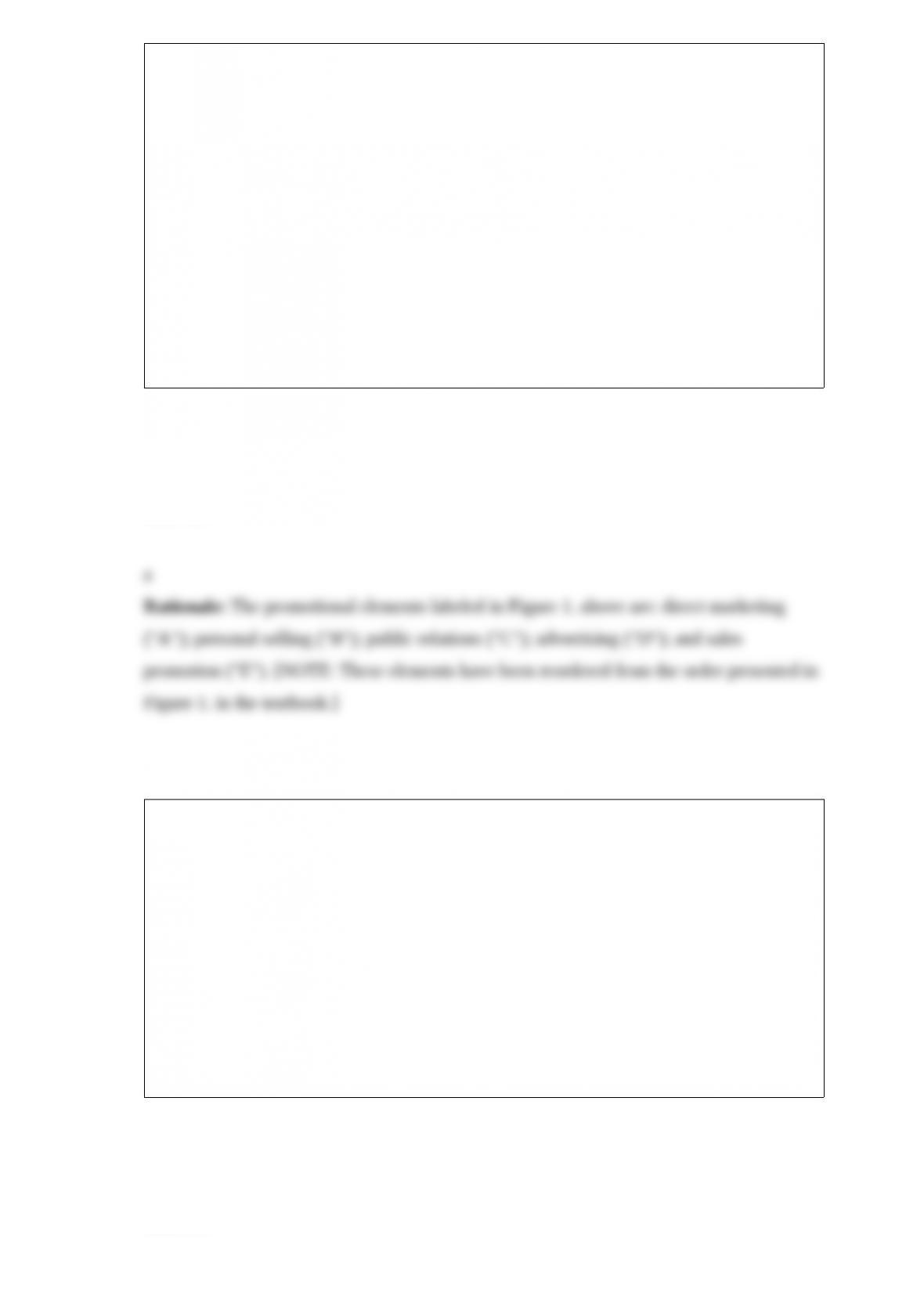
To communicate with consumers, a company can use one or more of five promotion
alternatives. In Figure 1. above, the promotional element labeled “D” represents
_________.
a. advertising
b. personal selling
c. public relations
d. sales promotion
e. direct marketing
Answer:
The “risk” in a transactional function refers to
a. unpredictable costs of transportation because of fuel prices.
b. product liability from poorly produced products that become defective.
c. the need to stock merchandise in anticipation of sales, which may become obsolete.
d. trying new promotional campaigns.
e. investments in new product development.
Answer:
Small businesses account for __________ of the gross domestic product (GDP).
a. 25 percent
b. 30 percent
c. 50 percent
d. 65 percent
e. 80 percent
Answer:
Rack jobbers refer to wholesalers who
a. furnish the shelves that display merchandise in retail stores, perform all channel
functions, and sell on consignment to retailers.
b. own the merchandise they sell and have retailers store it in their warehouses.
c. own the merchandise they sell but do not physically handle, stock, or deliver it.
d. have a small warehouse from which they stock their trucks for distribution to
retailers.
e. work for several producers and carry noncompetitive, complementary merchandise in
an exclusive territory.
Answer:
Market analysts for a large cereal company estimated that the price elasticity of demand
for presweetened cereal is 1., but that the entire market for ready-to-eat cereals exhibits
a price elasticity of demand of 0.36. Marketers collect this type of information in which
step of the price-setting process?
a. identifying pricing objectives and constraints
b. estimating demand and revenue
c. estimating the break-even point
d. selecting an approximate price level
e. making special adjustments to list or quoted price
Answer:
Go to any Kroger supermarket and walk to the cereal aisle. You will notice that four
major brandsKellogg’s, Quaker, General Mills, and Postseem to occupy most of the
shelf space. These cereals are all priced about the same. There is a good deal of product
differentiation as the result of licensing agreements with movie studios (Disney,
DreamWorks, etc.) and through the use of different health claims. The cereal industry is
an example of what type of competitive market?
a. a pure monopoly
b. monopolistic competition
c. pure competition
d. monopolistic oligopoly
e. an oligopoly
Answer:
Price elasticity of demand (E) is expressed as
a. E = Percentage change in price (%∆ in P) Percentage change in quantity demanded
(%∆ in Q).
b. E = Price (P) Quantity demanded (Q).
c. E = Percentage change in quantity demanded (%∆ in Q) Percentage change in price
(%∆ in P).
d. E = Quantity demanded (Q) Price (P).
e. E = Quantity demanded (Q) Price (P).
Answer:
In terms of an organization’s business, railroads may have lost market share in the 20th
century because they
a. had less flexible routes than trucking.
b. defined their business too narrowly.
c. defined their business too broadly.
d. priced their services too high.
e. were simply an outmoded form of transportation.
Answer:
When selecting a brand name, it should (1) suggest product benefits; (2) be memorable,
distinctive and positive; (3) fit the company or product image; (4) __________; and (5)
be simple and emotional.
a. never have a humorous connotation
b. be easy to spell and pronounce
c. be patented
d. not be easily imitated
e. have no legal or regulatory restrictions
Answer:
All of the following statements about these social networks are true EXCEPT:
a. Facebook contains user-generated content that each member supplies to the Web
service.
b. Digg allows people to share articles.
c. Ning allows users to create custom social websites.
d. Google is increasingly becoming a fierce competitor to Facebook as a depository of
society’s information.
e. Today, MySpace is the largest social networking website.
Answer:
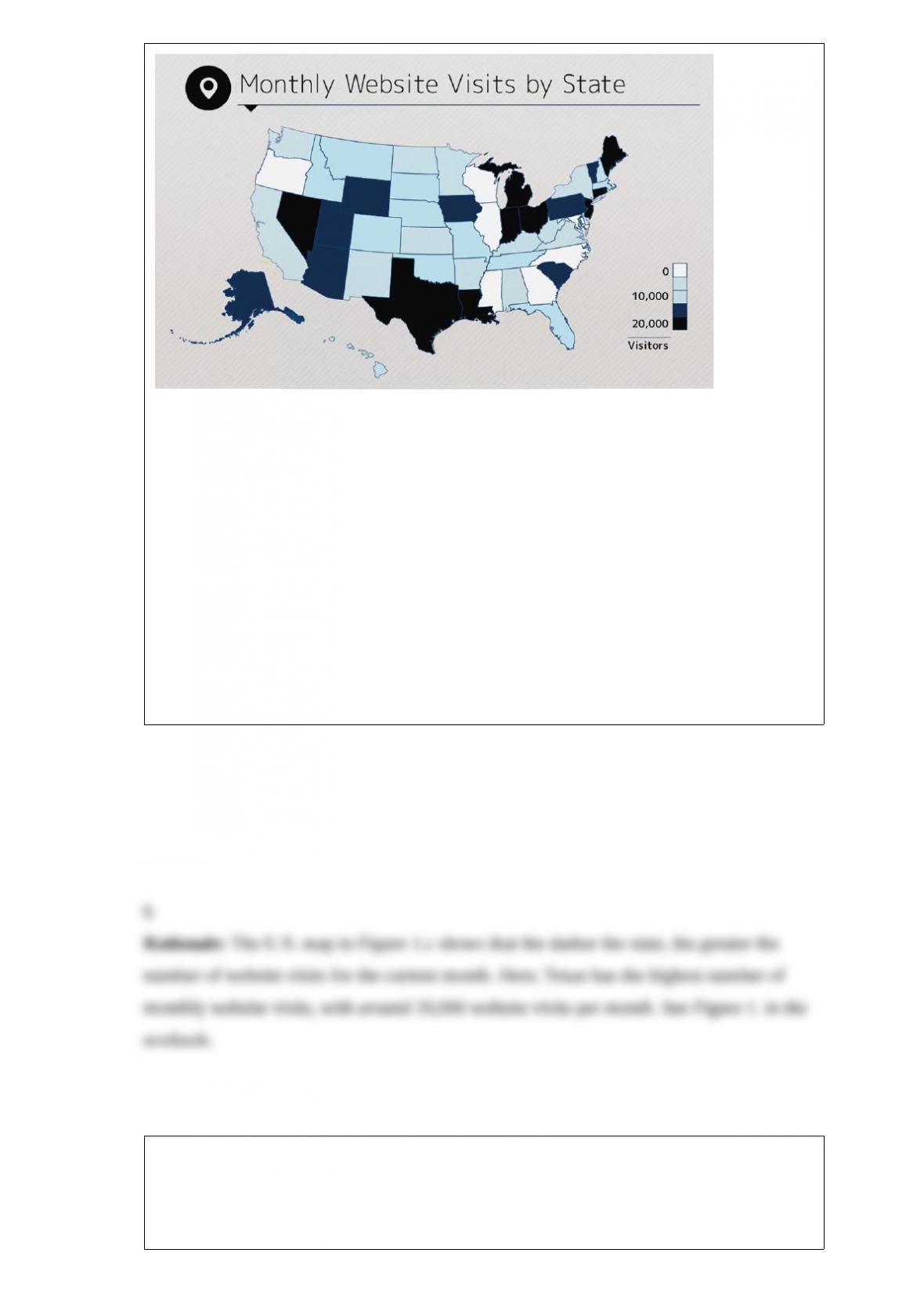
Figure 1.c
According to Figure 1.c above, which state has the highest number of monthly website
visits?
a. Illinois
b. Texas
c. California
d. Florida
e. Washington
Answer:
Private branding is also referred to as private labeling or __________.
a. reseller branding
b. generic branding
c. multibranding
d. co-branding
e. multiproduct branding
Answer:
IGA and Ben Franklin variety and craft stores represent a(n)
a. service-sponsored retail system
b. wholesaler-sponsored voluntary chain
c. retailer-sponsored cooperative
d. administered cooperative system
e. manufacturer-sponsored cooperative
Answer:
Subbranding involves __________.
a. having one firm manufacture a product and a second firm distribute it all under the
same name
b. changing a brand name of a product line extension product by making it “New and
Improved!”
c. combining a corporate brand with a new brand to distinguish a part of its product line
from others
d. creating a “knock-off” version of a product and changing the spelling of the name
(chicken to “chikin” as is the case with Chick-Fil-A)
e. using the same name for the original product and all subsequent product line and
brand extensions
Answer:
The Dutch lead the world in the cut-flower industry because of their research in flower
cultivation, packaging, and shipping. Using this knowledge as a resource is an example
of what Michael Porter would term
a. structural conditions.
b. demand conditions.
c. sociocultural conditions.
d. competitive conditions.
e. factor conditions.
Answer:
Seven Cycles has a __________ with its 233 authorized dealers and distributors.
a. contentious relationship
b. life reciprocity agreement
c. joint partnership
d. franchise contract
e. collaborative relationship
Answer:
Organizational groupings that represent the different departments or business activities
within a firm are referred to as __________.
a. reseller groupings
b. functional groupings
c. geographical groupings
d. product line groupings
e. market-based groupings
Answer:
Outlets where customers are responsible for most shopping activities, although
salespeople are available in some departments, would be classified as __________
outlets.
a. limited-service
b. exclusive-service
c. minimal-service
d. self-service
e. full-service
Answer: