
SCHOOL COUNSELOR SCENARIO
Clarence works as a school counselor in a high school. She finds her job very
challenging as she has to help teenagers deal with a variety of problems. Her years on
the job have given Clarence startling insight on teen behavior. Many high school
seniors with a binge drinking problem perceive nothing wrong with their behavior,
viewing it more as a requisite for acceptance in what is considered “adult behavior.”
Teenagers with a history of cyberbullying acknowledge that the act gives them a feeling
of dominance and power, with some even comparing it to the high they get with
substance abuse. Some go about destroying school property because they believe that
the education system has done them more harm than good. These teenagers believe that
destroying school property is a way to get back at the education system. Most students
report that they experience a high amount of peer pressure. Many students suffer from
eating disorders brought about by the pressure to comply with a certain body type.
Many girls feel the need to eat frequent huge meals and make themselves throw up
afterward. Clarence believes that growing up is troublesome for many but she is always
hopeful that most problems can be tackled. Once, her school organized an interstate
workshop on drunk driving. It was sponsored by a huge corporate house with the
intention of helping the student community. Clarence was happy that it was a big
success. Refer to School Counselor Scenario. Teenagers with a history of cyberbullying
acknowledge that the act gives them a feeling of dominance and power. Some even
compare it to the high they get with substance abuse. Which of the following
motivations of consumer misbehavior best explains this acknowledgment?
a. Unfulfilled aspirations
b. Thrill-seeking
c. Differential association
d. Pathological socialization
e. Opportunism
When consumers get so mad at a business that they become violent or try to vandalize
the business, it is called _____ revenge.
a. rancorous

b. retaliatory
c. restorative
d. distributive
e. procedural
Which of the following is at the heart of the consumer value framework and the focus
of marketing efforts?
a. Utilitarian and hedonic values
b. Personal values
c. Consumer perception
d. Environment
e. Cultural values
When Carl, a Cuban, migrated to England, he realized he had no suitable clothes for the
winter. Carl felt that he required some warm clothes to brace himself up for the English
winter. Which of the following activities in the decision-making process represents this
perceived requirement?

a. Need recognition
b. Search for information
c. Evaluation of alternatives
d. Choice
e. Postchoice evaluation
Jazzy, a personal care products manufacturer, incorporated customers’ suggestions in
designing its new brand of safety razors for men. However, when it reached the market,
customers could not perceive any improvement from the old razors. The customers’
reaction indicates that the new razor design failed to register a(n) _____ difference
when compared with the old one.
a. subliminal
b. assimilative
c. integrative
d. distortive
e. just noticeable
When consumers need to purchase a refrigerator, they usually evaluate different models

across a set of features or characteristics, such as storage capacity, freezer shelving, and
energy cost efficiency. Such an evaluation is an example of a(n) _____ evaluation.
a. affect-based
b. attribute-based
c. content-based
d. belief-based
e. attitude-based
LOUIS VUITTON SCENARIO
Carla purchased a Louis Vuitton Fantaisie handbag for $1,430 when she was in New
York City last weekend. She had always fancied this brand but had never purchased
anything of this brand before. In fact, many of her friends purchased counterfeit Louis
Vuitton handbags, wallets, and scarves. But Carla was very particular about using only
genuine goods. While the counterfeit products looked just as good as the real brand,
they weren”t of the same quality as the legitimate branded products. When she visited
the store to purchase the bag, she was very skeptical about spending so much money for
a handbag, but the sales lady was so kind and explained the benefits of the brand to her
and made her feel very welcome in the store. She explained that consumers could only
purchase true Louis Vuitton products at Louis Vuitton stores or from its website. She
also explained that if she ever encountered a problem with her handbag, she could
return it to the store for repair or a replacement. All things considered, Carla’s
experience at the store and her purchase far exceeded anything she had expected. Her
initial feeling of skepticalness on splurging on a handbag gave way to a feeling of
satisfaction and pride. This feeling was further strengthened when her friend who
bought a counterfeit Louis Vuitton handbag for a few hundred dollars expressed dismay
over her own purchase decision after she saw Carla’s authentic Louis Vuitton bag with a
superior finish. Refer to Louis Vuitton Scenario. Assume that before entering the Louis
Vuitton store in New York City, Carla expected to be treated well considering she was
going to spend over $1,000. Which of the following most likely corresponds to Carla’s
expectation?
a. Predictive expectation
b. Normative expectation
c. Comparative expectation
d. Equitable expectation
e. Relative expectation
AUTOMOBILE SCENARIO
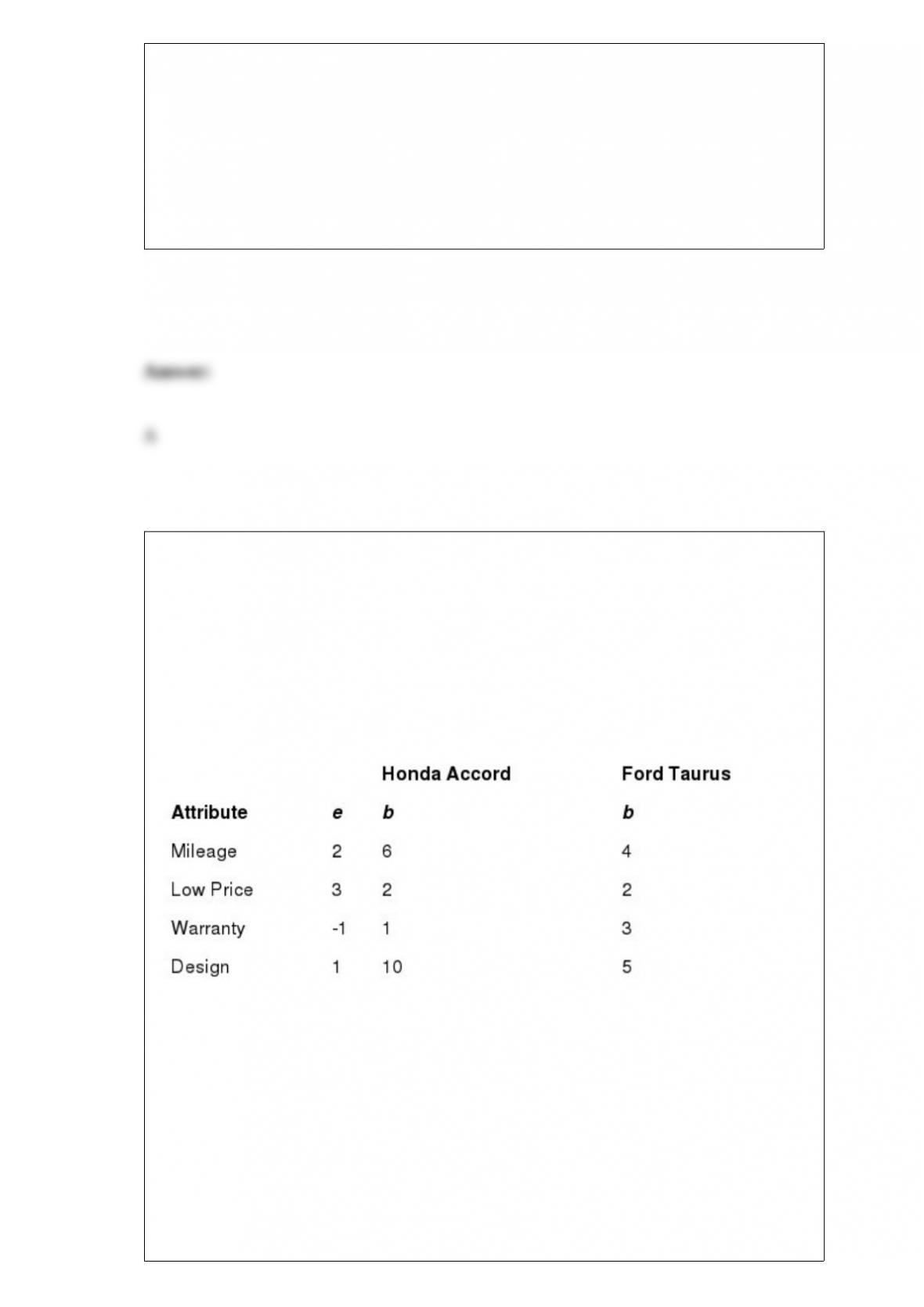
Consider a consumer who is contemplating a new automobile purchase. She has
narrowed her decision down to two brands, Honda Accord and Ford Taurus. She has
identified gas mileage, price, warranty, and styling to be important attributes to consider
in her decision. Her evaluative ratings (e) for each attribute and her beliefs of how each
brand performs on a given attribute (b) are given below:
Refer to the Automobile Scenario. According to the attitude-toward-the-object approach
to attitude change, if Honda publicized the fact that Accord is also being offered as a
hybrid with more environment-friendly features, by which of the following methods is
Honda attempting to change this consumer’s attitude toward its brand?
a. Changing beliefs
b. Adding beliefs about new attributes
c. Changing evaluations

d. Changing schema-based affect
e. Adding a social norm
THE DESIGNER CLOTHES SCENARIO
Fashion weeks in New York, Paris, and Milan featuring haughty supermodels strutting
up and down the ramp generate a lot of attention for designers, especially if the
collection is unique or unorthodox. But who buys these clothes? Apparently, only a
small group of customers, as the celebrities seen so often flaunting designer clothing get
these outfits for free in return for the publicity they generate for designers. This small
group of customers comprise of women like Anna, Cindy, and Christine. Anna
purchased a Balmain mini dress worth $24,000 and several other outfits because, as she
stated, “I buy what I love.” On the other hand, Cindy, an art enthusiast, purchased an
Alexander McQueen jacket priced over $11,000. To her an apparel, besides being a
work of art, also helps her form perceptions about herself. Christine, who attends high
society events almost every night, wears any dress only once and in case she is
attending more than one social event, changes several times in the course of a single
evening. For these women, their clothing is an expression of themselves and how they
want people to see them. Refer to The Designer Clothes Scenario. Cindy’s _____
represents the various designer outfits that she owns that help her form perceptions
about herself.
a. low need for cognition
b. self-esteem
c. ideal self
d. extended self
e. actual self

Jake has a passion for collecting old watches. He’s particularly interested in those from
the 1920s because they have a history behind them. He has learned that some of them
are fake. Therefore, he takes the watches to an appraiser to ensure that they are genuine
before he agrees to purchase them. Jake is concerned with the _____ of the watches.
a. canonicity
b. periodicity
c. reliability
d. stability
e. authenticity
Which of the following technologies enable consumers to gain easy access to all types
of product-related information and thus facilitate consumer search?
a. Morse codes
b. Wabun codes
c. Baudot codes
d. Quick response codes
e. ASCII codes

How is a complainer different from a noncomplainer?
a. Compared to a complainer, A noncomplainer is more likely to become satisfied with
company intervention.
b. Compared to a noncomplainer, a complainer is more likely to return following the
exchange.
c. Compared to a noncomplainer, a complainer is less likely to tell others when a
company performs poorly.
d. A complainer is not as valuable as a noncomplainer to a firm.
e. A complainer is more likely to be experiencing disgust than a noncomplainer.
Justin wants to buy a new smartphone. He did a lot of research over the Internet and
identified four attributes that he would rate his smartphone options on. He considered
low price, sensitivity to touch, low weight, and compatibility with apps, as the
attributes. He used a ten-point scale to rate how he thought each of his options would
perform or how likely was it that the phones had those attributes. Next, he used a -3 to
+3 scale to rate how he felt about these attributes. Finally, he opted for one particular
model based on the highest overall attitude score. Which model did Justin implement?
a. The balance model
b. The elaboration likelihood model
c. The behavioral intention model
d. The changing schema-based affect model
e. The attitude-toward-the-object model

Myrna is an anti-capitalist. She thinks that capitalism feeds consumers’ hedonistic
desires, pollute the earth, and make excessive profits. One evening, on her way back
from work, Myrna threw rocks through several retailers’ windows in an upscale
neighborhood. She did this as a form of revenge against capitalism. Which of the
following motivations of consumer misbehavior best explains Myrna’s behavior?
a. Unfulfilled aspirations
b. Thrill-seeking
c. Pathological socialization
d. Opportunism
e. Provocative situational factors
The perception of the negative consequences that are likely to result from a course of
action and the uncertainty of which course of action is best to take is referred to as
perceived _____.
a. need
b. stress
c. value
d. inertia

e. risk
Obtaining resources from consumers in return for the value they create is a basic tenet
of the _____, which is a theory explaining why companies succeed or fail.
a. cognitive resource theory
b. resource-advantage theory
c. need hierarchy theory
d. resource curse theory
e. resource-elaboration theory
Kim Mathews, a retired school teacher, recently relocated to her old neighborhood. She
called the trash collection company of her new neighborhood to enter her address but
was dismayed to learn that they charged an extra $10 compared to the other companies
in other areas. She complained to the company manager but was told that she had to
either pay the bill or dispose the trash on her own. Kim had no other option but to pay
the bill. Which of the following is the reason why Kim was treated so poorly by the
company?
a. The trash company was dependent on her repeat business.
b. The trash company had no other competitors providing this service.

c. It was a regulated service funded by the city’s authorities.
d. The trash company didn”t want to serve retired individuals.
e. The trash company served only the higher-income households.
The phenomenon in which the meaning of something is influenced by the information
environment is called _____.
a. framing
b. positioning
c. signaling
d. prospecting
e. distorting
When negative WOM spreads on a relatively large scale, it can result in _____.
a. negative public publicity
b. product recalls
c. negative attribution

d. negative disconfirmation
e. confirmation
Which of the following statements about self-concept is true?
a. Actual self refers to how a consumer would like to perceive himself.
b. Ideal self refers to how a consumer currently perceives him- or herself.
c. Ideal social self represents the image that a consumer would like others to have about
him or her.
d. Possible self represents the various possessions that a consumer owns that help him
form perceptions about himself.
e. Extended self refers to the positivity with which one holds his or her body image.
Everyone thinks that Rachel is a lucky girl as she was born with a silver spoon in her
mouth. She is the heir-apparent to one of the largest conglomerates in the world. This
description of Rachel corresponds best with her _____ status.
a. achieved
b. ideal
c. desired

d. ascribed
e. aspired
Which of the following statements is true about Generation Z?
a. Their lives and values are shaped very much by World War II and their post-war
experiences.
b. They are referred to as “latchkey” kids.
c. They tend to embody the “kids growing older, younger” concept.
d. They were born between 1981 and 1995.
e. They tend to be frugal and follow, largely, utilitarian motivations with their
purchases.
Everyday Jay gets tired at around two in the afternoon and takes a nap. Which of the
following best explains Jay’s energy level that fluctuates depending on the time of day?
a. Circadian cycle
b. Homeostatic cycle
c. Biometric cycle

d. Lunar cycle
e. Tachycardia cycle
_____ refers to human characteristics that can be associated with a brand.
a. Brand language
b. Brand personality
c. Brand architecture
d. Brand identity
e. Brand equity
Which of the following statements is true about the ethnic microculture in the United
States?
a. Hispanics in the U.S. place a high value on social intimacy.
b. The largest ethnic group in the U.S. is the African-American group.
c. Asian-Americans are the least affluent compared to the other minority groups.
d. All Hispanic consumers have identical preferences and tastes.

e. Asian-Americans are the least educated compared to the other minority groups.
Which of the following statements is true of consumer satisfaction?
a. It is a relatively enduring consumer trait.
b. It results from an unfavorable appraisal of a consumption outcome.
c. It is a postconsumption phenomenon as it is a reaction to an outcome.
d. It is a strong emotion that creates relatively strong behavioral reactions.
e. It functions as the single existing postconsumption emotion for consumers.
_____ is the process by which the human brain assembles the sensory evidence into
something recognizable.
a. Cognitive dissonance
b. Cognitive inertia
c. Cognitive organization
d. Cognitive disequilibrium
e. Cognitive distortions

WALMART SCENARIO
Walmart is the largest retailer in the world with more than 4,000 stores located in 14
countries outside the United States. The corporation has learned, sometimes the hard
way, that the Walmart business model cannot be applied to every country it enters due
to cultural differences. For example, the retailer ran into difficulties in many European
countries because stores are not open 24-hours a day, seven days a week, like Walmart
Supercenters in the United States. When negotiating the purchase of Trust-Mart stores
in China, the company had to develop “enduring” relationships with executives before
even discussing business opportunities. Making inroads into the Chinese market was
particularly difficult for Walmart. Chinese customers generally believe in the
superiority of home-made products to foreign ones. Establishing trust with these
customers was difficult as Chinese customers don”t warm up easily to foreign brands
and view them with suspicion. Most of the customers perceived a price-risk relationship
rather than a price-quality relationship while making purchasing decisions. Even within
China, the cultural diversity was immense. Standard Chinese was spoken differently in
different parts of the country. Keeping this diversity in mind, Walmart varied its
marketing mixes based on local tastes, cultures, and economic conditions. Refer to
Walmart Scenario. Keeping the existing diversity in mind, Walmart varied its marketing
mixes based on local tastes, cultures, and economic conditions. This practice is best
described as _____.
a. accommodation
b. acclimatization
c. glocalization
d. enculturation
e. acculturation

Aaron is proud of the traits associated with his countrymen. They are generally
perceived as adventurous with a pronounced inclination toward risk-taking and an
aversion for the structured routine life. According to the CSV dimension, this is an
example of a culture low in _____.
a. masculinity
b. individualism
c. power distance
d. short-term orientation
e. uncertainty avoidance
IMMIGRANT SCENARIO
Anita, a second-generation-Asian immigrant, just started college. A self-assured girl,
she displays none of the self-conscious traits one usually sees in her parents. Unlike
Anita, her parents have had it tough with only enough money to make both ends meet.
Till the time Anita was born, they could not afford to live in any of the respectable
residential neighborhoods. Some of the neighborhood authorities make it mandatory for
aspiring residents to submit details like age, ethnicity, sex, occupation, income, region,
religion, and gender. Anita has always seen her parents juggle between two world-views
whenever they had to make up their minds as they try to negotiate between a perceived
sense of guilt for their native country and a perceived sense of loyalty for the host
country. Despite their insistence that she joins an Asian community, Anita joined Delta,
a sorority for geometry lovers. She has always been passionate about geometry and her
membership to Delta, not only defines her on-campus personality, it makes her “cool”
in front of her other peers. Refer to Immigrant Scenario. Unlike Anita, her parents have
had it tough with only enough money to make both ends meet. Till the time Anita was
born, they could not afford to live in any of the respectable residential neighborhoods.
Such residences are affordable for certain groups in society, while they are unaffordable
for certain others. This categorization of people as “those who can afford” and “those
who cannot afford” can best be described as social _____.

a. diversification
b. stigmatization
c. stratification
d. isolation
e. assimilation
_____ word-of-mouth occurs naturally when consumers truly enjoy a product or service
and they want to share their experiences with others.
a. Primary
b. Organic
c. Natural
d. Amplified
e. Secondary
Which of the following terms describes a consumer’s immediate response after
exposure to a stimulus?
a. Sensation

b. Retention
c. Comprehension
d. Attention
e. Simulation
Carl restricts himself to social drinking because he feels that drinking too much alcohol
is not socially acceptable. According to the psychoanalytic approach, which of the
following motivates him to match societal norms and expectations?
a. Id
b. Value consciousness
c. Superego
d. The need for cognition
e. Materialism
WARNING LABELS SCENARIO

Cigarette packages and advertisements have included warning labels for several years,
but the Family Smoking Prevention and Tobacco Control Act (Tobacco Control Act)
signed into law in 2009 required that stronger and more graphic health warnings appear
on cigarette packages by 2012. In 2011, the Food and Drug Administration proposed
nine new textual warning statements that were much stronger than previous warning
statements. The new warning statements included statements such as “Cigarettes are
addictive,” “Cigarettes cause cancer,” and “Tobacco smoke may harm your children.”
These statements were to be accompanied by color graphics depicting the negative
health effects of smoking. Some of the proposed graphics included a picture of diseased
lungs, a man smoking with smoke coming out of a hole in his throat, rotted teeth and
mouth cancer, a mother blowing smoke in her baby’s face, and dead and dying people.
The Tobacco Control Act dictated the placement of these statements and graphics on
packages and advertisements, taking up at least 50 percent of the front of the package
and at least 20 percent of the advertisement. Research reveals that the best way to quit
is the reduce the intake of tobacco in small increments over time rather than an attempt
to quit it altogether. Refer to Warning Labels Scenario. Research reveals that the best
way to quit is the reduce the intake of tobacco in small increments over time rather than
an attempt at quitting it altogether. This is an example of achieving the desired behavior
through _____.
a. selective exposure
b. shaping
c. selective attention
d. delayed conditioning
e. accommodation
Patty saw a product at a spa that claimed it was a “facelift in a bottle.” She asked the
salesclerk if the claim was true. The salesclerk guaranteed Patty that the effects would
be visible if the product was used regularly. Patty paid $69.95 for the product and took
it home anticipating a positive result from using it. Which of the following best reflects
Patty’s expectation from the product?
a. Respite
b. Hope
c. Anxiety
d. Surprise
e. Relief
Emotional involvement increases when the consumer receives something extra with
products purchased.
Boomerang kids assert the traditional HLC.
Theodore Levitt’s article, “Marketing Myopia,” brought about a new perspective that
argued that businesses should define themselves in terms of the products that they make
rather than in terms of the consumer needs they satisfy.
The value that consumers believe they will receive from a product has a direct impact
on their evaluation of that product.
Cognitive structuring is a term that refers to the reliance on schema-based heuristics in
making decisions.
The JMD (just meaningful difference) represents the smallest amount of change in a
stimulus that would influence consumer consumption and choice.
Consumers engage in extended decision making when they put off the decision making
for a later time and restrain themselves from getting involved with the product in
consideration.
A blue ocean strategy seeks to position a firm so far away from competitors that, when
successful, the firm creates an industry of its own and at least for a time, isolates itself
from competitors.
The term habitus refers to mental and cognitive structures through which individuals
perceive the world based largely on their standing in a social class.
In balance theory, unit relations are the relations between the observer (consumer) and
the other elements in the system.
Consumer refuse is any packaging that is no longer necessary for consumption to take
place or, in some cases, the actual good that is no longer providing value to the
consumer.
Explain the role of perception in learning. Can learning take place without perception?
When consumers work their way into a class, it is termed as their ascribed status.
Situational influences are enduring characteristics of neither a particular consumer nor a
product or brand.
Attitude-behavior consistency refers to the extent to which a strong relationship exists
between attitudes and actual behavior.
Time pressure tends to switch a consumer’s orientation from utilitarian to hedonic.