
New product brands introduced as defensive moves to counteract and confront a firm’s
competition are referred to as __________.
a. co-brands
b. private brands
c. fighting brands
d. brand extensions
e. subbrands
Answer:
A moral philosophy that exists in the Consumer Bill of Rights and is favored by moral
philosophers and consumer interest groups is referred to as __________.
a. social responsibility
b. moral idealism
c. utilitarianism
d. hedonism
e. the Golden Rule
Answer:
Gillette spent $200 million in advertising to introduce the Fusion razor to male shavers.
Such expenditures are often made to stimulate primary demand, or desire for the
product __________, rather than for a specific brand, when there are few competitors
with the same product.
a. class
b. form
c. item
d. mix
e. concept
Answer:
Another name for cold calling is_____.
a. cold canvassing
b. seminar selling
c. conference selling
d. sales managed selling
e. trial-close selling
Answer:
A church put advertisements in its weekly bulletins to encourage its members to
participate in the services by telling a brief, positive story about how fellow members
have helped them during times of need. Jack volunteered and shared his story during a
service. Afterwards, he felt joyous. Was this an exchange in a marketing sense?
a. Yes, because the church ran an advertisement, a marketing activity.
b. No, because the church is nonprofit organization and these actions are expected
without any expectation of “exchange.”
c. No, because no money was exchanged.
d. Yes, because sharing his story at a service was exchanged for a feeling of joy.
e. No, because the church did not provide Jack with a tangible product or service.
Answer:
A survey asked consumers of dental products the following question “Have you used
toothpaste in the past week? ___ Yes ___ No” The results of this question show that
92.6 percent of the people in New York City have used toothpaste in the past week and

87.2 percent of people in Los Angeles have used toothpaste during the same period.
This information was gathered by using which type of question?
a. open-ended
b. dichotomous
c. holistic
d. evaluative
e. Likert scale
Answer:
A situation where products are bought in a lower-priced country from a manufacturer’s
authorized reseller, shipped to higher-priced countries, and then sold through
unauthorized retailers below the manufacturer’s suggested retail price is referred to as
__________.
a. the black market
b. a gray market
c. dumping
d. a globalized market
e. parallel exporting
Answer:

The name of a person who may be a possible customer is referred to as a __________.
a. hot lead
b. cold call
c. lead
d. prospect
e. qualified prospect
Answer:
Ace Shoe Company sells heel replacement kits for men’s shoes. It has fixed costs of $6
million and unit variable costs of $5 per pair. Suppose a consultant tells Ace it can sell
750,000 heel repair kits, what price must it charge to achieve a profit of $2.5 million?
a. $5.00
b. $8.33
c. $11.
d. $16.33
e. $20.00
Answer:
Breath mints, bottled water, and nail clippers would most likely use which type of
distribution density?
a. extensive distribution
b. intensive distribution
c. selective distribution
d. exclusive distribution
e. concentrated distribution
Answer:
Gatorade offers a range of product offerings. The firm uses one name for all its products
in a product class. Gatorade is using a __________ strategy.
a. multibranding
b. family branding
c. co-branding
d. dual branding
e. mixed branding
Answer:
The typical “online mom” is
a. 23-years-old, taking college classes online, and has an infant or toddler at home.
b. 28-years-old, a college graduate, recently remarried, and the mother of a blended
family.
c. 35-years-old, a high school graduate, and a single parent working outside the home.
d. 38-years-old, married, a college graduate, and working outside the home.
e. 43-years-old, recently divorced, children starting college, and working part-time.
Answer:
Among business products, which of the following would most likely be considered an
industrial service?
a. photocopier
b. sheet rock
c. photocopier maintenance
d. Cowboys Stadium
e. ink cartridges
Answer:
Business culture affects ethical behavior in competition. Two kinds of unethical
behavior are most common:
a. economic espionage and bribery.
b. price fixing and copyright infringement.
c. bribery and extortion.
d. price fixing and economic espionage.
e. economic espionage and antitrust infractions.
Answer:
No matter what the specific objective might be, from building awareness to increasing
repeat purchases, promotion objectives should possess three important qualities. They
should be designed for a well-defined target audience, cover a specified time period,
and be
a. unique in character.
b. measurable.
c. humorous.
d. repeatable.
e. creative.
Answer:
In its recent “You”re not you when you”re hungrySnickers satisfies” TV ad, Mars, the
maker of the Snickers candy bar, repositioned Snickers from a candy bar dessert-like
food to a snack food that can satisfy hunger. Mars used this repositioning strategy with
its Snickers brand to __________.
a. react to a competitor’s position
b. reach a new target market segment
c. catch a rising trend
d. change the value offered to its customers
e. implement a global strategy
Answer:
All of the following statements about a person’s moral philosophy are true EXCEPT:
a. Moral philosophy cannot be learned through formal education.
b. Moral philosophy is learned through the process of socialization with family.
c. Moral philosophy is influenced by the corporate culture he/she is in.
d. Moral philosophy is learned through the process of socialization with friends.
e. Moral philosophy is influenced by the societal culture he/she is in.
Answer:
After extensive analysis, a mail order company has decided to embark on a policy of
multiple-zone pricing. In which step of the price-setting process would the mail order
firm have made this decision?
a. make special adjustments to the list or quoted price
b. select an approximate price level
c. estimate demand and revenue
d. identify price constraints and objectives
e. set list or quoted price
Answer:
Intermediaries that represent a single producer and are responsible for designing
promotional plans, setting prices, determining distribution policies, and making
recommendations on product strategy are referred to as _________.
a. brokers
b. line brokers
c. distribution brokers
d. selling agents
e. manufacturer’s agents
Answer:
Which era of U.S. business history does the following statement best describe? “We are
in the business of satisfying the needs and wants of consumers while achieving our own
goals.”
a. the production era
b. the sales era
c. the marketing concept era
d. the marketing orientation era
e. the societal marketing era
Answer:
What is the annual market size for the products bought by or for preteens and
teenagers?
a. $100 million
b. $2 billion
c. $10 billion
d. $200 billion
e. $1 trillion
Answer:
All the following statements about user generated content (UGC) are true EXCEPT:
a. UGC is published on a publicly accessible website and created by end users.
b. UGC is reposting an article found in a newspaper or magazine without editing.
c. UGC is consumer-generated by an individual outside of a professional organization.
d. UGC shows a significant degree of creative effort.
e. UGC is not simply e-mail, but is published on a publicly accessible website.
Answer:
The largest inventory of wedding dresses in the Southeast can be found at Low’s Bridal
and Formal in Brinkley, Arkansas. From December 26 to January 16, a prospective
bride shopping at Low’s can find gowns once priced at $6,000 for $2,999 and $800
gowns for $400. The reduced prices of these gowns are reflected in which retail pricing
strategy?
a. markdowns
b. original markups
c. maintained markups
d. inventory shrinkages
e. net markups
Answer:
In terms of scheduling advertising, buyer turnover refers to
a. the amount of time between repeat purchases for a given product.
b. how often new buyers enter the market to buy a product.
c. the amount of time for a buyer to enter and exit a product’s life cycle.
d. how often a consumer will try competitive brands before becoming a brand loyal
customer of the firm’s product.
e. the ratio of repeat purchases to the number of buyers for an offering.
Answer:
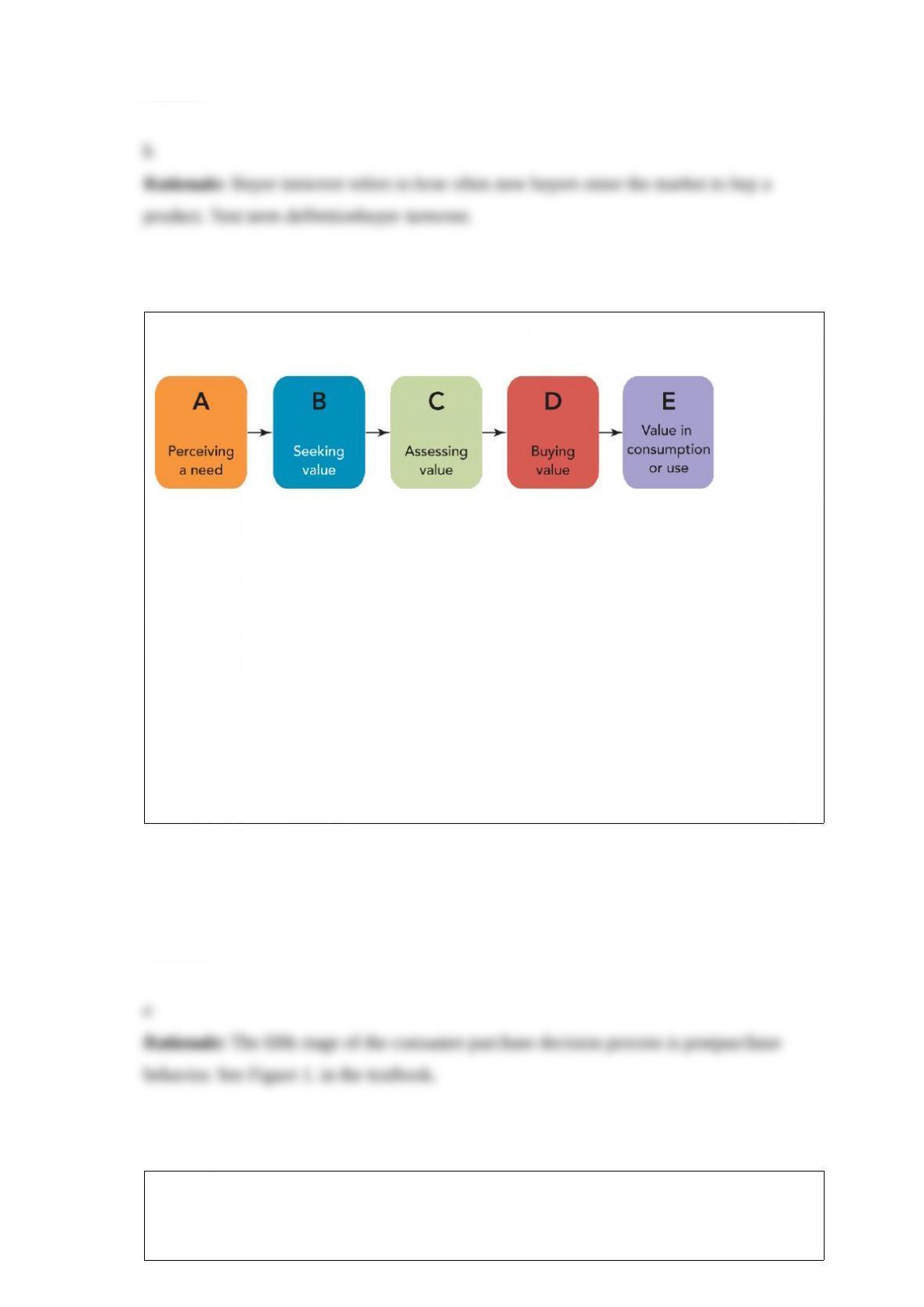
Figure 1.
In Figure 1. above, “E” represents which stage of the consumer purchase decision
process?
a. purchase decision
b. information search
c. problem recognition
d. alternative evaluation
e. postpurchase behavior
Answer:
According to Porter’s framework regarding generic business strategy, there are two
fundamental alternatives a firm can use to seek a competitive advantage. One of these is
to
a. become the high-cost producer within the markets it competes and using a skimming
pricing strategy to recoup these high R&D expenses.
b. adopt a “me too” strategy to achieve competitive parity.
c. become the low-cost producer within the markets in which it competes.
d. state its function in society to differentiate itself from competitors.
e. differentiate itself from competitors by developing similar marketing programs.
Answer:
Another term for maintained markup is __________.
a. original markup
b. maintained markup
c. markdown
d. gross margin
e. net margin
Answer:
A general review of the marketing strategy, product assessment, economic analysis, and
legal examination would all take place during which stage of the new-product process?
a. business analysis
b. screening and evaluation
c. new-product strategy development
d. development
e. These activities are addressed at every stage with the exception of new-product
strategy development.
Answer:
Which form of personal selling has the lowest requirement for problem solving?
a. order taker
b. order getter
c. sales engineer
d. missionary salesperson

e. partnership selling
Answer:
Four key challenges that package and label designers face include: (1) __________; (2)
environmental concerns; (3) health, safety, and security issues; and (4) cost reduction.
a. governmental regulations
b. cultural and societal issues
c. competition from global markets
d. connecting with customers
e. patent and trademark issues
Answer:
Loss-leader pricing refers to
a. a pricing method where the price the seller charges is below the actual cost to make

the product.
b. setting a low initial price and gradually but consistently increasing that price so as
not to antagonize the consumer.
c. deliberately selling a product below its customary price, not to increase sales, but to
attract customers’ attention in hopes that they will buy other products as well.
d. a method of pricing based on a product’s tradition, standardized channel of
distribution, or other competitive factors.
e. pricing a product between 8 and 10 percent lower than nationally branded
competitive products.
Answer: