Which of the following would most likely be considered a consumer product?
a. ball bearings
b. back hoe
c. printing press
d. suitcase
e. mainframe computer
Answer:
Among consumer products, advertising and wide distribution are especially important
for
a. durable goods.
b. specialty products.
c. nondurable goods.
d. production goods.
e. semidurable goods.
Answer:
The best way to assess the effectiveness of all promotion expenditures during the past
year is to compute a __________.
a. break-even point
b. promotion-to-sales ratio
c. ROI
d. promotion-to-expenses ratio
e. advertising-to-sales-promotion ratio
Answer:
The information search stage clarifies the problem for the consumer by: (1) suggesting
criteria to use for the purchase; (2) __________; and (3) developing consumer value
perceptions.
a. determining appropriate price ranges
b. selecting the type of purchase outlet
c. establishing a purchase timeline
d. minimizing cognitive dissonance
e. yielding brand names that might meet the criteria
Answer:
The promotional mix can be used to: (1) inform prospective buyers about the benefits
of the product, (2) persuade them to try it, and (3) __________.
a. explain how to use the product
b. inform customers of complementary offerings
c. remind them later about the benefits they enjoyed by using the product
d. inform customers of pricing changes
e. lure customers away from competitors’ products
Answer:
A __________ is a need that is shaped by a person’s knowledge, culture, and
personality.
a. desire
b. demand
c. utility
d. want
e. craving
Answer:
Which of the following is an example of a multiple products and multiple markets
strategy?
a. College Football magazine selects different covers for essentially the same magazine
in order to appeal to different geographic markets in the U.S.
b. A new movie used several different movie trailers. One set of previews showed the
action scenes in order to attract one audience and the other set showed romantic scenes
to attract another audience.
c. Betty Crocker carries one line of cake mixes for people with conventional ovens and
another line of cake mixes for people with microwave ovens.
d. Arm and Hammer Baking Soda can be used for baking and to remove odors from
refrigerators and litter boxes.
e. Johnson’s Baby Oil is advertised as a skin softener for babies and as a makeup
remover for women.
Answer:
Consider the PLC product photos above. Which stage of the product life cycle (PLC) is
the Pepsi Max soft drink?
a. introduction
b. growth
c. maturity
d. accelerated development
e. decline
Answer:
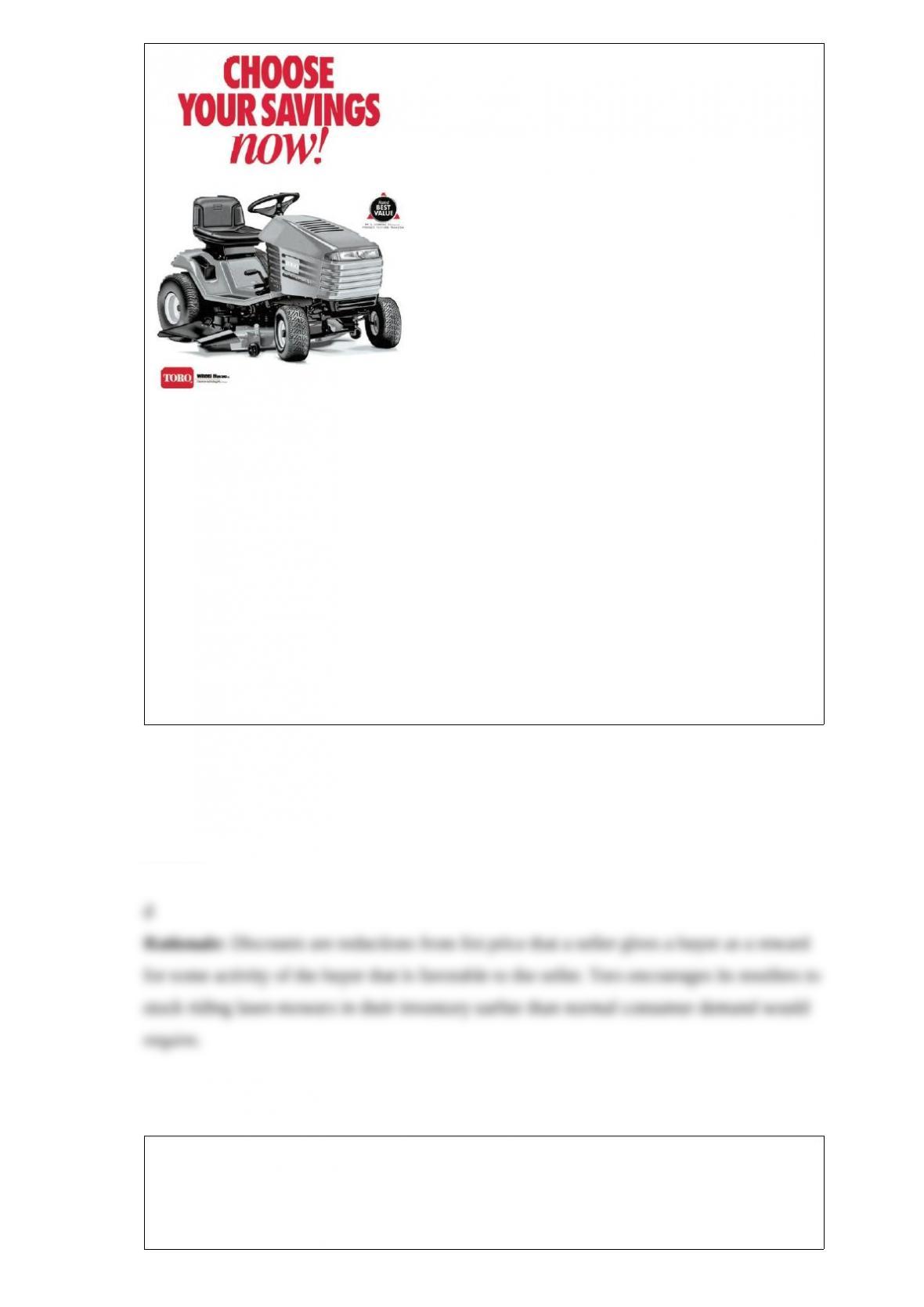
Toro Ad
Consider the Toro ad above. What type of discount does Toro offer its channel members
to carry and sell its riding lawn mowers during the winter months?
a. noncumulative discounts
b. cumulative discounts
c. functional discounts
d. seasonal discounts
e. trade discounts
Answer:
Microsoft has developed __________ software to use with its 3D image capture
technology called Kinect.
a. natural user interface
b. Facebook
c. Twitter
d. cloud computing
e. digital payments
Answer:
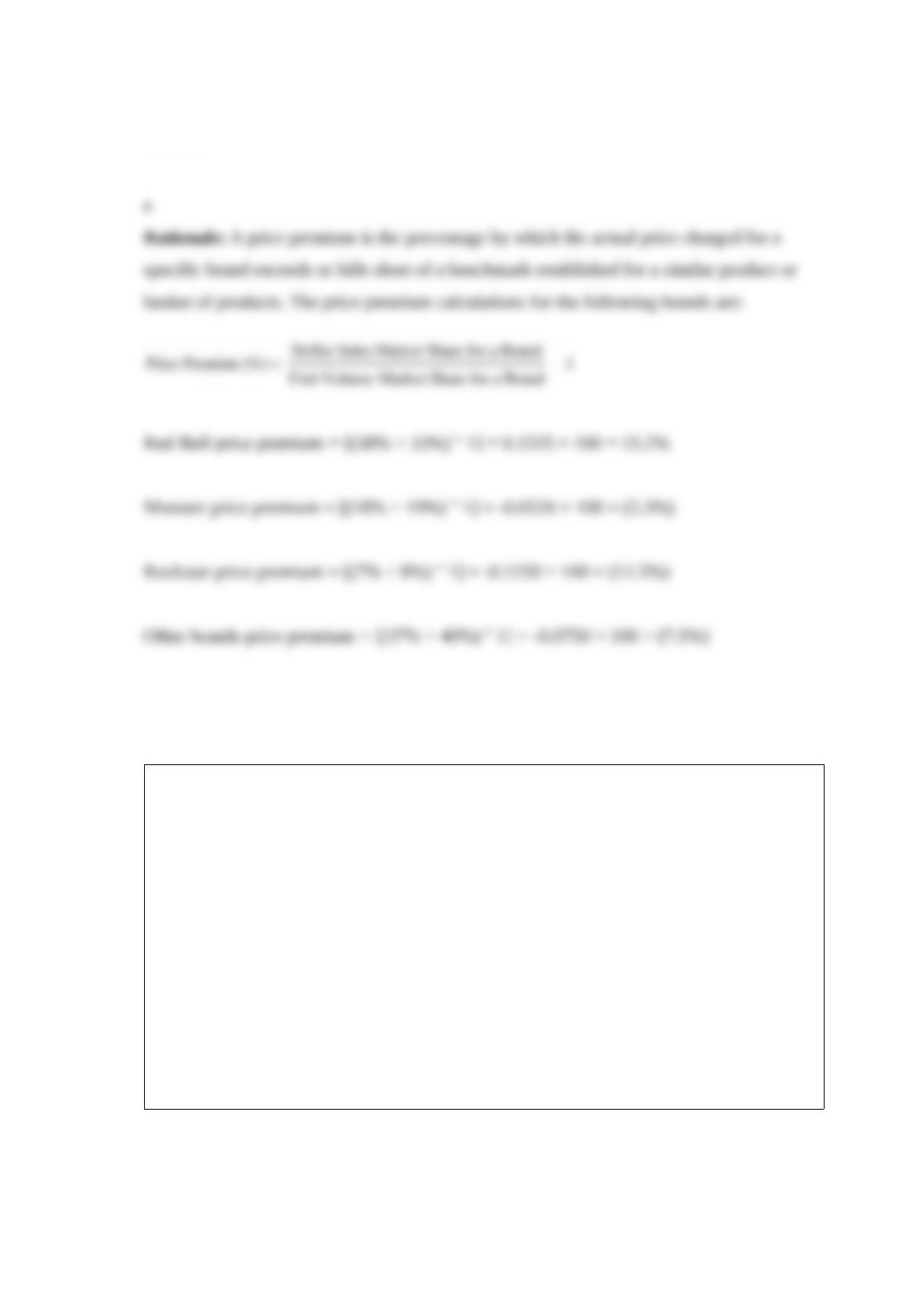
Price Premium Marketing Dashboard
The Price Premium Marketing Dashboard above shows the dollar and unit market
shares for selected energy drinks. What is the price premium for Red Bull in 2010?
a. -12.5%
b. -7.5%
c. -5.3%
d. 0%
e. 15.2%
Answer:
Taking stock of where the firm or product has been recently, where it is now, and where
it is headed in terms of the organization’s marketing plans and the external forces and
trends affecting it, is referred to as __________.
a. tactical planning
b. market planning
c. goal setting
d. environmental scanning
e. situation analysis
Answer:
The concept of the diffusion of innovation shows how a product “diffuses” or spreads
through the population over time. The consumer population is divided into five
categories of product adopters based on when they adopt (i.e., first buy) a new product.
Each product adopter category has a unique profile. Consumers who are venturesome,
highly educated, and use multiple information sources are called __________.
a. innovators
b. early adopters
c. early majority
d. late majority
e. laggards
Answer:
Distribution is very limited with which of the following type of consumer product?
a. shopping product
b. convenience product
c. discretionary product
d. unsought product
e. specialty product
Answer:
All products go through a product life cycle of __________ stages: __________.
a. two; new and improved
b. two; growth and decline
c. three; new, improved, and obsolete
d. four; awareness, interest, involvement, and evaluation
e. four; introduction, growth, maturity, and decline
Answer:
Another name for an e-marketplace is a(n)
a. e-hub.
b. E-place.
c. e-trade.
d. E-xchange.
e. 4NXchange.
Answer:
Ben & Jerry’s is founded on and dedicated to a sustainable corporate concept of linked
prosperity. Its mission consists of three interrelated parts: Ben & Jerry’s economic
mission is to operate the Company
a. with the goal of generating enough revenue to be a completely nonprofit
organization.
b. on a sustainable financial basis of profitable growth, increasing value for our
stakeholders and expanding opportunities for development and career growth for our
employees.
c. with the goal of making profits for selected charitable organizations such as Fair
Trade.
d. with the goal of increasing market share not only in ice cream sales but also in its
retail clothing and accessories merchandise lines.
e. with the goal of expanding into international markets by developing sustainable
dairies for developing nations.
Answer:
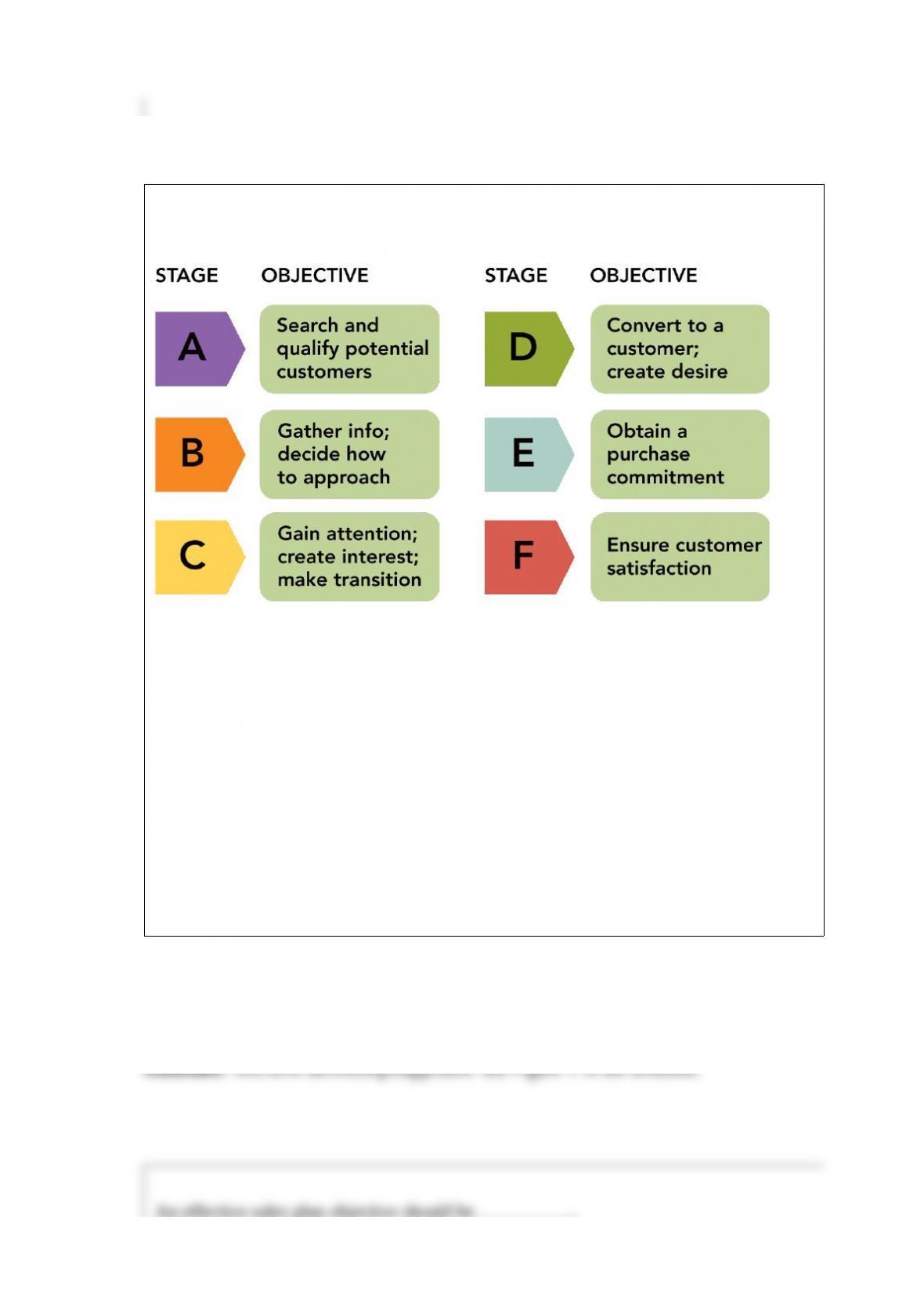
Figure 1.
As shown in Figure 1. above, “B” is the__________ stage in the personal selling
process.
a. presentation
b. approach
c. prospecting
d. follow-up
e. preapproach
Answer:
An effective sales plan objective should be __________.
a. general, measurable, and flexible
b. profitable, subjective, and measurable
c. precise, profitable, and flexible
d. precise, measurable, and time specific
e. general, flexible, and profitable
Answer:
In what way is Dell’s expansion into the global arena a departure from its prior
marketing practices?
a. All Dell products were manufactured in the countries within which they were sold.
b. Dell sold its products to emerging markets using the telephone and Internet sales
strategy that was so successful in the United States.
c. Dell opened stores in selected retailers in India.
d. Dell sold only laptops in China whereas it sold both desktops and laptops in India
due to trade restrictions in China.
e. Dell designed and distributed the same products globally to take advantage of
economies of scale.
Answer:
All of the following are commonly held values in the United States EXCEPT:
a. equality.
b. individualism.
c. continuous change.
d. belief in fate (fatalism).
e. personal control.
Answer:
The 80/20 rule suggests that
a. 80 percent of a firm’s inventory should be readily available and 20 percent should be
reserved for emergency demand.
b. 80 percent of a firm’s first-time users will become brand loyal and 20 percent will use
the product only once and then abandon it.
c. 80 percent of a firm’s sales are obtained from 20 percent of its customers.
d. 80 percent of a firm’s marketing program expenses are tax deductible and 20 percent
are not.
e. 80 percent of a firm’s products will be sold to ultimate consumers and 20 percent to
organizational buyers.
Answer:
Target return-on-investment pricing refers to
a. setting a price to achieve an annual target ROA.
b. adding a fixed percentage to the cost of all items in a specific product class.
c. setting prices to achieve a profit that is a specified percentage of the sales volume.
d. setting a price to achieve an annual target ROI.
e. setting a price based on an annual specific dollar target volume of profit.
Answer:
Lead generation refers to
a. the result of offers that contain all the information necessary for a prospective buyer
to make a decision to purchase and complete the transaction.
b. direct telephone communication only with consumers to generate a response in the
form of an order, a request for further information, or a visit to a retail outlet.
c. products that are shipped directly to the point of purchase rather than being stored or
distributed through intermediaries.
d. the outcome of an offer designed to motivate people to visit a business.
e. the result of a direct marketing offer designed to generate interest in a product or
service, and a request for additional information.
Answer:
In a marketing decision, constraints refer to
a. the external factors affecting the number of people who can work on a solution to a
problem.
b. the number of possible alternatives in a company’s solution set.
c. the restrictions placed on potential solutions to a problem.
d. the internal factors affecting whether to select one alternative over another.
e. the internal factors that determine who in the organization ultimate selects the best
solution to the problem.
Answer:
A _________ consists of a response and feedback.
a. feedback loop
b. consequence
c. source reaction
d. primary significance
e. concept effect
Answer:
Figure 1.
Consider Figure 1. above. Suppose a manufacturer quotes price in the following form:
List price$100 less 30/10/5. What does $7.00 represent?
a. the wholesaler’s trade discount
b. the retailer’s trade discount
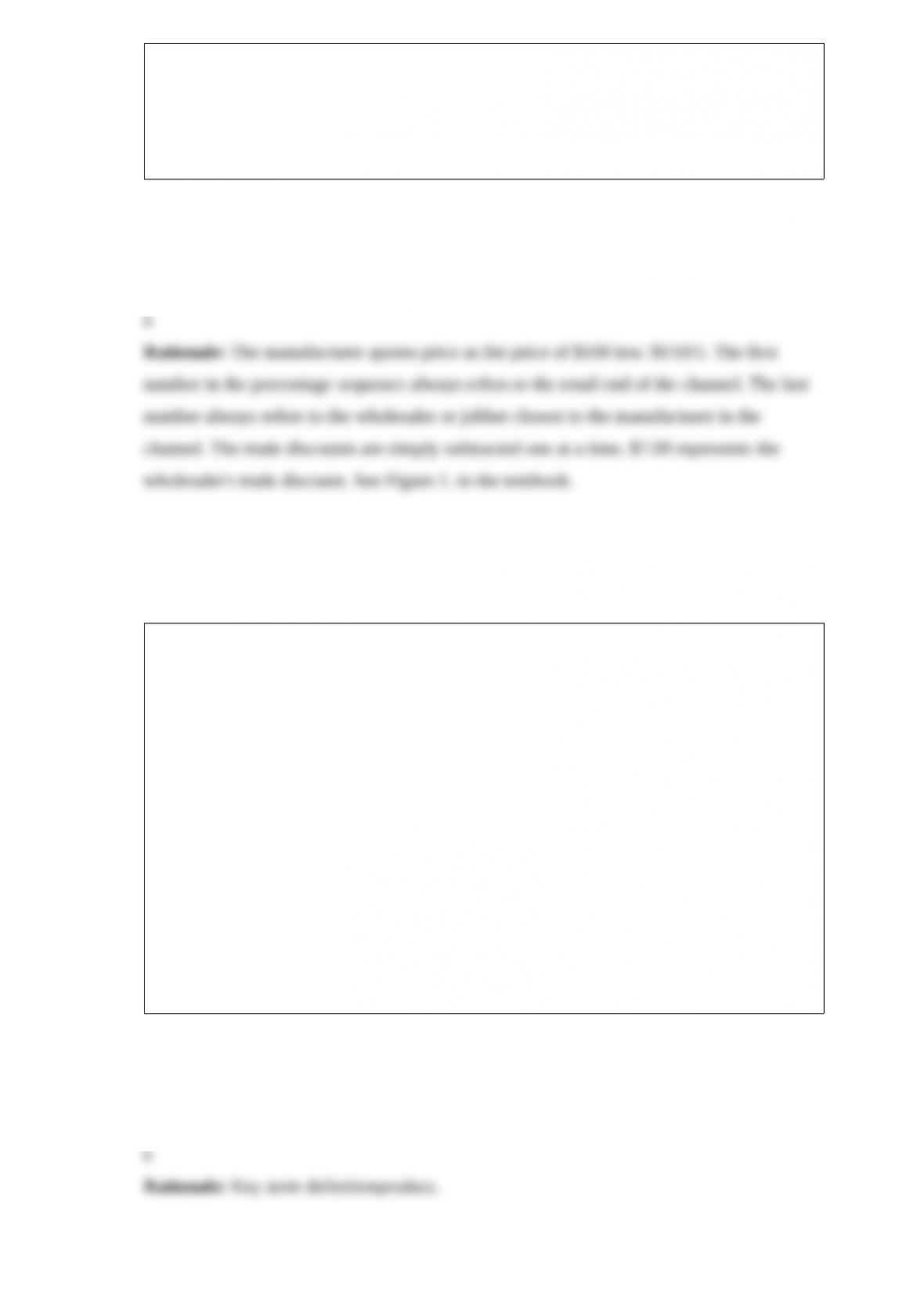
c. the jobber’s trade discount
d. the manufacturer’s trade discount
e. the manufacturer’s markup
Answer:
A product refers to
a. a tangible good received in exchange for a person’s time and effort.
b. intangible activities or benefits that an organization provides to satisfy consumers’
needs in exchange for money or something else of value.
c. a good that has in some way been altered, combined, or improved and sold to
organizational buyers consumers.
d. is a thought that leads to an action such as a concept for a new invention.
e. a good, service, or idea consisting of a bundle of tangible and intangible attributes
that satisfies consumers’ needs and is received in exchange for money or something else
of value.
Answer:
Setting the price of a product or service by adding a fixed percentage to the total unit
cost is referred to as
a. cost-plus fixed-fee pricing.
b. demand backward pricing.
c. cost-plus percentage-of-cost pricing.
d. experience curve pricing.
e. target return on investment pricing.
Answer:
The __________ imposed on bananas by European Union countries cost consumers $2
billion a year in higher prices.
a. boycotts
b. tariffs
c. quotas
d. sanctions
e. subsidies
Answer:
Amazon uses supply chain and logistics management to
a. make sure that it maintains the authority that comes with being the channel captain.
b. avoid having to use quick response replenishment.
c. lessen the amount of communication that is necessary between it and its suppliers.
d. manage the flow of products from its suppliers to its distribution centers.
e. implement its market divestment strategies.
Answer:
Which of the following conditions is necessary for marketing to occur?
a. two or more people, a method of assessing needs, a way to communicate, and an
exchange
b. two or more people, a product, a reasonable price, and a place to make an exchange
c. a quality product, a fair price, a clever method of promotion, and a place where a
customer can buy the product
d. two or more parties with unsatisfied needs, a desire and an ability to satisfy them, a
way to communicate, and something to exchange
e. an ability to see a hidden trend within an environmental force
Answer:
When Toyota featured images from the World of Warcraft game in a TV commercial, it
demonstrated that World of Warcraft has a high degree of __________, as visuals,
graphics, and animations were the major draw for World of Warcraft users.
a. media richness
b. self-disclosure
c. character development
d. product placement
e. “wikiness”
Answer:
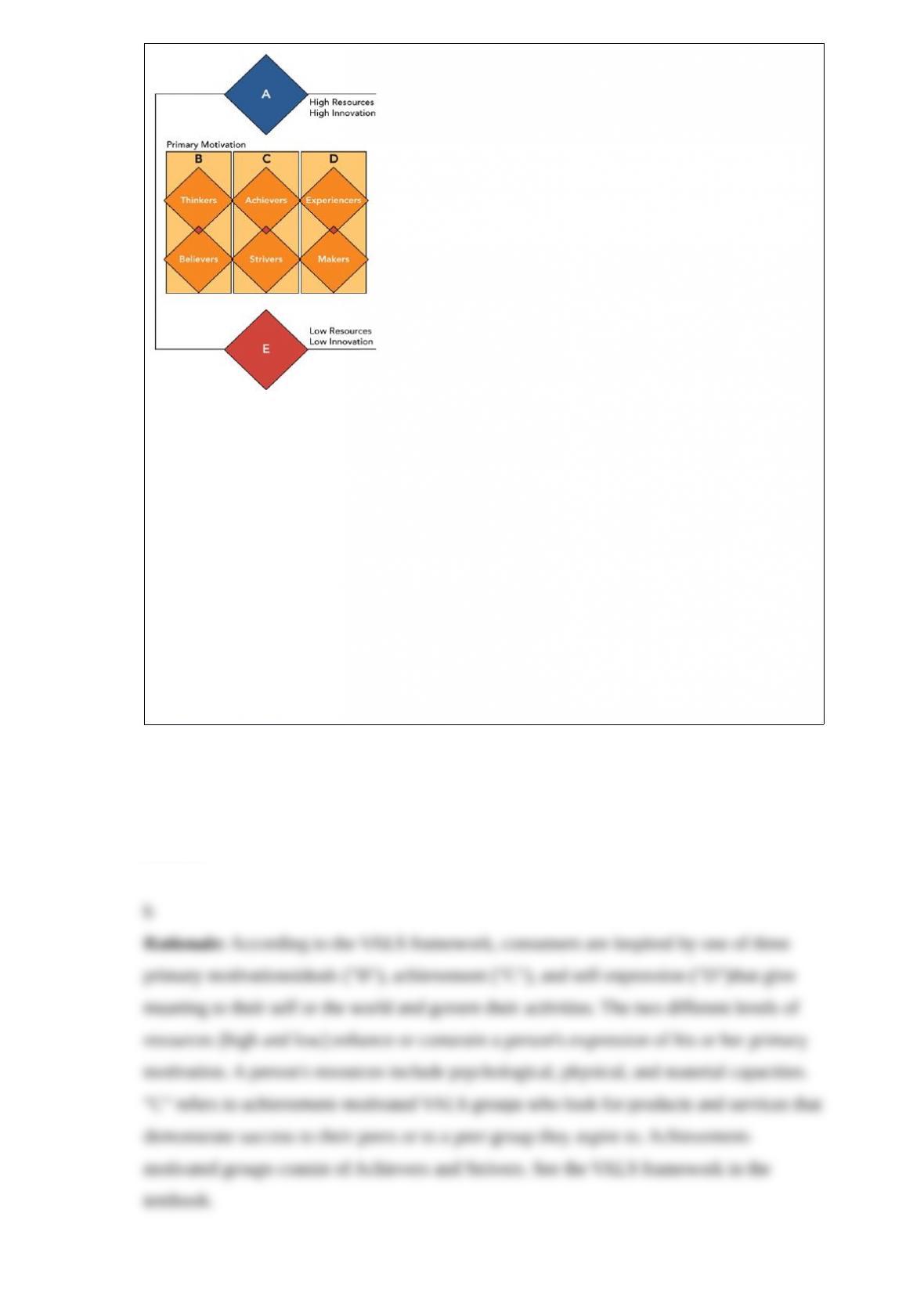
VALS Framework
VALS creates profiles of people based on their primary motivation and resources. In the
VALS framework above, “C” refers to
a. Ideals.
b. Achievement.
c. Self-Expression.
d. Survivors.
e. Innovators.
Answer:
In terms of target market coverage, density refers to the number of __________ in a
geographical area.
a. target market customers
b. competitors
c. wholesalers
d. retail stores
e. stakeholders
Answer: