Archer Daniels Midland Co. (ADM) is the world’s largest cocoa-bean processor. It buys
cocoa beans and converts them into cocoa powder and cocoa butter, which it then sells
to companies like Hershey’s that manufacture consumer products containing chocolate.
ADM is operating in a(n) __________ market.
a. consumer
b. government
c. service
d. reseller
e. industrial
Answer:
In terms of organizational buyers, Amazon.com, Lands’ End, and JCPenney would all
be generally classified as __________.
a. government units
b. resellers
c. manufacturers
d. wholesalers
e. industrial firms
Answer:
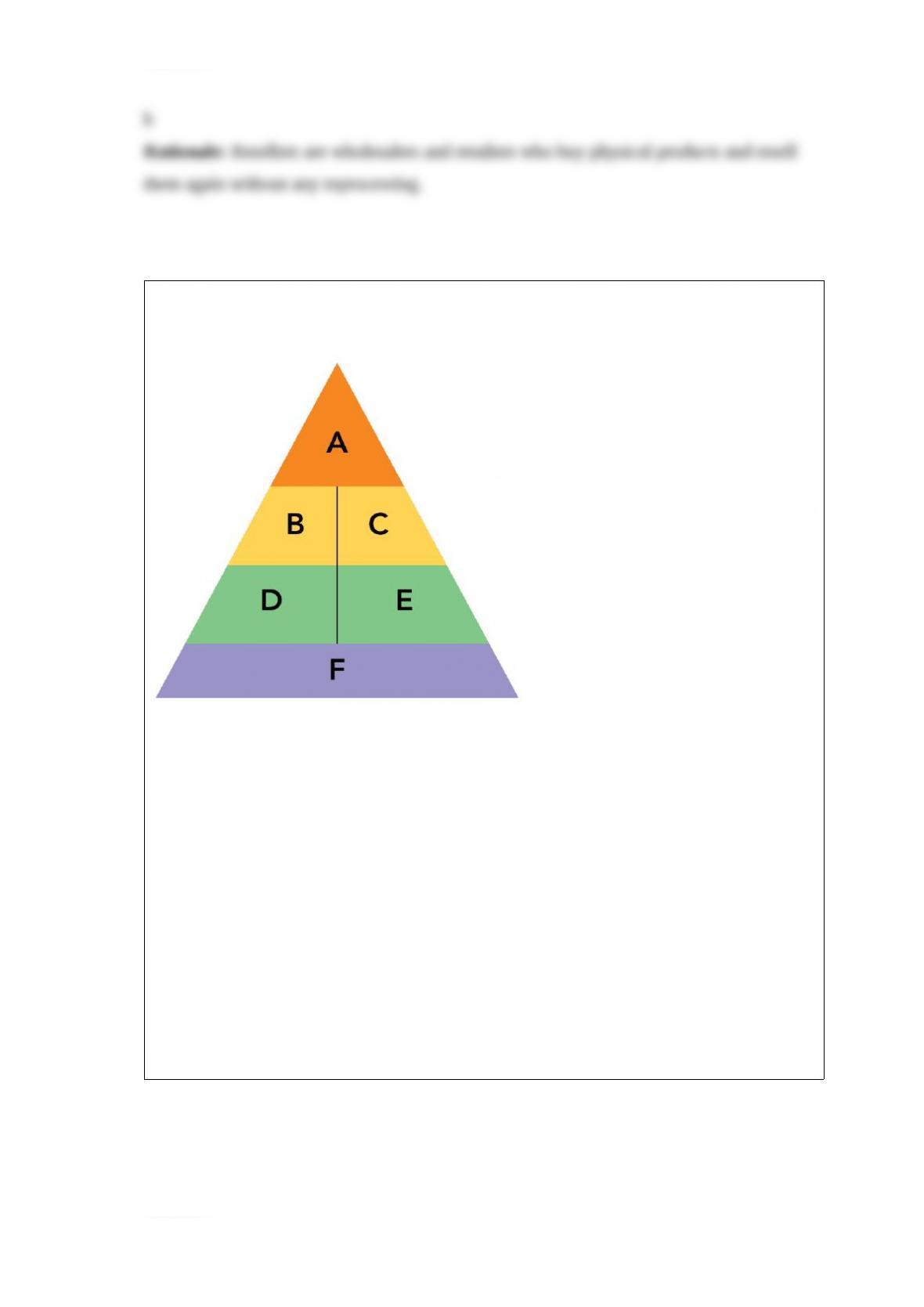
Figure 1.
Figure 1. above shows the sequential process of building brand equity. The third step is
to elicit the proper consumer responses to a brand’s identity and meaning. This step
consists of two dimensions, “B” and “C,” which stand for __________ and
__________.
a. brand identity; brand emotion
b. brand performance; brand imagery
c. consumer judgments; consumer feelings
d. brand awareness; consumer-brand connection
e. consumer feelings; brand imagery
Answer:
Expenses associated with transportation, materials handling and warehousing,
inventory, stockouts (being out of inventory), order processing, and return products
handling are referred to as __________.
a. supplier service cost
b. manufacturing cost
c. total logistics cost
d. social responsibility cost
e. total supply chain cost
Answer:
Megan is looking for a gift for her older brother who enjoys reading mysteries. A book
by one of his favorite authors was recently published and she plans to buy it. However,
she is on a limited budget so she wants to find the lowest price. The most convenient
way for Megan to find the best price for the book would be to
a. drive to a large shopping center where there are several bookstores to see which store
has the book at the lowest price.
b. call all the bookstores in her community to inquire about the price of the book at each
one.
c. use a bot to comb the websites of online booksellers and locate the one with the best
price.
d. use a cookie to contact various bookstores and find the one with the best price.
e. create a choiceboard using her gift-giving criteria.
Answer:
Carma Laboratories, Inc., the maker of Carmex lip balm, used __________ to conduct
marketing research to understand the nature of online conversations.
a. ethnographic research
b. social media
c. depth interviews
d. focus groups
e. telephone surveys
Answer:
Five pricing practices are closely scrutinized because of potential unethical or illegal
actions. They include: (1) price fixing; (2) price discrimination; (3) predatory pricing;
(4) geographical pricing; and (5) __________.
a. price discounting
b. deceptive pricing
c. lateral price fixing
d. regional rollbacks
e. delayed payment penalties
Answer:
One way neighborhood grocers can take advantage of volume discounts commonly
available to chains is to
a. purchase a franchise membership.
b. become a subsidiary of a larger supermarket chain like Kroger.
c. join a professional merchant association and hire food brokers to negotiate lower
prices for produce and dry goods.
d. create a grocery networking system to exchange coupon vouchers.
e. participate in a retailer-sponsored cooperative with other independent grocers.

Answer:
Three different objectives relate to a firm’s profit, which is often measured in terms of
return on investment. One objective, known as _________, occurs when a firm sets a
profit goal, usually determined by its board of directors.
a. maximizing current profit
b. managing for long-run profits
c. target return
d. break-even strategy
e. minimizing risk
Answer:
Retailers that integrate and leverage their stores, catalogs, and websites have seen
a. a sizeable increase in yearly sales from individual customers.
b. a small increase in yearly sales from aggregate target market segments.
c. no difference in yearly sales from individual customers.
d. a decrease in yearly sales from individual customers.
e. a large decrease in yearly sales from individual customers.
Answer:
The Boston Consulting Group (BCG) business portfolio analysis requires an
organization to locate the position for each of its strategic business units (SBUs) on a
growth-share matrix. The vertical axis of this matrix indicates
a. the annual rate of growth of the firm’s largest competitor.
b. the relative dollar ($) market share of the largest competitor.
c. the annual rate of growth of the SBU’s industry.
d. the relative unit (#) market share of the largest competitor.
e. the annual rate of growth of the firm itself.
Answer:
There are six commonly used techniques to deal with objections: __________; agree
and neutralize; accept the objection; denial; and ignore the objection.
a. redirect the conversation
b. defer to a supervisor
c. probe by asking additional questions
d. distract by identifying competitor shortcomings
e. acknowledge and convert the objection
Answer:
The three primary types of product advertisements are pioneering, __________, and
reminder.
a. informational
b. competitive
c. industrial
d. institutional
e. subliminal
Answer:
A blog refers to
a. a public online forum centered on a specific topic or theme.
b. a running account of all purchases made at a single website.
c. a webpage that serves as a publicly accessible personal journal for an individual or an
organization.
d. an itemized list of all website “hits” on an individual person including a short
biographical summary.
e. a Web network that works as a family tree linking all members of a group or
organization.
Answer:
Hindustan Lever realized it could not sell to the rural poor in India unless it found ways
to distribute its products such as soap, shampoos, and laundry detergents. Lever
provided start-up loans to women to buy stocks of products to sell to local villagers.
Today, over 45,000 poor women sell Lever products in 135,000 villages in India. This is
an example of Lever’s use of
a. macrofinance.
b. macrocapitalization.
c. microfinance.
d. microcapitalization.
e. megafinance.
Answer:
A consumer’s subjective perception of how a product or brand performs on different
attributes based on personal experience, advertising, and discussions with other people
are referred to as __________.
a. beliefs
b. values
c. attitudes
d. predispositions
e. opinions
Answer:
CAFTA-DR is a comprehensive free trade agreement between Costa Rica, the
Dominican Republic, El Salvador, Guatemala, Honduras, Nicaragua, and __________.
a. the United States
b. Panama
c. Belize
d. Cuba
e. Mexico
Answer:
Which of these statements regarding organizational buyers is most accurate?
a. Wholesalers and retailers resell the goods they buy without reprocessing them.
b. Wholesalers and retailers alter the products they sell to meet the specific needs of
their customers prior to sale.
c. Manufacturers purchase processed goods and resell them to suppliers who in turn
resell them to ultimate consumers.
d. Ultimate consumers can be considered organizational buyers when they purchase in
large quantities or make long-term purchase agreements.
e. Government agency purchases are more similar to ultimate consumer purchases than
they are to wholesalers and retailers.
Answer:
Frank needs to buy a new car. Before visiting a showroom, however, he logs onto
www.autobytel.com. Here, he can compare the attributes of various makes and models,
find information about the prices of various option packages and learn the
manufacturer’s suggested retail prices for different cars. After deciding on the car he
wants to buy, Frank visits the local showroom and negotiates with the salesperson for
the model and options package he wants. Because Frank is so well informed about
prices, he is able to make a deal for several hundred dollars less than the salesperson’s
best offer. Frank’s car buying experience illustrates which reason why consumers shop
online?
a. convenience
b. communication
c. customization
d. choice
e. control
Answer:
Apple launched its iPhone in 2007 and has become the world’s best smartphone with its
multitouch user interface and its “apps.” The product class has experienced tremendous
growth, both in terms of sales and the addition of formidable competitors such as
Samsung, LG, HTC, Nokia, BlackBerry, etc. vying for market share. Which stage of the
product life cycle are smartphones such as the iPhone in?
a. decline stage
b. commercialization stage
c. maturity stage
d. growth stage
e. introduction stage
Answer:
The growing practice of not only customizing a product or service but also
personalizing the marketing and overall shopping and buying interaction for each
customer is referred to as __________.
a. connectivity
b. customerization
c. customer digitalization
d. online facilitation
e. intermediation
Answer:
The National Do-Not-Call Registry was created to give Americans a tool for
maintaining their privacy on home telephone lines. More than __________ of all
households registered.
a. 95 percent
b. 90 percent
c. 80 percent
d. 70 percent
e. 60 percent
Answer:
All-you-can-afford-budgeting refers to
a. allocating funds to a promotion as a percentage of past or anticipated sales, in terms
of either dollars or units sold.
b. matching a competitor’s absolute level of spending or the proportion per point of
market share.
c. determining a firm’s promotion objectives, outlining the tasks to accomplish these
objectives, and determining the advertising cost of performing these tasks.
d. allocating funds to a promotion only after all other budget items are covered.
e. allocating funds to a promotion based on expected profits generated from it.
Answer:
The value to consumers that comes from the production or alteration of a product or
service constitutes __________ utility.
a. time
b. place
c. possession
d. market
e. form
Answer:
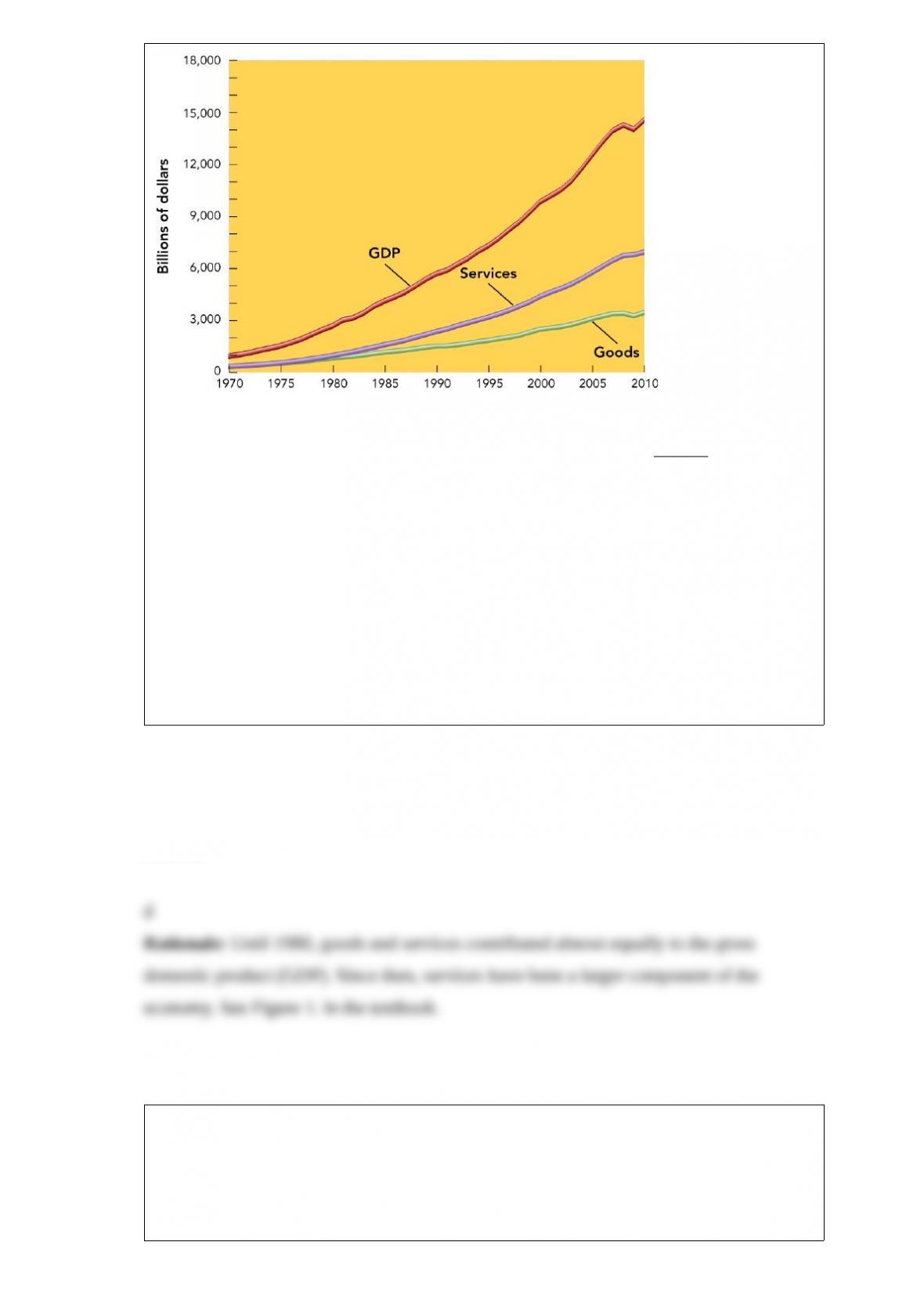
Figure 1.
As shown in Figure 1. above, which of the following statements is MOST accurate?
a. Services are a smaller part of the gross domestic product than are goods.
b. In 2010, goods represent a larger part of the gross domestic product than services.
c. In 1995, services were worth almost $1 billion.
d. Until 1980, goods and services contributed almost equally to the gross domestic
product (GDP).
e. In 2010, goods were 50 percent of the GDP.
Answer:
A website that provides the ability to conduct sales transactions for products and
services emphasizes the __________ design element.
a. commerce
b. context
c. community
d. content
e. connection
Answer:
The practice of __________, which can affect the natural flow of the free market, is
occasionally addressed in the ethics codes of companies or their purchasing policies.
a. tying agreements
b. just-in-time procurement
c. quid pro quo
d. supply partnerships
e. reciprocity
Answer:
Which of the following statements most accurately describes the people in the buying
center of a medium-sized manufacturing plant?
a. The composition of the buying center never changes.
b. The buying center avoids cross-functional teams whenever possible.
c. The composition of the buying center depends on the specific item being purchased.
d. It’s easy to locate and reach the people who comprise the buying center.
e. Most government units use a formal buying center to arrive at buying decisions.
Answer:
Figure 1.
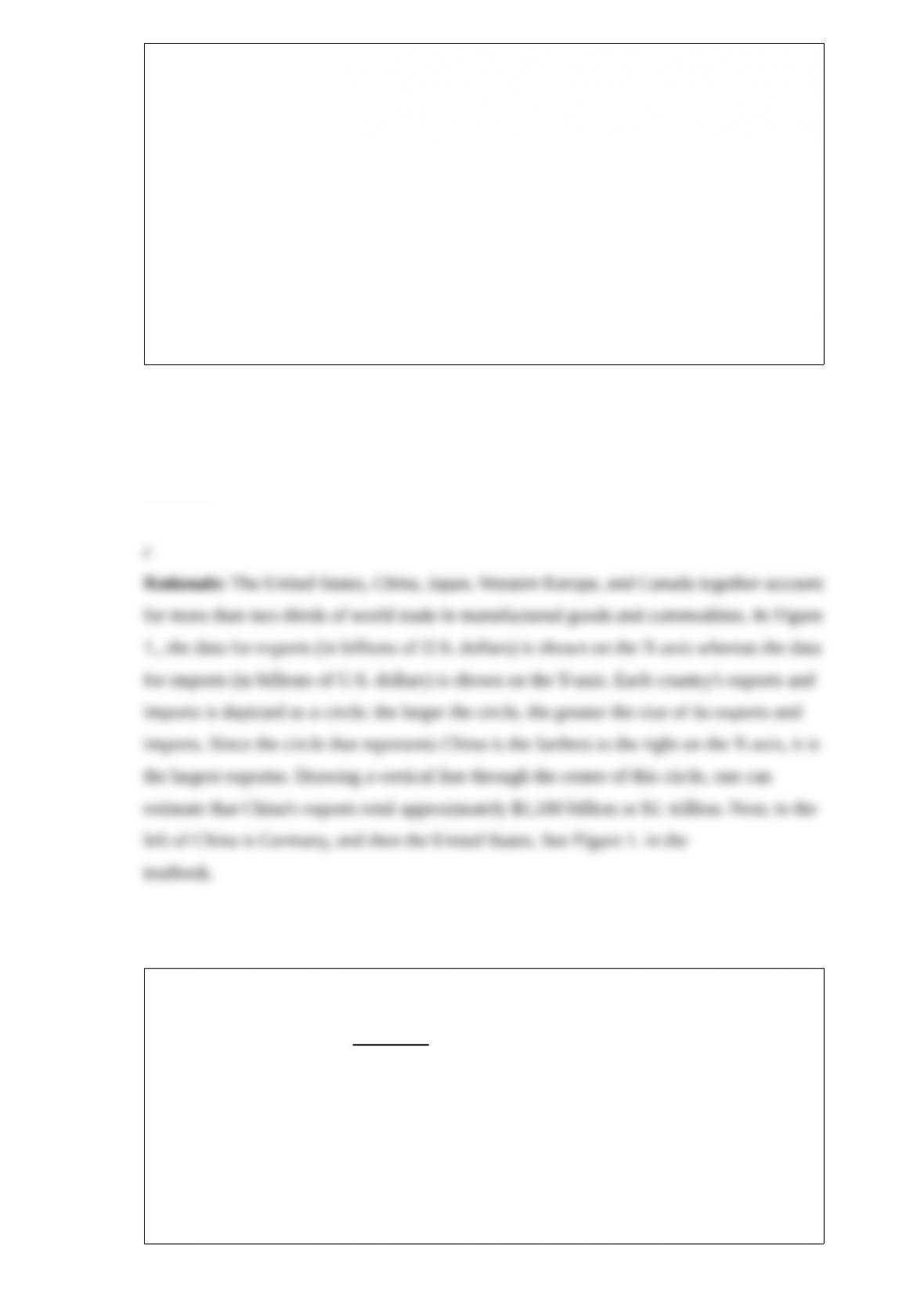
According to Figure 1. above, which of the following countries is the world’s leading
exporter?
a. United States
b. France
c. China
d. Germany
e. Japan
Answer:
All of the following are five situational influences can have an impact on a consumer’s
purchase decision process EXCEPT:
a. physical surroundings.
b. purchase task.
c. temporal effects.
d. consumer socialization.
e. antecedent states.
Answer:
A(n) __________ is an intermediary who sells to consumers.
a. agent
b. retailer
c. wholesaler
d. distributor
e. broker
Answer:
Which of the following statements about everyday low pricing (EDLP) is most
accurate?
a. EDLP encourages manufacturer allowances.
b. Supermarkets have hailed EDLP as the most effective form of value pricing.
c. Some argue that EDLP without price specials is boring for many grocery shoppers.
d. EDLP allows supermarkets to use deeply discounted price specials.
e. EDLP can increase average retail prices by as much as 10 percent.
Answer:
After a receiver responds to a message, the sender’s interpretation of the response
indicating whether the message was decoded and understood as intended during the
communications process is referred to as __________.
a. encoding
b. receiver response
c. feedback
d. noise
e. message loop
Answer:

A form of ownership that involves multiple outlets under common ownership is referred
to as a(n).
a. corporate chain
b. consumer cooperative
c. contractual system
d. independent retailer
e. administered system
Answer:
The practice of using the telephone rather than personal visits to contact customers is
referred to as __________.
a. missionary selling
b. outbound telemarketing
c. cold canvassing
d. inbound telemarketing
e. team selling
Answer: