Which of these promotional elements has the highest cost-per-contact or exposure?
A. advertising
B. personal selling
C. sales promotion
D. publicity
E. public service announcements
Answer:
Organizational buyers can be divided into three different markets, which are
A. industrial, wholesaler, and retailer.
B. industrial, retailer, and government.
C. retailer, manufacturer, and government.
D. industrial, government, and ultimate consumer.
E. industrial, reseller, and government.
Answer:
Which of the following is an example of a product line?
A. Scope mouthwash
B. Zephyrhills natural spring water in 8 oz. bottles
C. The Yellow Pages for Gainesville, Florida
D. Hallmark Mother’s, Father’s Day, and Grandparent’s Day cards
E. Apple iPad
Answer:
A firm’s profit equation equals
A. Total cost + Total revenue or [(Fixed cost + Variable cost) + (Unit price Quantity
sold)].
B. Total revenue – Total cost or [(Unit price Quantity sold) – (Fixed cost + Variable

cost)].
C. Total cost – Marginal cost or [(Fixed cost + Variable cost) – (Unit price Quantity
sold)].
D. Total cost – Variable cost or [(Fixed cost + Variable cost) – (Unit price Quantity
sold)].
E. Total revenue/Total cost or [(Unit price Quantity sold) (Fixed cost + Variable cost)].
Answer:
Talbot’s sells women’s clothes. A longsleeve scoopneck t-shirt with the Talbot’s label
costs $45. By comparison, you can buy a t-shirt for $5 at a Family Dollar Store, but it
won’t have the prestigious Talbot’s label or quality. What kind of demand-oriented
approach to pricing does Talbot’s use?
A. experience curve pricing
B. skimming pricing
C. demand-backward pricing
D. prestige pricing
E. flexible pricing
Answer:
The extraction of hidden predictive information from large databases to find statistical
links between consumer purchasing patterns and marketing actions is referred to as
A. predictive analysis.
B. information extraction.
C. variable analysis.
D. database management.
E. data mining.
Answer:
Many retailers take a markdown as soon as sales fall to free valuable selling space and
cash. This illustrates one tactic for handling the __________ of markdowns.
A. timing
B. demand
C. availability
D. bargain hunting
E. customer value
Answer:
When most consumers who would buy a product are either repeat purchasers of the
item or have tried and abandoned it, in what stage of the product life cycle is the
product?
A. introduction
B. growth
C. maturity
D. decline
E. harvest
Answer:
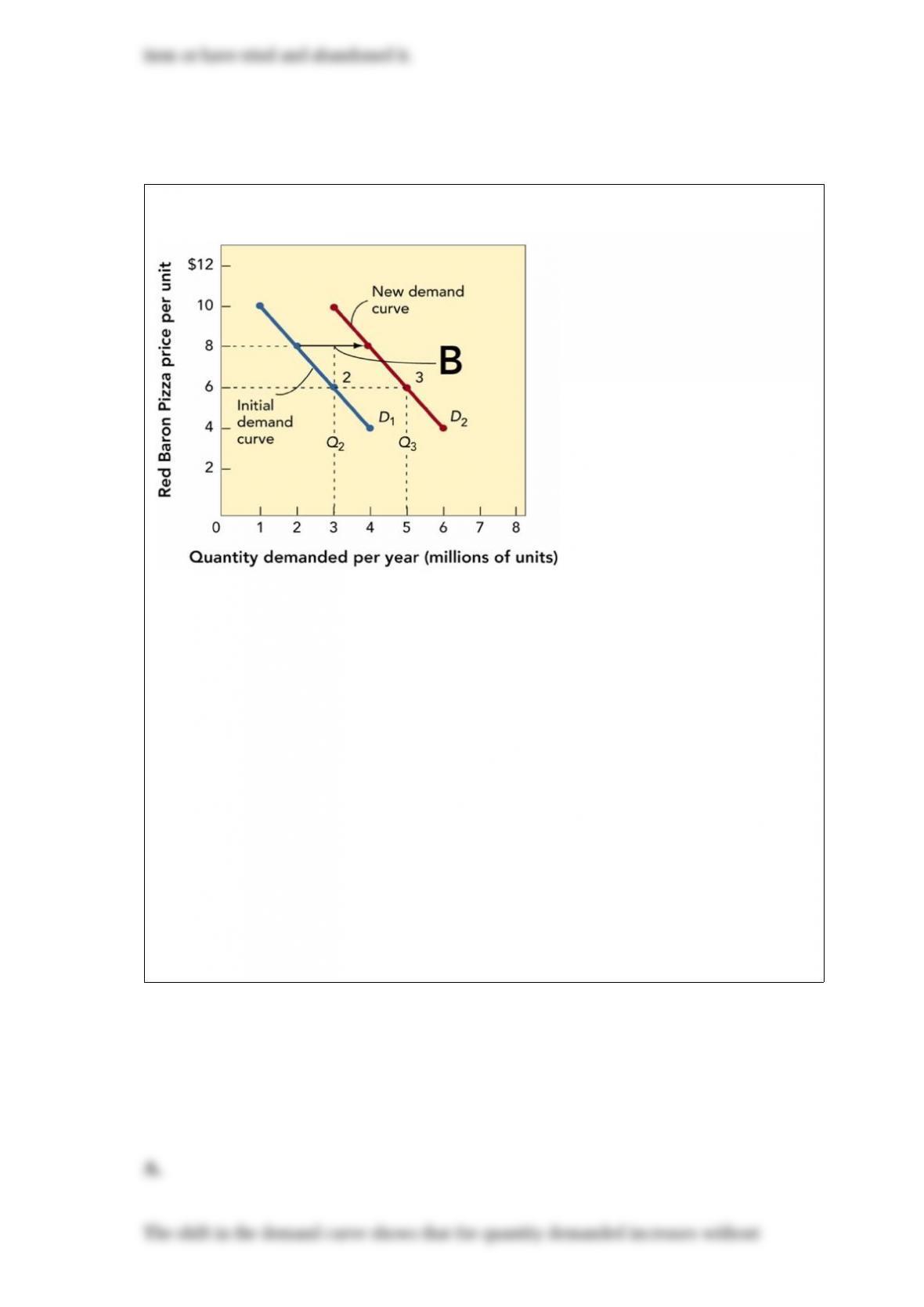
Figure 11-3B
In Figure 11-3B above, the demand curve shifts from D1 to D2. This most likely
represents
A. an increase in demand that did not require a change in price but was the result of a
change in one or more demand factors.
B. an increase in demand that required a decrease in price.
C. no change in price and a decrease in demand that results from internal business
practice changes.
D. no change in demand or price but a greater profit due to economies of scale.
E. an decrease in price from $8 to $6 per unit.
Answer:
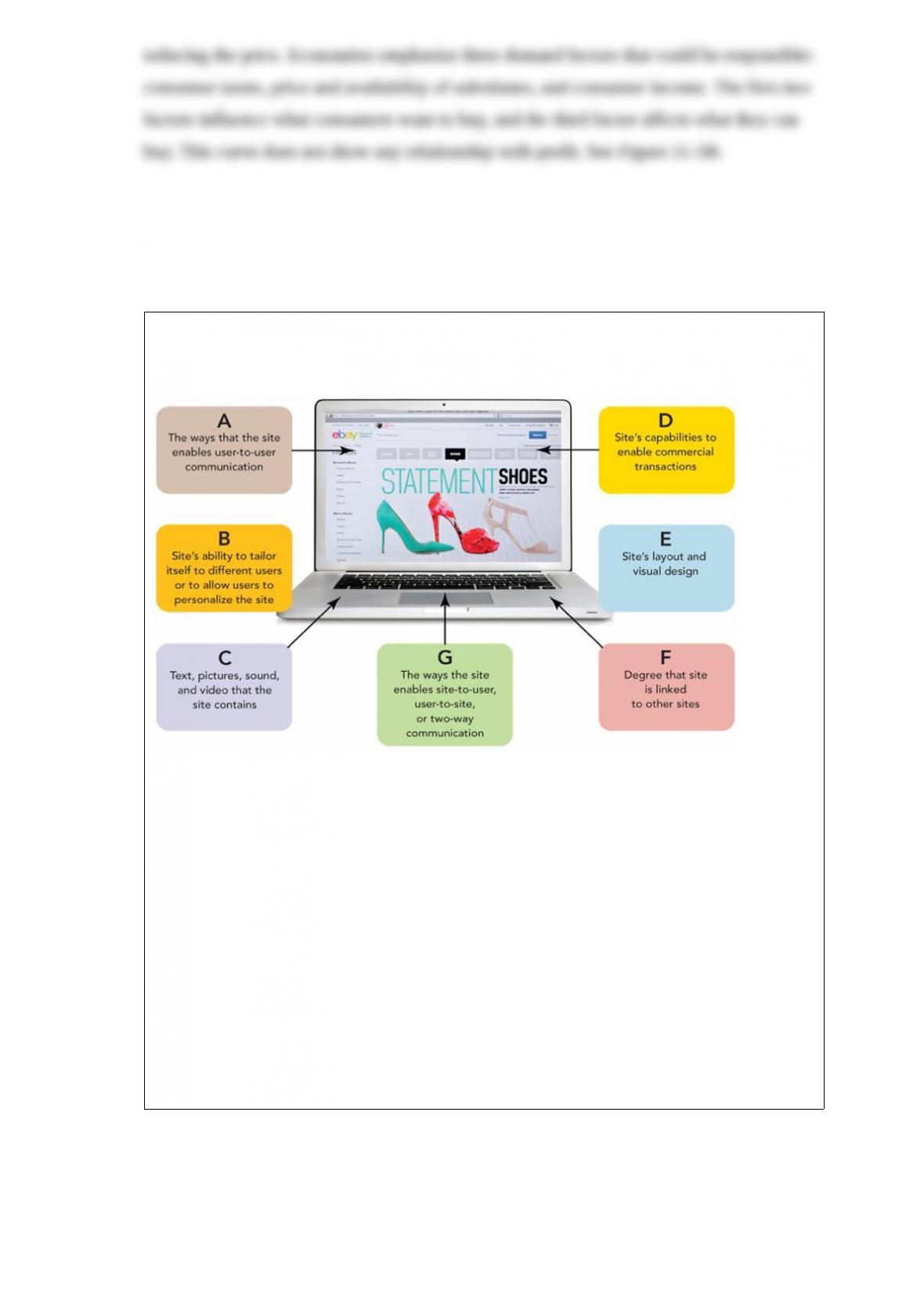
Figure 18-2
Consider Figure 18-2 above. G refers to which of the following website design
elements?
A. communication
B. commerce
C. customization
D. connection
E. context
Answer:
Sales promotion has become a key element of the promotional mix, which now
accounts for __________ in annual expenditures.
A. $100 million
B. $255 million
C. $5 billion
D. $25 billion
E. $70 billion
Answer:
What does idle production capacity refer to?

A. a situation where the demand for exceeds the availability of service providers and as
a result, no services can be offered
B. when the supply of service providers exceeds the primary demand for the service
C. a situation where a service provider is available but there is no demand for the
service
D. integrating the service component of the marketing mix with efforts to influence
consumer demand
E. the potential profits of one service provider serving multiple clients at the same time
Answer:
The actions taken during the implementation phase of the strategic marketing process
include: (1) obtain resources; (2) __________; (3) define precise tasks, responsibilities,
and deadlines; and (4) execute the marketing program.
A. select target markets
B. design marketing organization
C. position the product
D. find points of difference
E. develop the budget by estimating revenues, expenses, and profits
Answer:

Which type of purchase is most likely to be the result of joint decision-making?
A. groceries
B. children’s toys
C. medicine
D. home appliances
E. breakfast cereal
Answer:
During the __________ stage of personal selling, a salesperson would learn if her
prospect liked to talk about sports before getting down to business or preferred not to
waste time with idle chatter.
A. prospecting
B. preapproach
C. approach
D. presentation
E. closing
Answer:
Since global marketing is affected by economic considerations, a scan of the global
marketplace should include which of the following factors?
A. recognition of a country’s currency exchange rates
B. an analysis of cultural diversity within the country under consideration
C. regulatory constraints regarding contracts, mergers, and partnerships
D. an assessment of language differences including dialect variation
E. political and ideological differences between the countries involved
Answer:

In a marketing context, a message refers to
A. product information regarding benefits and usage found from receiver to the sender
outside the channel of communication.
B. the slogan or tagline of a specific product.
C. proprietary information linking a specific product to a promotional campaign.
D. the information sent by a source to a receiver during the communication process.
E. a television or radio commercial from the buyer to the seller.
Answer:
Channel conflict refers to
A. disagreements over the trade discounts allotted to each level of the distribution chain
by the Federal Trade Commission.
B. regulatory restrictions limiting the number of distributors that can sell a producer’s
products.
C. when one channel member believes another channel member is engaged in behavior
that prevents it from achieving its goals.
D. when one distributor carries two competing brands.
E. when the producer doesn’t allow other channel members to have input regarding
product specifications or benefits.
Answer:
Seeking to obtain as high a financial return on their investments (ROI) as possible,
firms will often set __________ goals.
A. sales
B. quality
C. market share
D. profit
E. employee welfare
Answer:
The idea that individuals and organizations are accountable to a larger society is known
as
A. the societal marketing concept.
B. social responsibility.
C. consumerism.
D. sustainable development.
E. capitalism.
Answer:
Environmental trends arise from all of the following forces EXCEPT:
A. competitive.
B. economic.
C. regulatory.
D. geographical.
E. social.
Answer:
The groups primarily served by a firm exhibiting stakeholder responsibility include
A. the general public, public interest groups, and the environment.
B. consumers, employees, suppliers, and distributors.
C. owners and stockholders.
D. the general public, owners, and stockholders.
E. government, owners, and stockholders.
Answer:
The break-even point (BEP) = [__________ (Unit price – Unit variable cost)].
A. Total cost
B. Total expense
C. Fixed cost
D. Unit variable cost
E. Total number of units produced or quantity
Answer:
The three steps used in choosing a supply chain include: (1) understand the customer;
(2) understand the supply chain; and (3) __________.
A. understand the environment
B. harmonize the supply chain with the marketing strategy
C. understand the marketing mix
D. understand the logistics
E. understand the company’s goals
Answer:
The Federal Trade Commission (FTC) considers a product new only
A. for a period of one year after it enters widespread distribution.
B. if it is functionally different from a competitor’s product.
C. until a new and improved version of the same product is produced.
D. for a period of six months after it enters regular distribution.
E. for a period of seventeen years at which time patent rights are returned to the public
domain.
Answer:
Which of the following statements about customer value is most accurate?
A. Target customers assess customer value in terms of the combination of benefits
(quality, convenience, etc.), regardless of the price.
B. Loyal customers are less profitable to firms in the long run since they expect lower
prices over time in order to remain loyal.
C. Research suggests that firms can be most successful by being all things to all
consumers.
D. It is impossible to place a dollar value on a loyal, satisfied customer.
E. To create value for targeted buyers, firms must build long-term relationships with
them.
Answer:
Which of the following is a criterion used for selecting a target market?
A. similarity of needs of potential buyers within a segment
B. difference of needs of buyers between segments
C. expected growth of a segment
D. feasibility of a marketing action to reach a segment
E. simplicity and cost of assigning potential buyers to segments
Answer:

The result of an offer designed to generate interest in a product or service and a request
for additional information is referred to as __________.
A. direct orders
B. lead generation
C. traffic generation
D. indirect orders
E. prospecting
Answer:
Which of the marketing strategies for expanding sales revenue below presents the most
risk for an organization?
A. product development
B. product-market evolution
C. market development
D. market penetration
E. diversification
Answer:
Which of the following statements regarding new car purchases in the U.S. is most
accurate?
A. While men of all races pay basically the same price, women, regardless of race, pay
considerably less.
B. Seventy-nine percent of all men purchasing cars cite haggling over price as the most
exciting aspect of the purchase.
C. A fixed price policy is now the standard in the automobile industry due to violations
of the Robinson-Patman Act.
D. Female automobile salespeople rarely, if ever, offer flexible pricing to women
customers.
E. African-Americans, women, and Hispanics pay higher prices than the average price
paid for a new car.
Answer:

In the early 1980s, typical round-trip coach airfares from the East Coast to London were
more than $500. Then Freddie Laker introduced the People’s Express, a competing
service into Newark at $350. Major airlines matched his price and did so until they
drove People’s Express out of business. Then prices shot back up to over $500. A
lawsuit filed under the Sherman Act resulted in a judgment that the major airlines had
explicitly tried to destroy a competitor. The People’s Express case is an example of
__________ on the part of the major airlines.
A. price fixing
B. price discrimination
C. deceptive pricing
D. predatory pricing
E. pricing constraints
Answer:
After watching the 30-minute infomercial on Oxy-Clean, Sarah was certain the cleaning
product would remove the grape juice stain from her white carpet. In terms of the
communication process, Sarah was __________ the message from Oxy-Clean.
A. integrating
B. decoding
C. transforming
D. translating
E. encoding
Answer:
An action item list refers to an aid to implement a marketing plan that consists of four
columns: (1) __________; (2) the person responsible for completing that task; (3) the
date to finish the task; and (4) what is to be delivered.
A. the task
B. the budget
C. the product or service
D. the points of difference
E. the promotional message
Answer:

Sales management refers to
A. the planning of the selling program and the implementing and evaluating of the
personal selling effort of the firm.
B. the process of allocating funds for direct selling.
C. only the recruiting, hiring, and training of a company’s salesforce.
D. the segmentation and selection of target markets to be addressed by a company’s
salesforce.
E. the two-way flow of communication between a buyer and seller, often in a
face-to-face encounter, designed to influence a person’s or group’s purchase decision.
Answer: