Operations Management, 11e (Heizer/Render)
Module C Transportation Models
Section 1 Transportation Modeling
1) The transportation model is an excellent tool for minimizing shipping costs among existing facilities,
but it is not useful when firms consider new facility locations.
2) The transportation model seeks satisfactory, but not necessarily optimal, solutions for shipping goods
from several origins to several destinations.
3) The transportation model is a special class of linear programming models.
4) A transportation problem requires exactly as many origins as destinations.
5) Which of the following is NOT needed in order to use the transportation model?
A) the source points and their capacity
B) the fixed costs of source points
C) the destination points and their demand
D) the cost of shipping one unit from each source to each destination
E) All of these are needed.
6) Which of the following is NOT information needed for a transportation problem?
A) the cost of shipping one unit from each origin to each destination
B) the set of destinations and the demand at each
C) the set of origins and the demand at each origin
D) the list of sources and the capacity at each
E) None of the above is needed.
7) The purpose of the transportation approach for location analysis is to minimize which of the following?
A) total costs
B) total variable costs
C) total fixed costs
D) total shipping costs
E) the number of shipments
8) The transportation method is a special case of the family of problems known as what?
A) regression problems
B) decision tree problems
C) linear programming problems
D) simulation problems
E) statistical problems
9) The elements of a transportation problem that supply goods are referred to as ________.
10) ________ finds the least-cost means of shipping supplies from several origins to several destinations.
11) The three information needs of a transportation problem are the origin points and the capacity at
each, the destination points and the demand at each, and ________.
12) What is transportation modeling?
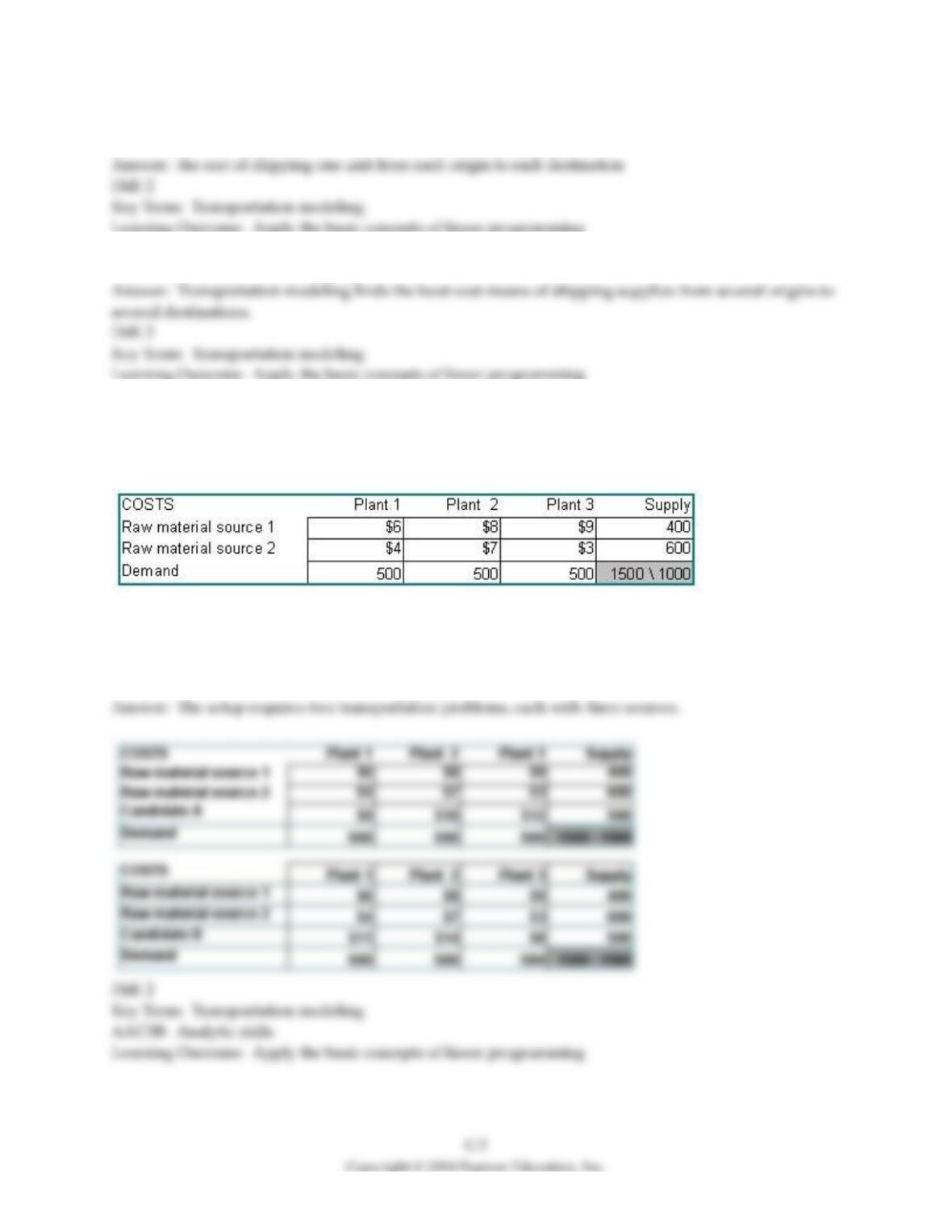
13) A firm has established a distribution network for the supply of a raw material critical to its
manufacturing. Currently there are two origins for this raw material, which must be shipped to three
manufacturing plants. The current network has the following characteristics:
The firm has identified two potential sites for a third raw material source; these are identified as
Candidate A and Candidate B. From A, the costs to ship would be $9 to Plant 1, $10 to Plant 2, and $12 to
Plant 3, respectively. From B, these costs would be $11, $14, and $8, respectively. The new source,
wherever it is located, will have a capacity of 500 units. Set up this problem as two separate
transportation matrices. (Do not solve the problem.)
Section 2 Developing and Initial Solution
1) Neither the northwest-corner rule nor the intuitive method considers shipping cost in making initial
allocations.
2) The intuitive method of generating an initial solution has different results for each problem solver
because “intuition” varies from person to person.
3) A feasible solution in transportation models is one in which all of the supply and demand constraints
are satisfied.
4) Upon completion of the northwest-corner rule, which source-destination cell is guaranteed to be
occupied?
A) top-left
B) top-right
C) bottom-left
D) bottom-right
E) the cell with the lowest shipping cost (or at least one of them if there’s a tie)
5) The initial solution to a transportation problem can be generated several ways, so long as:
A) it minimizes cost.
B) it ignores cost.
C) all supply and demand conditions are satisfied.
D) degeneracy does not exist.
E) all cells are filled.
6) The northwest-corner rule is best used:
A) to minimize the total shipping cost from several origins to several destinations.
B) to calculate whether a feasible solution is also an optimal solution.
C) to calculate how much to transfer from one shipping route to another.
D) to generate an initial feasible solution to a transportation problem.
E) to resolve cases of degeneracy in transportation problems.
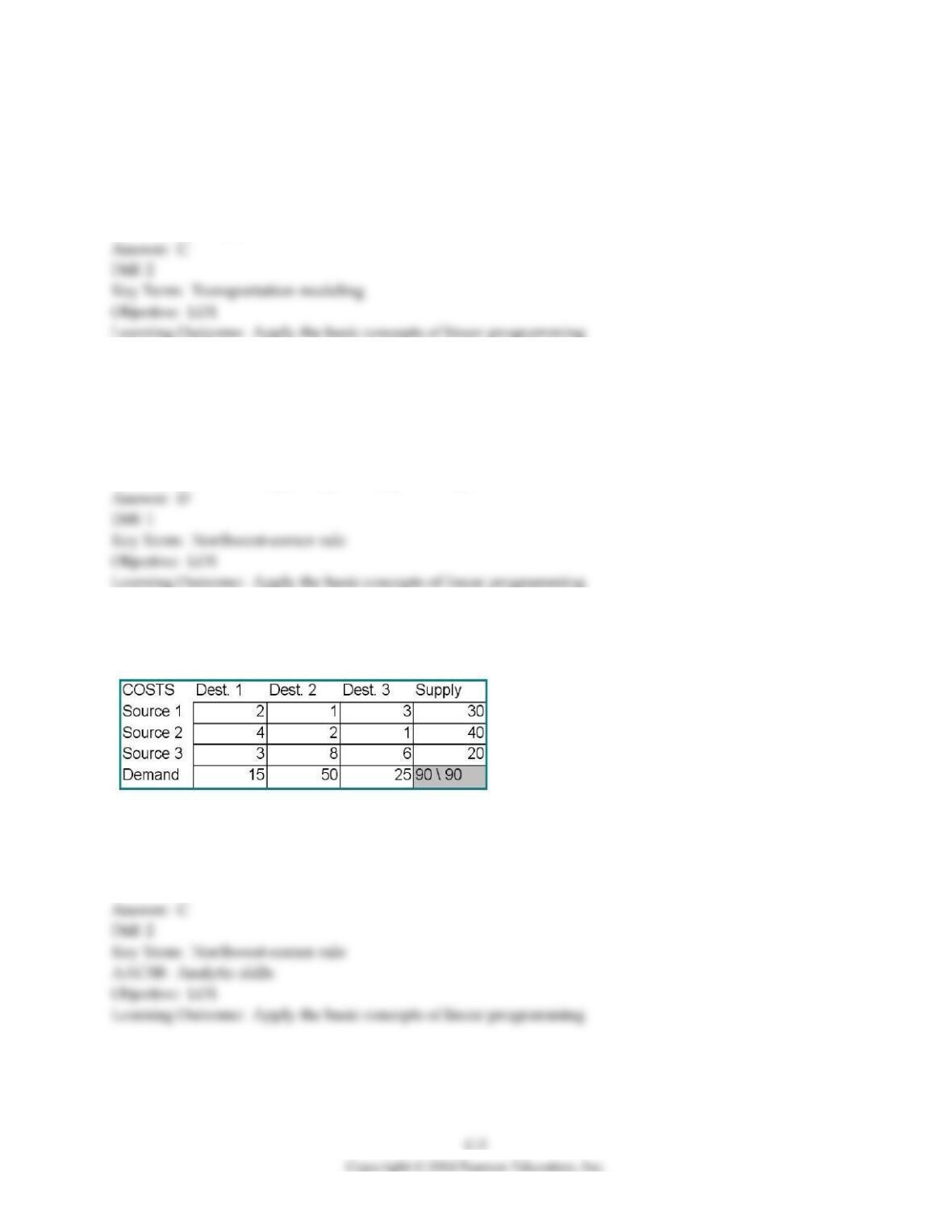
7) For the problem data set below, what is the northwest-corner allocation to the cell Source 1-Destination
1?
A) 0
B) 2
C) 15
D) 90
E) 30
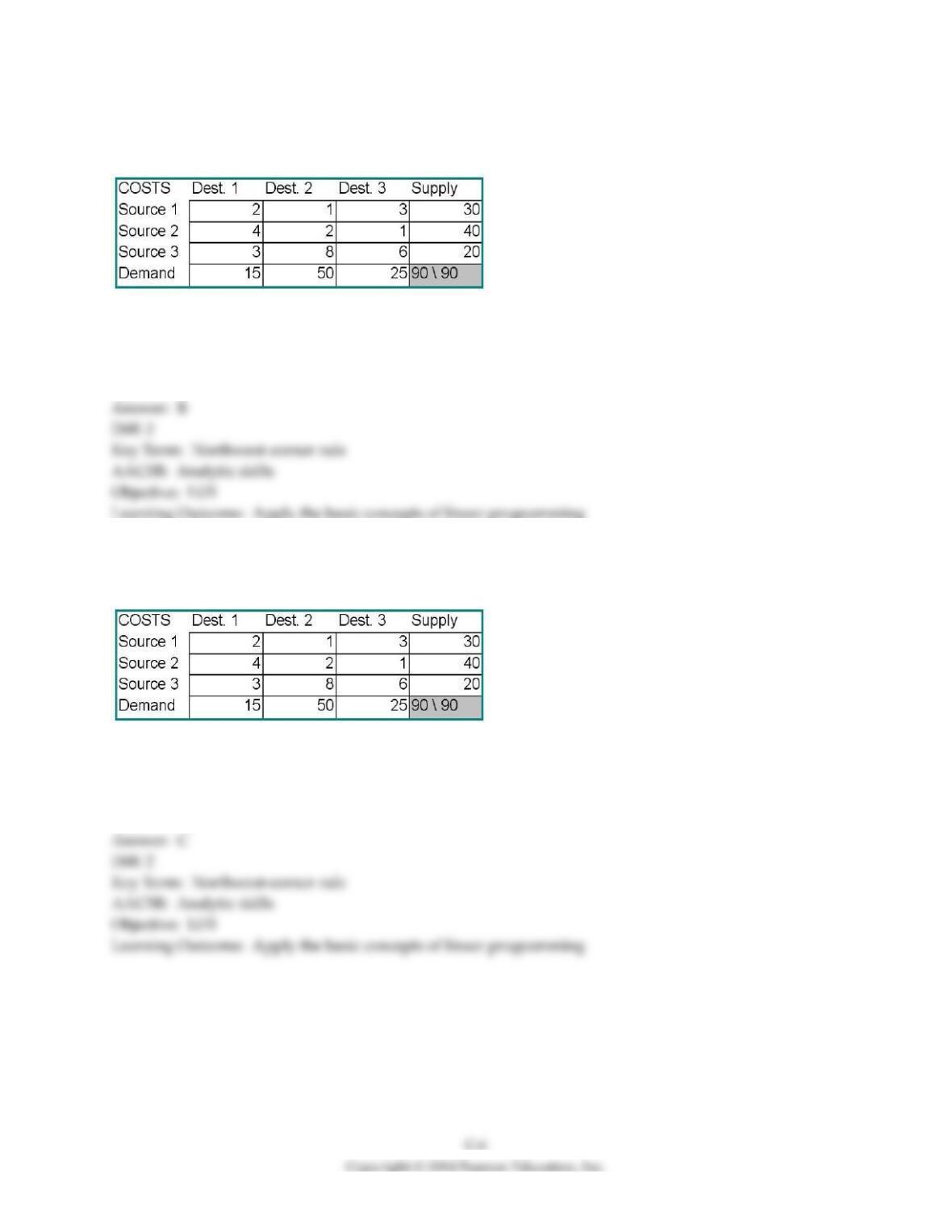
8) For the problem data set below, what is the northwest-corner allocation to the cell Source 1 —
Destination 2?
A) 0
B) 15
C) 25
D) 45
E) 35
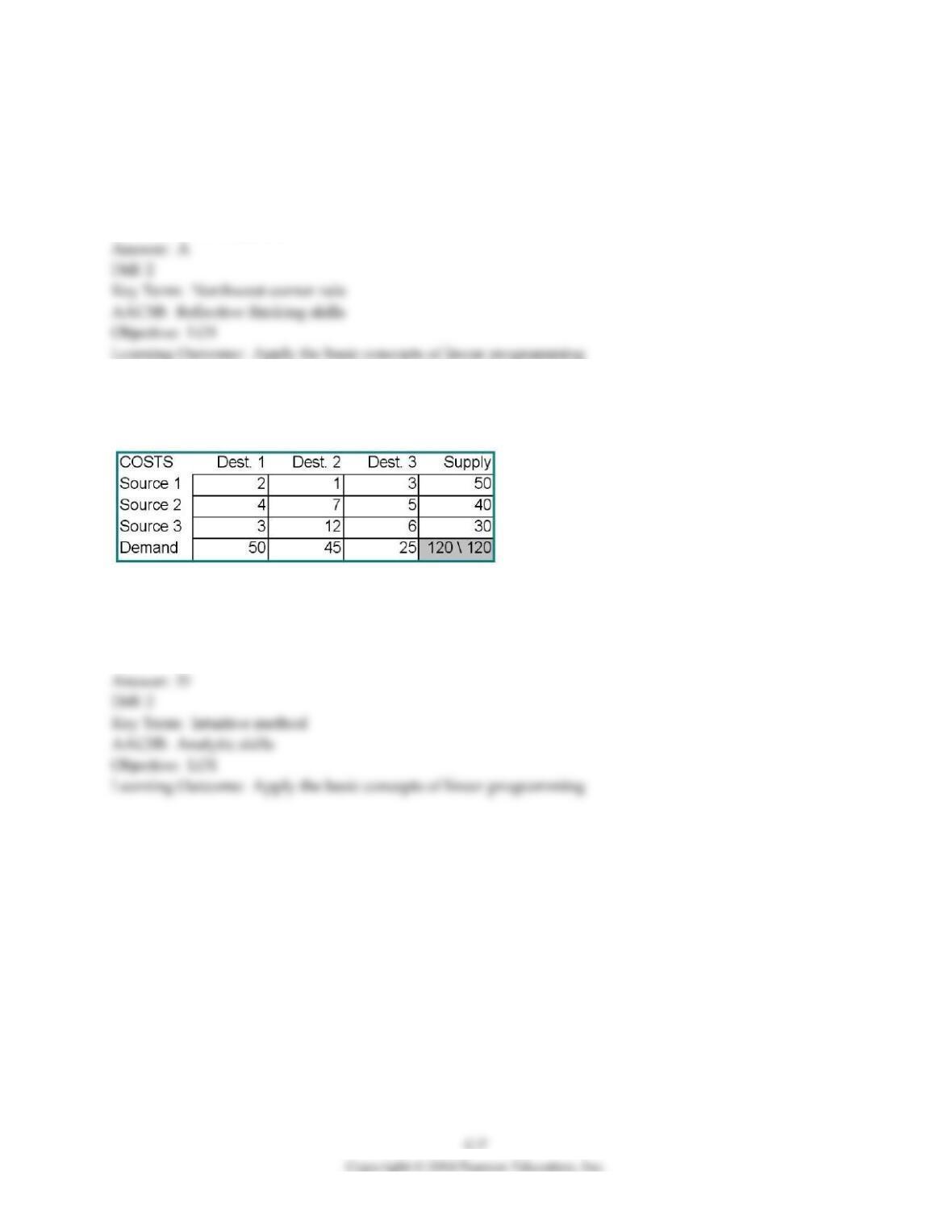
9) For the problem data set below, what is the northwest corner allocation to the cell Source 3-Destination
3?
A) 0
B) 15
C) 20
D) 35
E) 45
10) The northwest-corner rule’s biggest flaw is that:
A) it ignores costs.
B) it cannot generate feasible solutions.
C) it never generates ideal solutions.
D) it ignores shipping time.
E) There are no major flaws.
11) For the problem below, what is the quantity assigned to the cell Source 1-Destination 2 using the
intuitive method for an initial feasible solution?
A) 1
B) 5
C) 30
D) 45
E) 50
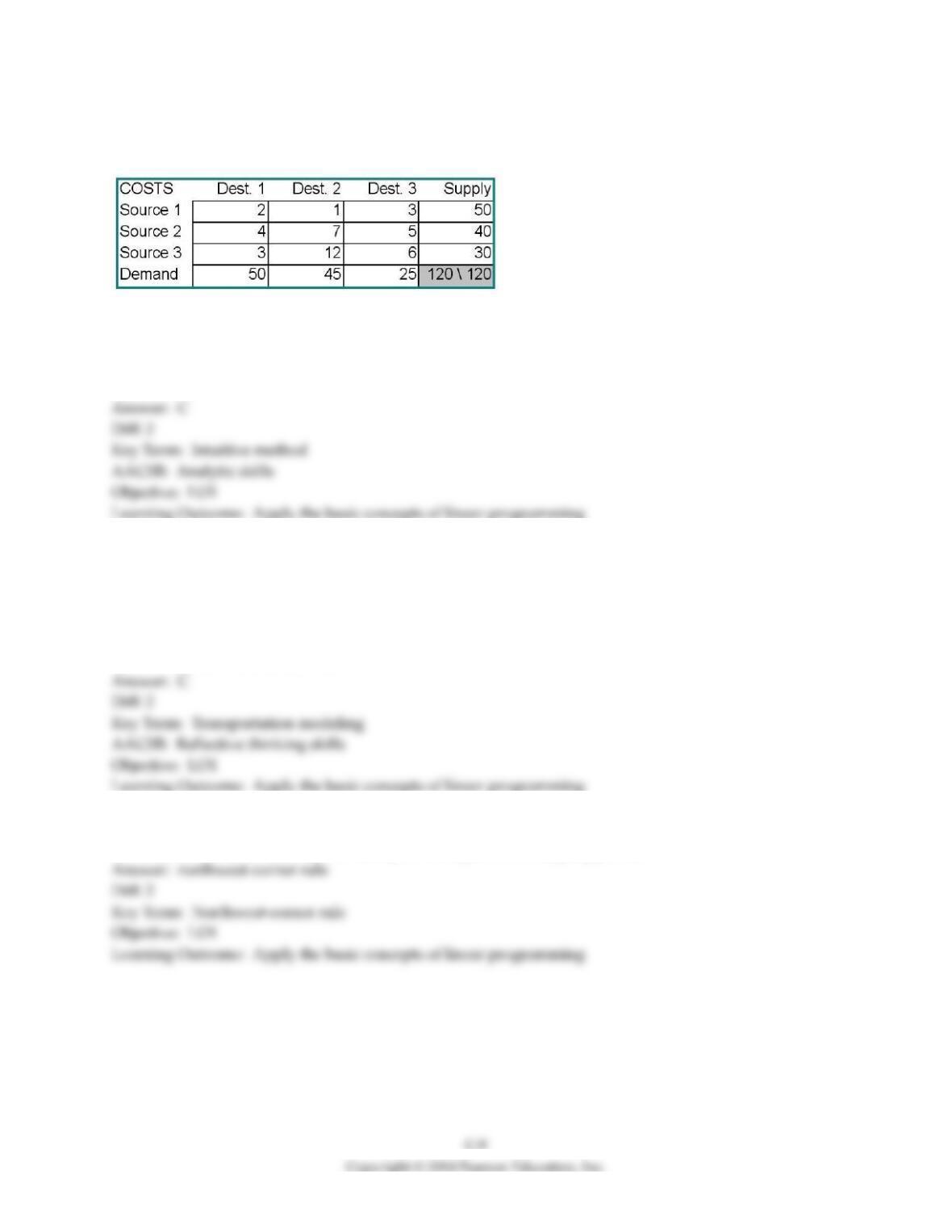
12) For the problem below, what is the quantity assigned to the cell Source 3-Destination 1 using the
intuitive method for an initial feasible solution?
A) 3
B) 13.333
C) 30
D) 45
E) 50
13) The main difference between the intuitive lowest-cost method and the northwest-corner rule is that:
A) the intuitive lowest-cost method always generates a better solution.
B) the northwest-corner rule is faster.
C) the northwest-corner rule ignores cost.
D) only the intuitive lowest-cost method generates an optimal solution.
E) None of the above is accurate.
14) The ________ develops an initial feasible solution for a transportation model by starting at the upper
left-hand cell of a table and systematically allocating units to shipping points.
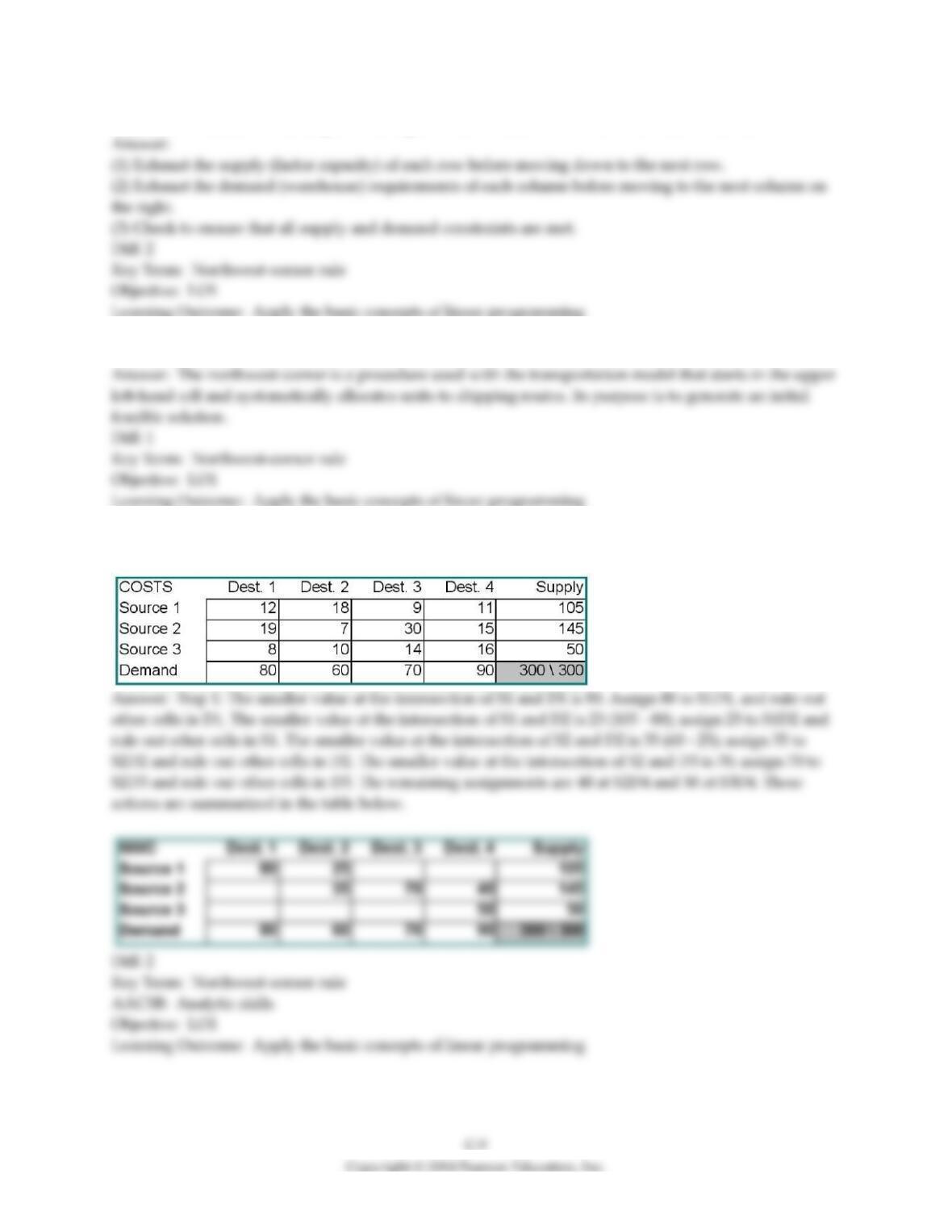
15) State, in order, the three steps in making an initial allocation with the northwest-corner rule.
16) What purpose does the northwest-corner rule serve?
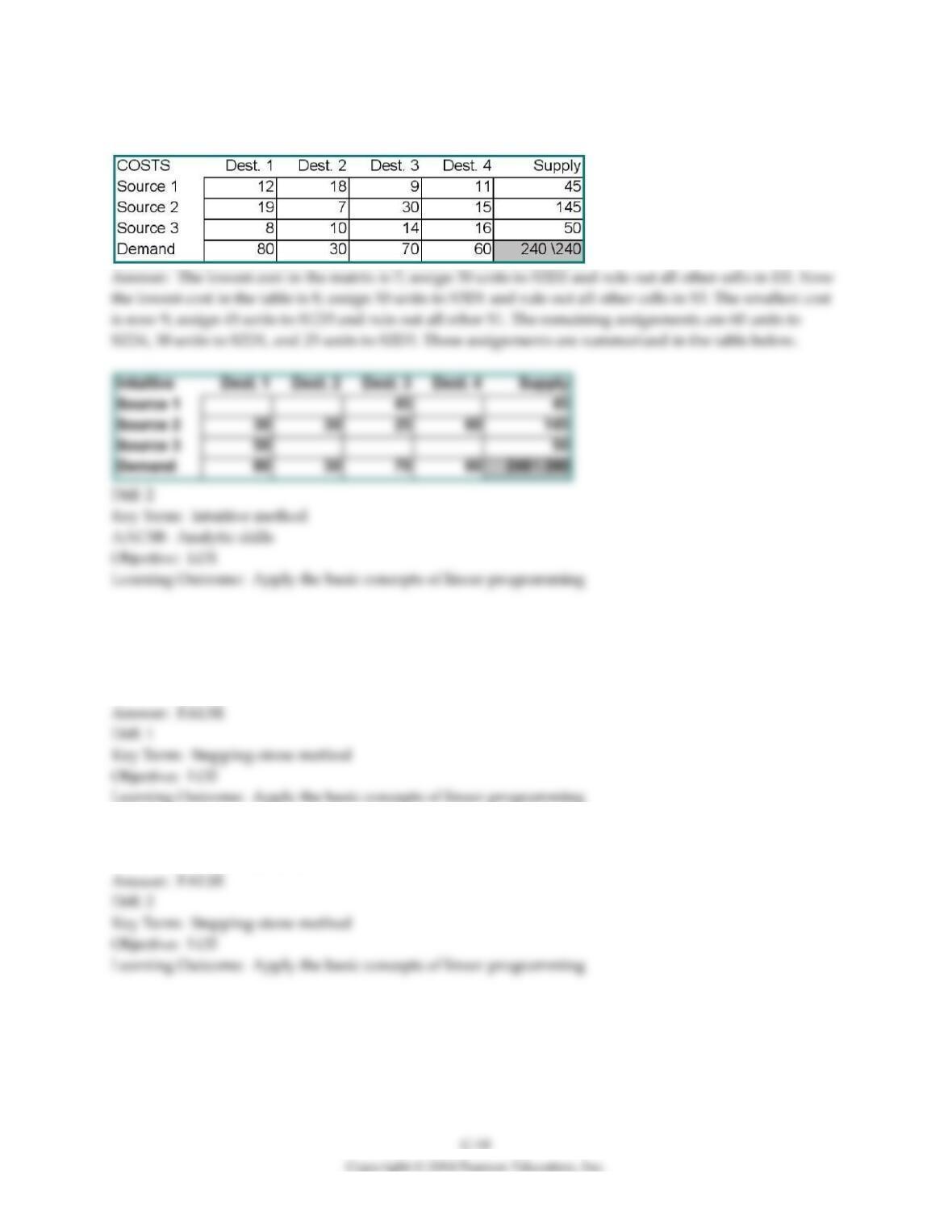
17) For the data below, construct an initial feasible solution using the northwest-corner rule.
18) For the transportation problem below, construct an initial feasible solution using the intuitive method.
Section 3 The Stepping-Stone Method
1) The stepping-stone method frequently achieves an optimal solution as soon as it calculates an initial
feasible solution.
2) When using the stepping-stone method, the improvement index for an unused cell equals the shipping
cost associated with that cell.
3) In a transportation minimization problem, the negative improvement index associated with a cell
indicates that reallocating units to that cell would lower costs.
4) When using the stepping-stone method, the closed path sometimes has the shape of a triangle as
diagonal moves are permitted.
5) When using the stepping-stone method for a minimization problem, the number of units that
reallocates corresponds to the smallest number found in the cells containing minus signs.
6) A transportation problem has a feasible solution when:
A) all of the improvement indices are greater than or equal to zero.
B) all demand and supply constraints are satisfied.
C) the number of filled cells is one less than the number of rows plus the number of columns.
D) all the squares are used.
E) the solution yields the lowest possible cost.
7) A transportation problem has an optimal solution when:
A) all of the improvement indices are greater than or equal to zero.
B) all demand and supply constraints are satisfied.
C) the number of filled cells is one less than the number of rows plus the number of columns.
D) all the squares are used.
E) all origin-destination combinations have been made equally low in cost.
8) In transportation model analysis, the stepping-stone method is used to:
A) identify a dummy origin point.
B) obtain an initial feasible solution.
C) evaluate empty cells for possible degeneracy.
D) balance supply and demand.
E) evaluate empty cells for potential solution improvements.
9) The total cost of the optimal solution to a transportation problem:
A) is calculated by multiplying the total supply (including any dummy values) by the average cost of the
cells.
B) cannot be calculated from the information normally included in a transportation problem.
C) can be calculated based only on the entries in the filled cells of the solution.
D) can be calculated from the original northwest-corner solution.
E) is found by multiplying the amounts in each cell by the cost for that cell for each row and then
subtracting the products of the amounts in each cell times the cost of each cell for the columns.
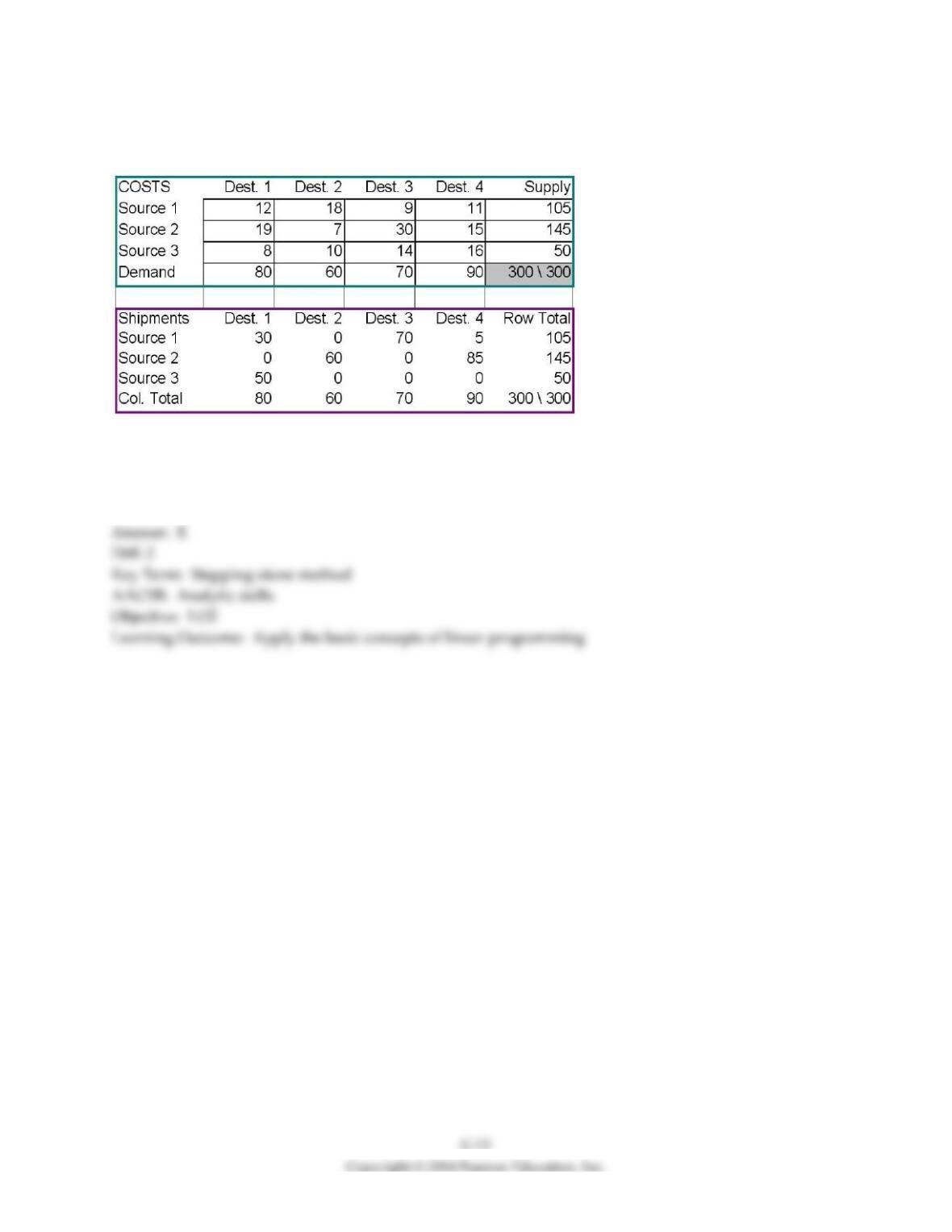
10) Consider the transportation problem and its optimal solution in the tables below. What is total
shipping cost?
A) 0
B) $169
C) 300 units
D) $2,100
E) $3,140
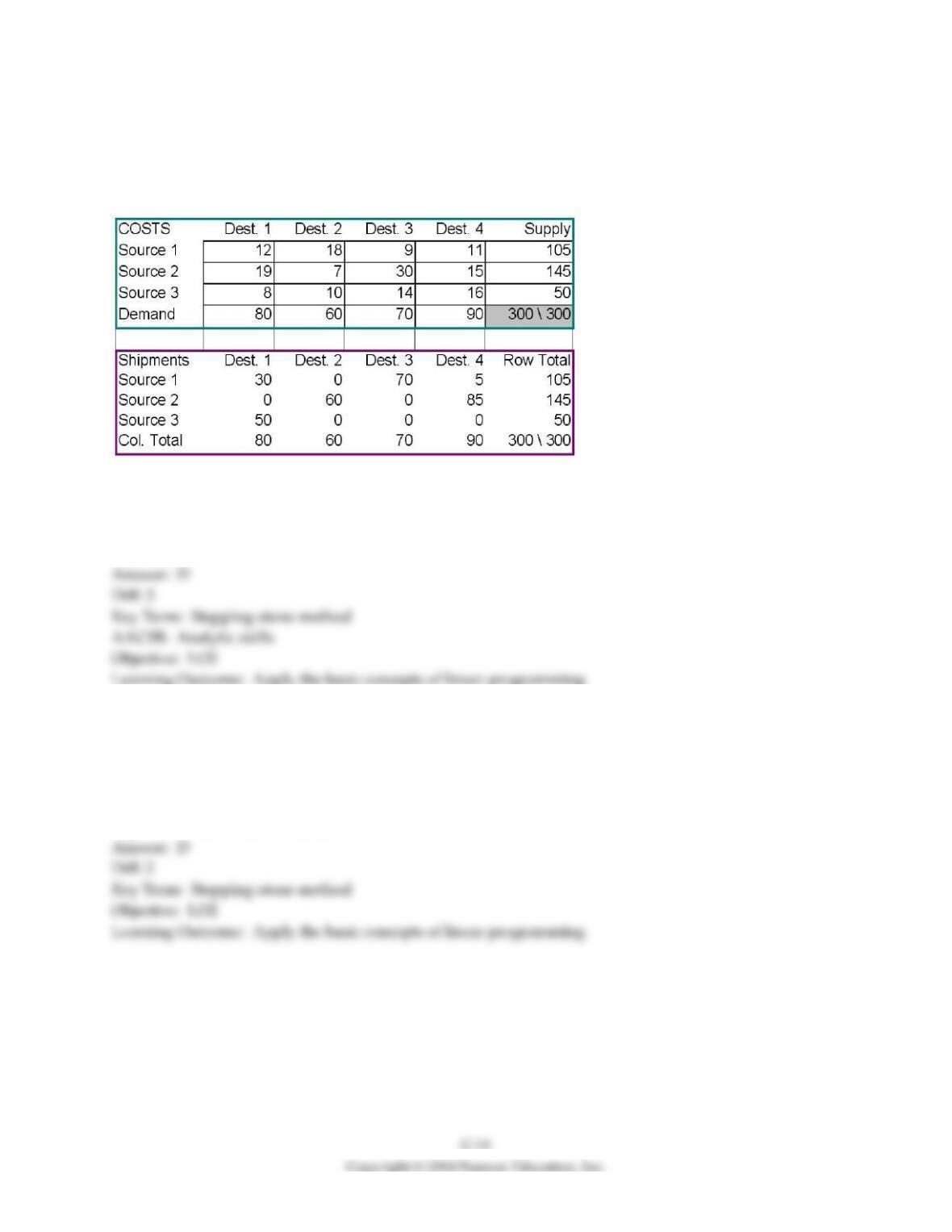
11) Consider the transportation problem and its optimal solution in the tables below. The cell Source 3 —
Destination 3 is currently empty. What would be the change in the total shipping cost if the largest
possible amount were shipped using that route, leaving all the supply and demand conditions
unchanged?
A) 0
B) fifty units
C) a decrease of $9
D) an increase of $450
E) an increase of $630
12) In a minimization problem, a negative improvement index in a cell indicates that the:
A) solution is optimal.
B) total cost will increase if units are reallocated to that cell.
C) current iteration is worse than the previous one.
D) total cost will decrease if units are reallocated to that cell.
E) problem has no feasible solution.
13) In a minimization problem, a positive improvement index in a cell indicates that:
A) the solution is optimal.
B) the total cost will increase if units are reallocated to that cell.
C) there is degeneracy.
D) the total cost will decrease if units are reallocated to that cell.
E) the problem has no feasible solution.
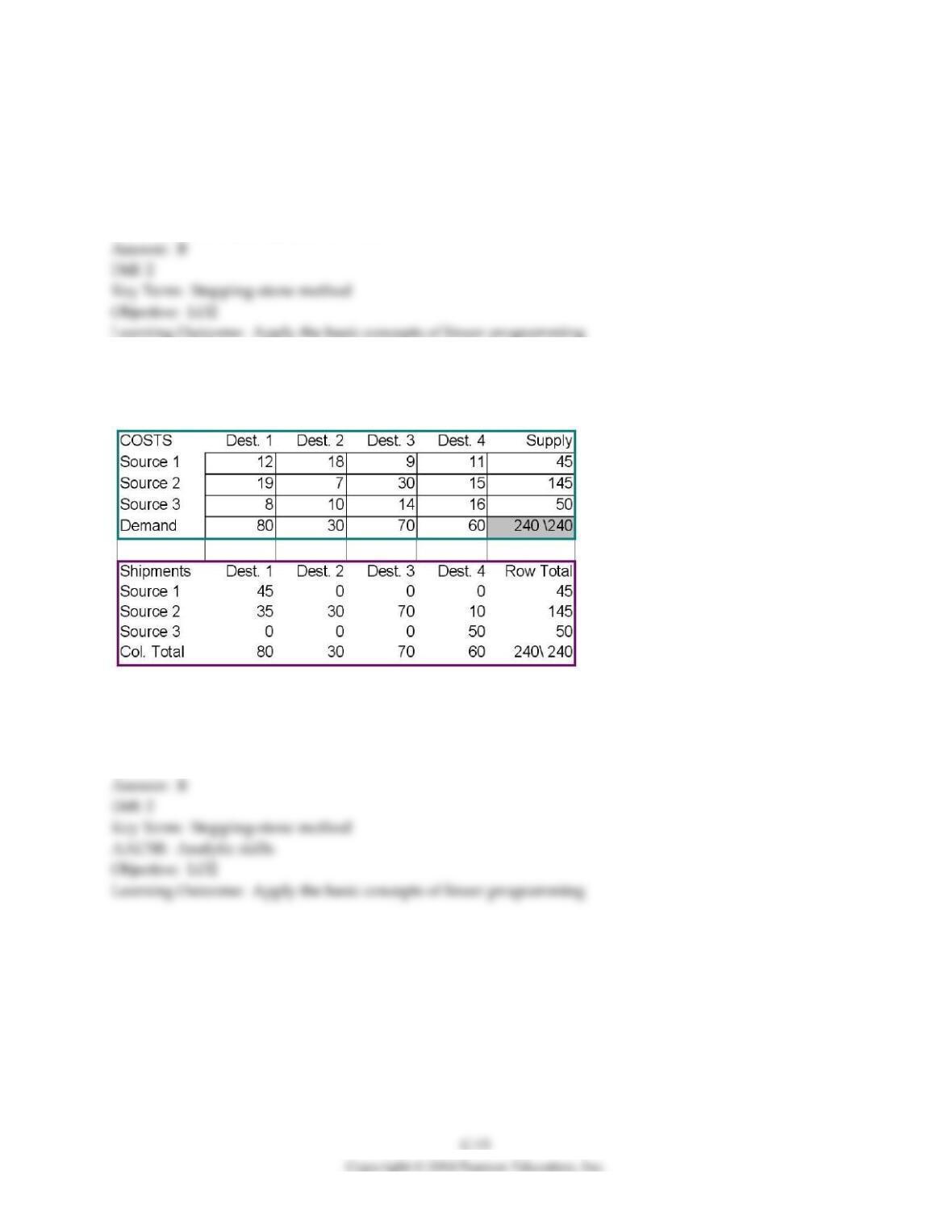
14) Consider the transportation problem and its initial solution in the table below. What is the
improvement index for the empty cell Source 1 — Destination 3?
A) 0
B) –14
C) –23
D) –70
E) 115
15) The stepping-stone method:
A) is an alternative to using the northwest-corner rule.
B) often involves tracing closed paths with a triangular shape.
C) is used to identify the relevant costs in a transportation problem.
D) is used to evaluate the cost effectiveness of shipping goods via transportation routes not currently in
the solution.
E) helps determine whether a solution is feasible or not.
16) One difference in the stepping-stone method compared to the northwest-corner and intuitive methods
is:
A) the stepping-stone method never finds a feasible solution.
B) the stepping-stone method ignores costs.
C) the stepping-stone method ALWAYS finds a lower-cost solution.
D) the stepping-stone method guarantees an optimal solution.
E) the stepping-stone method does not consider factory capacities.
17) A transportation problem has improvement indices of 5, 4, 0, and -3. Which of the following is always
true?
A) The transportation model is at its ideal solution.
B) The transportation model is at a feasible solution.
C) The total cost saved by changing one unit on the route with an improvement index of 5 would be $5.
D) The transportation matrix has four empty squares.
E) Both B and D
18) An improvement index indicates:
A) whether a method other than the stepping-stone should be used.
B) whether a method other than the northwest-corner rule should be used.
C) how much total cost would increase or decrease if a single unit was reallocated to that cell.
D) whether the transportation cost in the upper left-hand corner of a cell is optimal.
E) how much total cost would increase or decrease if the largest possible quantity were reallocated to that
cell.
19) The ________ is an iterative technique for moving from an initial feasible solution to an optimal
solution in the transportation method.
20) What does the stepping-stone method do?
21) What is the difference between a feasible solution and an optimal solution?