97
INVENTORY FUNDAMENTALS
CHAPTER 9
ANSWERS TO PROBLEMS
9.7
Quarter
1
Quarter
2
Quarter
3
Quarter
4 Total $
98
9.8
Quarter
1
Quarter
2
Quarter
3
Quarter
4 Total $
9.9
Quarter
1
Quarter
2
Quarter
3
Quarter
4 Total $
9.10 Owners’ equity = assets liabilities
99
9.17
Part
number
Annual
unit
Unit
cost $
Annual $
usage
100
Part
number
Annual $
usage
Cumulative
$ usage
Cumulative
% $ usage
Cumulative
% of items Class
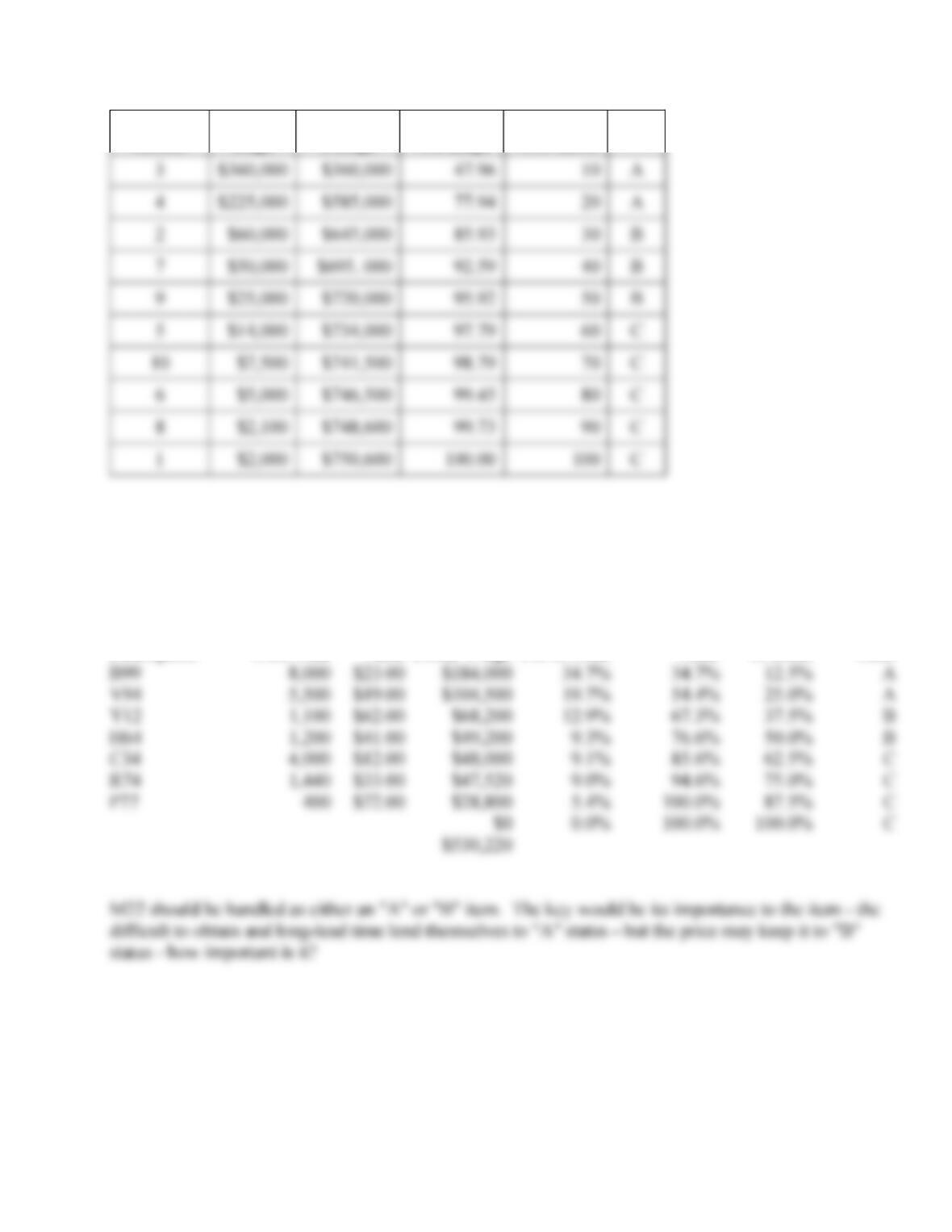
9.18
Part
number
Annual
unit
usage
Unit
cost $
Annual $
usage
101
Part
number
Annual $
usage
Cumulative
$ usage
Cumulative
% $ usage
Cumulative
% of items Class
9.19
Cumulative %
Cumulative
%
Description
Qty
Used/Year
Value
Dollar Usage
Pct of Total
of Dollar
Value
of Items
Class
102
MULTIPLE CHOICE QUESTIONS
1. Which of the following statements is best about inventory management?
a. inventories and production can be managed separately
b. inventory is not important at the production planning level
c. inventories are usually insignificant on the balance sheet
d. all the above are true
e. none of the above is true
2. ___________ are materials that have entered the production process and ___________ are
materials that are used in the production process but do not become part of the product.
I. Raw materials
II. Work in process
III. Finished goods
IV. Maintenance, repair and operational supplies
a. I and II
b. II and III
c. III and IV
d. I and III
e. II and IV
3. Inventories that are built up in advance of a peak selling season, a promotion program or a plant
shut-down are known as:
a. lot-size inventories
b. transportation inventories
c. safety stocks
d. anticipation inventories
e. none of the above
4. Transportation inventories can be reduced by:
a. reducing transportation time
b. reducing order quantities
c. increasing order quantities
d. reducing the order point
e. none of the above
5. Items that are purchased or manufactured in quantities greater than needed immediately create
________ inventories:
a. anticipation
b. lot size
c. hedge
d. any of the above
e. none of the above
103
6. Select the one best of the following statements:
a. inventories allow manufacturing to level out production and to satisfy peak demand
b. inventories allow manufacturing to reduce production runs, reducing unit cost
c. inventories allow manufacturers to operate different work centers at the same output
d. all the above are true
e. none of the above is true
7. Which of the following company objectives are in conflict?
I. Maximize customer service.
II. Low-cost plant operation.
III. Minimum inventory investment.
a. I, II and III
b. I and II, not III
c. I and III, not II
d. II and III, not I
e. none
8. In managing inventory, the problem is to balance the inventory investment with:
I. Customer service.
II. Costs associated with changing production levels.
III. Costs of placing orders.
IV. Transportation costs.
a. II and III only
b. III and IV
c. I, II and III only
d. II, III and IV only
e. I, II, III, and IV
9. Which of the following costs are relevant to inventory management decisions?
a. carrying costs
b. ordering costs
c. capacity-related costs
d. all the above
e. none of the above
10. Which of the following is NOT a cost of carrying inventory?
a. capital costs
b. storage costs
c. purchase cost
d. all the above
e. none of the above

104
11. Which of the following are considered ordering costs?
I. Production control costs.
II. Lost capacity costs.
III. Risk costs.
a. I, II and III
b. I and II
c. I and III
d. II and III
e. none of the above
12. Which of the following statements is NOT true?
a. the annual cost of ordering depends on the number of orders per year
b. the annual cost of ordering can be reduced by ordering less at any one time
c. the annual cost of carrying inventory can be decreased by ordering less at one time
d. all the above are true
e. none of the above is true
13. Which of the following costs would NOT be included in the cost of placing an order?
a. setup costs
b. costs of placing a purchase order
c. back-order costs
d. all the above
e. none of the above
14. Which of the following would NOT be included in calculating inventory carrying costs?
a. capital costs
b. ordering costs
c. obsolescence costs
d. all the above
e. none of the above
15. Which of the following equations is correct?
a. Assets = liabilities + revenue
b. Profit = revenue + owners equity
c. Liabilities = assets owners equity
d. Revenue = accounts receivable liabilities
16. If the annual cost of goods sold is $10,000,000 and the average inventory is $2,000,000, what is the
turns ratio?
a. $8,000,000
b. 5
c. 0.2
d. 20%
e. cannot be calculated from the information given
105
17. If there are 20 working days in a month, the monthly usage is 660 units, and there are 100 units on
a. 3
b. 5
c. 7
d. 33
18. Which of the following statements is most accurate?
a. about 20% of the items will usually account for about 80% of the total value
b. ‘A’ class items should have the tightest possible control
c. the general rule using the ABC approach is to have plenty of everything in stock
d. a and b only are true
e. none of the above is true
19. Of the following statements:
I. ‘A’ items usually
II. About 50% of the items usually account for 50% of the value.
III. ‘C’ items should be given the top priority in inventory management.
a. I and II are true
b. II and III are true
c. I and III are true
d. only III is true
e. only I is true
20. Which of the following statements is best?
a. two items with the same part number but in two different inventories would be one
stock
keeping unit (SKU)
b. two white shirts of different sizes in the same inventory would be one SKU
c. two items with the same part number in the same inventory would be one SKU
d. all the above are true
e. none of the above is true
21. Delivery of goods from a supplier is in transit for 14 days. If the annual demand is 2600 units, what
is the average annual inventory in transit?
a. 89.7 units
b. 100 units
c. 1.97 units
d. cannot be determined from the data given
106
22. A company carries an average annual inventory of $1,000,000. If the cost of capital is 10%, storage
costs are 8%, and risk costs are 7%, what does it cost per year to carry this inventory?
a. $100,000
b. $80,000
c. $70,000
d. $250,000
e. cannot be determined from the data given
23. Which of the following would not be considered work-in-process inventory?
I. Finished goods in the stockroom.
II. Processed material waiting for inspection.
III. Raw materials not issued.
IV. Components in queue ahead of a milling machine.
a. I and II
b. I and III
c. I and IV
d. II and III
24. Which of the following are reasons for keeping inventory?
I. To allow for goods in transit.
II. To build up stock for seasonal demand.
III. To reduce production costs.
IV. To guard against uncertainty in supply and demand.
a. I, II and III only
b. II, III and IV only
c. II and IV only
d. all the above are valid reasons
25. Given the following information, calculate the inventory turns.
Sales = $200,000,000
Cost of sales = $160,000,000
Average inventory = $ 40,000,000
Carrying cost = 12%
a. 0.20
b. 0.25
c. 4.0
d. 5.0

107
26. All of the following are reasons to keep inventory EXCEPT:
a. Allow flexibility in production scheduling
b. Couple supply with demand
c. Meet fluctuations in product demand
d. Provide a safeguard against delivery time variations
27. Which of the following represents a major method to establish a forecast for the need for MRO
supplies?
a. Base the forecast on the lot sizes of production material
b. Base the forecast on the mean time between failures
c. Base the forecast on the exponential smoothing approach
d. Base the forecast on extrinsic methods
Answers.