32
9) Which of these quantitative techniques is a causal model?
A) linear regression
B) last period
C) exponential smoothing
D) weighted moving average
10) Heidi runs a multiple regression for the output of cheese curds by using the daily temperature
and the consumption of sweet clover. The intercept term is 23, the slope coefficient for the daily
temperature is 1.5 and the slope coefficient for the consumption of sweet clover is 0. Which of
these conclusions is most appropriate?
A) Heidi should collect more data.
B) The most important term in Heidi’s model is the intercept.
C) As the daily temperature rises, the intercept term probably decreases.
D) Heidi should drop the sweet clover term from her model.
11) Models that predict demand based upon some independent factor(s) other than time are
________ forecasting models.
33
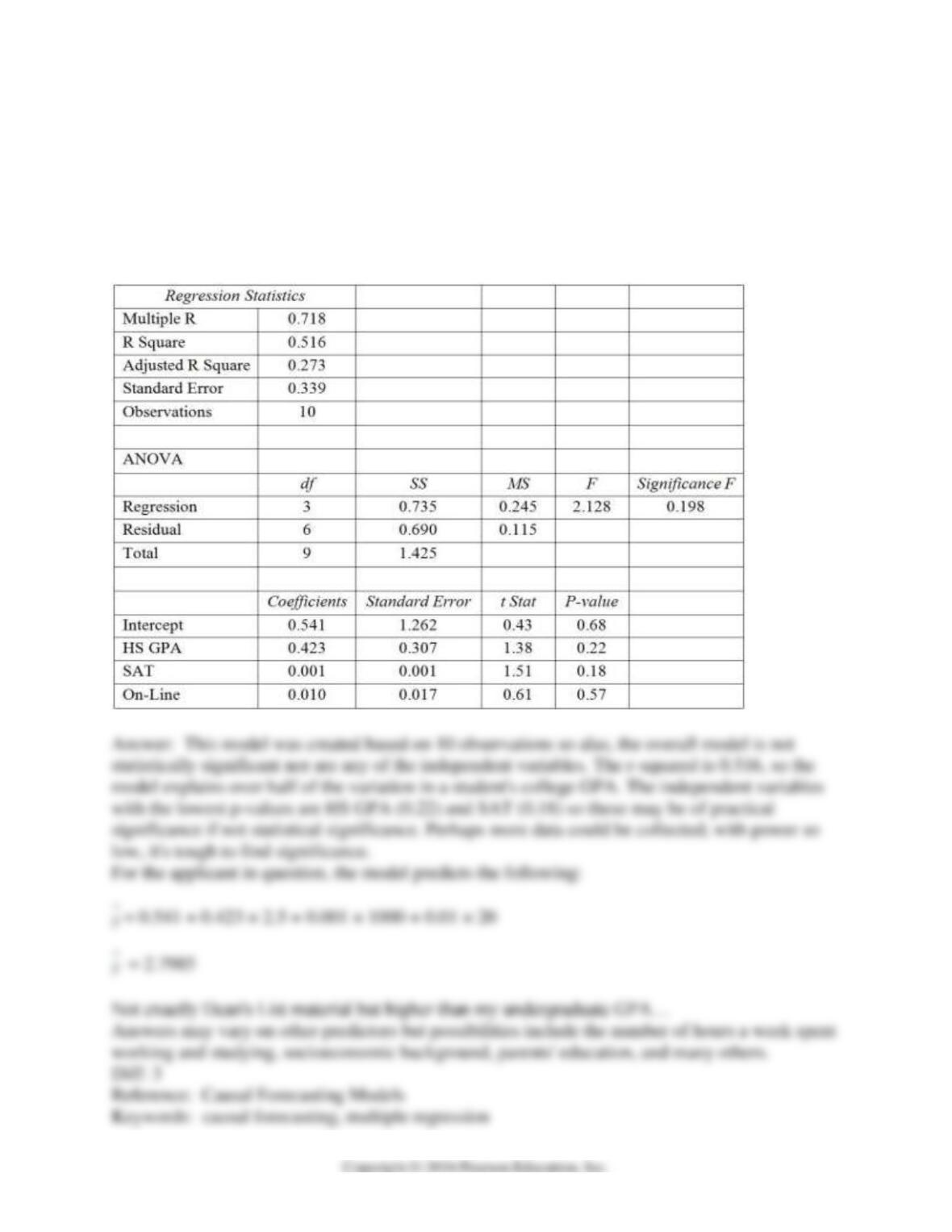
12) Multiple regression was used to forecast success in college (GPA) based upon SAT score,
high school GPA, and hours spent on-line. Use the regression output shown and comment on the
overall fit of the model, the usefulness of each independent variable, and the value to an
admissions department of using the model to make admission decisions. What is the model’s
forecast for an applicant having a high school GPA of 2.5 and an SAT score of 1000 that spends
20 hours a week on-line? What other variables do you feel would make good indicators of
college GPA?
34
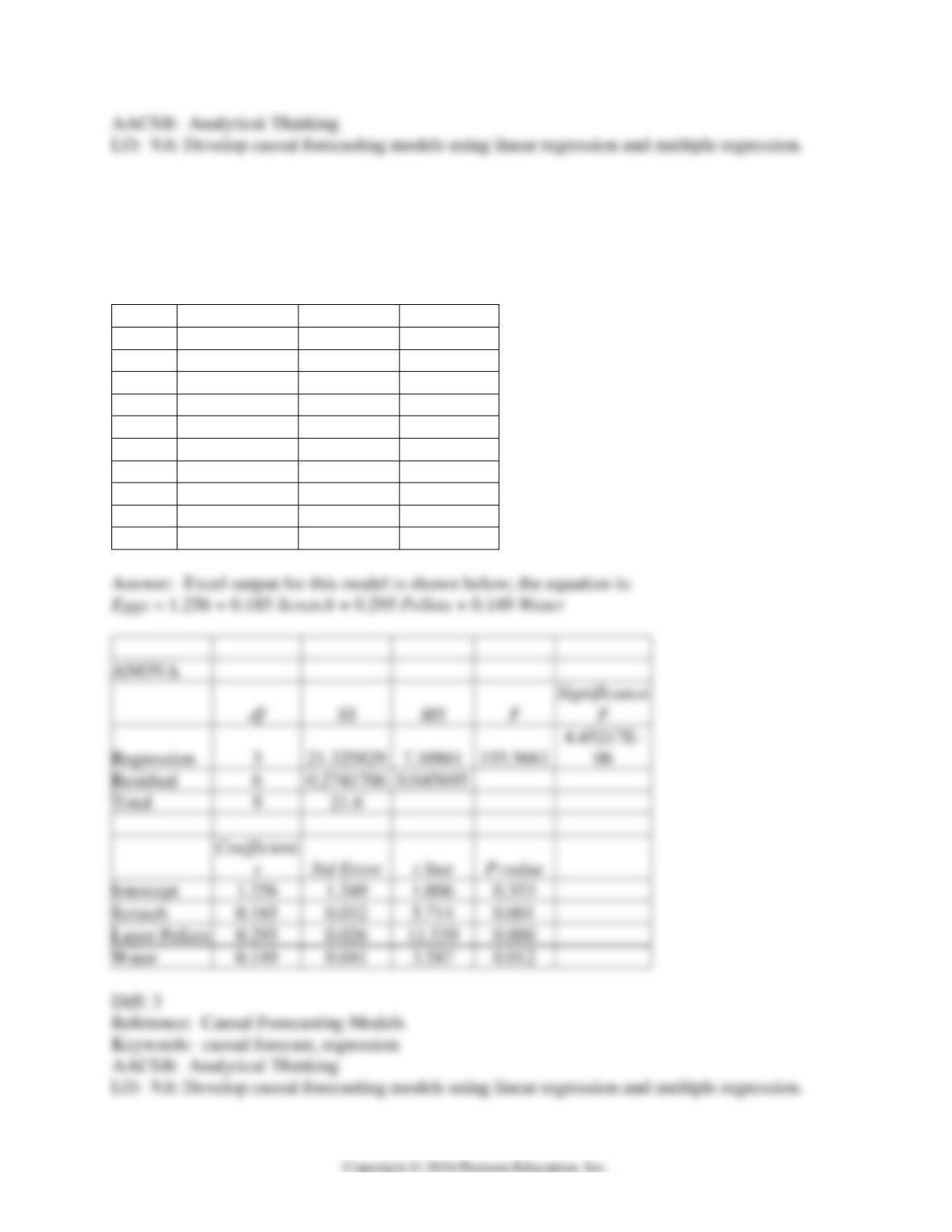
13) A poultry farmer that dabbles in statistics is interested in exploring the relationship between
two types of feed, layer pellets and scratch, water, and the output of his laying hens. For ten days
he records the number of ounces of layer pellets and scratch the hens consume and the number of
fluid ounces of water and tracks the number of eggs that are produced. What is his regression
equation based on the data?
Scratch
Layer Pellets
Water
Eggs
48
29
36
24
44
27
34
22
41
22
31
20
42
21
32
20
48
23
34
22
44
28
34
23
42
22
37
21
41
28
33
22
42
22
31
20
47
29
37
24
1.256
1.249
0.185
0.032
0.295
0.026
0.149
0.041
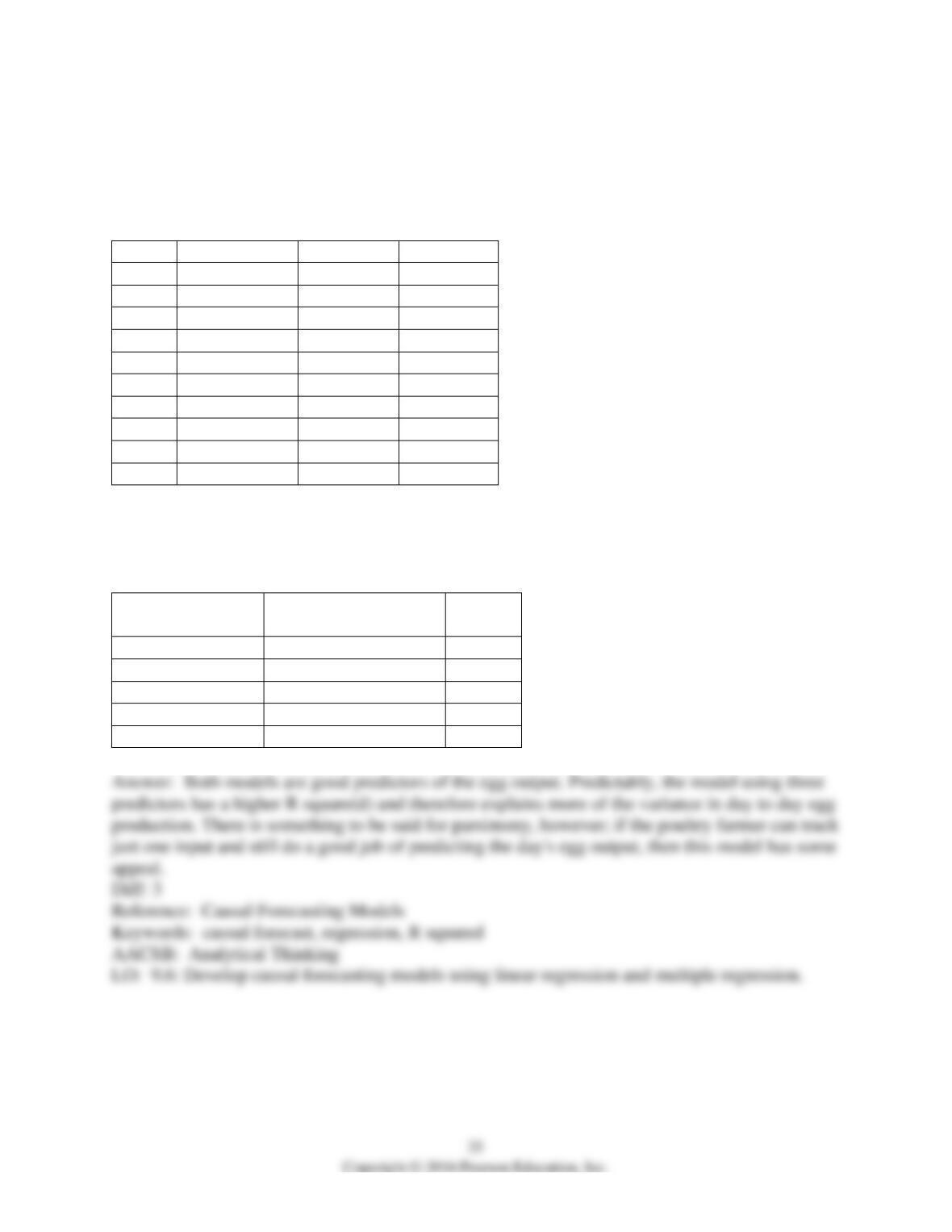
14) A poultry farmer that dabbles in statistics is interested in exploring the relationship between
two types of feed, layer pellets and scratch, water, and the output of his laying hens. For ten days
he records the number of ounces of layer pellets and scratch the hens consume and the number of
fluid ounces of water and tracks the number of eggs that are produced. What is his regression
equation based on the data?
Scratch
Layer Pellets
Water
Eggs
48
29
36
24
44
27
34
22
41
22
31
20
42
21
32
20
48
23
34
22
44
28
34
23
42
22
37
21
41
28
33
22
42
22
31
20
47
29
37
24
He develops one equation based on three predictors, the scratch, pellets, and water, and another
equation based only on the layer pellet consumption. The output for the two models are shown
side by side. Comment on the two models and which one should be used.
Pellets, Scratch,
Water
Pellets
Multiple R
0.994
0.904
R Square
0.987
0.817
Adjusted R Square
0.981
0.794
Standard Error
0.214
0.703
Observations
10
10

36
Learning Objective 9-7
1) The forecast data matches the actual data perfectly if the mean absolute deviation is 0.0.
2) A model with a positive mean forecast error suggests that, on average, the model
underforecasts.
3) The tracking signal calculated for the first forecast is always either +1 or -1.
4) Which of these forecasts is the BEST?
A) the one with a MAD of zero
B) the one with the tracking signal of +4
C) the one with the tracking signal of -4
D) the one where the tracking signal times the MAD equals zero

37
5) Nora Damus reviews her forecasting triumphs and failures as part of her annual report to the
Chief Operating Officer. She notes that her monthly forecast for batteries has a mean forecast
error of 20, and a mean absolute deviation of 20. Which of the following statements about her
forecast is BEST?
A) Nora has miscalculated her mean forecast error.
B) Nora has miscalculated her mean absolute deviation.
C) Nora has a negative tracking signal.
D) Nora has a positive tracking signal.
6) A counseling service records the number of calls to their hotline for the last year. Based on
MAD, which of these models does the best job of forecasting?
Month
Demand
January
111
February
127
March
146
April
159
May
165
June
165
July
178
August
182
September
191
October
208
November
223
December
228
A) A simple moving average of three periods
B) A simple moving average of five periods
C) A weighted moving average of .7, .2, .1
D) A weighted moving average of .5, .2, .2, .1

38
7) In order to indicate ________ in a forecast model, you should use the mean forecast error
approach rather than the mean absolute deviation approach.
8) A tracking signal value between ________ and ________ would suggest that the forecasting
technique in use is appropriate.
39
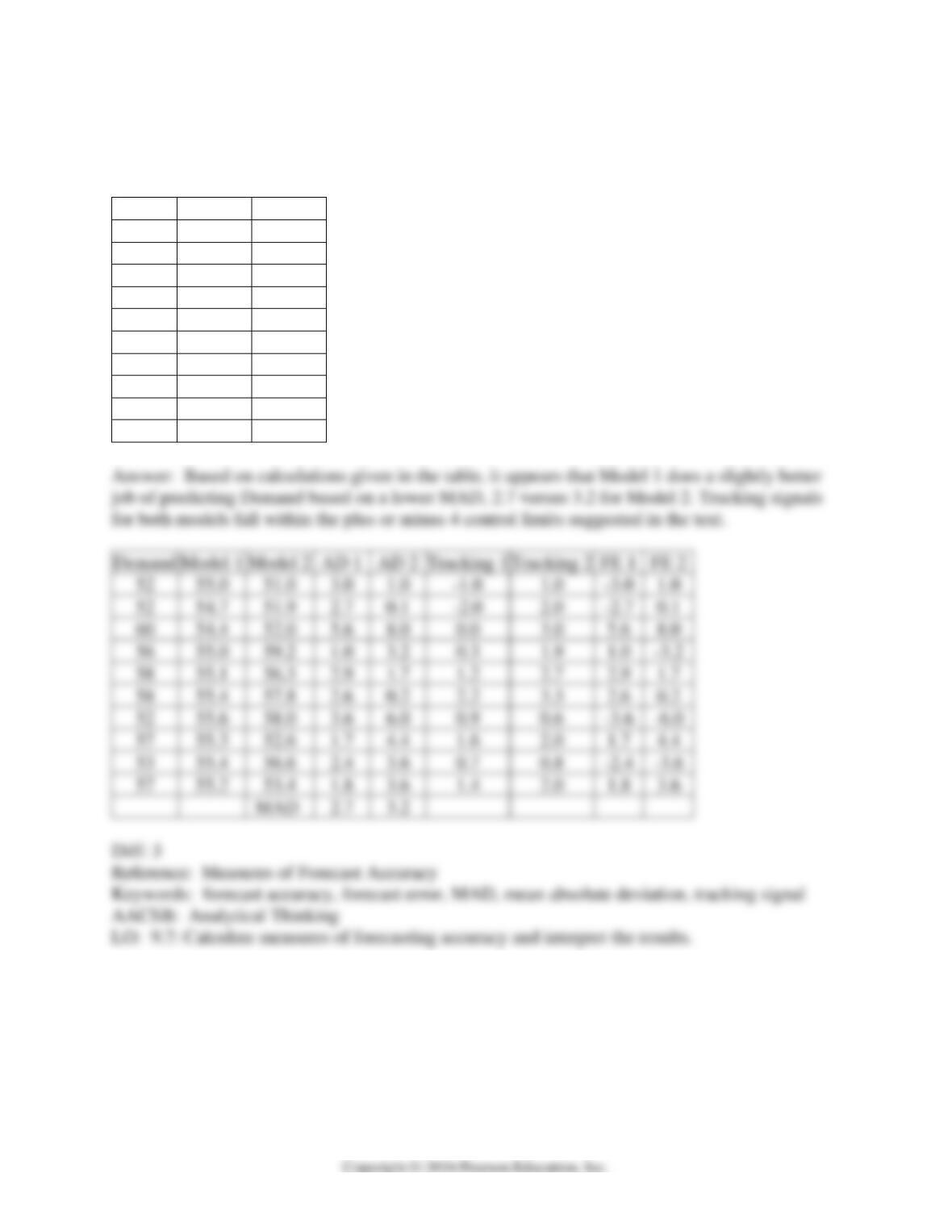
9) A forecaster is assessing two different models for demand. The output from each model and
the actual demand data appear in the table. Use MAD and a tracking signal to compare the two
models. Which model does a better job of forecasting?
Demand
Model 1
Model 2
52
55.0
51.0
52
54.7
51.9
60
54.4
52.0
56
55.0
59.2
58
55.1
56.3
58
55.4
57.8
52
55.6
58.0
57
55.3
52.6
53
55.4
56.6
57
55.2
53.4
52
52
60
56
58
58
52
57
53
57

Learning Objective 9-9
1) A collaborative planning, forecasting and replenishment system eliminates the need for
forecasting.
2) What distinguishes collaborative planning, forecasting, and replenishment (CPFR) systems
from traditional planning approaches is the emphasis on forecasting.
3) Which one of the following statements regarding collaborative planning, forecasting, and
replenishment (CPFR) systems is best?
A) In CPFR, each business develops a sales and operations plan and the mainframe system
reconciles these plans to find a middle ground that all businesses work towards.
B) CPFR is a set of business processes.
C) CPFR has the Project Management Body of Knowledge (PMBOK©) as its basis.
D) Studies have demonstrated that manual, paper-based CPFR systems are more responsive and
more accurate than computer-based CPFR systems.
4) Supply chain partners might use a(n) ________ to develop joint sales and operations plans and
projections of output if they have agreed on a common set of objectives.

41
5) What is a collaborative planning, forecasting, and replenishment system and how might it
benefit those who choose to use it?