
Managing Information Technology, 7e (Brown)
Chapter 9 Methodologies for Custom Software Development
1) The SDLC phase that typically requires the greatest percentage of the total cost for a custom
development project is the ________ phase.
A) definition
B) construction
C) implementation
D) final
2) During the feasibility analysis phase of the SDLC, which of the following types of feasibility
is not assessed?
A) economic
B) operational
C) time-driven
D) technical
3) Who usually takes primary responsibility for establishing the custom development costs for an
SDLC project?
A) end user
B) business manager
C) IS analyst
D) both B and C
4) The ________ approach to systems development has often been referred to as the “waterfall”
model.
A) SDLC
B) prototyping
C) RAD
D) XP
5) Deciding what hardware and systems software will be used to operate the system and defining
the processing modules that will comprise the system are part of which SDLC step?
A) system building
B) requirements definition
C) system design
D) feasibility analysis
6) Testing a new custom system before implementation is the responsibility of:
A) both users and IS analysts.
B) users only.
C) IS analysts only.
D) independent third parties.
7) Which of the following accurately describes the order in which a system is tested?
A) module testing, subsystem testing, integration testing, acceptance testing
B) subsystem testing, acceptance testing, integration testing, module testing
C) acceptance testing, integration testing, subsystem testing, module testing
D) module testing, integration testing, subsystem testing, acceptance testing
8) A conversion strategy whereby an organization continues to operate the old system together
with the new one for one or more cycles, until the new system is working properly and the old
system can be discontinued, is called a:
A) pilot strategy.
B) phased strategy.
C) cutover strategy.
D) parallel strategy.
9) A conversion strategy whereby the new system is first implemented in only part of the
organization to solve any problems before implemented in the rest of the organization is called a:
A) pilot strategy.
B) phased strategy.
C) cutover strategy.
D) parallel strategy.
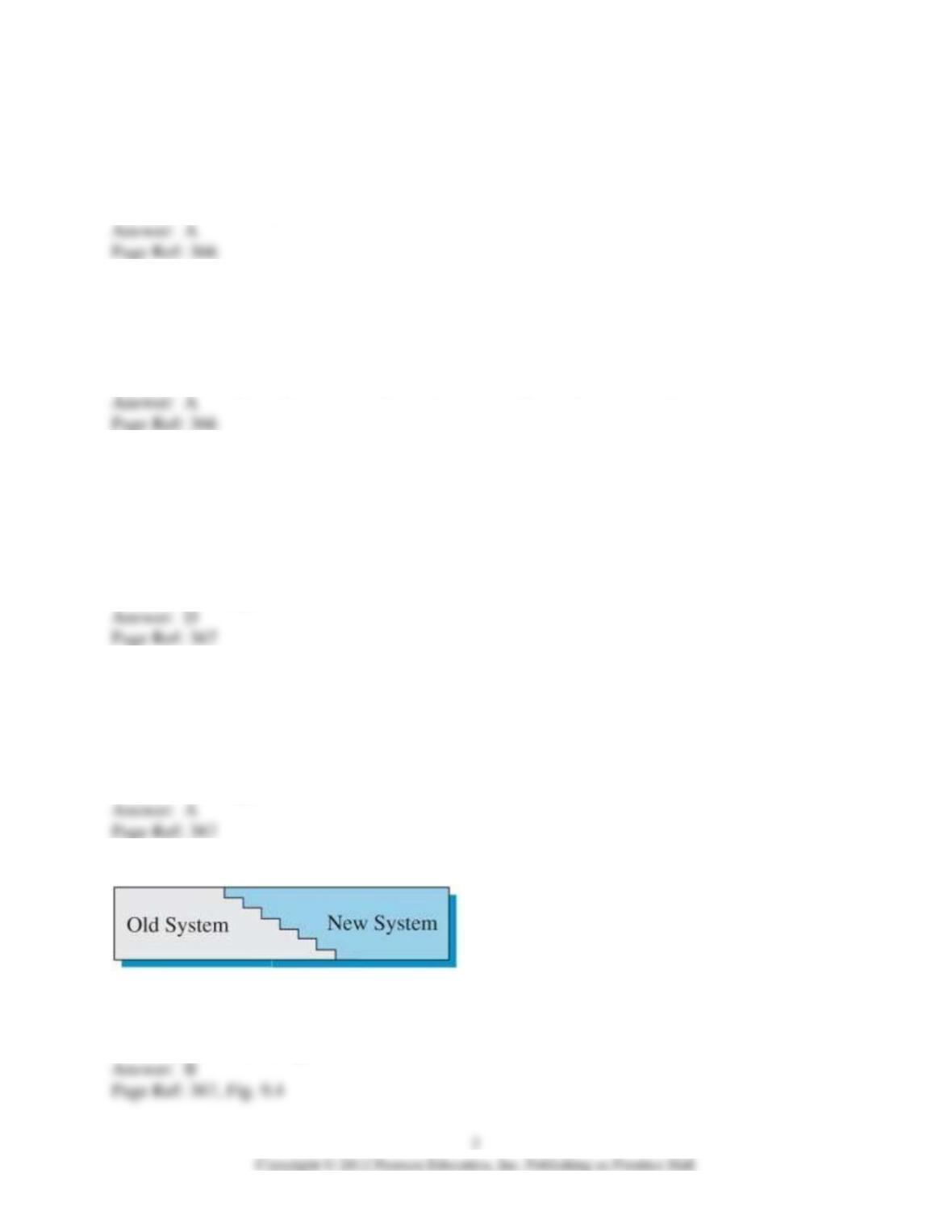
10) The following diagram depicts which of the following conversion strategies?
A) parallel strategy
B) phased strategy
C) pilot strategy
D) entrepreneurial strategy

11) The following diagram depicts a cutover conversion strategy. Which of the following best
characterizes this type of conversion strategies?
A) costly
B) time consuming
C) risky
D) all of the above
12) The percentage of resources devoted to the maintenance of a system:
A) generally increases over time.
B) generally decreases over time.
C) generally stays about the same over time.
D) is variable depending on the system.
13) Which of the following is not typically the responsibility of an IT project manager?
A) approve funds for the project
B) oversee multiple project phases
C) determine how long each development task will take
D) form a project team with appropriate knowledge and skills
14) Which of the following best describes a responsibility of a systems analyst?
A) ensure the promised benefits of a system are achieved
B) develop detailed system requirements
C) train users
D) all of the above
15) Which prototyping step is not the responsibility of the system builders?
A) develop initial prototype
B) use prototype and note desired changes
C) revise and enhance prototype
D) assist with converting the prototype to an operational system

16) Which of the following is not an advantage of prototyping?
A) Only basic system requirements are needed at the front-end of the project.
B) End-prototype typically has more security and control features than a system developed with
an SDLC process.
C) Strong top-down commitment may be less necessary at the outset of the project.
D) User acceptance is likely to be higher than with a system developed using an SDLC process.
17) Which of the following is typical for a pure prototyping approach?
A) Firms use the approach to explore the use of newer technologies.
B) Documentation is less complete than with traditional systems development approaches.
C) Less security and control features are incorporated than with traditional SDLC approach.
D) all of the above
18) When prototyping is incorporated into a traditional SDLC approach, it is most commonly
included as part of which of the following steps?
A) requirements definition
B) feasibility analysis
C) system design
D) system building
19) Which of the following best describes a common prototyping goal when it is used as part of a
prototyping/piloting approach?
A) to establish and demonstrate basic concepts of the new system and to get buy-in from key
stakeholders
B) to demonstrate the technical feasibility of the new system
C) to test a complex system
D) both A and B
20) Which of the following is a technique where a team of users and IS specialists engage in an
intensive session to minimize the total time required for gathering information from multiple
participants?
A) RAD
B) Piloting
C) JAD
D) CASE

21) A software tool used to automate one or more steps of a software development methodology
is referred to as:
A) RAD.
B) Piloting.
C) JAD.
D) CASE.
22) All of the following are considered advantages to using RAD methodology, except:
A) dramatic savings in development time.
B) system quality much higher than with SDLC.
C) focuses on essential system requirements.
D) ability to rapidly change system design at user request.
23) Which is a potential advantage of having an application developed by a business user, rather
than an IS professional?
A) The system requirements do not have to be explained to an IS analyst.
B) If the system is a high priority for a business unit, it does not have to compete with other
business units for IS personnel to work on it.
C) Business managers have more control over the development costs for the application.
D) all of the above
24) Which is not a potential disadvantage of having an application developed by a business user,
rather than an IS professional?
A) A similar application may already exist in another business unit, so it could be a redundant
effort.
B) Users typically pay more attention to system controls for ensuring data quality and security,
and therefore development costs are higher.
C) It is common for user developers to change jobs.
D) User-developed systems are frequently less well documented.
25) What three characteristics should be evaluated by organizations when choosing whether or
not to have a non-IS professional develop a new application?
A) application, development tool, and telecommunications characteristics
B) training classes attended by user, IS professional certifications, security issues
C) application, development tool, and developer characteristics
D) number of years developer has been in the organization, the application size, and the cost of
the development tool

26) What is a specific characteristic of an application that can be important for determining the
potential risks of developing a new business application by an employee with no professional IS
training?
A) the number of users of the application
B) the potential impact on operations or decisions based on the application
C) the average age of the developer
D) both A and B
27) A common shortcoming of user-developed applications is:
A) inadequate system testing.
B) inadequate knowledge of the business problem.
C) the usage of a prototyping methodology.
D) too much time spent on documenting the system.
28) Which of the following is not a characteristic of eXtreme Programming (XP)?
A) it is a one type of so-called agile approaches to systems development
B) programmers write code in pairs and test their own code
C) both definition and construction tasks are accomplished together
D) it works best when developing large-scale, complex transaction processing systems
29) The agile method that emphasizes independent project teams, coordination and
communication between and within teams with lots of team meetings, iterative and continuous
monitoring of work, team ownership of the final product is called:
A) XML.
B) RAD.
C) Scrum.
D) JAD.
30) Which of the following is not a key guideline for managing day-to-day interactions with
outsourced staff?
A) communicate frequently
B) closely monitor and manage the work of the outsourcer’s staff
C) create a centralized project management office
D) hire offshore legal expertise for writing contracts

7
31) The parallel strategy of installing a new system is the riskiest method of installation because
the old system is abandoned as soon as the new system is implemented.
32) The Construction phase of the SDLC involves installation and operations of the new system.
33) The SDLC methodology is the best methodology when an application needs to be quickly
developed.
34) Agile methodologies are especially useful for developing smaller systems rather than
largescale transaction processing applications.
35) A type of testing where the objective is to make sure that the system performs reliably and
does what it is supposed to do in a user environment is referred to as user acceptance testing.
36) When a change made to one part of a system results in unexpected changes to another part of
the system, it is commonly referred to as a ripple effect.
37) Some consultants have claimed that up to one-third of all spreadsheets contain errors, which
can include mechanical errors (typos), errors in logic, as well as errors in omission.