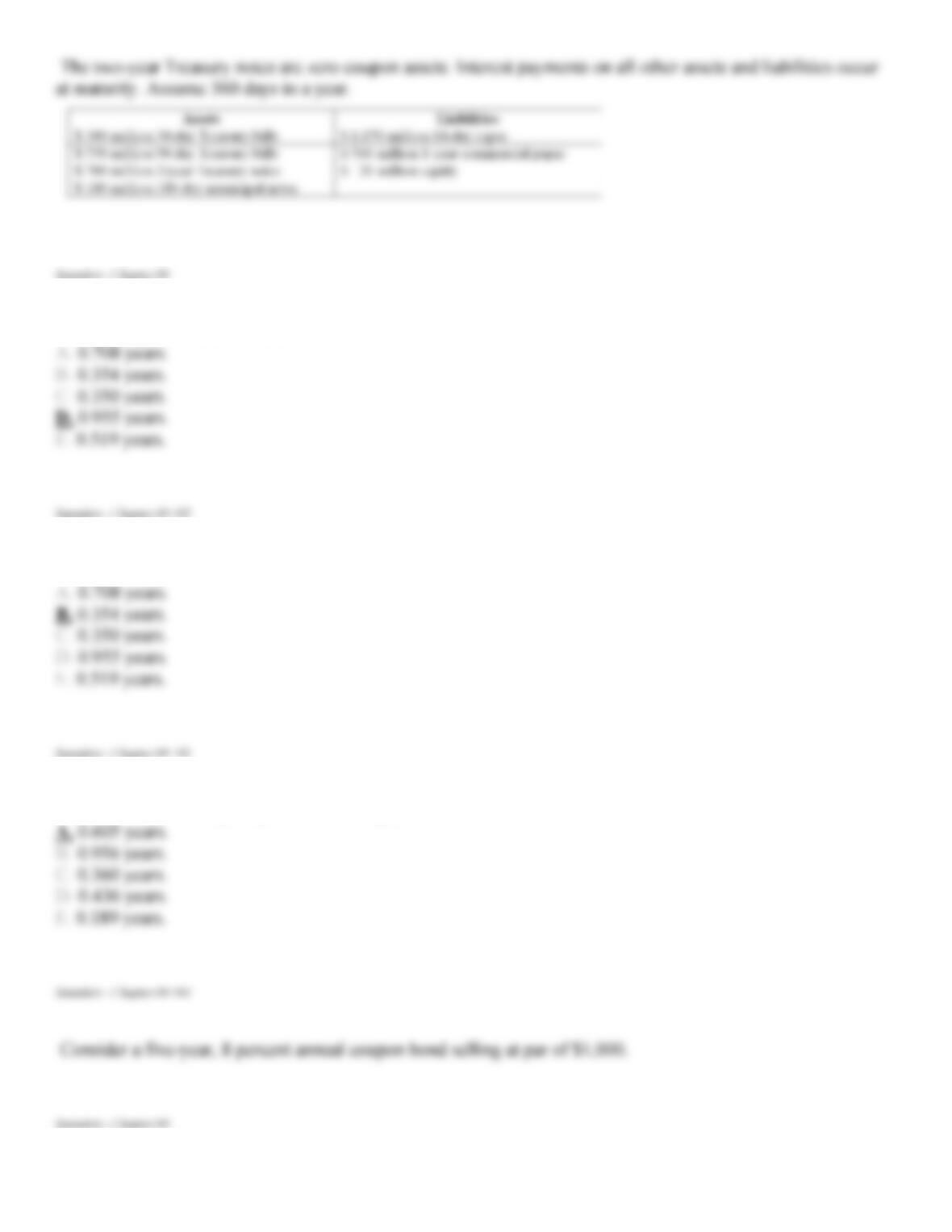
92. What is the duration of the assets?
93. What is the duration of the liabilities?
94. What is the leverage-adjusted duration gap?
95. What is the duration of this bond?
96. If interest rates increase by 20 basis points, what is the approximate change in the market price using the
duration approximation?
97. Using present value bond valuation techniques, calculate the exact price of the bond after the interest rate
increase of 20 basis points.
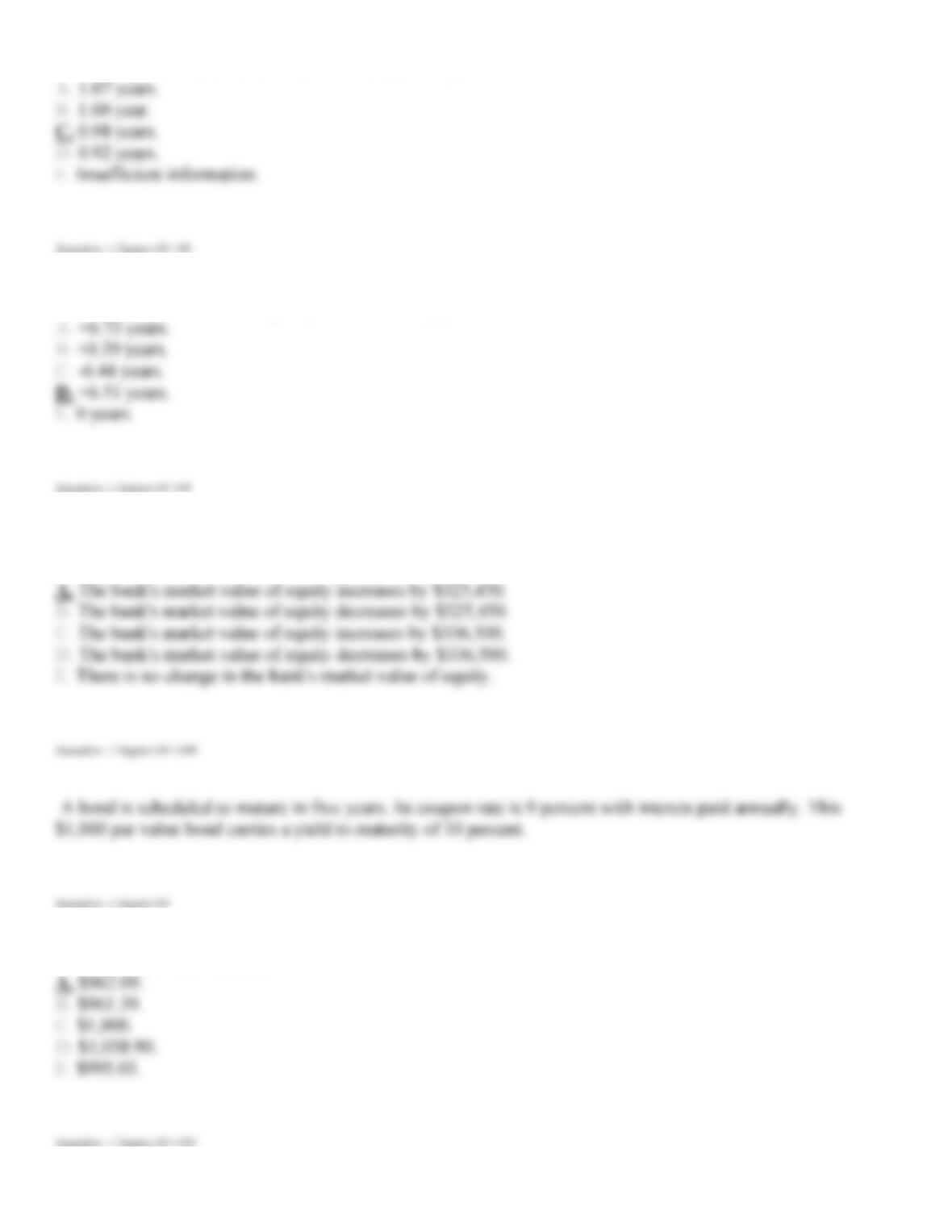
98. What is the duration of the bank’s Treasury note portfolio?
99. What is the bank’s leverage adjusted duration gap?
100. If all interest rates fall by 1 percent, calculate the impact on the bank’s market value of equity using the
duration approximation. (That is, R/(1+R) = -1 percent)
101. What is the bond’s price?
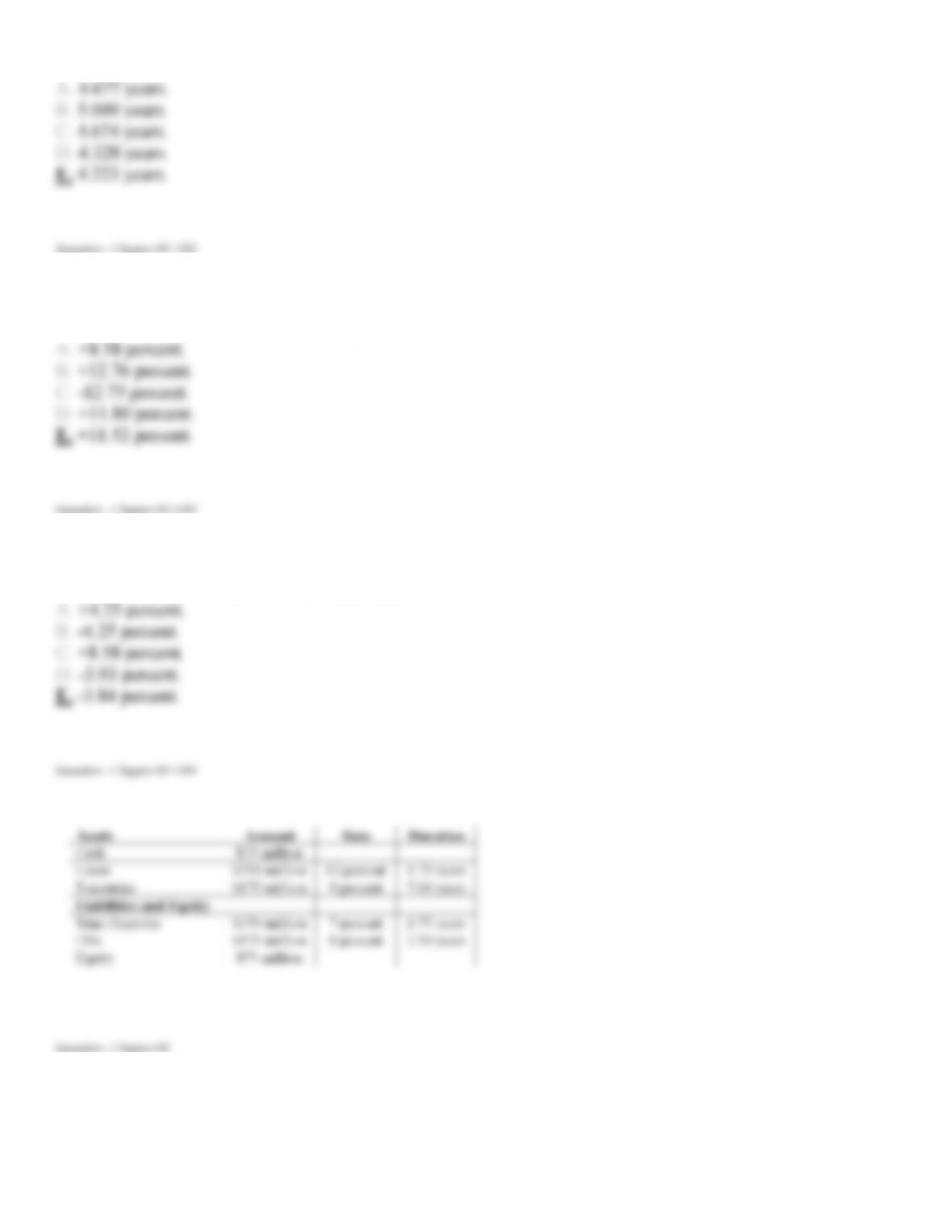
102. What is the duration of the bond?
103. Calculate the percentage change in this bond’s price if interest rates on comparable risk securities decline to
7 percent. Use the duration valuation equation.
104. Calculate the percentage change in this bond’s price if interest rates on comparable risk securities increase
to 11 percent. Use the duration valuation equation.
105. Calculate the duration of the assets.
106. Calculate the duration of the liabilities.
107. Calculate the leverage-adjusted duration gap and state the FI’s interest rate risk exposure.
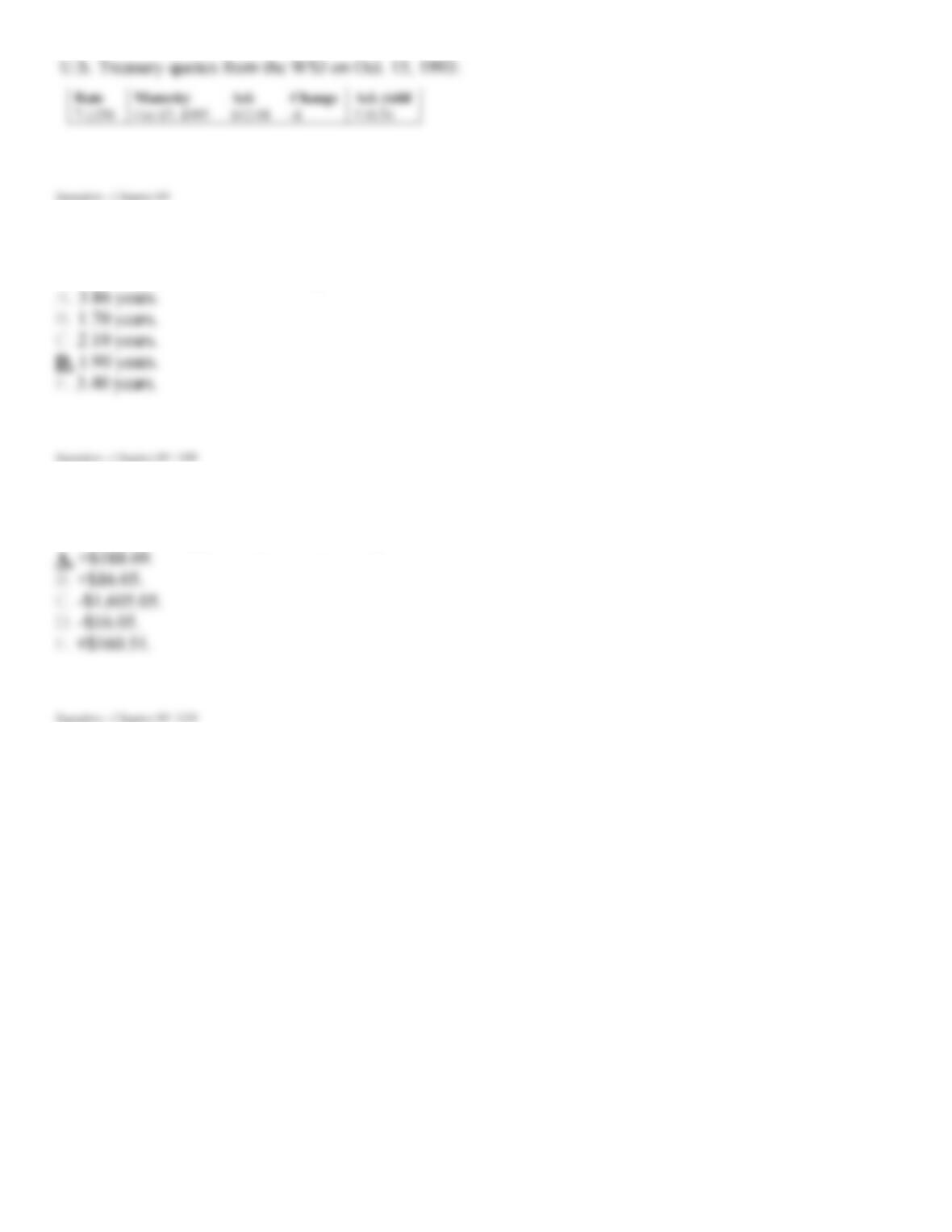
109. What is the duration of the above Treasury note? Use the asked price to calculate the duration. Recall that
Treasuries pay interest semiannually.
110. If yields increase by 10 basis points, what is the approximate price change on the $100,000 Treasury note?
Use the duration approximation relationship.
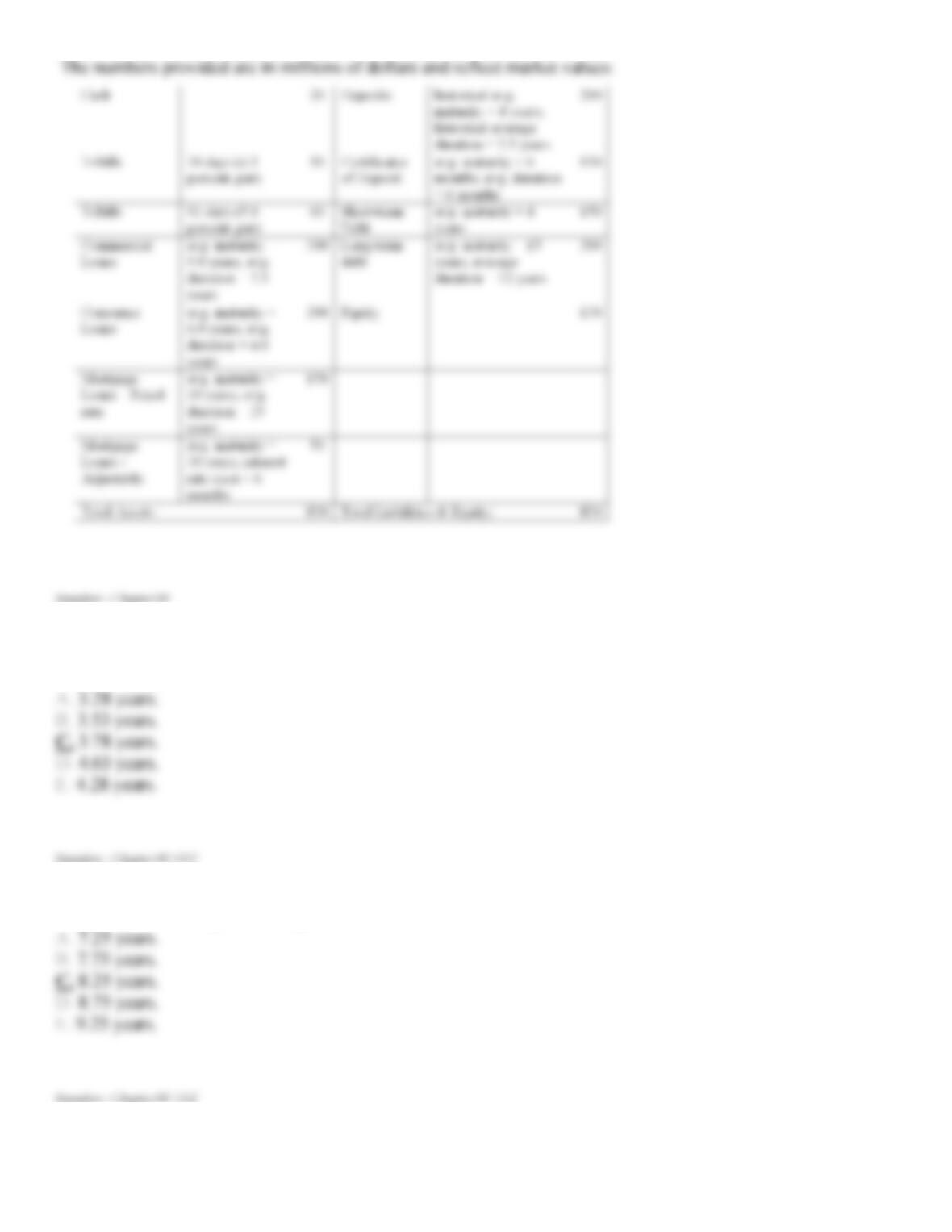
111. The short-term debt consists of 4-year bonds paying an annual coupon of 4 percent and selling at par. What
is the duration of the short-term debt?
112. What is the weighted average duration of the assets of the FI?
113. What is the weighted average duration of the liabilities of the FI?
114. What is the leverage adjusted duration gap of the FI?
115. A risk manager could restructure assets and liabilities to reduce interest rate exposure for this example by
116. The shortcomings of this strategy are the following except
117. What is the effect of a 100 basis point increase in interest rates on the market value of equity of the FI? Use
the duration approximation relationship. Assume r = 4 percent.
118. What is the duration of the municipal notes (the value of x)?
119. What is this bank’s interest rate risk exposure, if any?
120. What will be the impact, if any, on the market value of the bank’s equity if all interest rates increase by 75
basis points? (i.e., R/(1+R) = 0.0075)
121. Calculating modified duration involves dividing the value of duration by the change in the market interest
rate.
Error! Hyperlink reference not valid.
122. The degree of curvature in the price-yield relationship is reflected by the CX parameter which measures
the degree to which the capital loss effect exceeds the capital gain effect.

123. Convexity decreases as the maturity decreases.
124. Given the same maturity, zero coupon bonds have more convexity than coupon bonds.
125. Given the same duration, zero coupon bonds have more convexity than coupon bonds.
126. A key assumption of the (Macaulay) duration model is that the term structure of interest rates must be
upward sloping.
127. In the purest sense, the appropriate duration measure of a bond should be found by discounting the cash
flows of the bond by the discount rates on similar maturity zero coupon bonds.
128. The purest duration measure, D*, is robust in the sense that changes in the yield curve from which it was
calculated will not change its value.

129. The effect of rescheduling an interest payment on a defaulted bond will cause the measure of duration to
increase.
130. The duration value for floating-rate assets is calculated in the same manner as for fixed-rate assets.
131. One method of calculating the duration of demand deposits is to consider duration to be the average
turnover of the deposit accounts in days.
132. Duration is difficult to calculate for mortgages and mortgage-backed securities because of prepayment
risk.
133. The convexity adjustment
134. All of the following statements are true for fixed-rate bonds EXCEPT
135. What is the duration of this bond?
136. If interest rates increase to 9 percent, what is the amount of error (Pduration – Pmarket) in the price estimate
using the duration relationship versus the true bond price determined in the market?
137. What is the convexity factor (CX) for this bond?
138. What is the change in price caused by convexity in the duration-convexity model for an interest rate
increase to 9 percent?
139. What is the duration of this bond?
140. If interest rates increase to 8 percent, what is the amount of error (Pduration – Pmarket) in the price
estimate using the duration relationship versus the true bond price determined in the market?
141. What is the convexity factor (CX) for this bond?
142. What is the change in price caused by convexity in the duration-convexity model for an interest rate
increase to 8 percent?
143. If your bank wanted to maximize net interest income, what position would you put on?
144. What would be the risk exposure of the position that maximizes net interest income?
145. If your bank puts on the position to maximize net interest income, what will be the impact on the bank’s
end of year 2 net interest income if all interest rates immediately (at t=0) increase 25 basis points?
146. What is the duration of the Treasury note?

147. What is the duration of the Treasury bill?
148. What is the duration of the 2-year CD?
149. What is the duration of the AAA-corporate debt?
150. If AAA-corporate debt rates increase 10 basis points, use duration to calculate the approximate price
change for a $100,000 bond.
151. Use convexity to find the approximate price change for the 2-year AAA-corporate debt if interest rates
increase by 10 basis points.
152. If the position that maximizes net interest income is fully financed using liabilities (i.e. there is no capital
contribution), what is the position’s duration gap?
153. Using the position’s duration gap, what is the impact on the bank’s capital if all interest rates increase by a
percentage rate of 10 basis points? (That is, R/1+R = 0.10 percent)