Chapter 08S – The Transportation Model
1. The transportation model assumes similar, homogeneous goods.
2. The transportation model assumes shipping cost per unit is the same regardless of the
number of units shipped (there are no quantity discounts).
3. The transportation model is a special type of linear regression model.
Chapter 08S – The Transportation Model
4. For a transportation model to be used, more than one location must be considered.
5. The linear programming model of a transportation problem has one goal – the maximization
of its objective function.
6. Dummy rows or columns to equate supply and demand are available but not required in
linear programming models of transportation problems.
Chapter 08S – The Transportation Model
7. The transportation model method for evaluating location alternatives minimizes total:
8. An automobile manufacturer that has eight assembly plants and thousands of dealers
throughout the United States can find the optimal distribution plan by using:
Chapter 08S – The Transportation Model
9. Which of the following is not information needed to use the transportation model?
10. The transportation method is a linear programming technique. Linearity is present in the
following way:
Chapter 08S – The Transportation Model
11. Which of the following are assumptions or requirements of the transportation method?
(I) Goods are the same, regardless of source.
(II) There must be multiple sources.
(III) Minimum quantities must be shipped from each source.
(IV) Shipping costs per unit do not vary with the quantity shipped.
12. Which of the following is not an assumption of the transportation model?
Chapter 08S – The Transportation Model
8S-6
13. Which of the following is the information needed to use the transportation model?
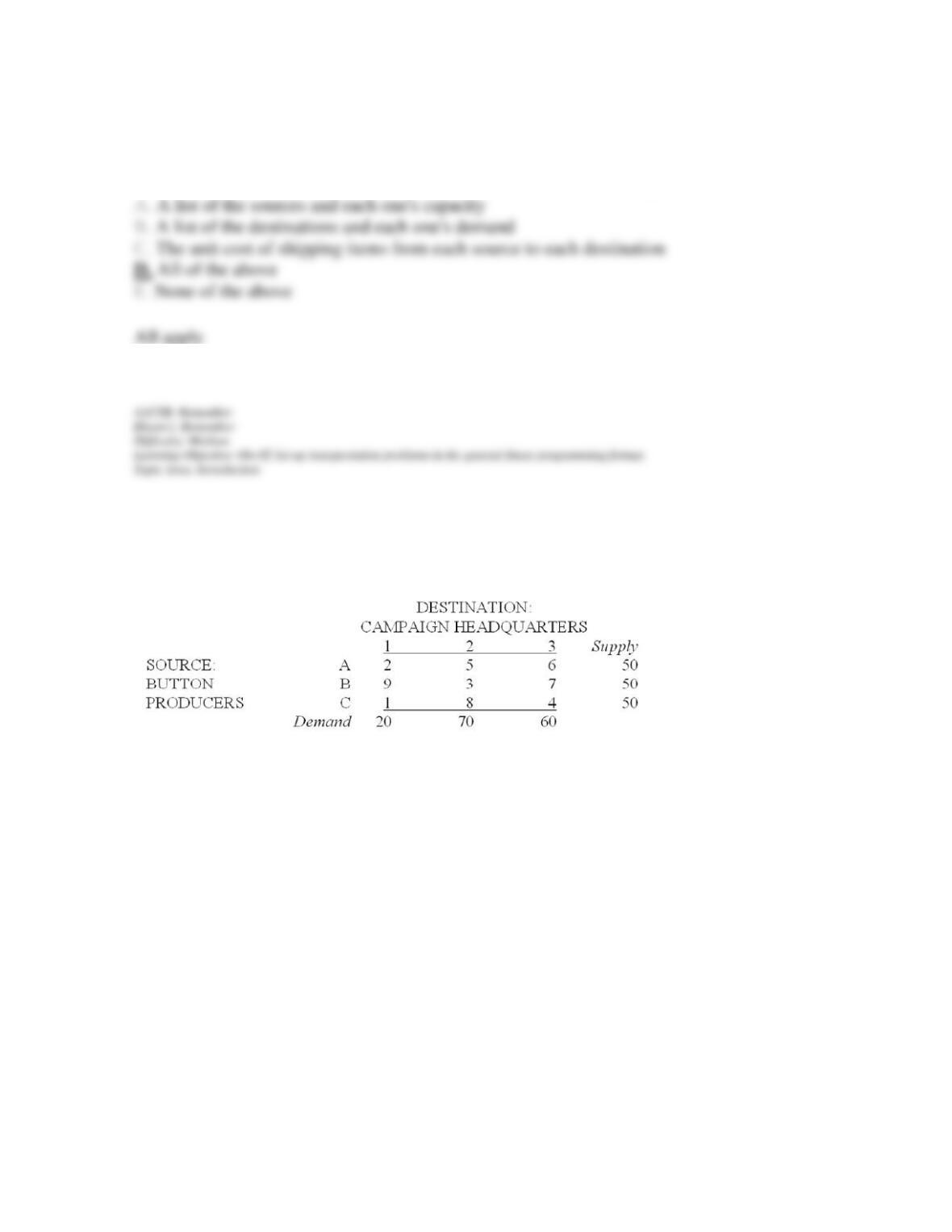
A campaign manager for a political candidate must arrange the shipment of 150 cartons of
campaign buttons from three button producers to three campaign headquarters. The supplies
and demands, and the per-carton transportation costs, are shown below:
Chapter 08S – The Transportation Model
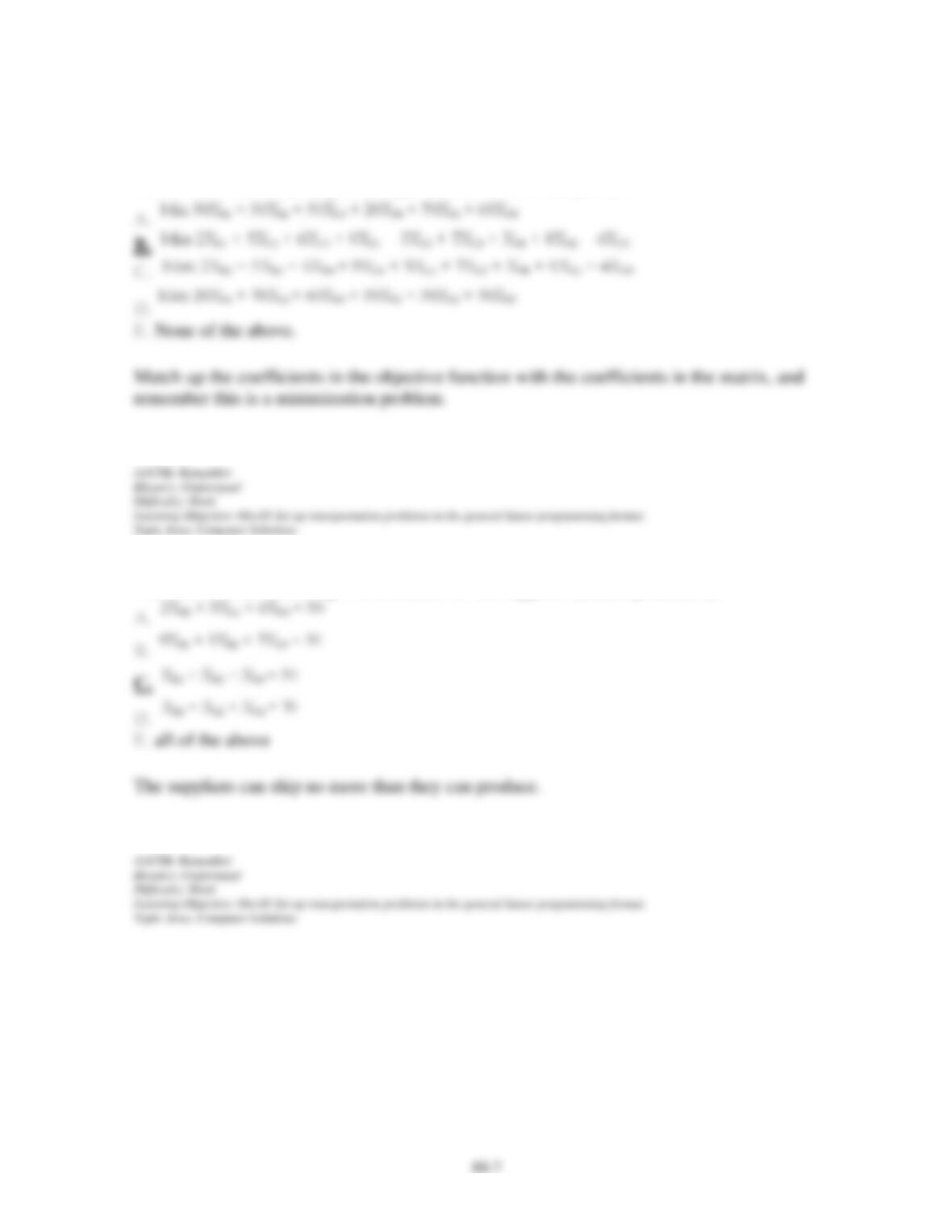
14. Which of the following is an objective function for the problem?
15. Which of the following is a constraint for the suppliers (button producers)?
Chapter 08S – The Transportation Model
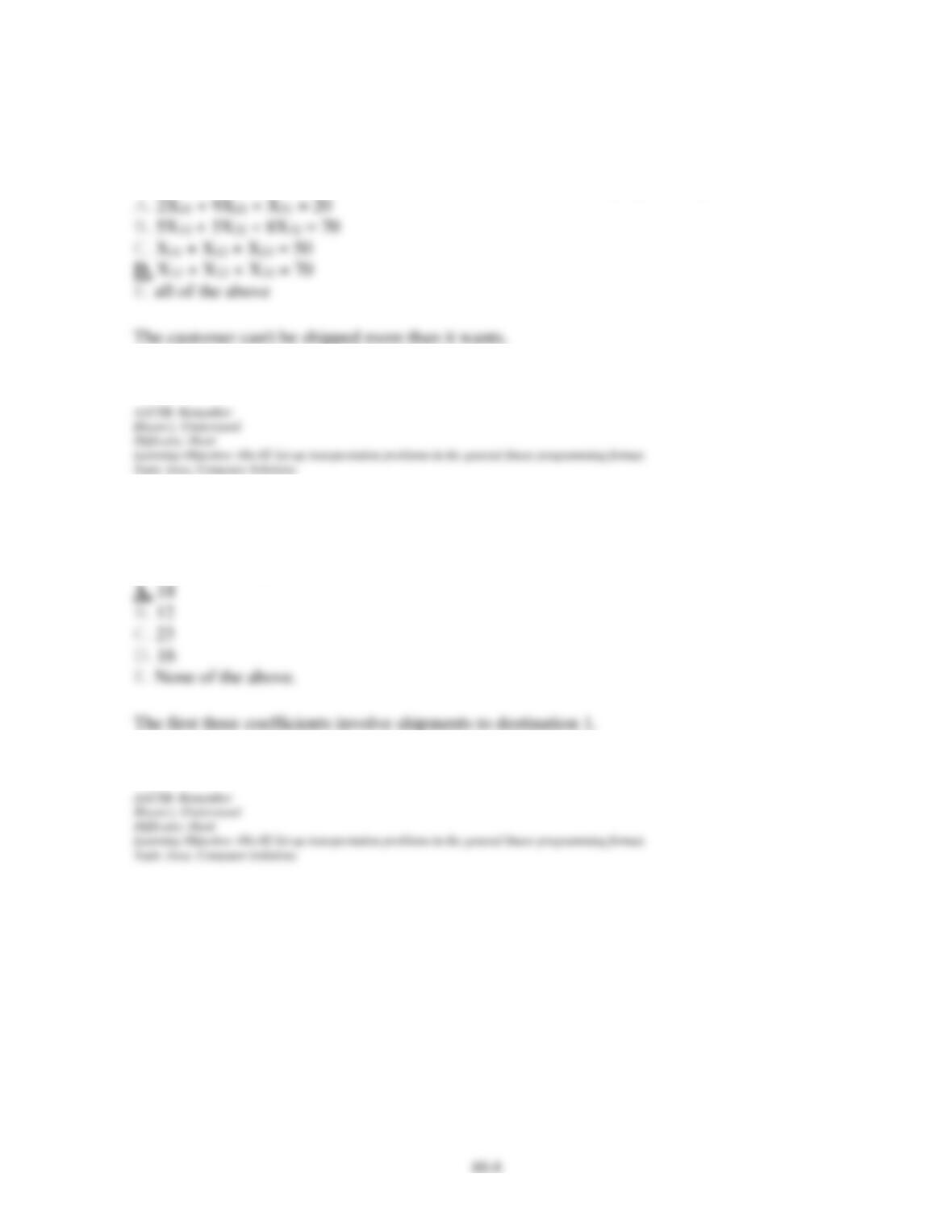
16. Which of the following is a constraint for the customer (campaign headquarters)?
17. In a transportation problem with three locations and two destinations, the objective
function is as follows: Min 20X11 + 18X21 + 23 X31 + 16X12 + 14X22 + 12X32. How much
does it cost to ship one unit from location 2 to destination 1?
Chapter 08S – The Transportation Model
8S-9
18. In a transportation problem with three locations and two destinations, the objective
function is as follows: Min 20X11 + 18X21 + 23 X31 + 16X12 + 14X22 + 12X32. How much
does it cost to ship one unit from location 1 to destination 2?
Chapter 08S – The Transportation Model
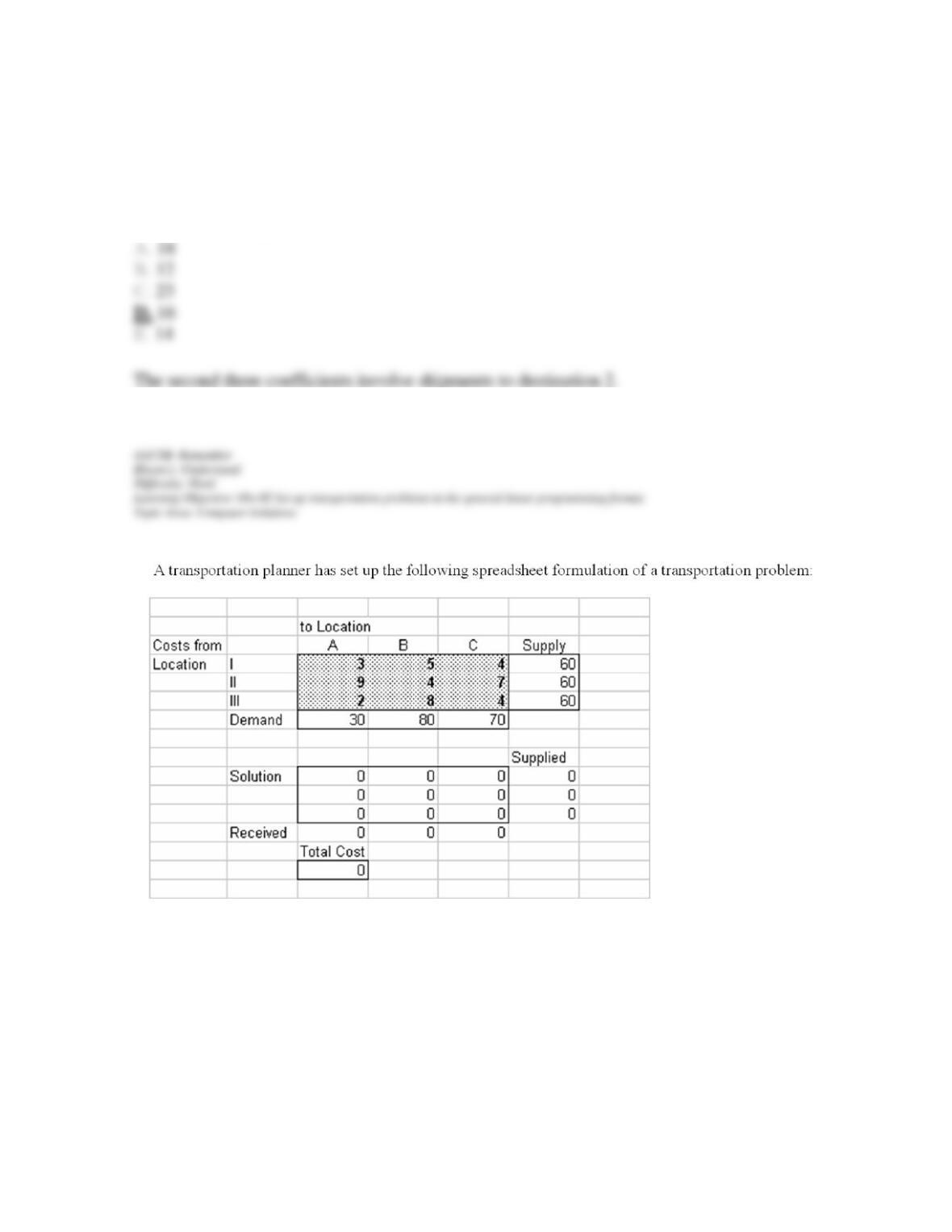
19. This model indicates that it costs ________ dollars to ship one unit from location(s)
_______ to location(s) ___.
Chapter 08S – The Transportation Model
8S-11
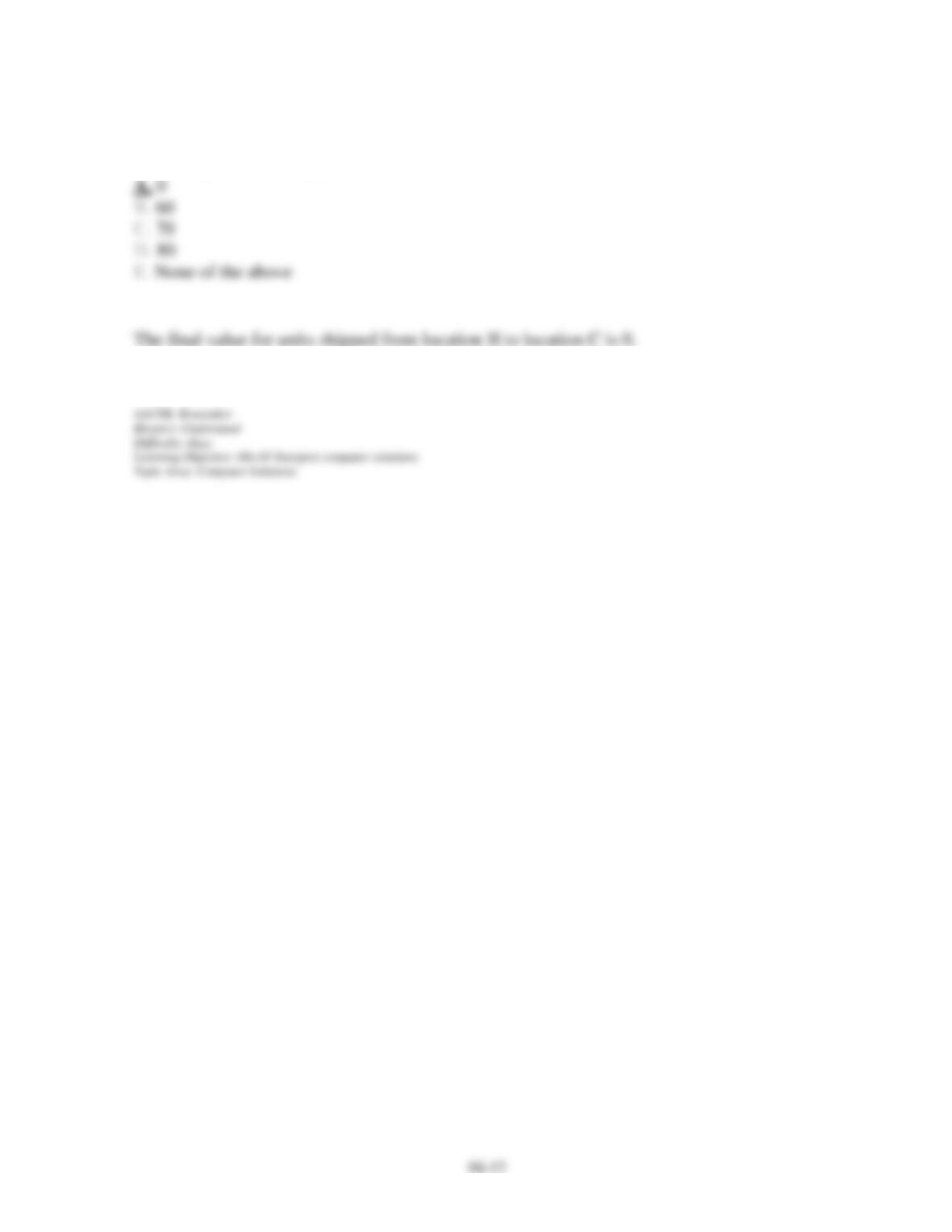
20. Suppose the output from the above formulation is as follows:
Chapter 08S – The Transportation Model
How many units are shipped from location II to location C?