85
FORECASTING
CHAPTER 8
ANSWERS TO PROBLEMS
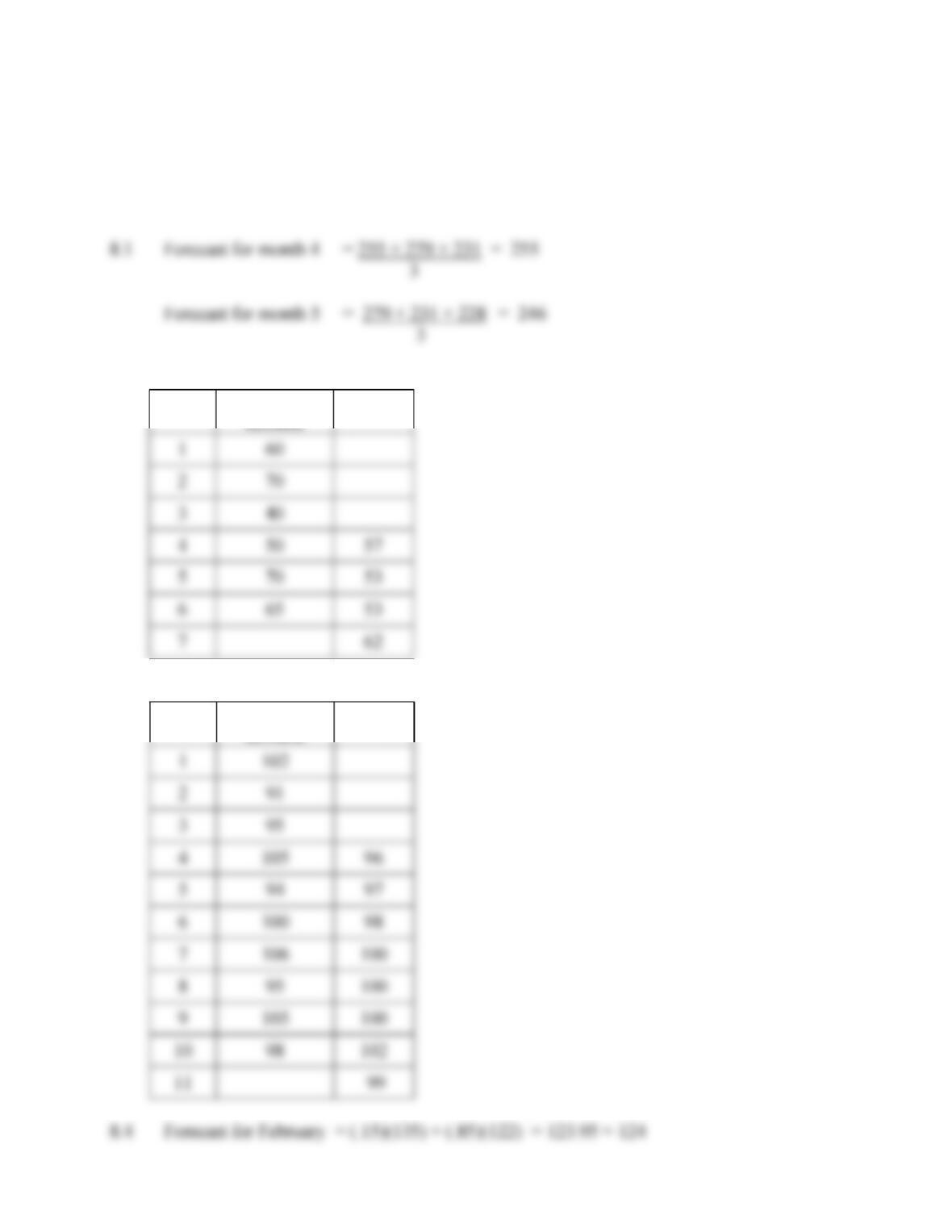
8.2
Month
Actual
demand Forecast
8.3
Month
Actual
demand Forecast
86
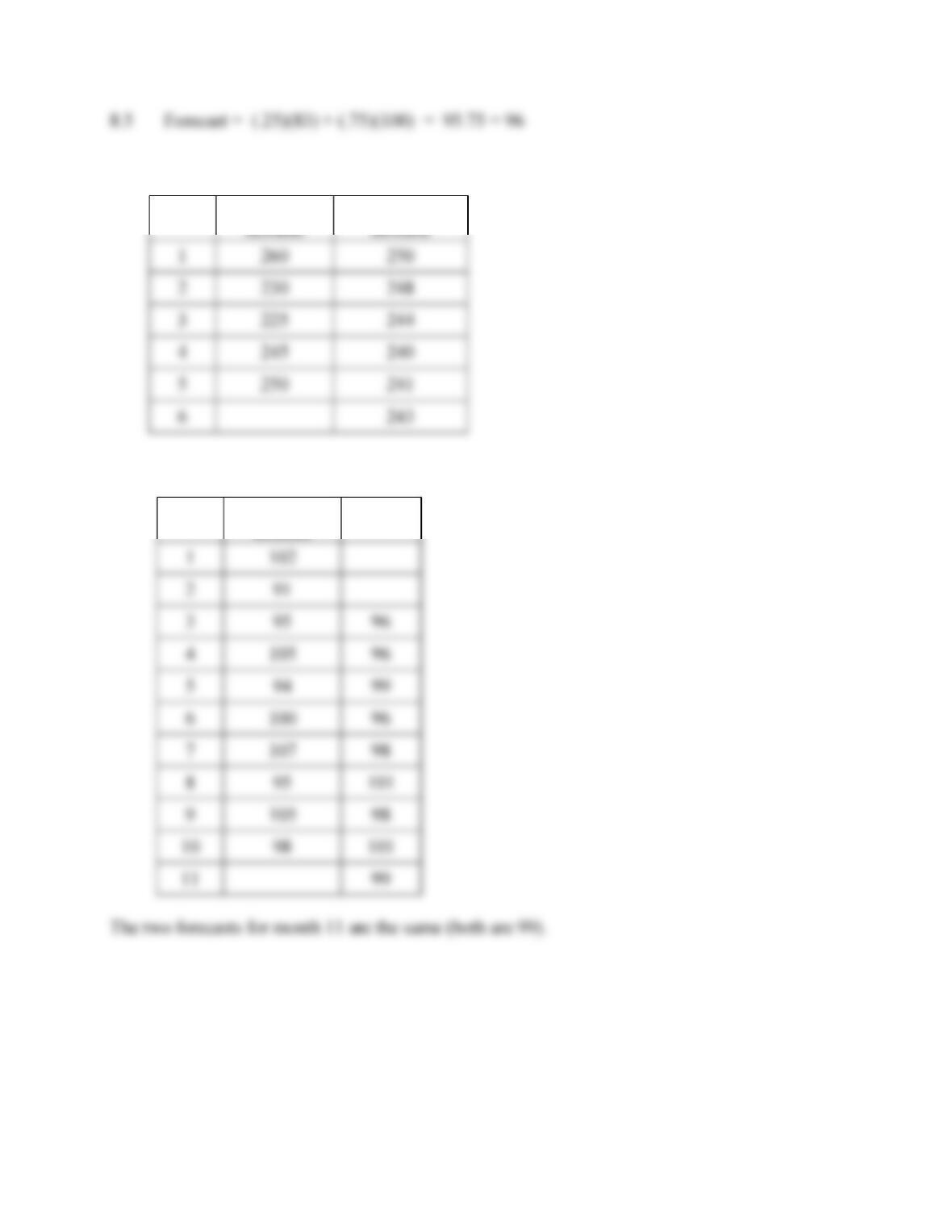
8.6
Month
Actual
Forecast
8.7
Month
Actual
demand Forecast
87
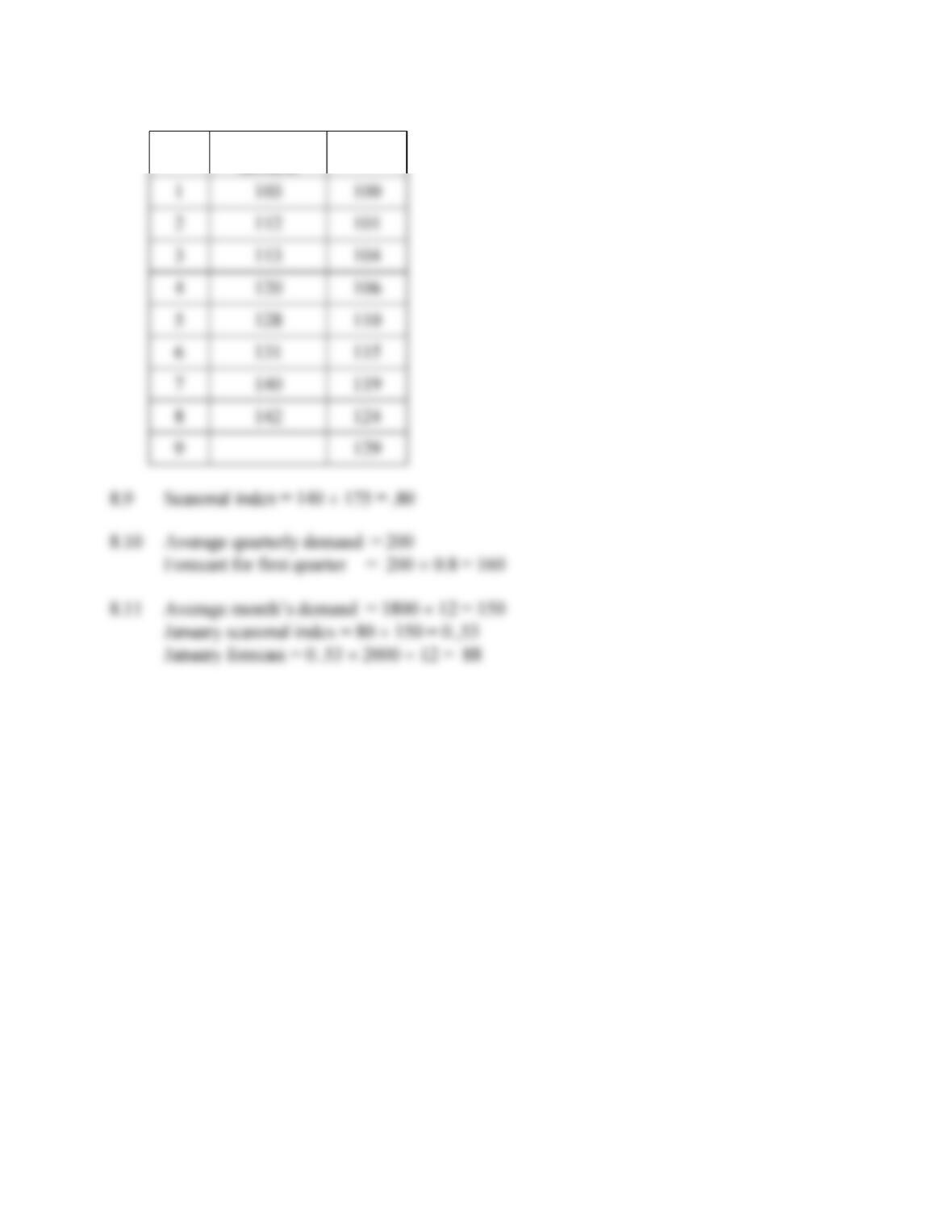
8.8
Week
Actual
demand Forecast
88
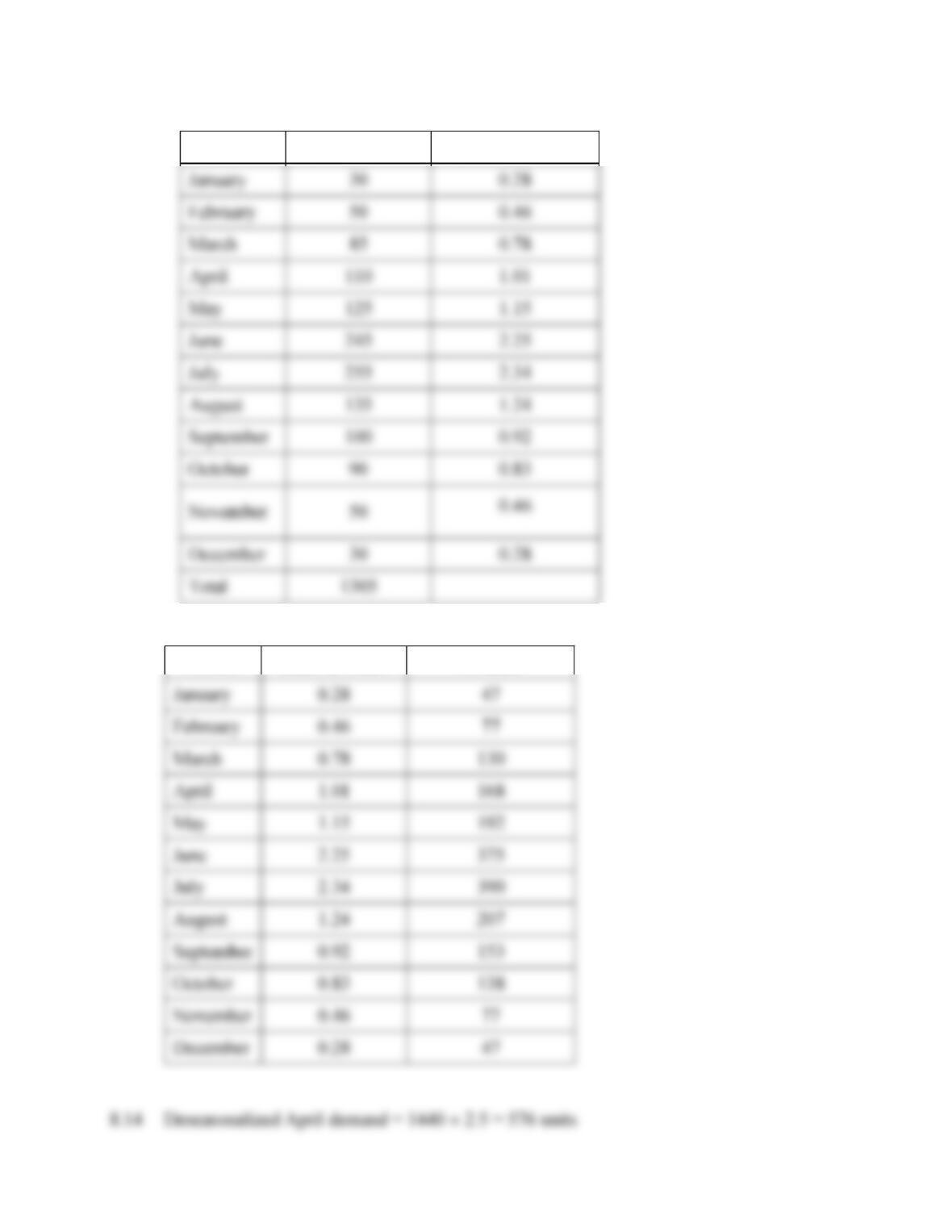
8.12
Month Average demand Seasonal index
8.13
Month Seasonal index Forecast
89
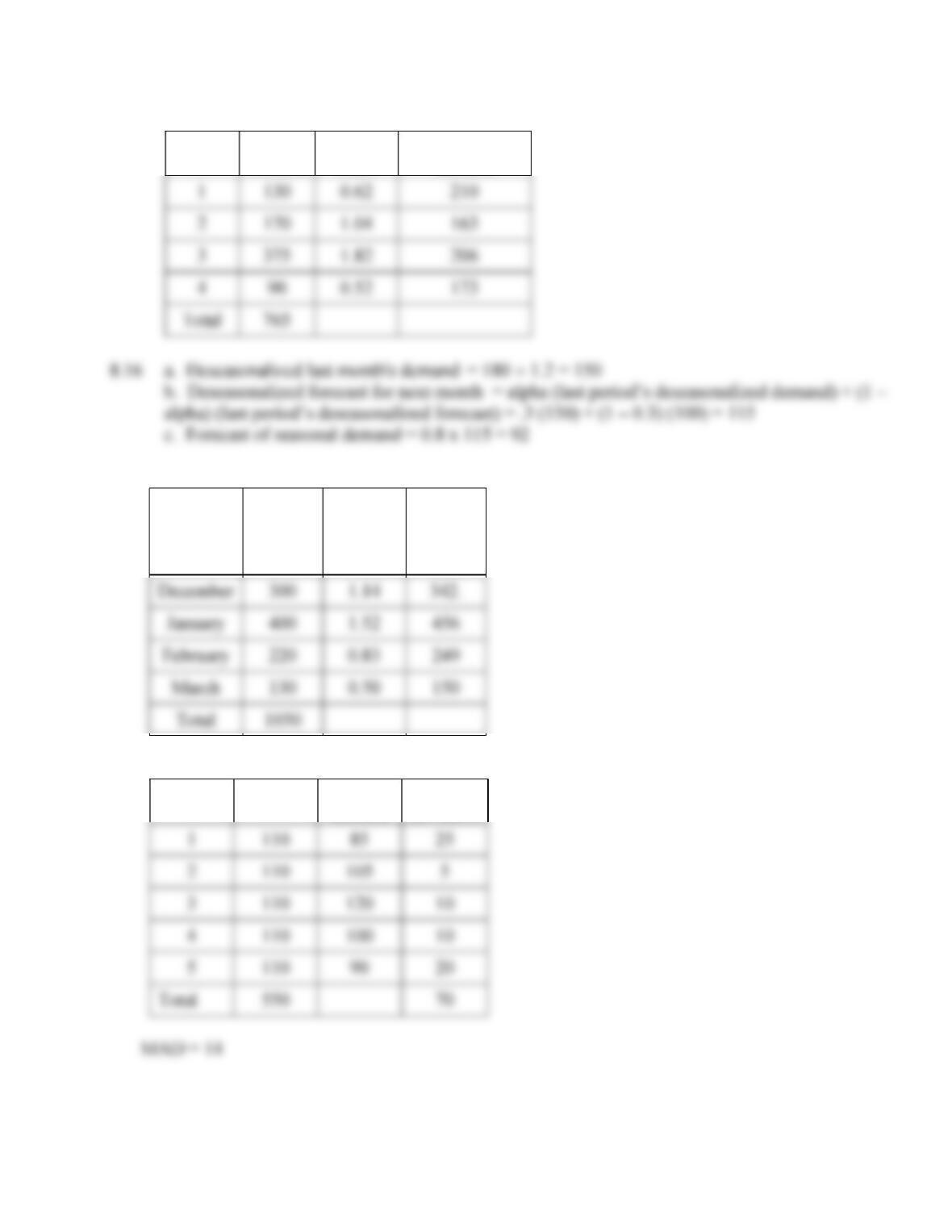
8.15
Quarter
Actual
demand
Seasonal
index
Depersonalized
demand
8.17
Month
Average
Past
Demand
Seasonal
Index
Forecast
Demand
Next
Year
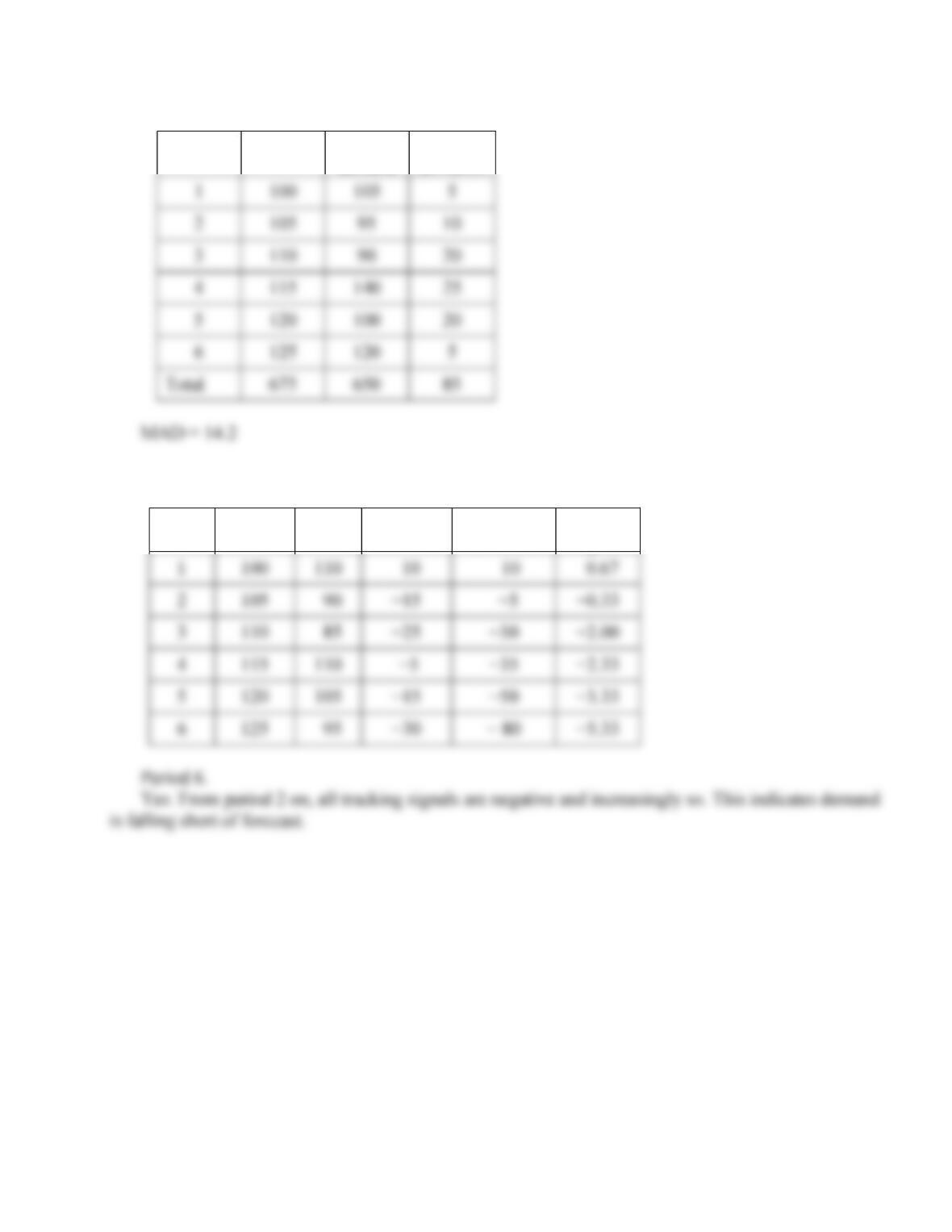
8.18
Period Forecast Actual
demand
Absolute
deviation
90
8.19
Period Forecast Actual
demand
Absolute
deviation
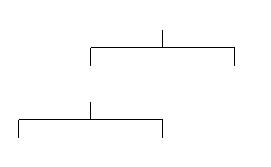
8.20
Period
Forecast
Actual
Deviation
Cumulative
deviation
Tracking
signal
91
MULTIPLE CHOICE QUESTIONS
1. Which of the following statements is best statement about forecasting?
I. It must be done by all who wish to meet the demands of the future.
II. Companies who make to order to NOT have to forecast.
a. I and II are true
b. I only is true
c. II only is true
d. neither I nor II are true
2. Which of the following is NOT a component of a demand pattern?
a. trend
b. standard deviation
c. seasonal variation
d. random variation
e. all of the above are components of a demand pattern
3. Given this product tree which item(s) should be forecast?
a. only A
b. A, B and C
c. D and E
d. B, C, D, and E
a. all items should be forecast
4. Which of the following is the best statement about the general principles of forecasting?
a. forecasts are more accurate for larger groups of items
b. forecasts are more accurate for nearer periods of time
c. every forecast should include an estimate of error
d. all of the above are general principles of forecasting
e. none of the above is a general principle of forecasting
A
B
C
E
D
92
5. Which of the following statements is best?
a. dependent demand items should be forecast
b. a forecast for sales next week will not be as accurate as for a year from now
c. forecasts for families of products should be built up from individual product forecasts
d. all of the above are true
e. none of the above is true
6. Which of the following statements is best?
a. if we wish to forecast demand, then past sales must be used for the forecast
b. forecasts made in dollars for total sales should be used for manufacturing
c. forecasts should be made for all items, models, and options manufactured
d. all of the above are true
e. none of the above is true
7. A firm manufactures a line of vacuum cleaners composed of standard, custom and deluxe models.
All are essentially the same except for the options and add-ons. What should they forecast?
a. the total of all models
b. each model
c. each model and add the forecasts together
d. all of the above
e. none of the above
8. Which of the following is NOT true?
a. number of orders shipped is a good measure of demand for an item
b. circumstances relating to historical data should be recorded
c. demand for different groups should be recorded separately
d. none of the above is true
9. Which of the following statements is best regarding forecasting techniques?
a. qualitative techniques are based on judgment
b. techniques that use external economic indicators are classified as extrinsic
c. intrinsic techniques use historical data
d. all of the above are true
e. none of the above is true
10. What important assumption is made about statistical (quantitative) forecasting methods?
a. the past is a valid indicator of the future
b. demand trend is seldom linear
c. seasonal variations are small
d. random variations are small
e. all of the above

93
11. Which of the following methods can be used to forecast the demand for a NEW product?
a. equation fitting
b. moving averages
c. qualitative techniques
d. all of the above
e. none of the above
12. A forecasting technique that takes the average demand for some past number of periods is called:
a. trend time analysis
b. moving average
c. exponential smoothing
d. none of the above
e. all of the above
13. Demand over the past three months has been 700, 750, and 900. Using a three-month moving
average, what is the forecast for month four?
a. 700
b. 750
c. 900
d. 783
e. 822
14. The old forecast was for 200 units and last month’s sales were 225 units. If (alpha) is 0.2 what is
the forecast for next month?
a. 200
b. 225
c. 212½
d. 205
e. 210
15. Select the one best answer from the following:
a. demand fluctuations that depend on the time of the year, week or day are called
seasonality
b. The seasonal index is an estimate of how much the demand during the season will be
above or below the average demand
c. seasonality ALWAYS occurs in summer, winter, spring and fall
d. a and b are true
e. b and c are true
94
16. If the average quarterly demand is 200 units and the first quarter demand is 350 units, what is the
seasonal index for the quarter?
a. .57
b. 200
c. 350
d. 1.75
e. none of the above
17. Select the one best answer from the following:
a. deseasonalized data should be used for forecasting
b. seasonalize the base forecast to predict actual demand for future periods
c. actual sales should only be compared on a month-to-month basis
d. a and b are best
e. b and c are best
18. If the February demand for a product is 5,000 units and the seasonal index for February is 0.75,
what is the deseasonalized February demand?
a. 3,750
b. 6,667
c. 8,750
d. 10,000
e. 15,000
19. Forecast error will be caused by:
a. random variation from the average demand
b. errors in forecasting average demand
c. differences in lead times
d. a and b above
e. none of the above
20. Select the one best answer from the following:
a. the mean absolute deviation can be used as a measure of forecast error
b. usually forecast error is distributed normally about the average demand
c. in a normal distribution the error will be within 1 MAD of the average about 60% of the
time
d. all the above are true
e. none of the above is true
95
21. Select the one best answer from the following:
a. forecasts do not need to be tracked
b. forecast error does not need to be measured
c. when actual demand exceeds a reasonable error, it should be investigated to discover the
cause of the error
d. all the above are true
e. none of the above is true
22. Forecasts are far more accurate for which of the following?
a. Short term
b. Individual items
c. Product families
d. End use components
23. Forecasts are far more accurate for which of the following?
a. Short term
b. Individual items
c. Product families
d. End use components
24. Which of the following is good for short-range forecasts, can detect trends, but lags the trend?
a. Exponential smoothing
b. Stable forecasting
c. Forecast smoothing
d. Delphi technique
25. Which of the following is NOT a source of demand?
a. Internal customers
b. External customers
c. Stockholders
d. Spare parts
26. When the demand for one item can be used to forecast the demand for another item, the demand for
the first item is called which of the following?
a. a seasonal index
b. a leading indicator
c. a forward commodity
d. a demand manager
27. Which of the following best describes the concept of Collaborative Planning, Forecasting, and
Replenishment
a. Supply chain partners combining production facilities
b. Supply chain partner developing joint business plans
c. Supply chain partners sharing inventory positions and demands
d. Supply chain partners sharing MRP outputs
96
28. Which of the following best describes demand management?
a. Syncronize market demand with company capabilities
b. Setting priorities for demand when supply will not cover all demand
c. Making delivery promises
d. All of the above
e. None of the above