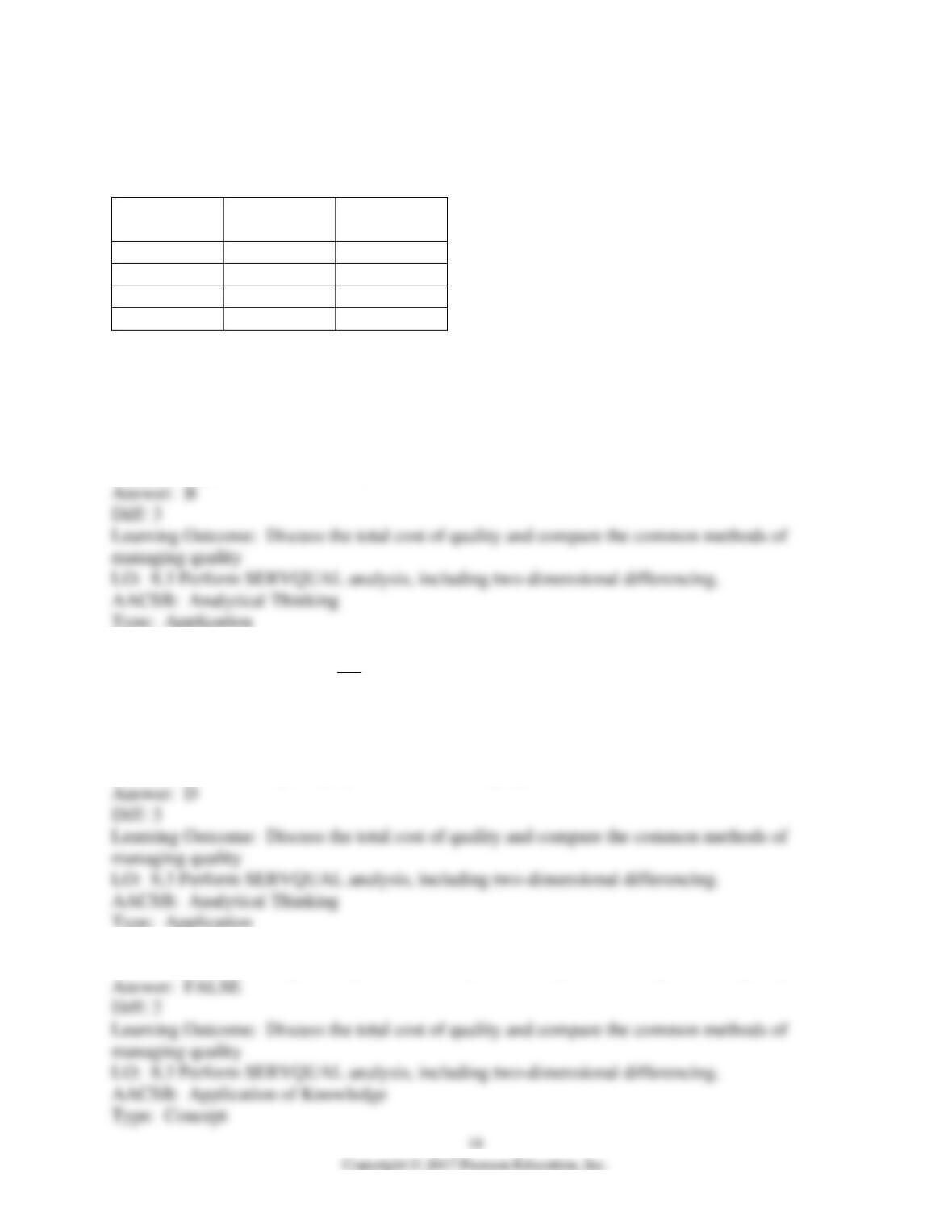
53) A university administered the SERVQUAL survey to its customers as a way to assess its
current position in the market. On the basis of 80 responses, the following averages were
computed for the reliability construct.
Item
#
Avg.
Perception
Avg.
Expectation
1
6.2
6.6
2
6.3
6.2
3
6.5
6.7
4
6.9
6.5
What is the difference for the reliability dimension?
A) -0.2
B) -0.025
C) 0.025
D) 0.2
E) not enough data to determine the answer
54) Which of the following is not one of the advantages of the SERVQUAL instrument?
A) It has been shown to be valid for a number of service situations.
B) It has been accepted as a standard.
C) It has a standardized analysis procedure.
D) It is more widely used that statistical quality control.
E) It can be filled out quickly by customers and employees.
55) W. Edwards Deming developed the SERVQUAL survey for assessing services quality.
56) The SERVQUAL instrument is accepted as a standard for assessing different dimensions of
services quality.
57) The two parts of a SERVQUAL survey are services liability and manufacturing liability.
58) The greater potential for increasing customer satisfaction lies in addressing tangibles first.
59) The SERVQUAL instrument is useful for performing gap analysis.
60) When a retailer incorrectly feels that the majority of his customers are men shopping for
tools when in fact most customers are women shopping for linens, they are experiencing gap 3.
61) Gap 1 shows that there can be a difference between actual customer expectations and
management’s idea or perception of customer expectations.
62) Gap 3 is the difference between service delivery and service quality specifications.
63) Gap 4 is the difference between expected and perceived services.
64) State the advantages of the SERVQUAL instrument.
65) Explain the different gaps in communication that arise due to intangible services.
66) A ________ is a flowchart that isolates potential fail points in a process.
A) services statement
B) services draft
C) services plan
D) services blueprint
E) services data table
67) What is the first step in the development of a service blueprint?
A) Identify processes.
B) Isolate fail points.
C) Establish a time frame.
D) Eliminate highest risks.
E) Analyze profits.
68) Which of the following best defines the front office in a service blueprint?
A) the portion of the firm’s activities that the customer can see
B) the area in the firm where the majority of the work is done
C) the portion of the firm’s activities that the customer cannot see but is necessary to perform
D) the area in the firm where the majority of the profitability is generated
E) the area in the firm where the employees plan quality initiatives
69) Which of the following best defines the back office in a service blueprint?
A) the area in the firm where the majority of the work is done
B) the portion of the firm’s activities that the customer cannot see but are necessary to perform
C) the portion of the firm’s activities that the customer can see
D) the area in the firm where the majority of the profitability is generated
E) the area in the firm where the employees plan quality initiatives
70) ________ should be kept on every process in a service and available on a computer network
for all to view.
A) Service blueprints
B) STA sheets
C) CBPs
D) SERVQUALs
E) Gap analyses
71) A services blueprint is a flowchart that isolates potential fail points in a process.
72) The first step in the development of a services blueprint is to isolate fail points.
73) In a services blueprint, the area above the line of visibility is referred to as the back office.
74) Services process blueprinting places the focus on front-office activities.
75) What is services blueprinting?
76) The fail points in the service blueprint are often referred to as ________.
A) defining events
B) turning points
C) poka-yokes
D) moments of truth
E) tangibles
77) The idea behind fail-safing is to ensure that ________.
A) certain errors will never occur
B) customer expectations are met
C) the highest risks are eliminated
D) forward planning takes place
E) the importance of quality is not neglected
78) After a customer sits down in a restaurant, the server coming to the table to take the
customer’s order is an example of a ________.
A) service transaction analysis
B) moment of truth
C) poka-yoke
D) customer perception
E) gap analysis
79) Which of the following is one of the classifications of fail-safe devices?
A) emotional contact methods
B) visual contact methods
C) task awareness methods
D) intangible methods
E) error notification methods
80) The “three Ts” of fail-safe methods are ________.
A) transactions, task, and tangibles
B) tangibles, theories, and transactions
C) task, transactions, and treatment
D) task, treatment, and tangibles
E) task, theories, and transactions
81) The fail points in the services blueprints are referred to as turning points.
82) The idea behind fail-safing is to ensure that certain errors will never occur.
83) Explain the concept of poka-yoke.
84) The package of tangibles that define a service and intangibles that make up a service is
referred to as a(n) ________.
A) quality output package
B) internal services package
C) service vision package
D) fail-safe package
E) customer benefits package
85) In a customer benefits package, tangibles are known as ________.
A) service-content
B) process-content
C) product-content
D) quality-content
E) goods-content
86) In a customer benefits package, intangibles are referred to as ________.
A) service-content
B) goods-content
C) quality-content
D) process-content
E) product-content
87) Which of the following is not one of the four stages of the service benefit package design
process?
A) idea/concept generation
B) service concept investigation
C) the definition of a services package
D) process definition and selection
E) facilities requirement definition
88) The first stage of the service benefit package design process is ________.
A) service concept investigation
B) facilities requirement definition
C) process definition and selection
D) the definition of a services package
E) idea/concept generation
89) ________ service packages are of the one-size-fits-all variety.
A) Unique
B) Selective
C) Restricted
D) Generic
E) Constricted
90) ________ service packages are especially tailored for each customer.
A) Selective
B) Constricted
C) Unique
D) Restricted
E) Generic
91) Which of the following is not an issue that could affect a firm’s ability to provide unique
services packages?
A) organizational flexibility
B) employee motivation
C) training
D) product offerings
E) nature of the service
92) Which of the following is not a type of service package offered by firms?
A) selective
B) constricted
C) unique
D) restricted
E) generic
93) In a customer benefits package, the tangibles that define the service are known as service-
content.
94) The first stage of the service benefit package design process is the definition of a services
package.
95) One of the objectives of customer benefits package design is to evaluate each attribute in
terms of process and service encounter capability.
96) Generic services packages are of the one-size-fits-all variety.
97) Selective services packages are especially tailored for each customer.
98) What are the four stages of the service benefit package design process?
99) ________ is a service improvement technique that allows managers to analyze their service
processes at a very detailed level.
A) Generic service analysis
B) Selective service analysis
C) Service transaction analysis
D) Service data analysis
E) Service quality analysis
100) Service transaction analysis entails ________ rating each transaction in the process being
studied.
A) managers
B) quality experts
C) mystery shoppers
D) service employees
E) customers
101) Which of the following helps service designers, managers, and staff understand why
customers did not like certain aspects of a service so they may improve the service?
A) service blueprints
B) SERVQUAL surveys
C) service transaction analysis sheet
D) poka-yokes
E) benefits packages analysis
102) Service analysis transactions do all of the following except ________.
A) they lead to prescribed service customization packages
B) they lead to improving service processes
C) they help managers analyze service processes at a very detailed level
D) they identify a series of transactions
E) they help identify gaps between service design and customer perception of service
103) Service transaction analysis is a service improvement technique that allows managers to
analyze their service processes at a very detailed level.
104) Explain service transaction analysis (STA).