127. {Phone Orders Narrative} What proportion of customers having to hold more than 1.5 minutes will
hang up before placing an order?
128. {Phone Orders Narrative} Find the waiting time at which only 10% of the customers will continue to
hold.
129. {Phone Orders Narrative} Find the time at which 50% of the customers will continue to hold?
130. {Phone Orders Narrative} What proportion of callers are put on hold longer than 3 minutes?
131. {Phone Orders Narrative} What is the probability that a randomly selected caller is placed on hold for
fewer than 6 minutes?
132. {Phone Orders Narrative} What is the probability that a randomly selected caller is placed on hold for
3 to 6 minutes?
ANS:
133. Like that of the Student t distribution, the shape of the chi-squared distribution depends on its number
of degrees of freedom.
134. The value of
2 with v degrees of freedom such that the area to its right under the chi-squared curve is
equal to A is denoted by , while denotes the value such that the area to its left is A.
135. The variance of a Student t random variable with v degrees of freedom (v > 2) is always greater than 1.
136. We define as the value of the F with v1 and v2 degrees of freedom such that the area to its
right under the F curve is A, while is defined as the value such that the area to its left is A.
137. The value of A such that P(−A t A) = 0.95, where the degrees of freedom are 20, is 2.086.
138. The variance of a
2 distribution is twice the value of its mean.
139. As the degrees of freedom approach infinity, the values of a Student t distribution approach those of a
standard normal distribution.
140. The value of an F distribution with v1 = 5 and v2 = 10 degrees of freedom such that the area to its left is
0.95 is 3.33.
141. The expected value of the Student t distribution is zero.
142. The variance of a Student t distribution approaches zero as the degrees of freedom approaches infinity.
143. The value of an F distribution with v1 = 6 and v2 = 9 degrees of freedom such that the area to its right is
0.05 is 3.37.
ANS:
144. The value of a chi-squared distribution with 5 degrees of freedom such that the area to its left is 0.10 is
1.61.
145. The Student t distribution looks similar in shape to a standard normal distribution, except it is not as
widely spread.
146. The value of a chi-squared distribution with 8 degrees of freedom such that the area to its left is 0.95 is
2.73.
147. The Student t distribution:
a.
is symmetrical.
b.
approaches the normal distribution as the degrees of freedom increase.
c.
has more area in the tails than the standard normal distribution does.
d.
All of these choices are true.
148. The Student t distribution with parameter v = 2 has a mean E(t) equal to:
a.
0
b.
1
c.
2
d.
None of these choices.
149. The Student t distribution with parameter v = 4 has a variance V(t) equal to:
a.
4
b.
0
c.
2
d.
1
150. Which of the following statements is correct regarding the percentile points of the F distribution?
a.
F0.10,10,20 = 1/F0.90,10,20
b.
F0.90,10,20 = 1/F0.10,20,10
c.
F0.90,10,20 = 1/F0.90,20,10
d.
F0.10,10,20 = 1/F0.10,20,10
151. Which of the following statements is true?
a.
The chi-squared distribution is positively skewed.
b.
All the values of the chi-squared distribution are non-negative.
c.
The shape of the chi-squared distribution depends on its degrees of freedom.
d.
All of these choices are true.
152. What number corresponds to t0.05,10?
a.
1.812
b.
1.372
c.
2.228
d.
1.833
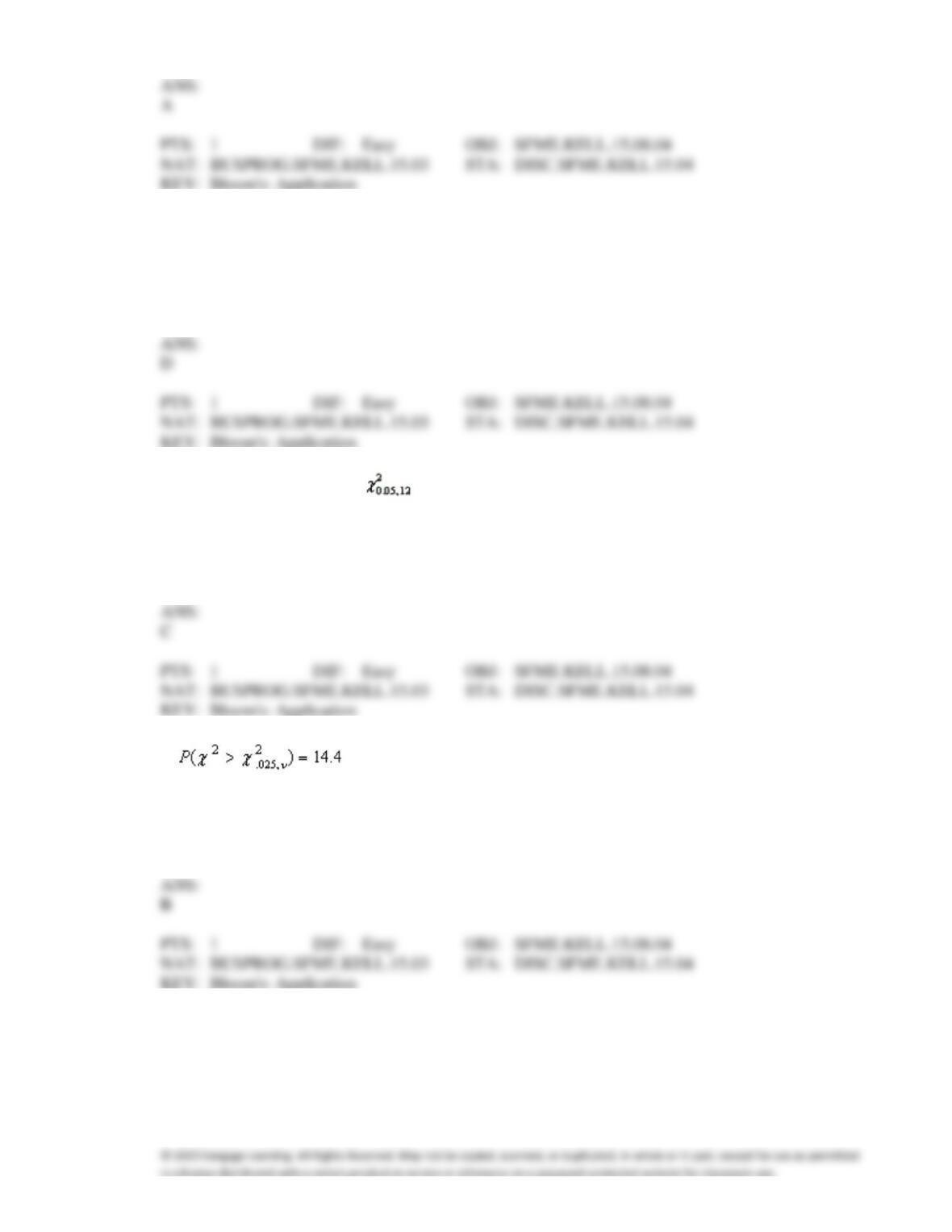
153. If P(t > t.01,v) = 2.50, then the number of degrees of freedom v is:
a.
20
b.
21
c.
22
d.
23
154. What number corresponds to ?
a.
28.30
b.
26.22
c.
21.00
d.
5.23
155. If , then the number of degrees of freedom v is:
a.
5
b.
6
c.
7
d.
8
156. What number corresponds to F0.95,4,8?
a.
6.040
b.
3.840
c.
0.260
d.
0.166
157. What number corresponds to F.025,3,5?
a.
14.88
b.
7.76
c.
12.06
d.
5.41
158. Suppose X has a chi-squared distribution with 10 degrees of freedom. The mean of X is:
a.
10
b.
9
c.
20
d.
None of these choices.
159. Suppose X has a chi-squared distribution with 10 degrees of freedom. The variance of X is:
a.
20
b.
10
c.
9
d.
None of these choices.
160. The number of parameters for an F distribution is:
a.
1
b.
2
c.
0
d.
None of these choices.
161. Suppose X has an F distribution. Which of the following is true?
a.
f(x) is symmetrical.
b.
All the values of X are non-negative.
c.
The mean of X is zero.
d.
All of these choices.
162. Which of the following distributions can take on negative values?
a.
Student t
b.
2
c.
F
d.
None of these choices.
163. Which of the following distributions is not skewed?
a.
Student t
b.
2
c.
F
d.
All of these distributions are skewed.
164. Which of the following has a mean and variance that depend on degrees of freedom?
a.
Student t
b.
2
c.
F
d.
All of these choices are true.
D
165. The shape of the ____________________ distribution is similar to a normal distribution, except it has
more area in the tails.
166. The mean of a Student t distribution is ____________________.
167. The variance of a Student t distribution approaches ____________________ as the degrees of freedom
increase to infinity.
168. A
2 distribution with 5 degrees of freedom has a mean of ____________________ and a variance of
____________________.
169. The mean and variance of a
2 distribution approach ____________________ as the degrees of
freedom increase.
170. For values of degrees of freedom greater than 100, the
2 distribution can be approximated by a(n)
____________________ distribution.
171. The shape of a
2 distribution is ____________________.
172. The F distribution has two parameters called degrees of freedom,
1 and
2. We call
1 the
____________________ degrees of freedom, and we call
2 the ____________________ degrees of
freedom.
173. As the ____________________ degrees of freedom increase, the mean of the F distribution
approaches 1.
174. The shape of an F distribution is ____________________.
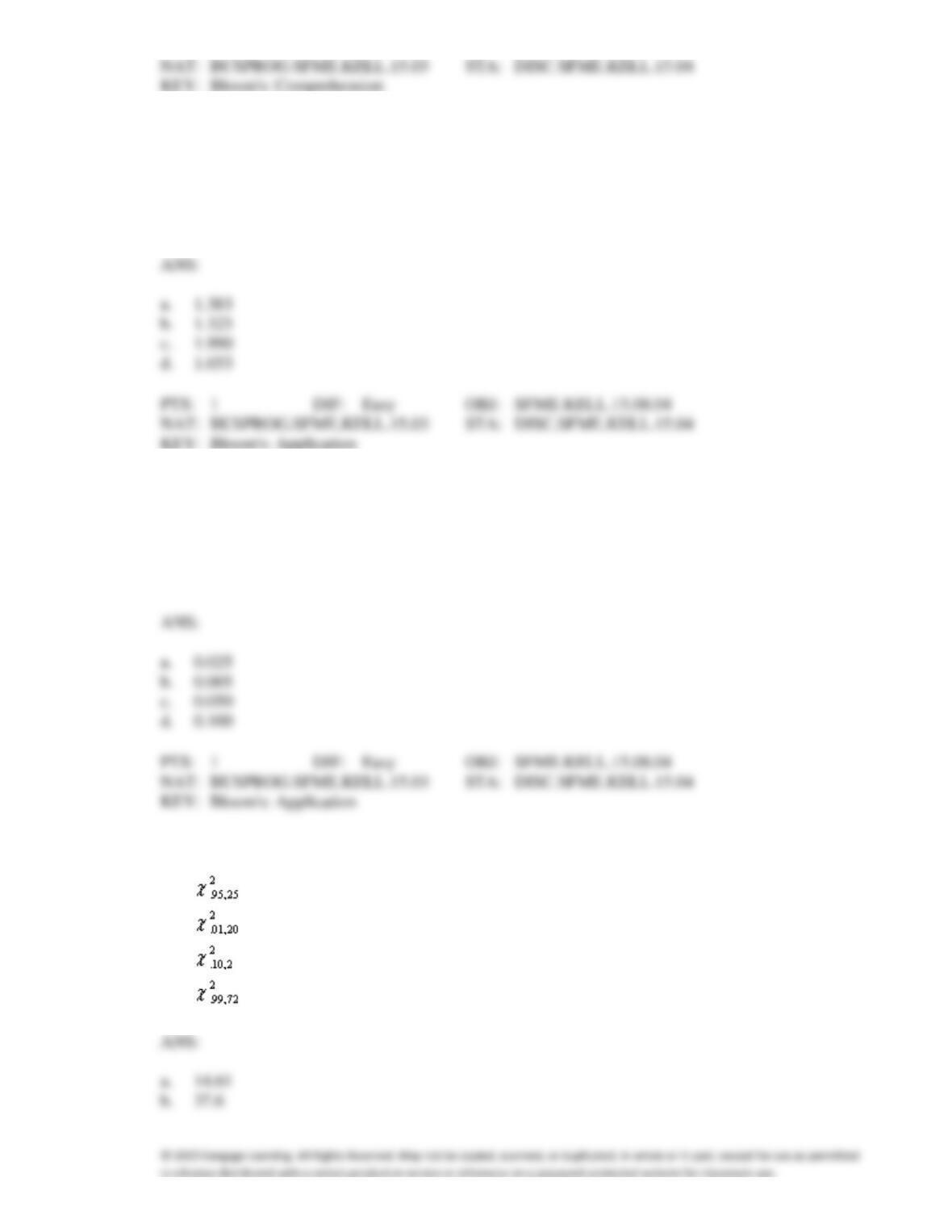
175. Use the t-table to find the following values of t.
a.
t.10,9
b.
t.10,20
c.
t.025,82
d.
t.05,196
a.
1.383
b.
1.325
c.
1.990
d.
1.653
176. Use the t-table to find the following probabilities.
a.
P(t8 > 2.306)
b.
P(t80 > 2.639)
c.
P(t24 > 1.711)
d.
P(t35 > 1.306)
a.
0.025
b.
0.005
c.
0.050
d.
0.100
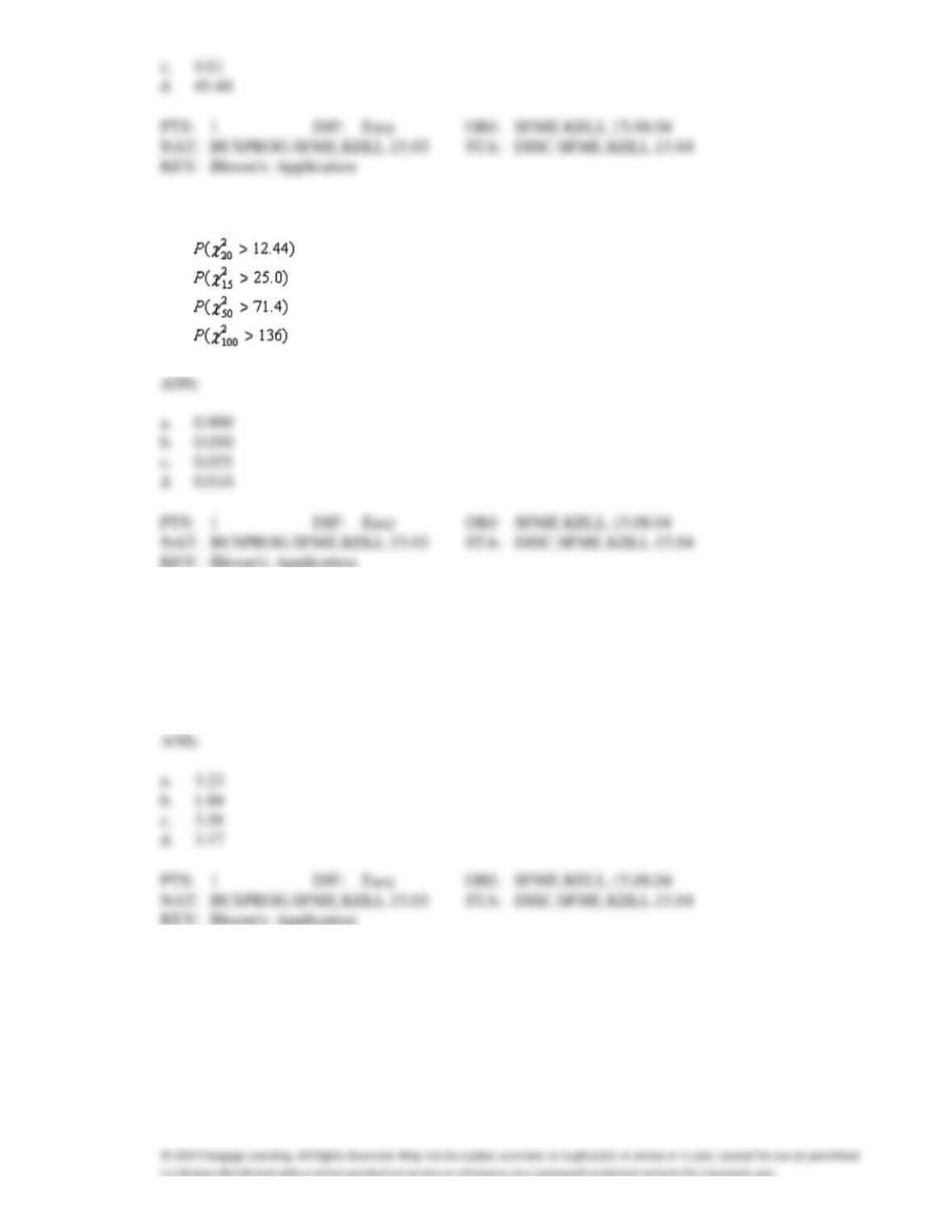
177. Use the
2 table to find the following values of
2.
a.
b.
c.
d.
b.
37.6
c.
4.61
d.
45.44
178. Use the
2 table to find the following probabilities.
a.
b.
c.
d.
a.
0.900
b.
0.050
c.
0.025
d.
0.010
179. Use the F table to find the following values of F.
a.
F.01,12,20
b.
F.05,20,40
c.
F.025,5,15
d.
F.01,8,30
a.
3.23
b.
1.84
c.
3.58
d.
3.17
180. Use the F table to find the following values of F.
a.
F.99,12,20
b.
F.95,20,40
c.
F.975,5,15
d.
F.99,8,30
ANS:
a.
1 / 3.86 = 0.2591
b.
1 / 1.99 = 0.5025
c.
1 / 6.43 = 0.1555
d.
1 / 5.20 = 0.1923
181. Use the F table to find the following probabilities.
a.
P(F6,14 > 2.85)
b.
P(F20,60 > 2.20)
c.
P(F12,25 > 2.51)
d.
P(F15,30 > 2.01)
a.
0.05
b.
0.01
c.
0.025
d.
0.05
182. Suppose you have a Student t distribution with 20 degrees of freedom.
a.
Find the mean.
b.
Find the variance.
c.
Find the standard deviation.
a.
0
b.
20/18 = 1.11
c.
1.05
183. Suppose you have a
2 distribution with 20 degrees of freedom.
a.
Find the mean.
b.
Find the variance.
c.
Find the standard deviation.
b.
40
c.
6.32
184. Suppose you have an F distribution with degrees of freedom 10, 20.
a.
Find the mean
b.
Find the variance.
c.
Find the standard deviation.
a.
20/18 = 1.11
185. What happens to the shape, mean, and variance of a Student t distribution as the degrees of freedom
increase?
186. What happens to the shape, mean, and variance of a
2 distribution as the degrees of freedom
increase?