
1. The economic insolvency of many thrift institutions during the 1980s was due, at least in part, to unexpected
increases in interest rates.
2. Because the increased level of financial market integration has increased the speed with which interest rate
changes are transmitted among countries, control of U.S. interest rates by the Federal Reserve is more difficult.
3. The repricing gap model is a book value accounting based model.
4. The maturity gap model estimates the difference between interest earned and interest during a given period of
time.
5. The Bank for International Settlements (BIS) strongly urges regulators to use the repricing model to evaluate
a bank’s interest rate risk.
6. In the repricing gap model, assets or liabilities are rate sensitive within a given time period if the dollar values
of each are subject to receiving a different interest rate should market rates change.

7. The repricing model is a simplistic approach to focusing on the exposure of net interest income to changes in
market levels of interest rates for given maturity periods.
8. A positive repricing gap implies that a decrease in interest rates will cause interest expense to decrease more
than the decrease in interest income.
9. The cumulative repricing gap position of an FI for a given extended time period is the sum of the repricing
gap values for the individual time periods that make up the extended time period.
10. When a bank’s repricing gap is positive, net interest income is positively related to changes in interest rates.
11. A bank with a negative repricing (or funding) gap faces reinvestment risk.
12. A bank with a negative repricing (or funding) gap faces refinancing risk.

13. One reason to include demand deposits when estimating a bank’s repricing gap is because rising interest
rates could lead to high withdrawals.
14. One reason to exclude demand deposits when estimating a bank’s repricing gap is because, by regulation,
explicit interest cannot be paid on these deposits.
15. Retail passbook savings accounts should not be considered as part of rate sensitive liabilities because the
rates on these accounts rarely change.
16. Runoff in demand deposits in a repricing model is typically lower during periods of falling interest rates.
17. The gap ratio is useful because it indicates the scale of the interest rate exposure by dividing the gap by the
asset size of the institution.
18. Because the repricing model ignores the market value effect of changing interest rates, the repricing gap is
an incomplete measure of the true interest rate risk exposure of an FI.

19. Defining buckets of time over a range of maturities assures the capture of all relevant information necessary
to accurately assess the interest rate risk exposure of an FI.
20. Defining buckets of time over wider intervals creates greater accuracy in the use of the repricing model
because fewer calculations are required.
21. If the spread between rate sensitive assets and rate sensitive liabilities increases for a bank, future changes in
interest rates will lead to an increase in net interest income.
22. The runoff component of long-term mortgages should be considered in the time buckets in which the
maturities actually occur.
23. When interest rates increase, banks are more likely to be forced to increase rate-sensitive liabilities to
replace decreased balances in demand deposits and savings accounts.
24. For a given change in interest rates, fixed-rate assets with long-term maturities will have greater changes in
price than assets with shorter maturities.

25. The market value of a fixed-rate liability will decrease as interest rates rise, just as the market value of a
fixed-rate asset will decrease as interest rates rise.
26. The market value of a fixed-rate liability will increase as interest rates rise, although the market value of a
fixed-rate asset will decrease as interest rates rise.
27. The change in economic value of a fixed-rate liability for a decrease in interest rates is considered to be
good news.
28. For a given change in interest rates, fixed-rate liabilities with longer-term maturities will have smaller
changes in price than liabilities with shorter maturities.
29. For a given change in interest rates, the change in price for each additional year of maturity of a fixed-rate
asset is smaller as the maturity increases.
30. The maturity of a portfolio of assets or liabilities is a weighted average of the maturities of the assets or
liabilities that comprise that portfolio.

31. If the average maturity of assets is 4 years and the average maturity of liabilities is 4 years, then the FI has
no interest rate risk exposure.
32. If the average maturity of assets is 5 years and the average maturity of liabilities is 7 years, then the FI has
no interest rate risk exposure.
33. The maturity gap for a bank is the average maturity of the assets minus the average maturity of the
liabilities.
34. The net worth of a bank is the difference between the
35. Because of its simplicity, smaller depository institutions still use this model as their primary measure of
interest rate risk.
36. The repricing gap approach calculates the gaps in each maturity bucket by subtracting the
37. Which of the following observations about the repricing model is correct?
38. When repricing all interest sensitive assets and all interest sensitive liabilities in a balance sheet, the
cumulative gap will be
39. The repricing gap does not accurately measure FI interest rate risk exposure because

40. An FI’s net interest income reflects
41. A positive gap implies that an increase in interest rates will cause _______ in net interest income.
42. If interest rates decrease 50 basis points for an FI that has a gap of +$5 million, the expected change in net
interest income is
43. If interest rates increase 75 basis points for an FI that has a gap of -$15 million, the expected change in net
interest income is

44. If interest rates decrease 40 basis points (0.40 percent) for an FI that has a cumulative gap of -$25 million,
the expected change in net interest income is
45. An FI finances a $250,000 2-year fixed-rate loan with a $200,000 1-year fixed-rate CD. Use the repricing
model to determine (a) the FI’s repricing (or funding) gap using a 1-year maturity bucket, and (b) the impact of
a 100 basis point (0.01) decrease in interest rates on the FI’s annual net interest income?
46. The gap ratio expresses the reprice gap for a given time period as a percentage of
47. What is spread effect?
48. If an FI’s repricing gap is less than zero, then
49. A bank that finances long-term fixed-rate mortgages with short-term deposits is exposed to
50. The repricing model measures the impact of unanticipated changes in interest rates on
51. If the chosen maturity buckets have a time period that is too long, the repricing model may produce
inaccurate results because
52. An increase in interest rates
53. Which of the following describes the condition known as runoff in the repricing model approach to
measuring interest rate risk of an FI?
54. A method of measuring the interest rate or gap exposure of an FI is
55. The repricing model is based on an accounting world that reports asset and liability values at
56. Which of the following is a weakness of the repricing model to measure interest rate risk?
57. The repricing model ignores information regarding the distribution of assets and liabilities within maturity
buckets. This limitation of the model refers to
58. An interest rate increase
59. Which of the following statements is true?
60. Can an FI immunize itself against interest rate risk exposure even though its maturity gap is not zero?
61. Which of the following relationships does NOT hold in the pricing of fixed-rate assets given changes in
market rate?
62. The average maturity of the liabilities of an FI‘s balance sheet is equal to
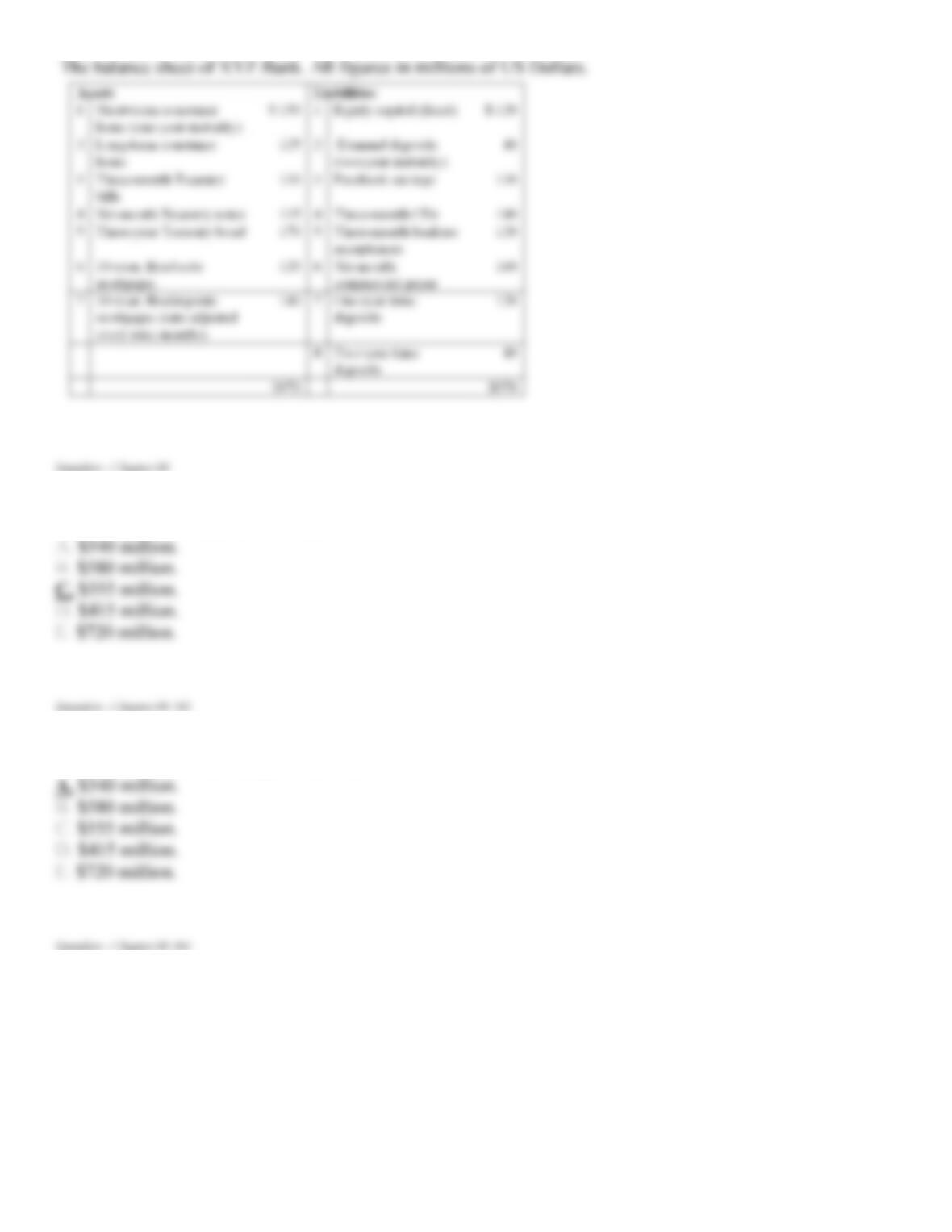
63. Total one-year rate-sensitive assets is
64. Total one-year rate-sensitive liabilities is