
32
86. In a macro-economic based risk factor model, which factor would be one of many appropriate factors?
a.
Confidence risk.
b.
Maturity risk.
c.
Expected inflation risk.
d.
Call risk.
e.
Return difference between small capitalization and large capitalization stocks.
87. In a multifactor model, what does confidence risk represent?
a.
Unanticipated changes in the level of overall business activity.
b.
Unanticipated changes in investors’ desired time to receive payouts.
c.
Unanticipated changes in short term and long term inflation rates.
d.
Unanticipated changes in the willingness of investors to take on investment risk.
e.
None of the above.
88. In a multifactor model, what does the time horizon risk represent?
a.
Unanticipated changes in the level of overall business activity.
b.
Unanticipated changes in investors’ desired time to receive payouts.
c.
Unanticipated changes in short term and long term inflation rates.
d.
Unanticipated changes in the willingness of investors to take on investment risk.
e.
None of the above.
89. In a micro-economic (or characteristic) based risk factor model, which factor would be one of many
appropriate factors?
a.
Confidence risk.
b.
Maturity risk.
c.
Expected inflation risk.
d.
Call risk.
e.
Return difference between small capitalization and large capitalization stocks.
90. A study by Chen, Roll, and Ross in 1986 examined all of the following factors in applying the
Arbitrage Pricing Theory (APT) except the
a.
Return on a market value-weighted return.
b.
Monthly growth rate in U.S. industrial production.
c.
Change in the consumer price index (CPI).
d.
Expected change in the bond credit spread.
e.
All of the above factors were used in their 1986 study.
33
91. Which of the following is not a step required for a multifactor risk model to estimate expected return
for an individual stock position?
a.
Identify a set of K common risk factors.
b.
Estimate the risk premia for the factors.
c.
Estimate the sensitivities of the each stock to these K factors.
d.
Calculate the expected returns using linear programming analysis.
e.
All of the above are necessary steps for a multifactor risk model.
92. A 1994 study by Burmeister, Roll, and Ross defined all of the following risk factors except
a.
Confidence risk
b.
Market risk
c.
Inflation risk
d.
Market-timing risk
e.
Business cycle risk
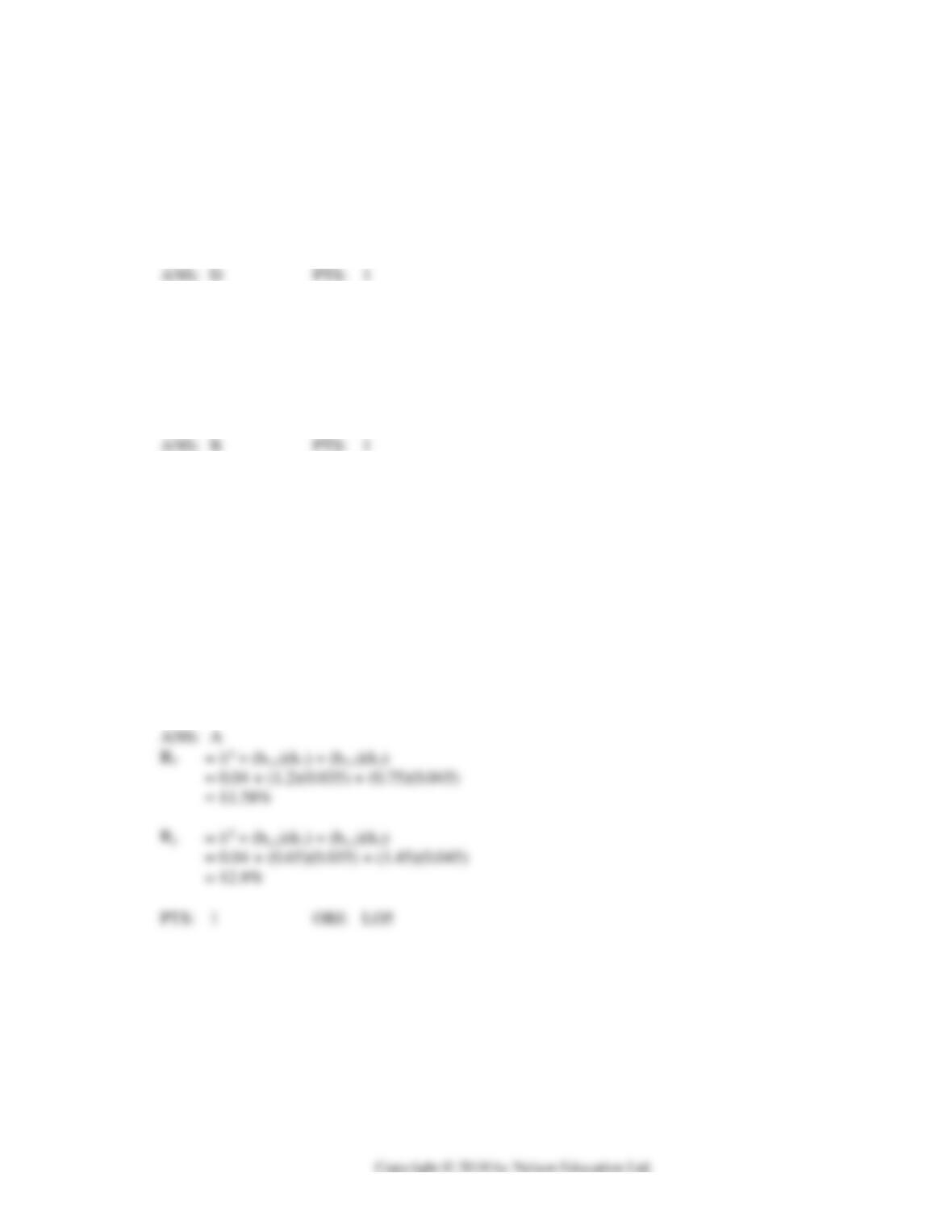
93. Under the following conditions, what are the expected returns for stocks X and Y?
0 = 0.04
bx,1 = 1.2
k1 = 0.035
bx,2 = 0.75
k2 = 0.045
by,1 = 0.65
by,2 = 1.45
a.
11.58% and 12.8%
b.
15.65% and 18.23%
c.
13.27% and 15.6%
d.
18.2% and 16.45%
e.
None of the above
Rx
= 0.04 + (1.2)(0.035) + (0.75)(0.045)
Ry
= 12.8%
34
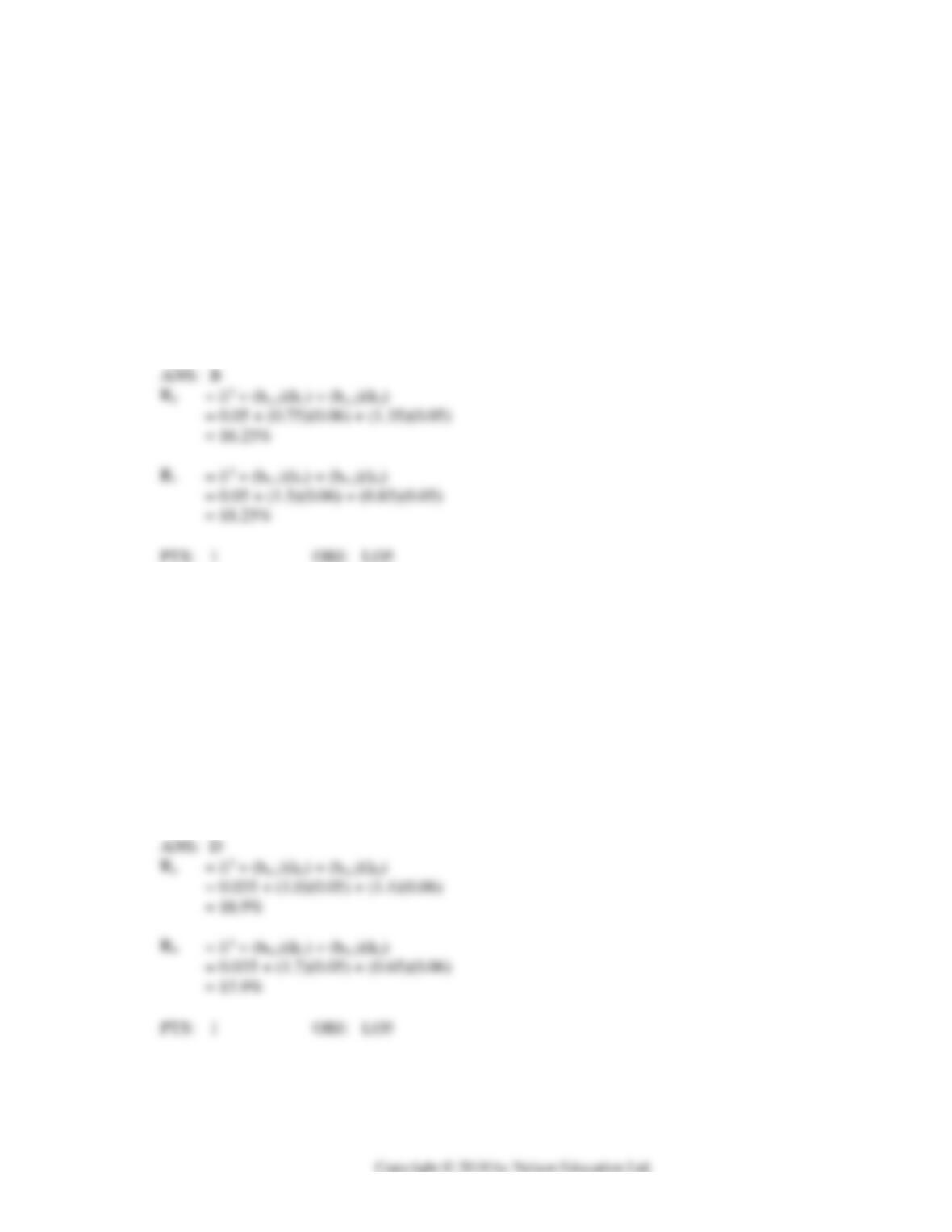
94. Under the following conditions, what are the expected returns for stocks Y and Z?
0 = 0.05
by,1 = 0.75
k1 = 0.06
by,2 = 1.35
k2 = 0.05
bz,1 = 1.5
bz,2 = 0.85
a.
17.61% and 13.23%
b.
16.25% and 18.25%
c.
13.24% and 28.46%
d.
14.83% and 17.69%
e.
None of the above
Ry
= 0.05 + (0.75)(0.06) + (1.35)(0.05)
= 16.25%
Rz
= 0.05 + (1.5)(0.06) + (0.85)(0.05)
= 18.25%
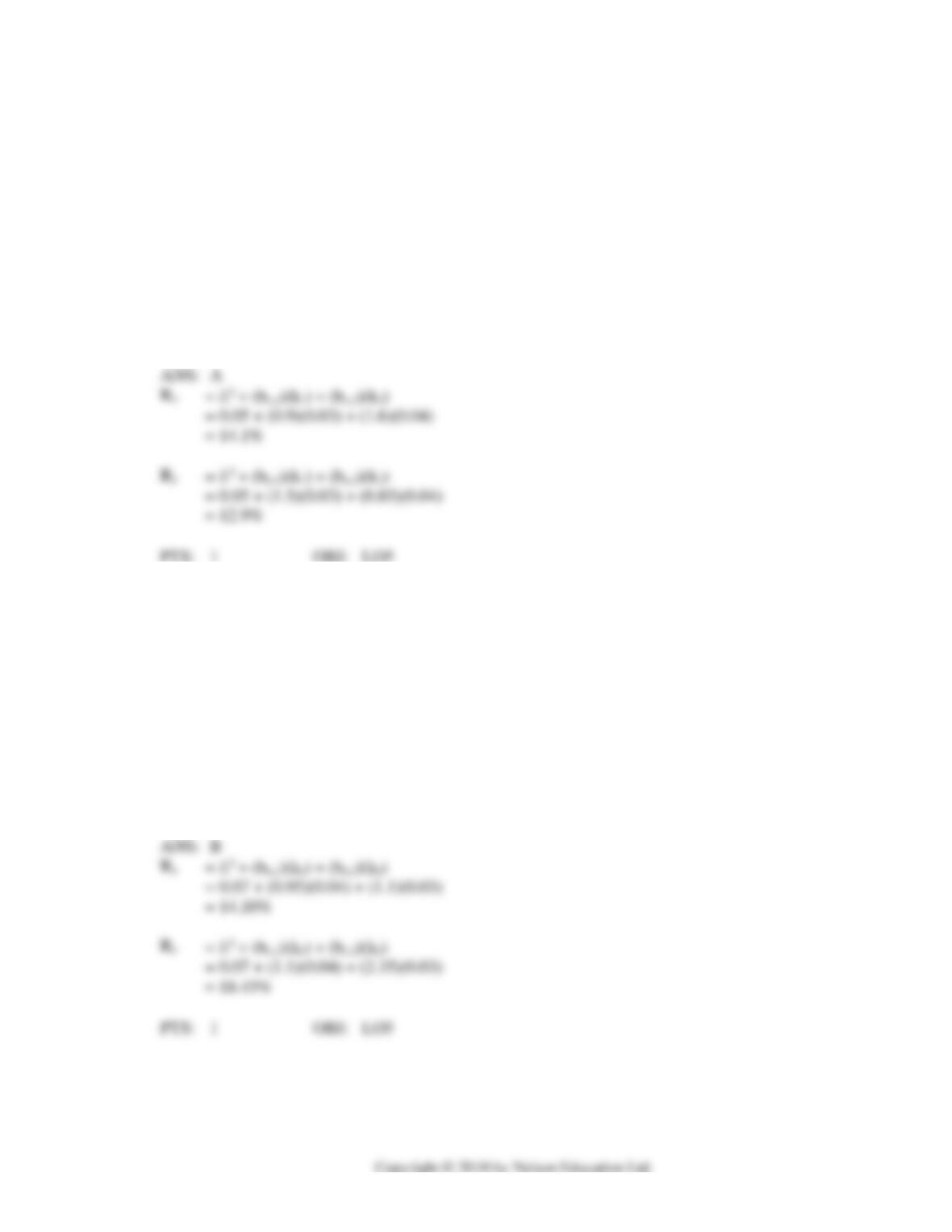
95. Under the following conditions, what are the expected returns for stocks A and B?
0 = 0.035
ba,1 = 1.00
k1 = 0.05
ba,2 = 1.40
k2 = 0.06
bb,1 = 1.70
bb,2 = 0.65
a.
14.8% and 13.8%
b.
19.8% and 29.5%
c.
16.0% and 19.8%
d.
16.9% and 15.9%
e.
None of the above
Ra
= 0.035 + (1.0)(0.05) + (1.4)(0.06)
= 16.9%
Rb
= 0.035 + (1.7)(0.05) + (0.65)(0.06)
= 15.9%
35
96. Under the following conditions, what are the expected returns for stocks X and Y?
0 = 0.05
bx,1 = 0.90
k1 = 0.03
bx,2 = 1.60
k2 = 0.04
by,1 = 1.50
by,2 = 0.85
a.
14.1% and 12.9%
b.
12.5% and 19.5%
c.
19.5% and 18.5%
d.
21.2% and 18.5%
e.
None of the above
Rx
= 0.05 + (0.9)(0.03) + (1.6)(0.04)
= 14.1%
Ry
= 0.05 + (1.5)(0.03) + (0.85)(0.04)
= 12.9%
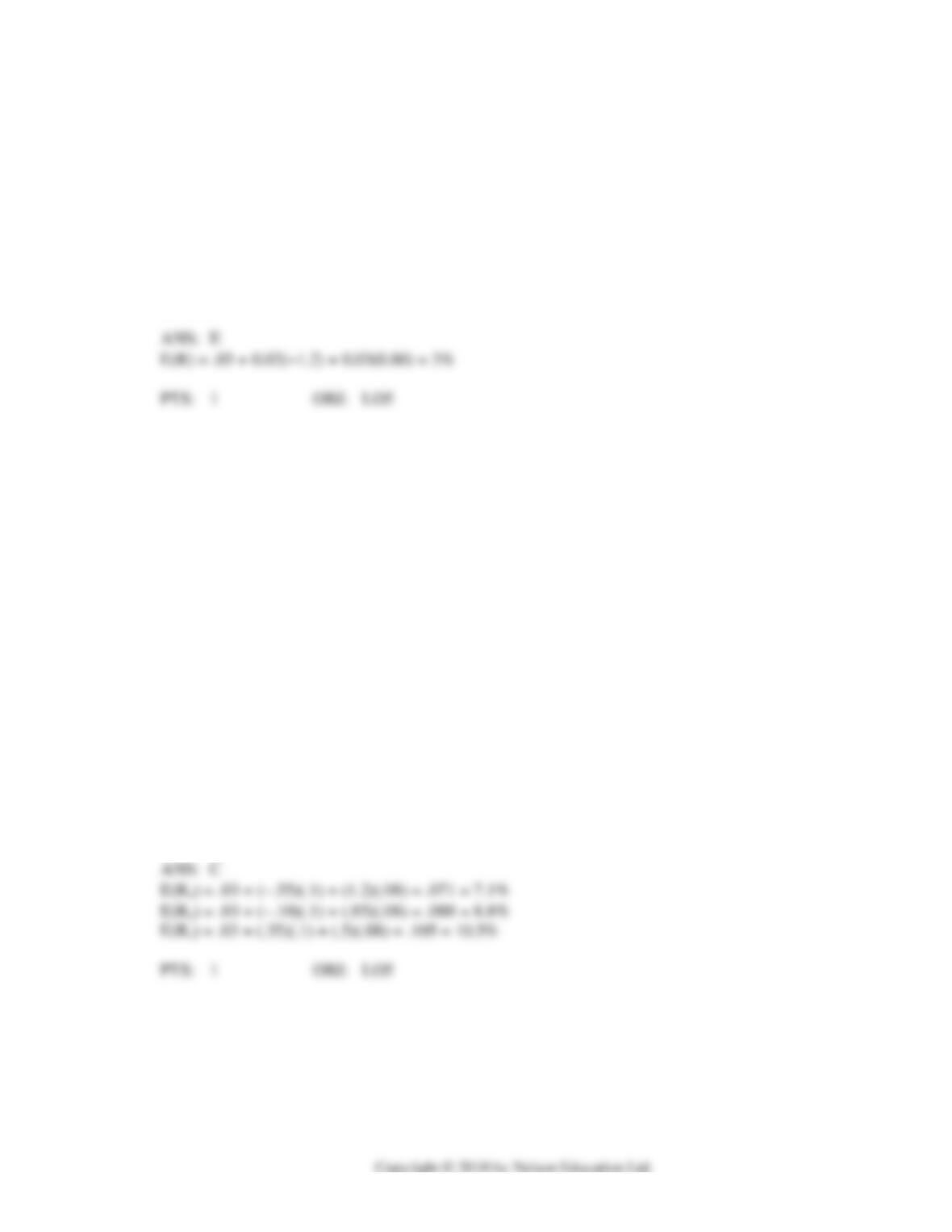
97. Under the following conditions, what are the expected returns for stocks A and C?
0 = 0.07
ba,1 = 0.95
k1 = 0.04
ba,2 = 1.10
k2 = 0.03
bc,1 = 1.10
bc,2 = 2.35
a.
14.1% and 17.65%
b.
14.1% and 18.45%
c.
17.65% and 18.45%
d.
18.45% and 17.52%
e.
None of the above
Ra
= 0.07 + (0.95)(0.04) + (1.1)(0.03)
= 14.10%
Rc
= 0.07 + (1.1)(0.04) + (2.35)(0.03)
= 18.45%
36
98. Consider a two-factor APT model where the first factor is changes in the 30-year T-bond rate, and the
second factor is the percent growth in GNP. Based on historical estimates you determine that the risk
premium for the interest rate factor is 0.02, and the risk premium on the GNP factor is 0.03. For a
particular asset, the response coefficient for the interest rate factor is −1.2, and the response coefficient
for the GNP factor is 0.80. The rate of return on the zero-beta asset is 0.03. Calculate the expected
return for the asset.
a.
5.0%
b.
2.4%
c.
−3.0%
d.
−2.4%
e.
3.0%
Exhibit 7-8
USE THE FOLLOWING INFORMATION FOR THE NEXT PROBLEM(S)
Consider the three stocks, stock X, stock Y and stock Z, that have the following factor loadings (or
factor betas)
Stock
Factor 1 Loading
Factor 2 Loading
X
−0.55
1.2
Y
−0.10
0.85
Z
0.35
0.5
The zero-beta return (0) = 3%, and the risk premia are 1 = 10%, 2 = 8%. Assume that all three
stocks are currently priced at $50.
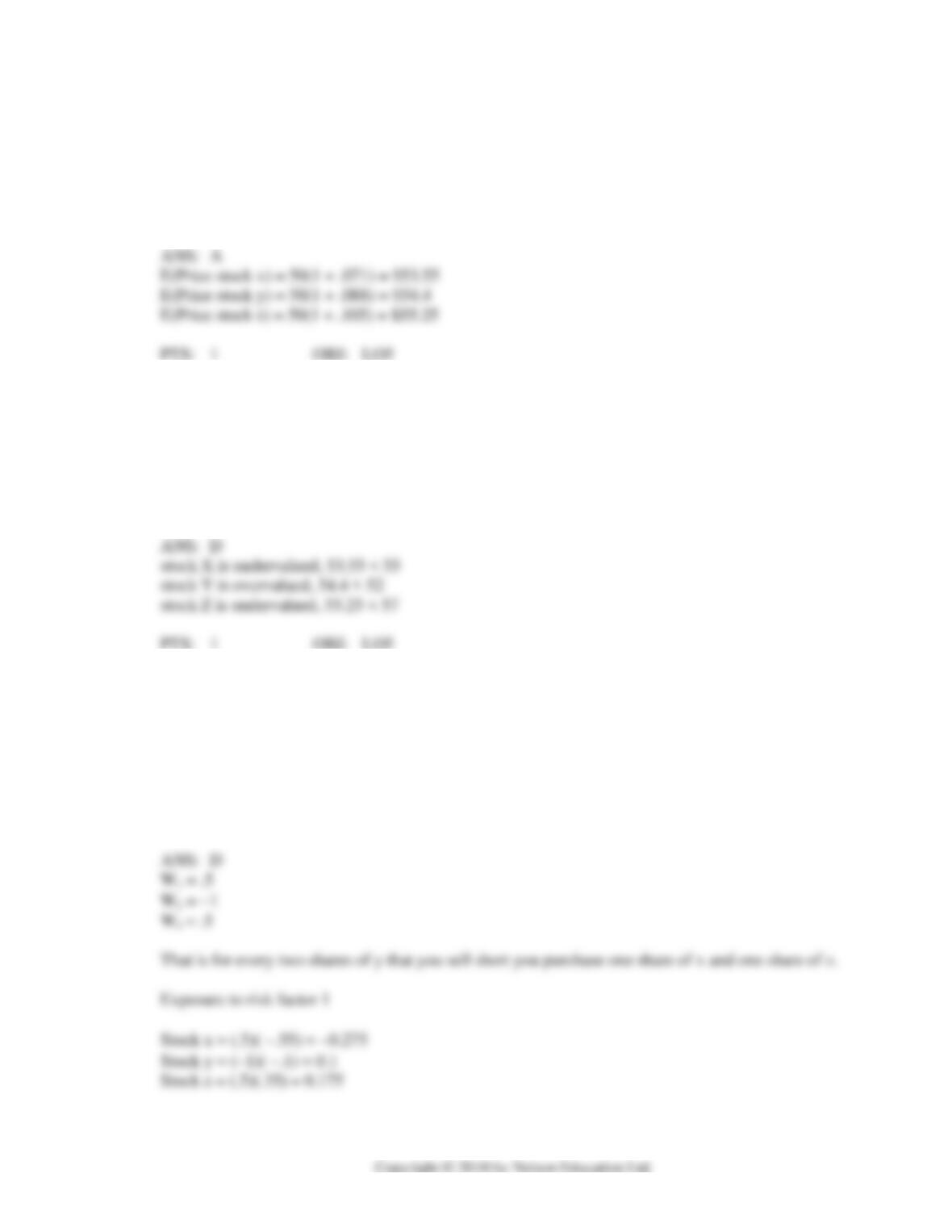
99. Refer to Exhibit 7-8. The expected returns for stock X, stock Y, and stock Z are
a.
3%, 8%, 10%
b.
7.1%, 10.5%, 8.8%
c.
7.1%, 8.8%, 10.5%
d.
10%, 5.5%, 14%
e.
None of the above.
37
100. Refer to Exhibit 7-8. The expected prices one year from now for stocks X, Y, and Z are
a.
$53.55, $54.4, $55.25
b.
$45.35, $54.4, $55.25
c.
$55.55, $56.35, $57.15
d.
$50, $50, $50
e.
$51.35, $47.79, $51.58.
101. Refer to Exhibit 7-8. If you know that the actual prices one year from now are stock X $55, stock Y
52, and stock Z $57, then
a.
stock X is undervalued, stock Y is undervalued, stock Z is undervalued.
b.
stock X is undervalued, stock Y is overvalued, stock Z is overvalued.
c.
stock X is overvalued, stock Y is undervalued, stock Z is undervalued.
d.
stock X is undervalued, stock Y is overvalued, stock Z is undervalued.
e.
stock X is overvalued, stock Y is overvalued, stock Z is undervalued.
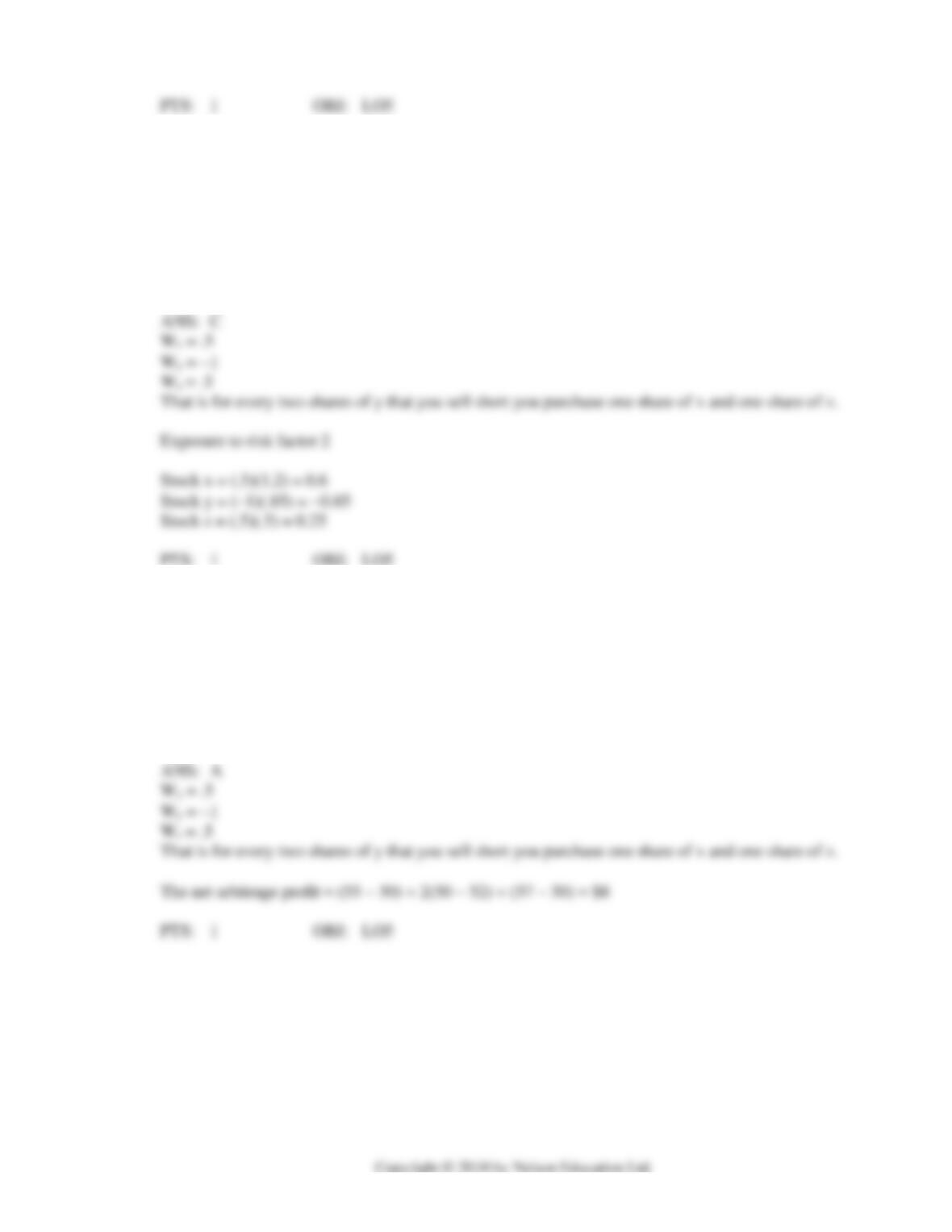
102. Refer to Exhibit 7-8. Assume that you wish to create a portfolio with no net wealth invested. The
portfolio that achieves this has 50% in stock X, −100% in stock Y, and 50% in stock Z. What are the
weighted exposures to risk factor 1 for stocks X, Y, and Z?
a.
0.50, −1.0, 0.50
b.
−0.50, 1.0, −0.50
c.
0.60, −0.85, 0.25
d.
−0.275, 0.10, 0.175
e.
None of the above.
38
103. Refer to Exhibit 7-8. Assume that you wish to create a portfolio with no net wealth invested. The
portfolio that achieves this has 50% in stock X, −100% in stock Y, and 50% in stock Z. The weighted
exposure to risk factor 2 for stocks X, Y, and Z are
a.
0.50, −1.0, 0.50
b.
−0.50, 1.0, −0.50
c.
0.60, −0.85, 0.25
d.
−0.275, 0.10, 0.175
e.
None of the above.
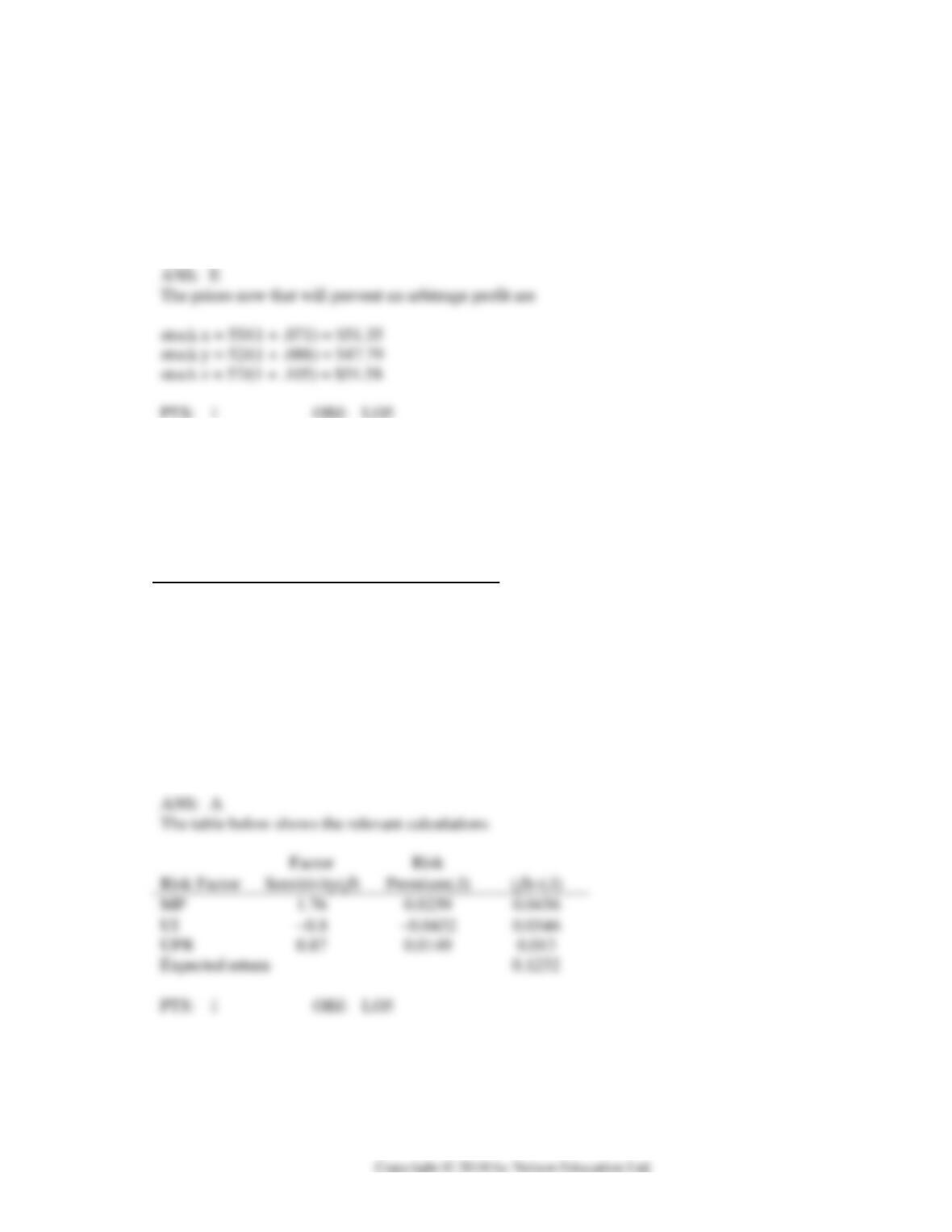
104. Refer to Exhibit 7-8. Assume that you wish to create a portfolio with no net wealth invested and the
portfolio that achieves this has 50% in stock X, −100% in stock Y, and 50% in stock Z. What is the net
arbitrage profit?
a.
$8
b.
$5
c.
$7
d.
$12
e.
$15
39
105. Refer to Exhibit 7-8. The new prices now for stocks X, Y, and Z that will not allow for arbitrage
profits are
a.
$53.55, $54.4, $55.25
b.
$45.35, $54.4, $55.25
c.
$55.55, $56.35, $57.15
d.
$50, $50, $50
e.
$51.35, $47.79, $51.58.
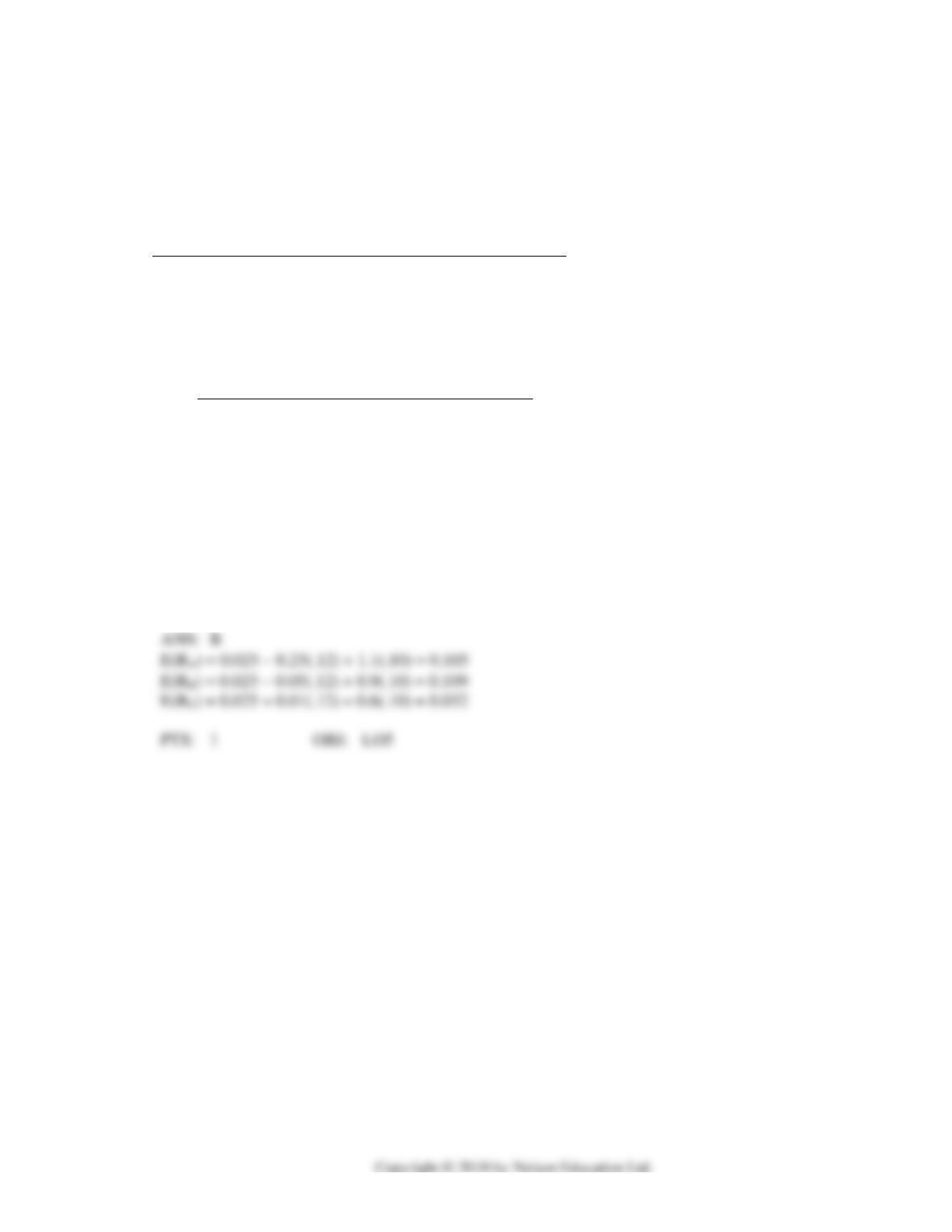
106. The table below provides factor risk sensitivities and factor risk premia for a three factor model for a
particular asset where factor 1 is MP the growth rate in U.S. industrial production, factor 2 is UI the
difference between actual and expected inflation, and factor 3 is UPR the unanticipated change in bond
credit spread.
Risk Factor
Factor
Sensitivity(
)
Risk
Premium(
)
MP
1.76
0.0259
UI
−0.8
−0.0432
UPR
0.87
0.0149
Calculate the expected excess return for the asset.
a.
12.32%
b.
9.32%
c.
4.56%
d.
6.32%
e.
8.02%
Risk Factor
UPR
Expected return
40
Exhibit 7-9
USE THE FOLLOWING INFORMATION FOR THE NEXT PROBLEM(S)
Stocks A, B, and C have two risk factors with the following beta coefficients. The zero-beta return (0)
= .025 and the risk premiums for the two factors are (1) = .12 and (0) = .10.
Stock
Factor 1 b i1
Factor 2 b i2
A
−0.25
1.1
B
−0.05
0.9
C
0.01
0.6
107. Refer to Exhibit 7-9. Calculate the expected returns for stocks A, B, C.
A
B
C
I.
0.082
0.091
0.033
II.
0.105
0.109
0.032
III.
0.132
0.128
0.033
IV.
0.165
0.121
0.032
V.
0.850
0.850
0.610
a.
I
b.
II
c.
III
d.
IV
e.
V
41
108. Refer to Exhibit 7-9. Assume that stocks A, B, and C never pay dividends and stocks A, B, and C are
currently trading at $10, $20, and $30, respectively. What is the expected price next year for each
stock?
A
B
C
I.
$10.82
$21.82
$30.99
II.
$11.05
$22.18
$30.96
III.
$11.32
$22.56
$30.99
IV.
$11.65
$22.42
$30.96
V.
$18.50
$37.00
$48.30
a.
I
b.
II
c.
III
d.
IV
e.
V
109. Refer to Exhibit 7-9. Suppose that you know that the prices of stocks A, B, and C will be $10.95,
22.18, and $30.89, respectively. Based on this information
a.
All three stocks are overvalued.
b.
All three stocks are undervalued.
c.
Stock a is undervalued, stock b is properly valued, stock c is undervalued.
d.
Stock a is undervalued, stock b is properly valued, stock c is overvalued.
e.
Stock a is overvalued, stock b is overvalued, stock c is undervalued.