CHAPTER 7A: RANDOM VARIABLES AND DISCRETE PROBABILITY
DISTRIBUTIONS
TRUE/FALSE
1. The time required to drive from New York to New Mexico is a discrete random variable.
2. A random variable is a function or rule that assigns a number to each outcome of an experiment.
3. The number of home insurance policy holders is an example of a discrete random variable
4. The mean of a discrete probability distribution for X is the sum of all possible values of X, divided by
the number of possible values of X.
5. The length of time for which an apartment in a large complex remains vacant is a discrete random
variable.
6. The number of homeless people in Boston is an example of a discrete random variable.
7. A continuous variable may take on any value within its relevant range even though the measurement
device may not be precise enough to record it.
8. Given that X is a discrete random variable, then the laws of expected value and variance can be applied
to show that E(X + 5) = E(X) + 5, and V(X + 5) = V(X) + 25.
9. A table, formula, or graph that shows all possible values a random variable can assume, together with
their associated probabilities, is referred to as probability distribution.
10. Faculty rank (professor, associate professor, assistant professor, and lecturer) is an example of a
discrete random variable.
11. For a random variable X, if V(cX) = 4V(X), where V refers to the variance, then c must be 2.
12. The amount of milk consumed by a baby in a day is an example of a discrete random variable.
13. Another name for the mean of a probability distribution is its expected value.
14. For a random variable X, E(X + 2) − 5 = E(X) − 3, where E refers to the expected value.
15. For a random variable X, V(X + 3) = V(X + 6), where V refers to the variance.
MULTIPLE CHOICE
1. A table, formula, or graph that shows all possible values a random variable can assume, together with
their associated probabilities, is called a(n):
a.
probability distribution.
b.
discrete random variable.
c.
expected value of a discrete random variable.
d.
None of these choices.
2. A function or rule that assigns a numerical value to each outcome of an experiment is called:
a.
a sample space.
c.
a random variable.
b.
a probability distribution.
d.
None of these choices.
3. The weighted average of the possible values that a random variable X can assume, where the weights
are the probabilities of occurrence of those values, is referred to as the:
a.
variance.
c.
expected value.
b.
standard deviation.
d.
None of these choices.
4. The number of accidents that occur annually on a busy stretch of highway is an example of:
a.
a discrete random variable.
b.
a continuous random variable.
c.
expected value of a discrete random variable.
d.
expected value of a continuous random variable.
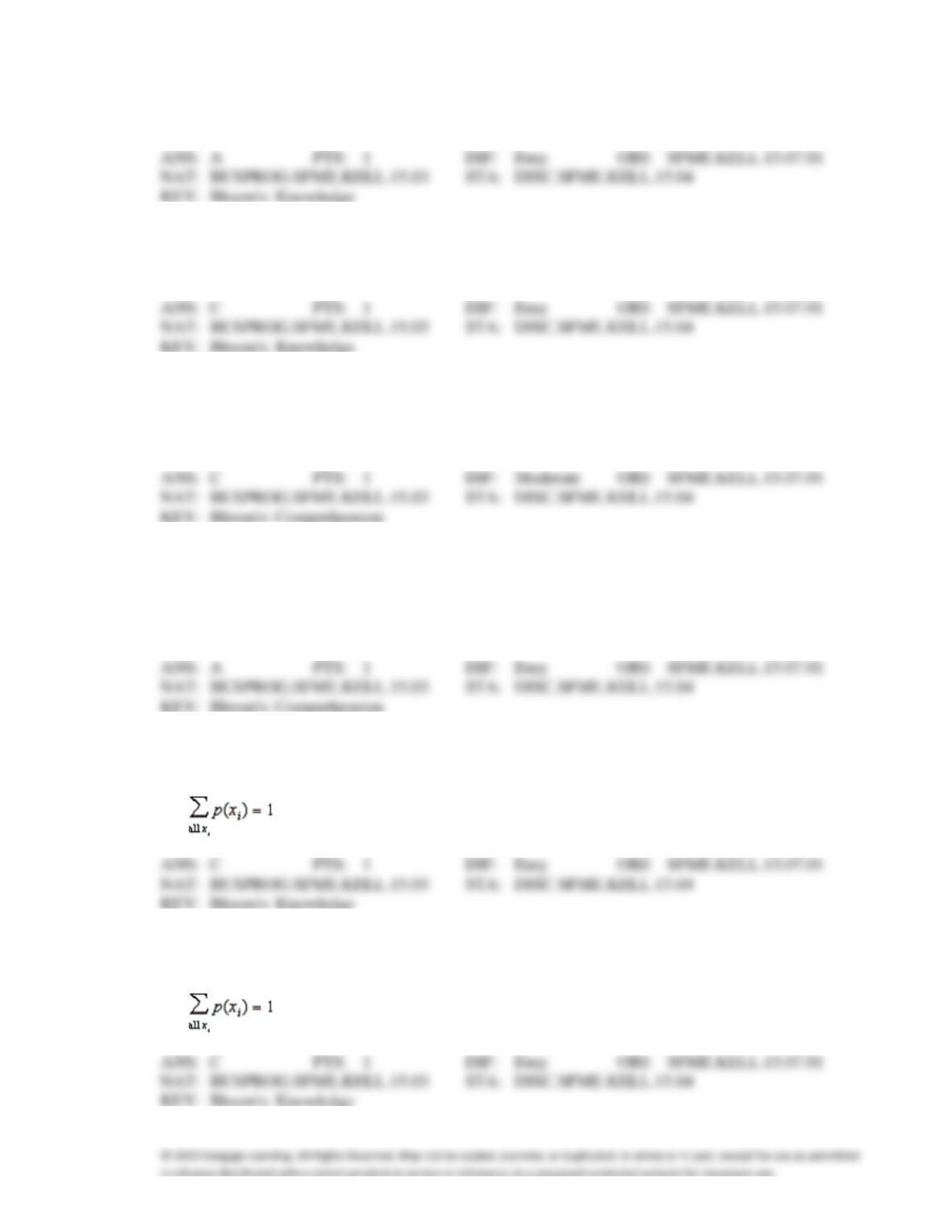
5. Which of the following are required conditions for the distribution of a discrete random variable X that
can assume values xi?
a.
0 p(xi) 1 for all xi
c.
Both a and b are required conditions.
b.
d.
Neither a nor b are required conditions.
6. Which of the following is not a required condition for the distribution of a discrete random variable X
that can assume values xi?
a.
0 p(xi) 1 for all xi
c.
p(xi) > 1 for all xi
b.
d.
All of these choices are true.
7. A lab at the DeBakey Institute orders 150 rats a week for each of the 52 weeks in the year for
experiments that the lab conducts. Suppose the mean cost of rats used in lab experiments turned out to
be $20.00 per week. Interpret this value.
a.
Most of the weeks resulted in rat costs of $20.00
b.
The median cost for the distribution of rat costs is $20.00
c.
The expected or average costs for all weekly rat purchases is $20.00
d.
The rat cost that occurs more often than any other is $20.00
8. In the notation below, X is the random variable, c is a constant, and V refers to the variance. Which of
the following laws of variance is not true?
a.
V(c) = 0
c.
V(cX) = c2 V(X)
b.
V(X + c) = V(X) + c
d.
None of these choices.
9. Which of the following is a discrete random variable?
a.
The Dow Jones Industrial average.
b.
The volume of water in Michigan Lakes.
c.
The time it takes you to drive to school.
d.
The number of employees of a soft drink company.
10. Which of the following is a continuous random variable?
a.
The number of employees of an automobile company.
b.
The amount of milk produced by a cow in one 24-hour period.
c.
The number of gallons of milk sold at Albertson’s grocery store last week.
d.
None of these choices.
11. In the notation below, X is the random variable, E and V refer to the expected value and variance,
respectively. Which of the following is false?
a.
E(3X) = 3E(X)
c.
E(X + 1) = E(X) + 1
b.
V(2) = 0
d.
All of these choices are true.
COMPLETION
1. A motorcycle insurance company evaluates many numerical variables about a person before deciding
on an appropriate rate for motorcycle insurance. How long a person has been a licensed rider is an
example of a(n) ____________________ random variable.
2. An auto insurance company evaluates many numerical variables about a person before deciding on an
appropriate rate for automobile insurance. The number of claims a person has made in the last 3 years
is an example of a(n) ____________________ random variable.
3. An auto insurance company evaluates many numerical variables about a person before deciding on an
appropriate rate for automobile insurance. A person’s age is an example of a(n)
____________________ random variable.
4. A motorcycle insurance company evaluates many numerical variables about a person before deciding
on an appropriate rate for motorcycle insurance. The number of tickets a person has received in the last
3 years is an example of a(n) ____________________ random variable.
5. A motorcycle insurance company evaluates many numerical variables about a person before deciding
on an appropriate rate for motorcycle insurance. The distance a person rides in a year is an example of
a(n) ____________________ random variable.
6. The dean of students conducted a survey on campus. Grade point average (GPA) is an example of a(n)
____________________ random variable.
7. The amount of time that a microcomputer is used per week is an example of a(n)
____________________ random variable.
8. The number of days that a microcomputer goes without a breakdown is an example of a(n)
____________________ random variable.
9. A(n) ____________________ random variable is one whose values are uncountable.
10. A(n) ____________________ random variable is one whose values are countable.
SHORT ANSWER
1. For each of the following random variables, indicate whether the variable is discrete or continuous,
and specify the possible values that it can assume.
a.
X = the number of traffic accidents in Albuquerque on a given day.
b.
X = the amount of weight lost in a month by a randomly selected dieter.
c.
X = the average number of children per family in a random sample of 175 families.
d.
X = the number of households out of 10 surveyed that own a convection oven.
e.
X = the time in minutes required to obtain service in a restaurant.
ANS:
a.
discrete; x = 0, 1, 2, 3, . . .
c.
d.
discrete; x = 0, 1, 2, . . . , 10
e.
continuous; x > 0
Number of Motorcycles
The probability distribution of a discrete random variable X is shown below, where X represents the
number of motorcycles owned by a family.
x
0
1
2
3
p(x)
0.25
0.40
0.20
0.15
2. {Number of Motorcycles Narrative} Find the following probabilities:
a.
P(X > 1)
b.
P(X 2)
c.
P(1 X 2)
d.
P(0 < X < 1)
e.
P(1 X < 3)
a.
0.35
c.
0.60
d.
0.00
3. {Number of Motorcycles Narrative} Find the expected value of X.
4. {Number of Motorcycles Narrative} Find the standard deviation of X.
5. {Number of Motorcycles Narrative} Apply the laws of expected value to find the following:
a.
E(X2)
b.
E(2X2 + 5)
c.
E(X − 2)2
a.
2.55
c.
1.55
6. {Number of Motorcycles Narrative} Apply the laws of expected value and variance to find the
following:
a.
V(3X)
b.
V(3X − 2)
c.
V(3)
d.
V(3X) − 2
ANS:
a.
b.
8.89
c.
0
Number of Horses
The random variable X represents the number of horses per family in a rural area in Iowa, with the
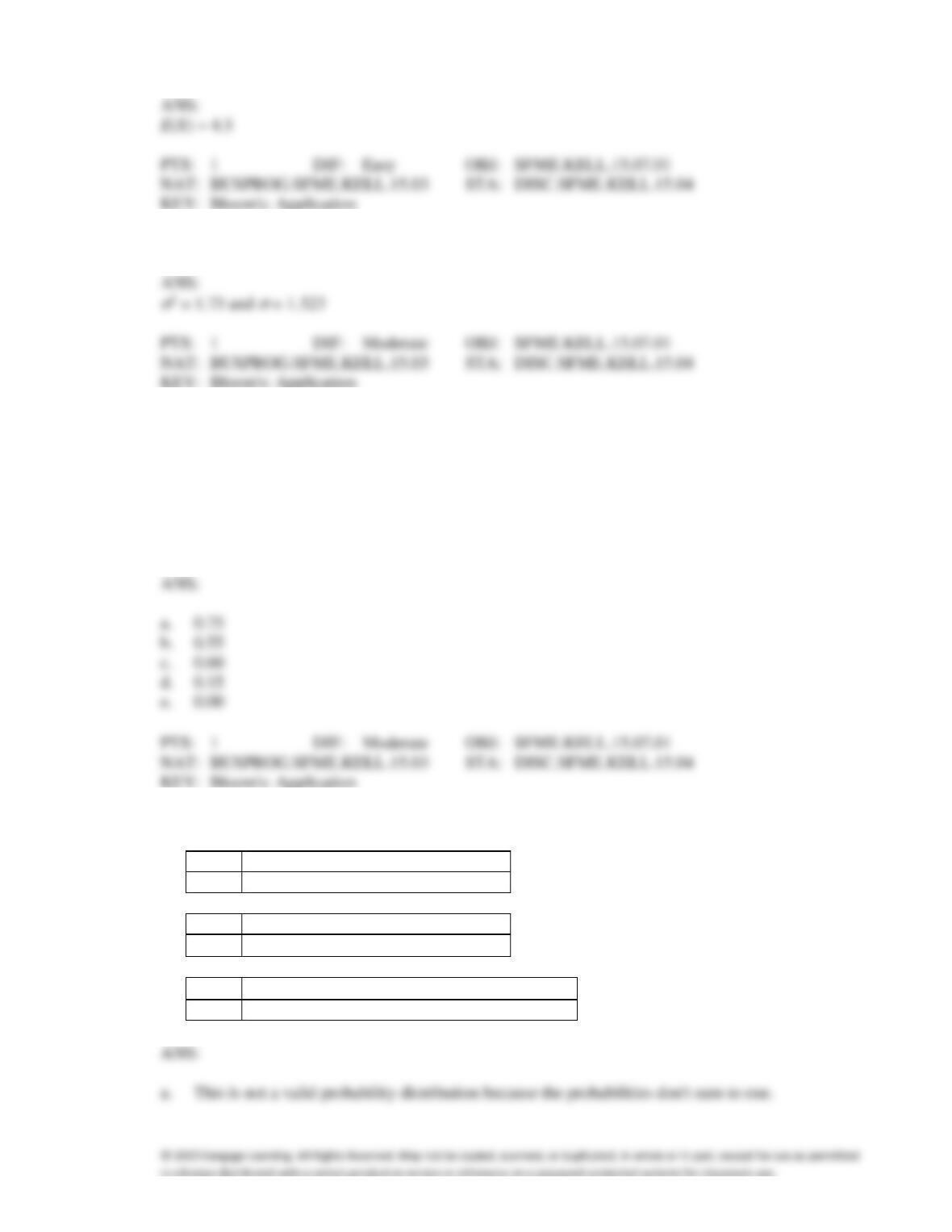
probability distribution: p(x) = 0.05x, x = 2, 3, 4, 5, or 6.
7. {Number of Horses Narrative} Express the probability distribution in tabular form.
8. {Number of Horses Narrative} Find the expected number of horses per family.
9. {Number of Horses Narrative} Find the variance and standard deviation of X.
10. {Number of Horses Narrative} Find the following probabilities:
a.
P(X 4)
b.
P(X > 4)
c.
P(3 X 5)
d.
P(2 < X < 4)
e.
P(X = 4.5)
a.
0.75
c.
0.60
d.
0.15
e.
0.00
11. Determine which of the following are not valid probability distributions, and explain why not.
a.
x
0
1
2
3
p(x)
0.15
0.25
0.35
0.45
b.
x
2
3
4
5
p(x)
−0.10
0.40
0.50
0.25
c.
x
−2
−1
0
1
2
p(x)
0.10
0.20
0.40
0.20
0.10
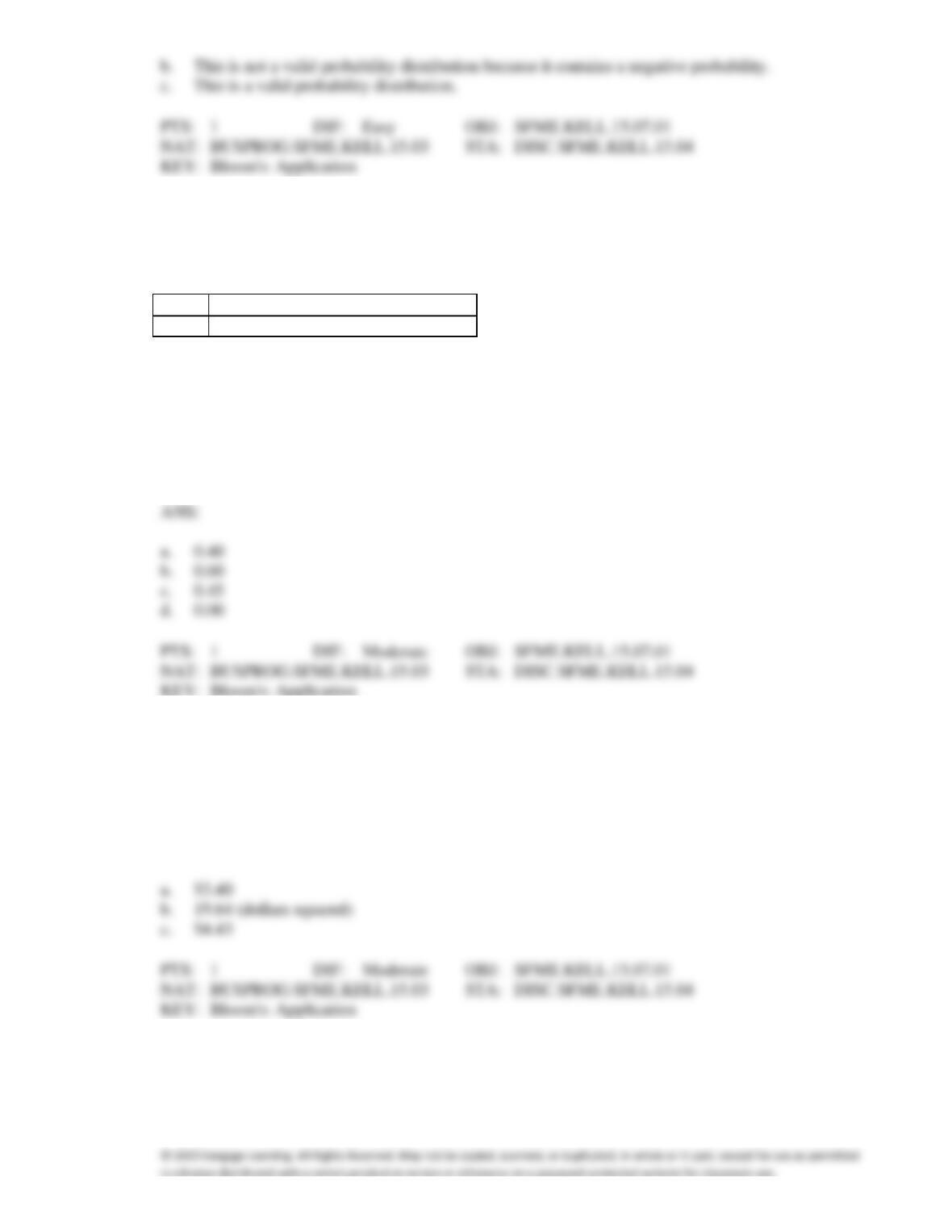
b.
This is not a valid probability distribution because it contains a negative probability.
c.
This is a valid probability distribution.
Blackjack
The probability distribution of a random variable X is shown below, where X represents the amount of
money (in $1,000s) gained or lost in a particular game of Blackjack.
x
−4
0
4
8
p(x)
0.15
0.25
0.20
0.40
12. {Blackjack Narrative} Find the following probabilities:
a.
P(X 0)
b.
P(X > 3)
c.
P(0 X 4)
d.
P(X = 5)
0.40
b.
0.60
0.45
d.
0.00
13. {Blackjack Narrative} Find the following values and indicate their units.
a.
E(X)
b.
V(X)
c.
Standard deviation of X
ANS:
$3.40
b.
19.64 (dollars squared)
$4.43
Gym Visits
Let X represent the number of times a student visits a gym in a one month period. Assume that the
probability distribution of X is as follows:
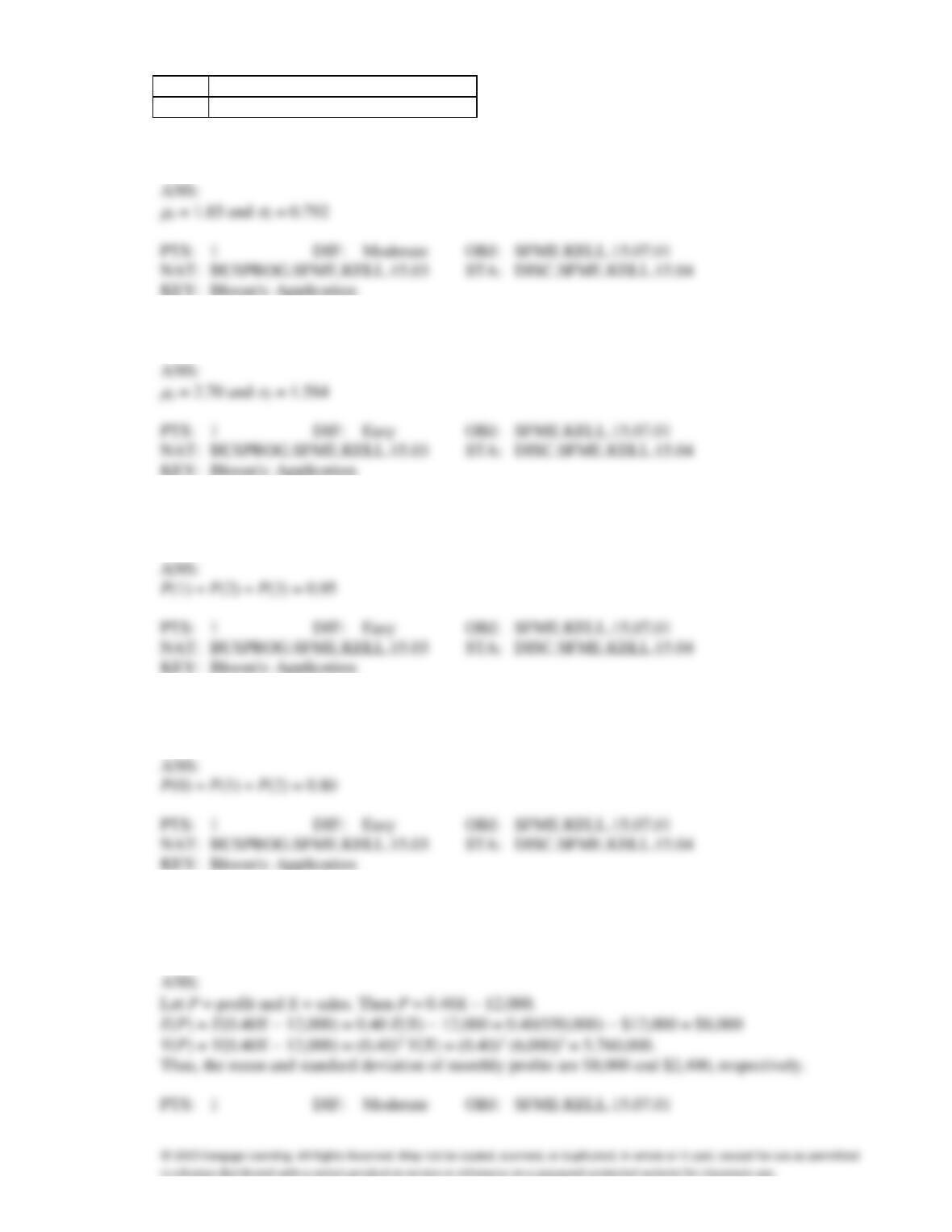
x
0
1
2
3
p(x)
0.05
0.25
0.50
0.20
14. {Gym Visits Narrative} Find the mean
and the standard deviation
of this distribution.
15. {Gym Visits Narrative} Find the mean and the standard deviation of Y = 2X − 1.
16. {Gym Visits Narrative} What is the probability that the student visits the gym at least once in a
month?
17. {Gym Visits Narrative} What is the probability that the student visits the gym at most twice in a
month?
18. The monthly sales at a Gas Station have a mean of $50,000 and a standard deviation of $6,000. Profits
are calculated by multiplying sales by 40% and subtracting fixed costs of $12,000. Find the mean and
standard deviation of monthly profits.
Shopping Outlet
A shopping outlet estimates the probability distribution of the number of stores shoppers actually enter
as shown in the table below.
x
0
1
2
3
4
p(x)
0.05
0.35
0.25
0.20
0.15
19. {Shopping Outlet Narrative} Find the expected value of the number of stores entered.
20. {Shopping Outlet Narrative} Find the variance and standard deviation of the number of stores entered.
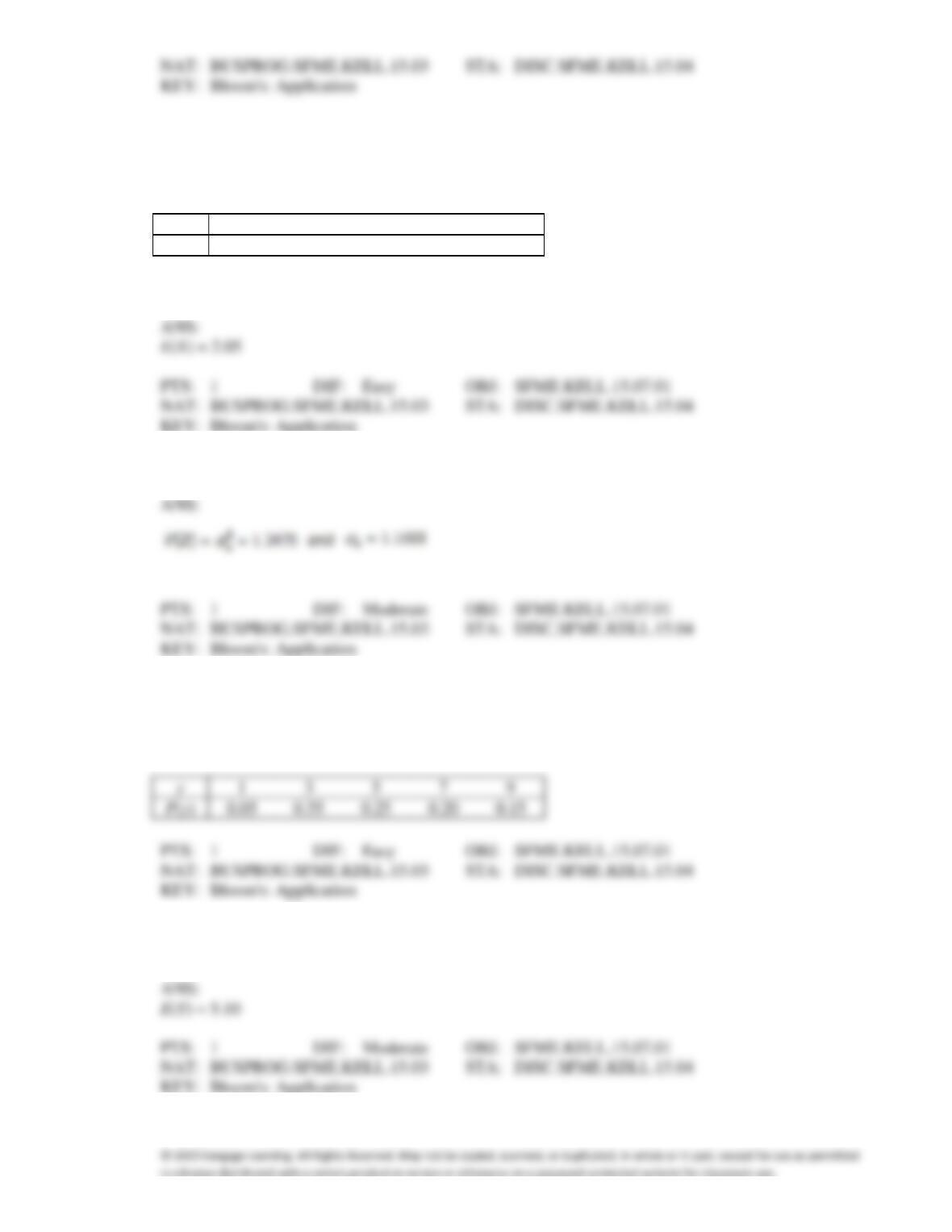
21. {Shopping Outlet Narrative} Suppose Y = 2X + 1 for each value of X. What is the probability
distribution of Y?
ANS:
22. {Shopping Outlet Narrative} Calculate the expected value of Y directly from the probability
distribution of Y.
23. {Shopping Outlet Narrative} Use the laws of expected value to calculate the mean of Y from the
probability distribution of X.
24. {Shopping Outlet Narrative} Calculate the variance and standard deviation of Y directly from the
probability distribution of Y.
25. {Shopping Outlet Narrative} Use the laws of variance to calculate the variance and standard deviation
of Y from the probability distribution of X.
26. {Shopping Outlet Narrative} What did you notice about the mean, variance, and standard deviation of
Y = 2X + 1 in terms of the mean, variance, and standard deviation of X?
Retries
The following table contains the probability distribution for X = the number of retries necessary to
successfully transmit a 1024K data package through a double satellite media.
x
0
1
2
3
p(x)
0.35
0.35
0.25
0.05
27. {Retries Narrative} What is the probability of no retries?
28. {Retries Narrative} What is the probability of a least one retry?
29. {Retries Narrative} What is the mean or expected value for the number of retries?
30. {Retries Narrative} What is the variance for the number of retries?
31. {Retries Narrative} What is the standard deviation of the number of retries?
32. The sum of the expected values always equals the expected value of the sums.
33. Bivariate distributions provide probabilities of combinations of two variables.
ANS:
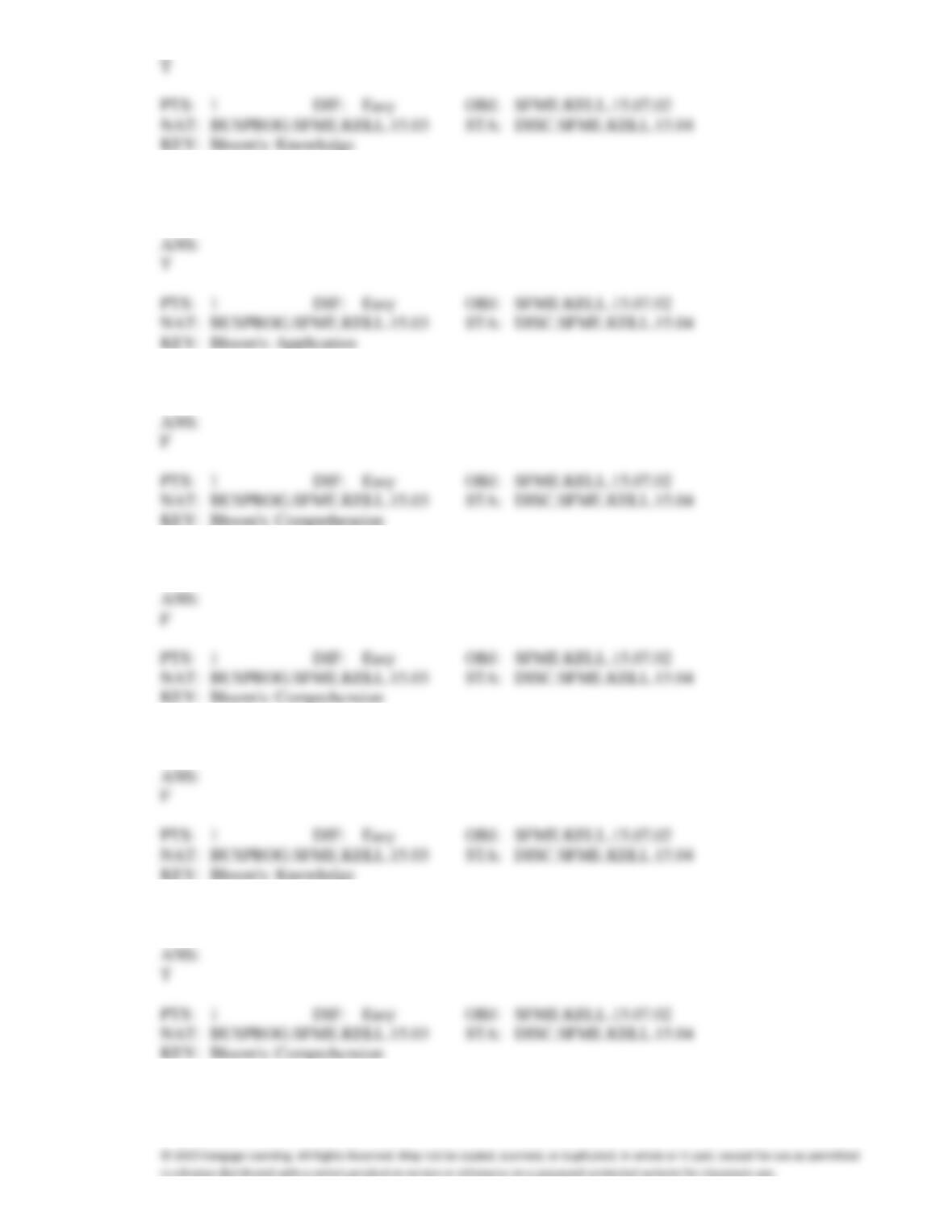
34. If X and Y are independent variables with V(X) = 23.48 and V(Y) = 36.52, then the standard deviation
of W = X + Y is
w = 7.746.
35. The covariance can be negative but the coefficient of correlation cannot.
36. The variance of the sum always equals the sum of the variances.
37. If X and Y are independent variables, then COV(X, Y) > 0.
38. If X and Y are independent variables, then their coefficient of correlation
= 0.
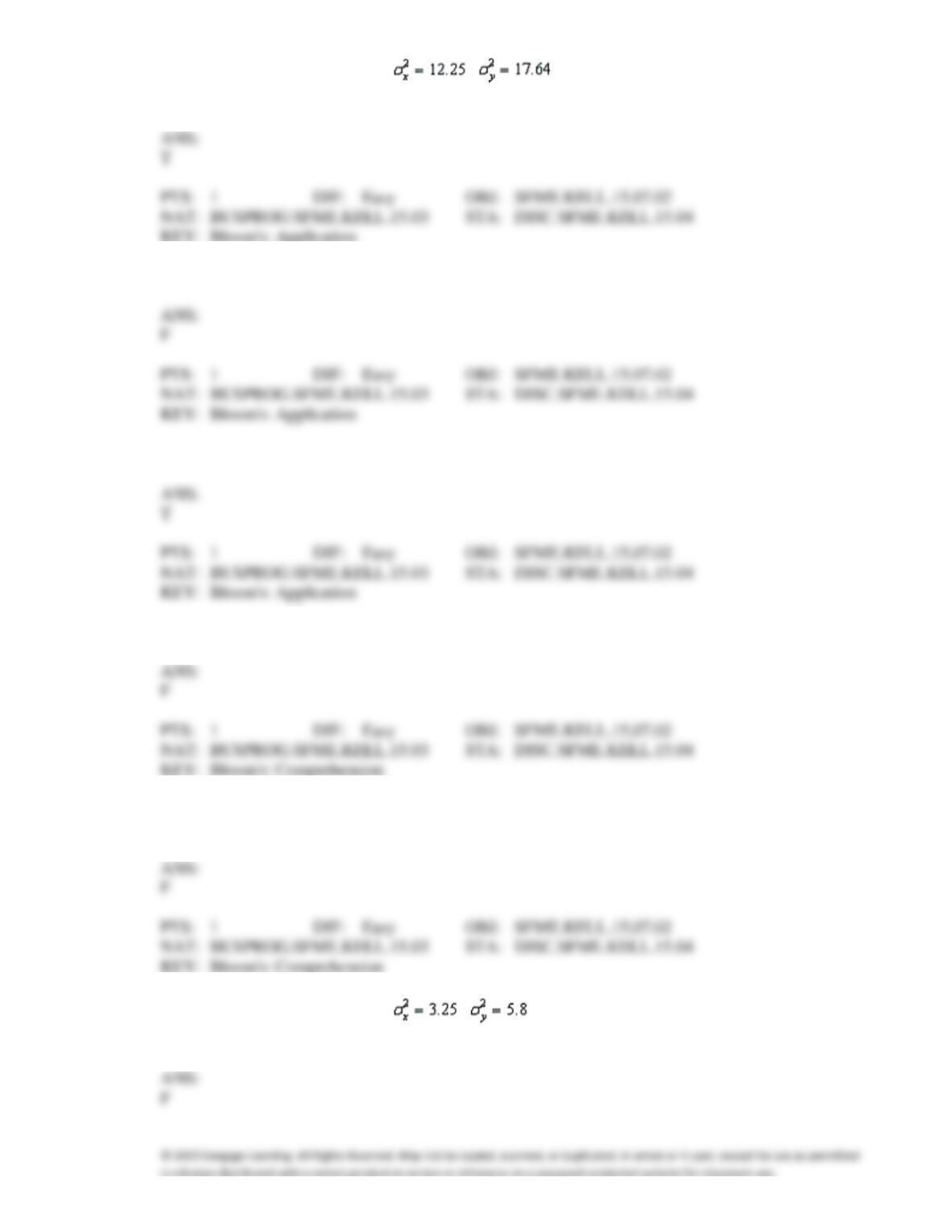
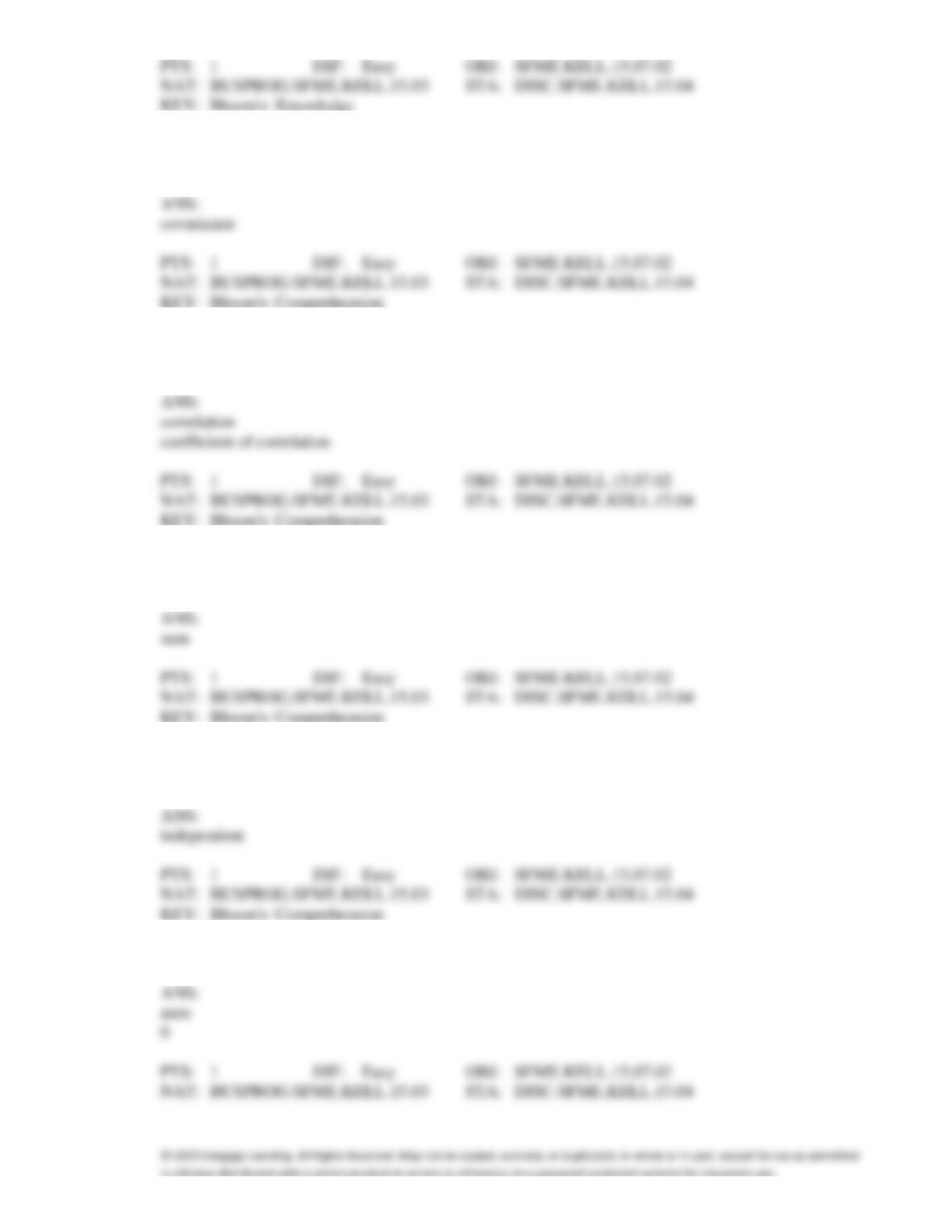
39. If X and Y are two variables with , , and COV(X, Y) = 11.76, then the coefficient
of correlation
= 0.8.
40. If X and Y are two variables with E(XY) = 10.56, E(X) = 4.22, and E(Y) = 5.34, then COV(X, Y) = 1.0.
41. If X and Y are two variables with
x = 3.8,
y = 4.2, and COV(X, Y) = −0.25, then V(X + Y) = 31.58.
42. If you add two single probability distributions together you get a bivariate distribution.
43. The variance of X must be non-negative; the variance of Y must be non-negative; hence the covariance
of X and Y must be non-negative.
44. If X and Y are two variables with , , and COV(X, Y) = 14.703, then the coefficient of
correlation
= 0.78.
45. A statistical measure of the strength of the relationship between two random variables X and Y is
referred to as the:
a.
expected value
b.
variance
c.
covariance
d.
standard deviation
46. If X and Y are random variables, the sum of all the conditional probabilities of X given a specific value
of Y will always be:
a.
0.0
b.
1.0
c.
the average of the possible values of X.
d.
the average of the possible values of Y.
47. If X and Y are random variables with E(X) = 6 and E(Y) = 9, then E(2X + 3Y) is:
a.
39
b.
15
c.
27
d.
12
48. The covariance of two variables X and Y:
a.
must be between −1 and +1.
b.
must be positive.
c.
can be any real number.
d.
None of these choices.
ANS:
49. If X and Y are any random variables with E(X) = 5, E(Y) = 6, E(XY) = 21, V(X) = 9 and V(Y) = 10, then
the relationship between X and Y is a:
a.
strong positive relationship
b.
strong negative relationship
c.
weak positive relationship
d.
weak negative relationship
50. If X and Y are any random variables with COV(X, Y) = 0.25, , and , then the
coefficient of correlation
is
a.
1.417
b.
1.190
c.
0.595
d.
0.354
51. If X and Y are independent random variables, which of the following identities is false?
a.
COV(X, Y) = 1
b.
E(X + Y) = E(X) + E(Y)
c.
V(X + Y) = V(X) + V(Y)
d.
All of these choices are true.
52. A(n) ____________________ distribution provides probabilities of combinations of two random
variables.
53. The ____________________ of X and Y is one measure of the strength and direction of the linear
relationship between X and Y. However this number is hard to put into perspective.
54. The ____________________ of X and Y is a measure of the strength and direction of the linear
relationship between X and Y. It is easy to put into perspective because it is always between −1 and 1.
55. The expected value of the sum of two random variables X and Y is equal to the
____________________ of the expected value of X and the expected value of Y.
56. If X and Y are ____________________, the variance of their sum is equal to the sum of their
variances.
57. If X and Y are independent, then COV(X, Y) = ____________________.
58. If X and Y are independent, then the coefficient of correlation equals ____________________.
59. In a bivariate distribution, the sum of all the ____________________ probabilities must equal 1.
60. A probability distribution for a single random variable is referred to as a(n) ____________________
distribution.
61. The ____________________ and the ____________________ both measure the relationship between
two random variables X and Y.
Number of Birds
Alana and Eva are sisters. Let X denote the number of birds that Alana may have in the next two years,
and let Y denote the number of birds Eva may have during the same period. The marginal probability
distributions of X and Y are shown below.
x
0
1
2
y
0
1
2
p(x)
0.5
0.3
0.2
p(y)
0.4
0.5
0.1
62. {Number of Birds Narrative} Compute the mean and variance of X.