77
PURCHASING
CHAPTER 7
ANSWERS TO PROBLEMS
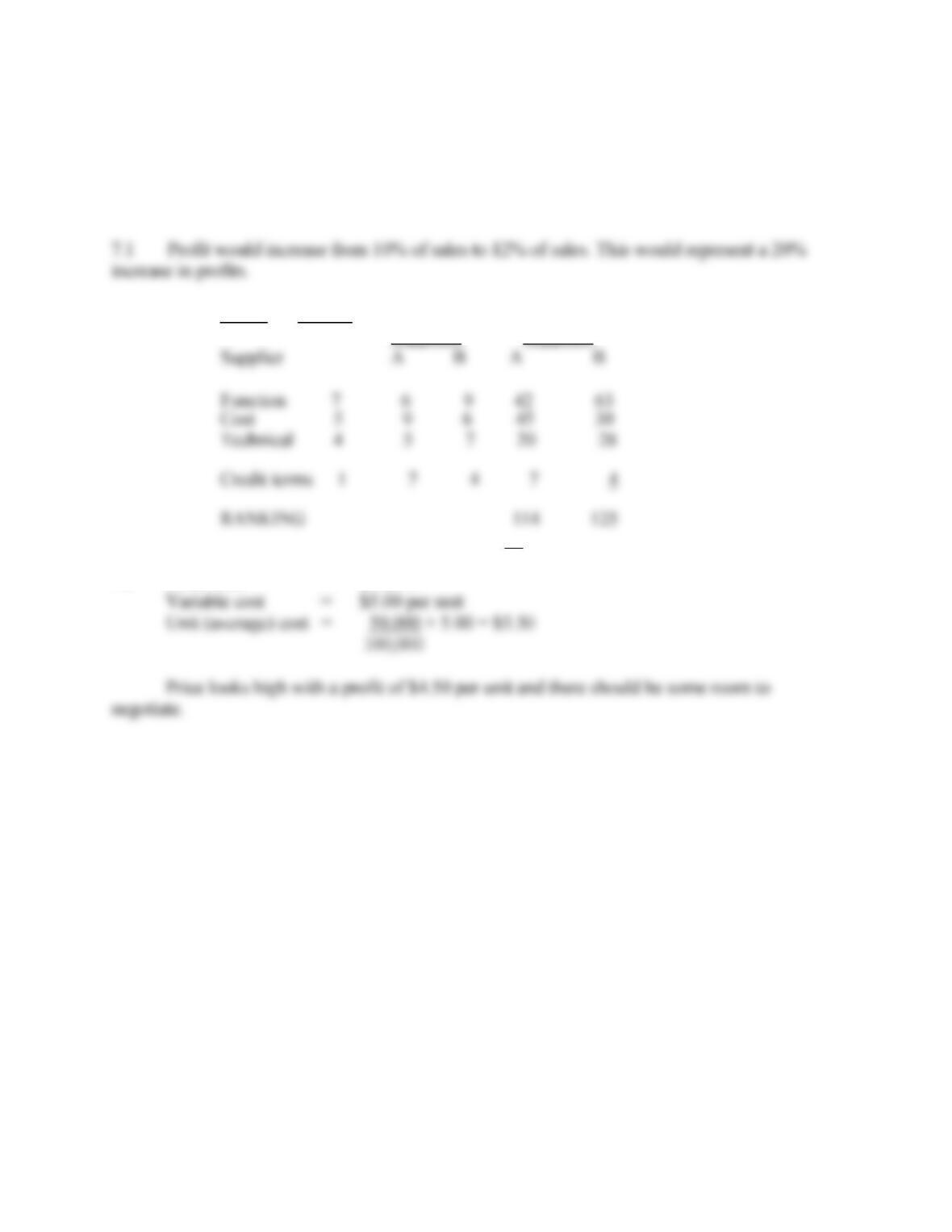
7.2
Factor
Weight
Rating of Ranking of
Suppliers Suppliers
7.3
Fixed cost
=
$50,000
78
MULTIPLE CHOICE QUESTIONS
1
. Which of the following is an objective of purchasing?
I
. Obtain goods and services of the required specification and quality.
II
. Obtain goods and services at the lowest cost.
III
. Be sure the best possible service and delivery are provided by the supplier.
a
. I only
b
. II only
c
. III only
d
. IV only
e
. all are objectives of purchasing.
2
. Which of the following is NOT a step in the purchasing cycle?
a
. receipt and analysis of purchase requisition
b
. selection of vendor
c
. make up the specification for the product
d
. issue a purchase order
e
. receive and accept the goods.
3
. Purchasing departments usually have the responsibility and authority to:
a
. legally commit the company to a contract
b
. satisfy the needs of the user department
c
. determine price and source
d
. all of the above
4
. ______ originates with the department or person who will be the ultimate user:
a
. A purchase requisition
b
. A purchase order
c
. Vendor selection
d
. any of the above
5
. The decision on what is the “best buy” involves consideration of:
a
. functional requirements
b
. price
c
. quantity required
d
. all of the above
6
. ____________ is concerned with the end use of the item and what it is expected to do:
a
. Quantity required
b
. Functional specification
c
. Production department
d
. all of the above
7
. Which of the following is NOT a phase in providing user satisfaction?
I. Quality and production planning.
II
. Quality and product design.
III
. Quality and manufacturing.
IV. Quality and use.
79
a
. all the above are phases in providing user satisfaction
b
. I only
c
. II only
d
. III only
e
. IV only.
8
. Functional specifications set out:
a
. how the product is to work
b
. the purpose for which the product is required
c
. all those aspects or characteristics of a product that are determined by its final
use
d
. none of the above.
9. The replacement of internal capacity and production with that of a supplier’s is known as:
a. Capacity buying
b. Outpartnering
c. Outsourcing
d. Capacity cushioning
10. Which of the following terms is an inquiry sent to multiple suppliers to receive
information?
a. Purchase requisition
b. Material authorization
c. Purchase order
d. Request for quote
11
. Which of the following applies to standard products?
a
. their prices are comparatively stable
b
. they are readily available
c
. they are purchased ONLY after firm quotations
d
. only a and b above apply
e
. all of the above apply.
12. Long-term supplier partnerships are supported by which of the following types of
sourcing:
a. Sole
b. Multiple
c. Single
d. Buyer/planner
13
. In which of the following situations would a company probably specify by brand?
a
. when buying small quantities
b
. when the item to be bought is patented
c
. when the item to be bought is made to an industry standard
d
. a and b above
e
. b and c above.
80
14
. Which of the following is FALSE regarding description of a product by specification?
a
. allows purchase from a number of sources
b
. developing specifications is an inexpensive process
c
. the minimum specifications set by the buyer are likely to become the maximum
furnished by
the supplier
d
. all the above
e
. b and c above.
15. Which of the following terms identifies materials whose price is set by market supply
and demand?
a. Commodities
b. Standard products
c. Items of small value
d. Made-to-order items
16
. Which of the following is the most important responsibility of a purchasing officer?
a
. getting the best price
b
. getting the best quality
c
. selecting the best source
d
. ensuring goods are delivered on time
17
. Which of the following is NOT a factor to consider when selecting a supplier?
a
. technical ability
b
. manufacturing capability
c
. reliability
d
. price
e
. size of organization
18
. Buyers should realize that when they make a continuing purchase they buy more than the
supplier’s product. They also buy the supplier’s:
a
. managerial capabilities
b
. procurement capabilities
c
. production capabilities
d
. technical capabilities
e
. all the above.
19
. Which of the following will help a purchasing officer select potential sources of supply?
a
. trade journals
b
. purchasing department’s own records
c
. advertising
d
. all the above
81
20
. Supplier relationships are necessary because:
a
. the buyer can expect price concessions
b
. the buyer can expect presents from the vendor
c
. the buyer and vendor depend upon each other for communication and problem
solving
d
. all of the above
21
. When using the ranking method of evaluating suppliers:
a
. each supplier is ranked for overall suitability
b
. important factors are selected and assigned a “weight”
c
. suppliers are rated against each factor
d
. weight and rating of each supplier is multiplied for each factor and the total
taken as the ranking of the supplier
e
. all the above are used.
22
. Which of the following is (are) a qualification(s) of a good supplier?
a
. has adequate plant and facilities
b
. has a sound financial position
c
. has reasonable prices
d
. all the above are qualifications of a good supplier
23. Which of the following refers to a means of replenishing inventory through a supplier’s
review and responsibility to maintain targeted inventory levels?
a. Safety stock
b. Vendor-managed inventory
c. Environmentally-responsible purchasing
d. Enterprise resource planning
24
. Special items will generally be purchased on the basis of a quotation. The purchasing agent
will select on the basis of:
a
. the lowest price
b
. the most reliable bidder
c
. the preference of the department that will use the item
d
. consideration of all the above
25
. In comparing prices, which of the following factors should be considered?
a
. base price
b
. shipping point
c
. installation and tooling costs
d
. all the above should be considered
26. The fluctuation in the supply upstream in a supply chain generated by a small
change in demand downstream in the supply chain is known as:
a. Forecast error
b. Bullwhip effect
c. Break-even point
d. Demand variation
82
27
. Which of the following is a function of supplier scheduling and follow-up?
a
. selecting suppliers
b
. establishing specifications
c
. taking corrective action on issues
d
. price determination
e
.
negotiation.
28
. Which of the following statements is true about planner/buyers?
I
. Planner/buyers handle more components than planners do.
II
. Planner/buyers issue material releases to suppliers.
III
. Planner/buyers establish supplier delivery priorities.
IV. Planner/buyers negotiate prices with suppliers.
a
. I and II are true
b
. II and III are true
c
. III and IV are true
d
. I, II, and III are true
e
. II, III, and IV are true.
29
. Which of the following statements is true?
a
. in contract buying, price and delivery are negotiated each time an order is
released.
b
. contract buying assures suppliers they have a given amount of business and
commits them to allocating that amount of their capacity to the customer
c
. contract buying is useful for short term purchases
d. EDI does not eliminate much of the paper work associated with buying
30
. Intranet stands for
…
a
. a net that includes all who are connected to it.
b
. an external net that can be used by all people
c
. an internal net normally used within the boundaries of the company
d
. an net shared by two or more companies
31
. Which of the following is not an objective of the Purchasing Department?
a
. Ensuring the best possible service and prompt delivery by the supplier.
b
. Developing good supplier relations.
c
. Issuing a regular quantity of purchase orders.
d
. Selecting products that reduce the impact on the environment.
e
. Obtaing goods and services at the lowest cost.
32
. If the fixed cost to produce an item is $500, labor is $2.00 per unit and materials are $2.50
per unit; then the unit cost for an order of 1,000 would be:
a
.
$6.50
b
.
$5,000
c
.
$5.00
d
.
$504.50
83
33
. A price that is competitive and allows the seller to make a profit is considered to be a price
that is:
a
. Optimal.
b
.
Fair.
c
. An incentive.
d
. The final price.
e
. The lowest price.
34
. Which
a
.
Reduce.
b
.
Reuse.
c
. Recycle.
d
. All of the above have equal impact.
35
. Which of the following departments is most likely to be familiar with knowledge of waste
products, the legislation governing their handling and other uses in the company.
a
.
Purchasing.
b
. Maintenance.
c
. Engineering.
d
. Direct Customer Sales.
e
. Human Resources
36
. A Purchasing Agent, wishing to dispose of waste plastic from one of their processes should
first contact:
a
. Plant Maintenance.
b
. A buyer of waste materials.
c
. Local Government regulators.
d
. The supplier.
e
. The customer who buys the products.
37
. ment?
a
. The approved budget and the purchase order.
b
. The purchase order and the receiving report.
c
. The purchase order and the invoice.
d
. The bill of lading and the receiving report.
e
. Approval can be made from the purchase order.
38
. Verifying shipments for quantity and having no damage is the responsibility of:
a
. The quality department.
b
. The purchasing department.
c
. Accounts payable.
d
. The receiving department.
e
. The shipping department.

84
Answers.