130. {Elizabeth’s Portfolio Narrative} Compute the standard deviation of the returns on the portfolio
assuming that the coefficient of correlation is 0.5.
ANS:
131. {Elizabeth’s Portfolio Narrative} Compute the standard deviation of the returns on the portfolio
assuming that the two stocks’ returns are uncorrelated.
ANS:
132. {Elizabeth’s Portfolio Narrative} Describe what happens to the standard deviation of the portfolio
returns when the coefficient of correlation
decreases.
Katie’s Portfolio
Katie is given the following information about the returns on two stocks:
E(R1) = 0.10, E(R2) = 0.15, V(R1) = 0.0225, and V(R2) = 0.0441.
133. {Katie’s Portfolio Narrative} If Katie is most interested in maximizing her returns, which stock should
she choose?
134. {Katie’s Portfolio Narrative} If Katie is most interested in minimizing her risk, which stock should she
choose?
135. {Katie’s Portfolio Narrative} Compute the expected value of the portfolio composed of 60% stock 1
and 40% stock 2.
136. {Katie’s Portfolio Narrative} Compute the variance of the portfolio composed of 60% stock 1, and
40% stock 2, if the coefficient of correlation is 0.40.
137. {Katie’s Portfolio Narrative} Compute the expected value of the portfolio composed of 30% stock 1
and 70% stock 2.
138. {Katie’s Portfolio Narrative} Compute the variance of the portfolio composed of 30% stock 1 and
70% stock 2, if the coefficient of correlation is 0.40.
139. The binomial random variable is the number of successes that occur in a fixed period of time.
140. The binomial probability distribution is a discrete probability distribution.
141. The binomial distribution deals with consecutive trials, each of which has two possible outcomes.
142. The number of customers arriving at a department store in a 5-minute period has a binomial
distribution.
143. The variance of a binomial distribution for which n = 50 and p = 0.20 is 8.0.
144. The expected number of heads in 250 tosses of an unbiased coin is 125.
145. If X is a binomial random variable with n = 25, and p = 0.25, then P(X = 25) = 1.0.
146. The standard deviation of a binomial random variable X is given by the formula
n is the number of trials, and p is the probability of success.
147. The number of female customers out of a random sample of 100 customers arriving at a department
store has a binomial distribution.
148. If the probability of success p remains constant in a binomial distribution, an increase in n will
increase the variance.
149. If the probability of success p remains constant in a binomial distribution, an increase in n will not
change the mean.
150. Which of the following about the binomial distribution is not a true statement?
a.
The probability of success must be constant from trial to trial.
b.
The random variable of interest is continuous.
c.
Each outcome may be classified as either “success” or “failure”.
d.
Each outcome is independent of the other.
151. The expected number of heads in 100 tosses of an unbiased coin is
a.
25
b.
50
c.
75
d.
100
152. Which of the following is not a characteristic of a binomial experiment?
a.
Each trial results in two or more outcomes.
b.
There is a sequence of identical trials.
c.
The trials are independent of each other.
d.
The probability of success p is the same from one trial to another.
153. The variance of a binomial distribution for which n = 100 and p = 0.20 is:
a.
100
b.
80
c.
20
d.
16
154. If n = 10 and p = 0.60, then the mean of the binomial distribution is
a.
0.06
b.
2.65
c.
6.00
d.
5.76
155. If n = 20 and p = 0.70, then the standard deviation of the binomial distribution is
a.
0.14
b.
2.05
c.
14.0
d.
14.7
156. The expected value, E(X), of a binomial probability distribution with n trials and probability p of
success is:
a.
n + p
b.
np(1 − p)
c.
np
d.
n + p − 1
157. A binomial experiment consists of a(n) ____________________ number of trials, n.
158. In each trial of a binomial experiment, there are ____________________ possible outcomes.
159. The probability of a success in a binomial experiment is denoted by ____________________.
160. The probability of a failure in a binomial experiment is denoted by ____________________.
161. The trials in a binomial experiment are ____________________, meaning the outcome of one trial
does not affect the outcomes of any other trials.
162. The mean of a binomial distribution is equal to ____________________.
163. The variance of a binomial distribution is equal to ____________________.
164. The probability P(X x) is called a(n) ____________________ probability. The binomial table reports
these probabilities.
165. To find the probability that X is at least 10, you should find the probability that X is 10 or
____________________.
166. To find the probability that X is at most 10, you should find the probability that X is 10 or
____________________.
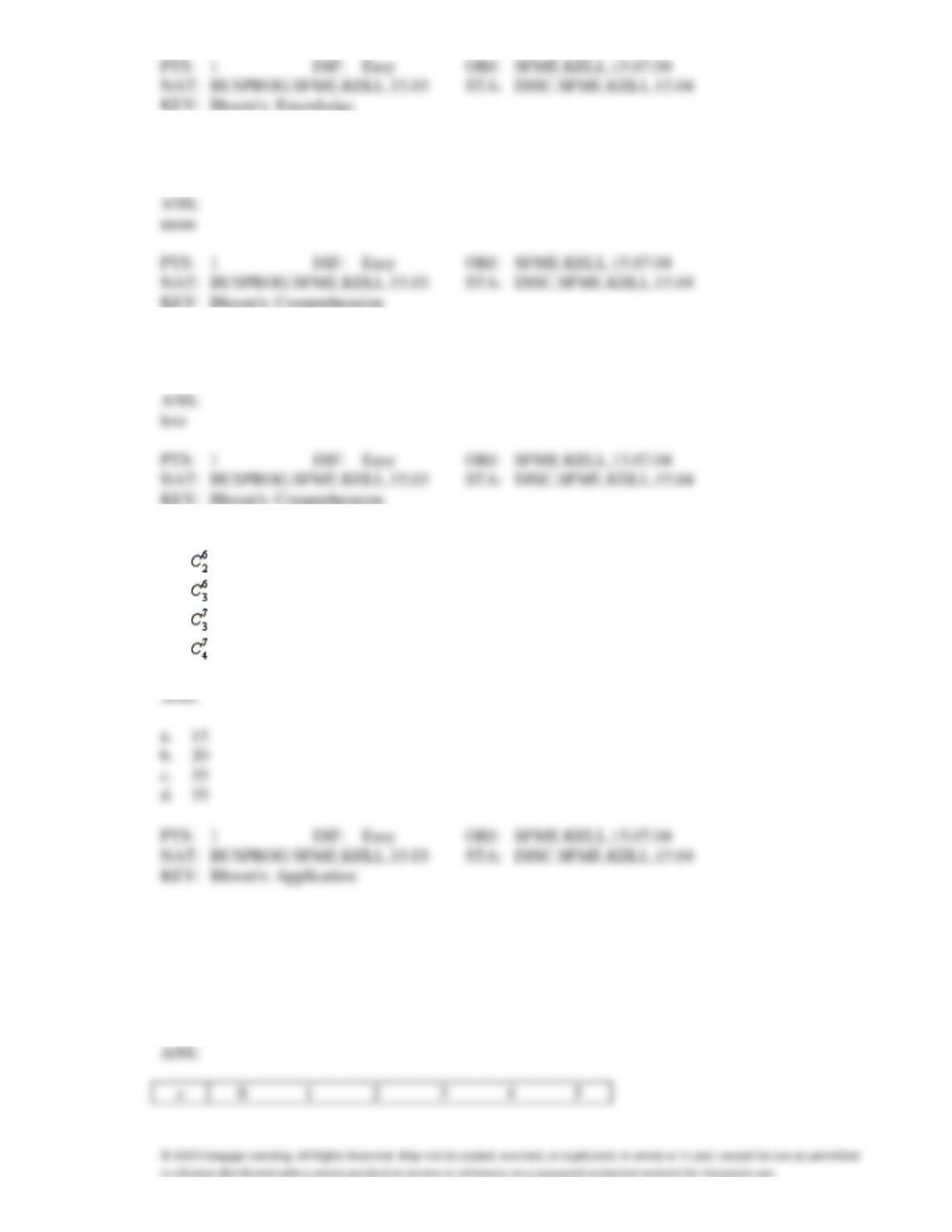
167. Evaluate the following binomial coefficients.
a.
b.
c.
d.
Stress
Consider a binomial random variable X with n = 5 and p = 0. 40, where X represents the number of
times in the final exam week a student with 18 credit hours may feel stressed.
168. {Stress Narrative} Find the probability distribution of X.
169. {Stress Narrative} Find P(X < 3).
170. {Stress Narrative} Find P(2 X 4).
171. {Stress Narrative} Find the expected number of times a student may feel stressed during the final
exam week.
172. {Stress Narrative} Find the variance and standard deviation.
173. Given a binomial random variable with n = 20 and p = 0.60, find the following probabilities using the
binomial table.
a.
P(X 13)
b.
P(X 15)
c.
P(X = 17)
d.
P(11 X 14)
e.
P(11 < X < 14)
ANS:
Montana Highways
A recent survey in Montana revealed that 60% of the vehicles traveling on highways, where speed
limits are posted at 70 miles per hour, were exceeding the limit. Suppose you randomly record the
speeds of ten vehicles traveling on US 131 where the speed limit is 70 miles per hour. Let X denote the
number of vehicles that were exceeding the limit.
174. {Montana Highways Narrative} What is the distribution of X?
175. {Montana Highways Narrative} Find P(X = 10).
176. {Montana Highways Narrative} Find P(4 < X < 9).
177. {Montana Highways Narrative} Find P(X = 2).
178. {Montana Highways Narrative} Find P(3 X 6).
179. {Montana Highways Narrative} Find the expected number of vehicles that are traveling on Montana
highways and exceeding the speed limit.
180. {Montana Highways Narrative} Find the standard deviation of number of vehicles that are traveling on
Montana highways and exceeding the speed limit.
Online Bankers
An official from the securities commission estimates that 75% of all online bankers have profited from
the use of insider information. Assume that 15 online bankers are selected at random from the
commission’s registry.
181. {Online Bankers Narrative} Find the probability that at most 10 have profited from insider
information.
182. {Online Bankers Narrative} Find the probability that at least 6 have profited from insider information.
183. {Online Bankers Narrative} Find the probability that all 15 have profited from insider information.
184. {Online Bankers Narrative} What is the expected number of Online bankers who have profited from
the use of insider information?
185. {Online Bankers Narrative} Find the variance and standard deviation of the number of Online bankers
who have profited from the use of insider information.
186. Let X be a binomial random variable with n = 25 and p = 0.01.
a.
Use the binomial table to find P(X = 0), P(X = 1), and P(X = 2).
b.
Find the variance and standard deviation of X.
a.
187. A remedial program evenly enrolls tradition and non-traditional students. If a random sample of 4
students is selected from the program to be interviewed about the introduction of a new on-line class,
what is the probability that all 4 students selected are traditional students?
188. If X has a binomial distribution with n = 4 and p = 0.3, find P(X = 1).
189. If X has a binomial distribution with n = 4 and p = 0.3, find P(X > 1).
190. If X has a binomial distribution with n = 4 and p = 0.3, find the probability that X is at most one.
191. If X has a binomial distribution with n = 4 and p = 0.3, find the probability that X is at least one.
Sports Fans
Suppose that past history shows that 5% of college students are sports fans. A sample of 10 students is
to be selected.
192. {Sports Fans Narrative} Find the probability that exactly 1 student is a sports fan.
193. {Sports Fans Narrative} Find the probability that at least 1 student is a sports fan.
194. {Sports Fans Narrative} Find the probability that less than 1 student is a sports fan.
195. {Sports Fans Narrative} Find the probability that at most 1 student is a sports fan.
196. {Sports Fans Narrative} Find the probability that more than 1 student is a sports fan.
197. {Sports Fans Narrative} A sample of 100 students is to be selected. What is the average number that
you would expect to sports fan?
198. {Sports Fans Narrative} A sample of 100 students is to be selected. What is the standard deviation of
the number of sports fans you expect?