Chapter 7—International Arbitrage and Interest Rate Parity
1. Due to ____, market forces should realign the relationship between the interest rate differential of two
currencies and the forward premium (or discount) on the forward exchange rate between the two
currencies.
a.
forward realignment arbitrage
b.
triangular arbitrage
c.
covered interest arbitrage
d.
locational arbitrage
2. Due to ____, market forces should realign the spot rate of a currency among banks.
a.
forward realignment arbitrage
b.
triangular arbitrage
c.
covered interest arbitrage
d.
locational arbitrage
3. Due to ____, market forces should realign the cross exchange rate between two foreign currencies
based on the spot exchange rates of the two currencies against the U.S. dollar.
a.
forward realignment arbitrage
b.
triangular arbitrage
c.
covered interest arbitrage
d.
locational arbitrage
4. If interest rate parity exists, then ____ is not feasible.
a.
forward realignment arbitrage
b.
triangular arbitrage
c.
covered interest arbitrage
d.
locational arbitrage
5. In which case will locational arbitrage most likely be feasible?
a.
One bank’s ask price for a currency is greater than another bank’s bid price for the
currency.
b.
One bank’s bid price for a currency is greater than another bank’s ask price for the
currency.
c.
One bank’s ask price for a currency is less than another bank’s ask price for the currency.
d.
One bank’s bid price for a currency is less than another bank’s bid price for the currency.
6. When using ____, funds are not tied up for any length of time.
a.
covered interest arbitrage
b.
locational arbitrage
c.
triangular arbitrage
d.
B and C
7. When using ____, funds are typically tied up for a significant period of time.
a.
covered interest arbitrage
b.
locational arbitrage
c.
triangular arbitrage
d.
B and C
8. Assume that the interest rate in the home country of Currency X is a much higher interest rate than the
U.S. interest rate. According to interest rate parity, the forward rate of Currency X:
a.
should exhibit a discount.
b.
should exhibit a premium.
c.
should be zero (i.e., it should equal its spot rate).
d.
B or C
9. If the interest rate is higher in the U.S. than in the United Kingdom, and if the forward rate of the
British pound (in U.S. dollars) is the same as the pound’s spot rate, then:
a.
U.S. investors could possibly benefit from covered interest arbitrage.
b.
British investors could possibly benefit from covered interest arbitrage.
c.
neither U.S. nor British investors could benefit from covered interest arbitrage.
d.
A and B
10. If the interest rate is lower in the U.S. than in the United Kingdom, and if the forward rate of the
British pound is the same as its spot rate:
a.
U.S. investors could possibly benefit from covered interest arbitrage.
b.
British investors could possibly benefit from covered interest arbitrage.
c.
neither U.S. nor British investors could benefit from covered interest arbitrage.
d.
A and B
11. Assume that the U.S. investors are benefiting from covered interest arbitrage due to high interest rates
on euros. Which of the following forces should result from the act of this covered interest arbitrage?
a.
downward pressure on the euro’s spot rate.
b.
downward pressure on the euro’s forward rate.
c.
downward pressure on the U.S. interest rate.
d.
upward pressure on the euro’s interest rate.
12. Assume that Swiss investors are benefiting from covered interest arbitrage due to a high U.S. interest
rate. Which of the following forces results from the act of this covered interest arbitrage?
a.
upward pressure on the Swiss franc’s spot rate.
b.
upward pressure on the U.S. interest rate.
c.
downward pressure on the Swiss interest rate.
d.
upward pressure on the Swiss franc’s forward rate.
13. Assume that a U.S. firm can invest funds for one year in the U.S. at 12% or invest funds in Mexico at
14%. The spot rate of the peso is $.10 while the one-year forward rate of the peso is $.10. If U.S. firms
attempt to use covered interest arbitrage, what forces should occur?
a.
spot rate of peso increases; forward rate of peso decreases.
b.
spot rate of peso decreases; forward rate of peso increases.
c.
spot rate of peso decreases; forward rate of peso decreases.
d.
spot rate of peso increases; forward rate of peso increases.
14. Assume the bid rate of a New Zealand dollar is $.33 while the ask rate is $.335 at Bank X. Assume the
bid rate of the New Zealand dollar is $.32 while the ask rate is $.325 at Bank Y. Given this
information, what would be your gain if you use $1,000,000 and execute locational arbitrage? That is,
how much will you end up with over and above the $1,000,000 you started with?
a.
$15,385.
b.
$15,625.
c.
$22,136.
d.
$31,250.
15. Based on interest rate parity, the larger the degree by which the foreign interest rate exceeds the U.S.
interest rate, the:
a.
larger will be the forward discount of the foreign currency.
b.
larger will be the forward premium of the foreign currency.
c.
smaller will be the forward premium of the foreign currency.
d.
smaller will be the forward discount of the foreign currency.
16. Assume the following information:
You have $1,000,000 to invest:
Current spot rate of pound
=
$1.30
90-day forward rate of pound
=
$1.28
3-month deposit rate in U.S.
=
3%
3-month deposit rate in Great Britain
=
4%
If you use covered interest arbitrage for a 90-day investment, what will be the amount of U.S. dollars
you will have after 90 days?
a.
$1,024,000.
b.
$1,030,000.
c.
$1,040,000.
d.
$1,034,000.
e.
none of the above
$1,024,000
17. Assume that the U.S. interest rate is 10%, while the British interest rate is 15%. If interest rate parity
exists, then:
a.
British investors who invest in the United Kingdom will achieve the same return as U.S.
investors who invest in the U.S.
b.
U.S. investors will earn a higher rate of return when using covered interest arbitrage than
what they would earn in the U.S.
c.
U.S. investors will earn 15% whether they use covered interest arbitrage or invest in the
U.S.
d.
U.S. investors will earn 10% whether they use covered interest arbitrage or invest in the
U.S.
18. Assume the following information:
U.S. investors have $1,000,000 to invest:
1-year deposit rate offered on U.S. dollars
=
12%
1-year deposit rate offered on Singapore dollars
=
10%
1-year forward rate of Singapore dollars
=
$.412
Spot rate of Singapore dollar
=
$.400
Given this information:
a.
interest rate parity exists and covered interest arbitrage by U.S. investors results in the
same yield as investing domestically.
b.
interest rate parity doesn’t exist and covered interest arbitrage by U.S. investors results in a
yield above what is possible domestically.
c.
interest rate parity exists and covered interest arbitrage by U.S. investors results in a yield
above what is possible domestically.
d.
interest rate parity doesn’t exist and covered interest arbitrage by U.S. investors results in a
yield below what is possible domestically.
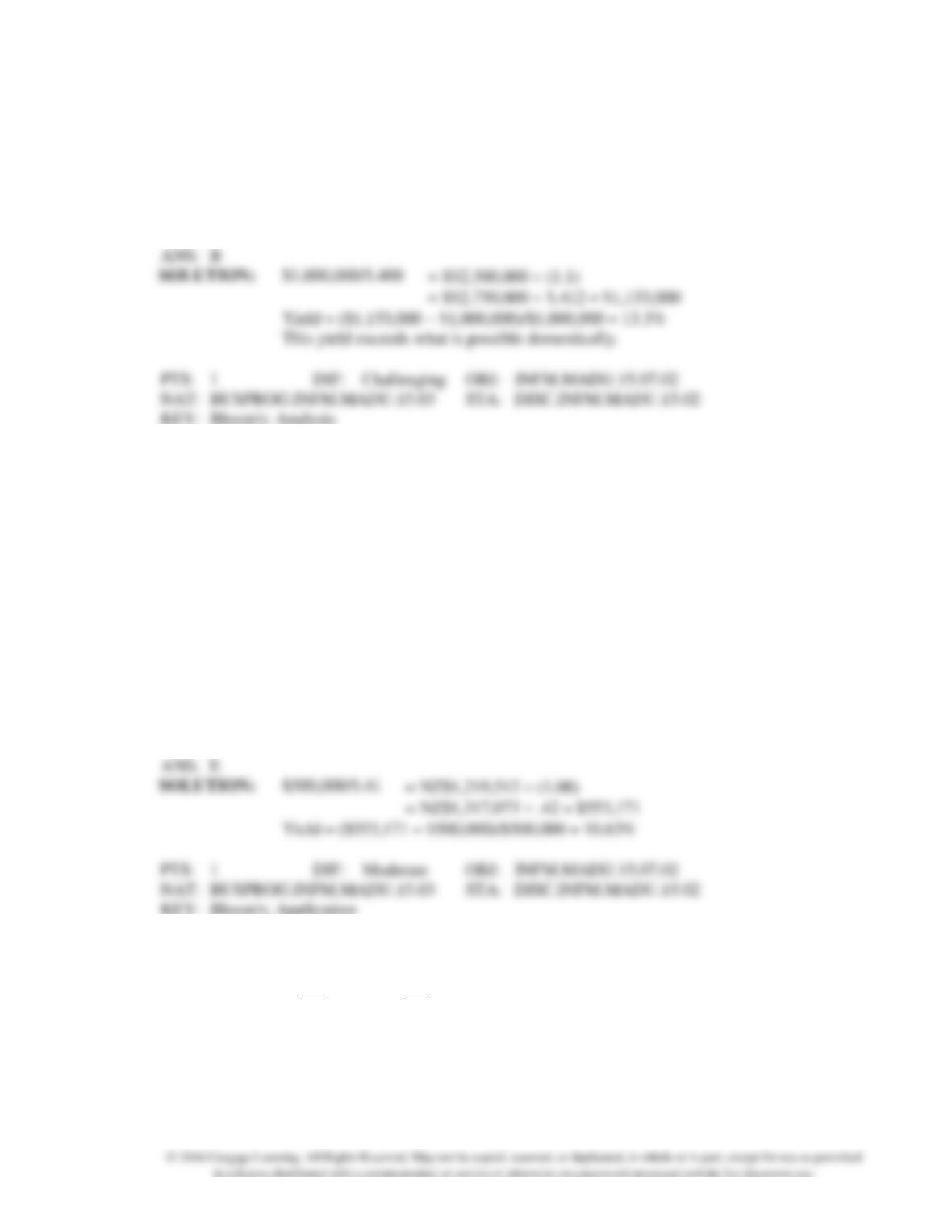
= S$2,500,000 (1.1)
= S$2,750,000 $.412 = $1,133,000
Yield = ($1,133,000 − $1,000,000)/$1,000,000 = 13.3%
This yield exceeds what is possible domestically.
19. Assume the following information:
Current spot rate of New Zealand dollar
=
$.41
Forecasted spot rate of New Zealand dollar 1 year from now
=
$.43
One-year forward rate of the New Zealand dollar
=
$.42
Annual interest rate on New Zealand dollars
=
8%
Annual interest rate on U.S. dollars
=
9%
Given the information in this question, the return from covered interest arbitrage by U.S. investors
with $500,000 to invest is ____%.
a.
about 11.97
b.
about 9.63
c.
about 11.12
d.
about 11.64
e.
about 10.63
= NZ$1,219,512 (1.08)
= NZ$1,317,073 .42 = $553,171
Yield = ($553,171 − $500,000)/$500,000 = 10.63%
20. Assume the following bid and ask rates of the pound for two banks as shown below:
Bid
Ask
Bank A
$1.41
$1.42
Bank B
$1.39
$1.40
As locational arbitrage occurs:
a.
the bid rate for pounds at Bank A will increase; the ask rate for pounds at Bank B will
increase.
b.
the bid rate for pounds at Bank A will increase; the ask rate for pounds at Bank B will
decrease.
c.
the bid rate for pounds at Bank A will decrease; the ask rate for pounds at Bank B will
decrease.
d.
the bid rate for pounds at Bank A will decrease; the ask rate for pounds at Bank B will
increase.
21. Assume the bid rate of a Singapore dollar is $.40 while the ask rate is $.41 at Bank X. Assume the bid
rate of a Singapore dollar is $.42 while the ask rate is $.425 at Bank Z. Given this information, what
would be your gain if you use $1,000,000 and execute locational arbitrage? That is, how much will
you end up with over and above the $1,000,000 you started with?
a.
$11,764.
b.
−$11,964.
c.
$36,585.
d.
$24,390.
e.
$18,219.
22. Based on interest rate parity, the larger the degree by which the U.S. interest rate exceeds the foreign
interest rate, the:
a.
larger will be the forward discount of the foreign currency.
b.
larger will be the forward premium of the foreign currency.
c.
smaller will be the forward premium of the foreign currency.
d.
smaller will be the forward discount of the foreign currency.
23. Assume the following exchange rates: $1 = NZ$3, NZ$1 = MXP2, and $1 = MXP5. Given this
information, as you and others perform triangular arbitrage, the exchange rate of the New Zealand
dollar (NZ) with respect to the U.S. dollar should ____, and the exchange rate of the Mexican peso
(MXP) with respect to the U.S. dollar should ____.
a.
appreciate; depreciate
b.
depreciate; appreciate
c.
depreciate; depreciate
d.
appreciate; appreciate
e.
remain stable; appreciate
24. Assume the following information:
Spot rate today of Swiss franc
=
$.60
1-year forward rate as of today for Swiss franc
=
$.63
Expected spot rate 1 year from now
=
$.64
Rate on 1-year deposits denominated in Swiss francs
=
7%
Rate on 1-year deposits denominated in U.S. dollars
=
9%
From the perspective of U.S. investors with $1,000,000, covered interest arbitrage would yield a rate
of return of ____%.
a.
5.00
b.
12.35
c.
15.50
d.
14.13
e.
11.22
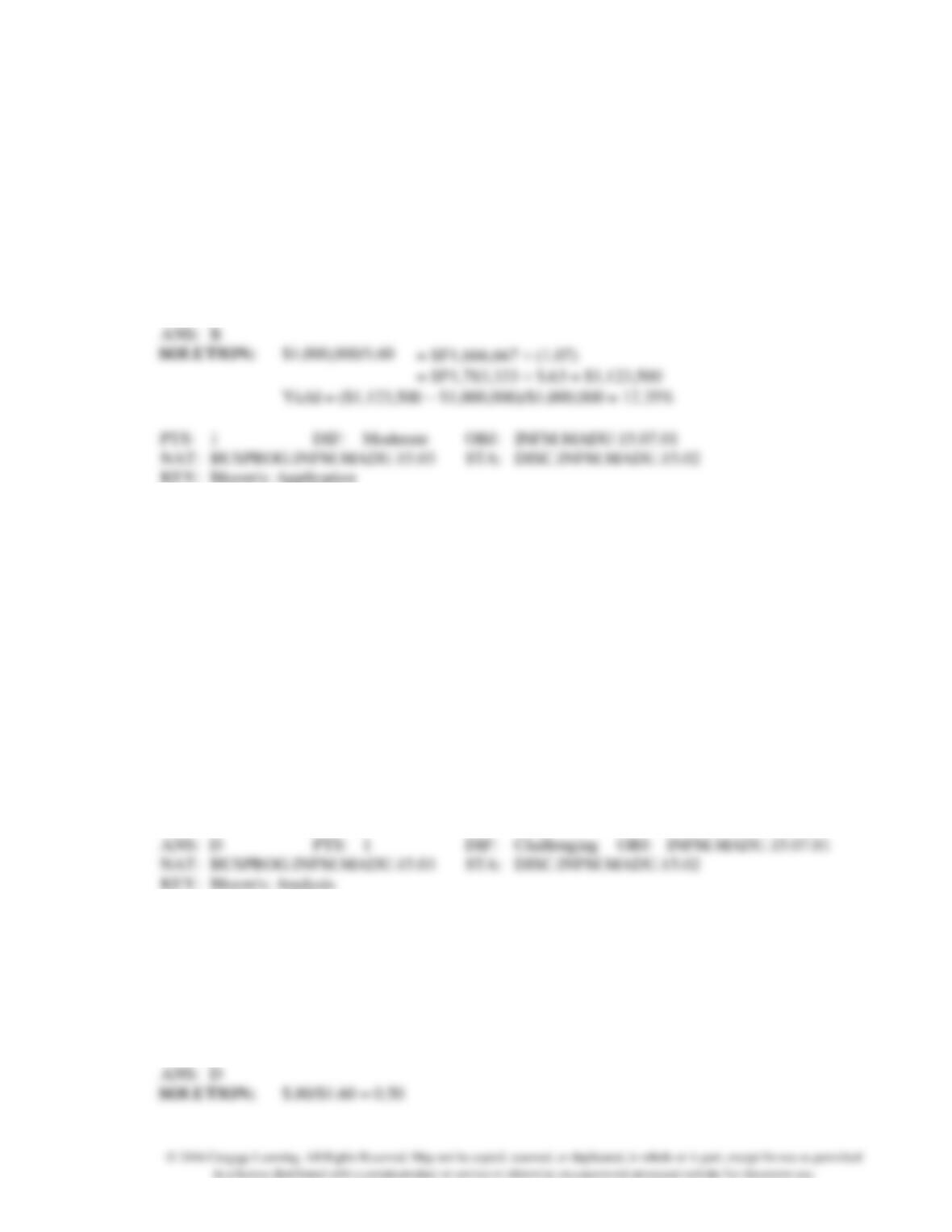
= SF1,666,667 (1.07)
= SF1,783,333 $.63 = $1,123,500
Yield = ($1,123,500 − $1,000,000)/$1,000,000 = 12.35%
25. Assume the following information for a bank quoting on spot exchange rates:
Exchange rate of Singapore dollar in U.S. $
=
$.32
Exchange rate of pound in U.S. $
=
$1.50
Exchange rate of pound in Singapore dollars
=
S$4.50
Based on the information given, as you and others perform triangular arbitrage, what should logically
happen to the spot exchange rates?
a.
The Singapore dollar value in U.S. dollars should appreciate, the pound value in U.S.
dollars should appreciate, and the pound value in Singapore dollars should depreciate.
b.
The Singapore dollar value in U.S. dollars should depreciate, the pound value in U.S.
dollars should appreciate, and the pound value in Singapore dollars should depreciate.
c.
The Singapore dollar value in U.S. dollars should depreciate, the pound value in U.S.
dollars should appreciate, and the pound value in Singapore dollars should appreciate.
d.
The Singapore dollar value in U.S. dollars should appreciate, the pound value in U.S.
dollars should depreciate, and the pound value in Singapore dollars should appreciate.
26. Assume the British pound is worth $1.60, and the Canadian dollar is worth $.80. What is the value of
the Canadian dollar in pounds?
a.
2.0.
b.
2.40.
c.
.80.
d.
.50.
e.
none of the above
$.80/$1.60 = 0.50
27. Assume that the euro’s interest rates are higher than U.S. interest rates, and that interest rate parity
exists. Which of the following is true?
a.
Americans using covered interest arbitrage earn the same rate of return as Germans who
attempt covered interest arbitrage.
b.
Americans who invest in the U.S. earn the same rate of return as Germans who attempt
covered interest arbitrage.
c.
Americans who invest in the U.S. earn the same rate of return as Germans who invest in
Germany
d.
A and B
e.
None of the above
28. Assume the U.S. interest rate is 2% higher than the Swiss rate, and the forward rate of the Swiss franc
has a 4% premium. Given this information:
a.
Swiss investors who attempt covered interest arbitrage earn the same rate of return as if
they invested in Switzerland.
b.
U.S. investors who attempt covered interest arbitrage earn a higher rate of return than if
they invested in the U.S.
c.
A and B
d.
none of the above
29. Assume that British interest rates are higher than U.S. rates, and that the spot rate equals the forward
rate. Covered interest arbitrage puts ____ pressure on the pound’s spot rate, and ____ pressure on the
pound’s forward rate.
a.
downward; downward
b.
downward; upward
c.
upward; downward
d.
upward; upward
30. Assume that interest rate parity holds, and the euro’s interest rate is 9% while the U.S. interest rate is
12%. Then the euro’s interest rate increases to 11% while the U.S. interest rate remains the same. As a
result of the increase in the interest rate on euros, the euro’s forward ____ will ____ in order to
maintain interest rate parity.
a.
discount; increase
b.
discount; decrease
c.
premium; increase
d.
premium; decrease
31. Assume the bid rate of a Swiss franc is $.57 while the ask rate is $.579 at Bank X. Assume the bid rate
of the Swiss franc is $.560 while the ask rate is $.566 at Bank Y. Given this information, what would
be your gain if you use $1,000,000 and execute locational arbitrage? That is, how much will you end
up with over and above the $1,000,000 you started with?
a.
$7,067.
b.
$8,556.
c.
$10,114.
d.
$12,238.
32. Assume the following information:
You have $1,000,000 to invest:
Current spot rate of pound
=
$1.60
90-day forward rate of pound
=
$1.57
3-month deposit rate in U.S.
=
3%
3-month deposit rate in U.K.
=
4%
If you use covered interest arbitrage for a 90-day investment, what will be the amount of U.S. dollars
you will have after 90 days?
a.
$1,020,500.
b.
$1,045,600.
c.
$1,073,330.
d.
$1,094,230.
e.
$1,116,250.
$1,020,500
33. Assume the following information:
U.S. investors have $1,000,000 to invest:
1-year deposit rate offered by U.S. banks
=
12%
1-year deposit rate offered on Swiss francs
=
10%
1-year forward rate of Swiss francs
=
$.62
Spot rate of Swiss franc
=
$.60
Given this information:
a.
interest rate parity exists and covered interest arbitrage by U.S. investors results in the
same yield as investing domestically.
b.
interest rate parity doesn’t exist and covered interest arbitrage by U.S. investors results in a
yield above what is possible domestically.
c.
interest rate parity exists and covered interest arbitrage by U.S. investors results in a yield
above what is possible domestically.
d.
interest rate parity doesn’t exist and covered interest arbitrage by U.S. investors results in a
yield below what is possible domestically.
$1,000,000/$.60 = SF1,666,667 (1.1) = SF1,833,333 $.62 = $1,136,667
Yield = ($1,136,667 − $1,000,000)/$1,000,000 = 13.7%
This yield exceeds what is possible domestically.
34. Assume the following information:
Current spot rate of Australian dollar
=
$.64
Forecasted spot rate of Australian dollar 1 year from now
=
$.59
1-year forward rate of Australian dollar
=
$.62
Annual interest rate for Australian dollar deposit
=
9%
Annual interest rate in the U.S.
=
6%
Given the information in this question, the return from covered interest arbitrage by U.S. investors
with $500,000 to invest is ____%.
a.
about 6.00
b.
about 9.00
c.
about 7.33
d.
about 8.14
e.
about 5.59
= A$781,250 (1.09)
= A$851,563 $.62 = $527,969
Yield = ($527,969 − $500,000)/$500,000 = 5.59%
35. Assume the following bid and ask rates of the pound for two banks as shown below:
Bid
Ask
Bank C
$1.61
$1.63
Bank D
$1.58
$1.60
As locational arbitrage occurs:
a.
the bid rate for pounds at Bank C will increase; the ask rate for pounds at Bank D will
increase.
b.
the bid rate for pounds at Bank C will increase; the ask rate for pounds at Bank D will
decrease.
c.
the bid rate for pounds at Bank C will decrease; the ask rate for pounds at Bank D will
decrease.
d.
the bid rate for pounds at Bank C will decrease; the ask rate for pounds at Bank D will
increase.
36. Assume the bid rate of an Australian dollar is $.60 while the ask rate is $.61 at Bank Q. Assume the
bid rate of an Australian dollar is $.62 while the ask rate is $.625 at Bank V. Given this information,
what would be your gain if you use $1,000,000 and execute locational arbitrage? That is, how much
will you end up with over and above the $1,000,000 you started with?
a.
$10,003.
b.
$12,063.
c.
$14,441.
d.
$16,393.
e.
$18,219.
$16,393.
37. Assume the following information for a bank quoting on spot exchange rates:
Exchange rate of Singapore dollar in U.S. $
=
$.60
Exchange rate of pound in U.S. $
=
$1.50
Exchange rate of pound in Singapore dollars
=
S$2.6
Based on the information given, as you and others perform triangular arbitrage, what should logically
happen to the spot exchange rates?
a.
The Singapore dollar value in U.S. dollars should appreciate, the pound value in U.S.
dollars should appreciate, and the pound value in Singapore dollars should depreciate.
b.
The Singapore dollar value in U.S. dollars should depreciate, the pound value in U.S.
dollars should appreciate, and the pound value in Singapore dollars should depreciate.
c.
The Singapore dollar value in U.S. dollars should depreciate, the pound value in U.S.
dollars should appreciate, and the pound value in Singapore dollars should appreciate.
d.
The Singapore dollar value in U.S. dollars should appreciate, the pound value in U.S.
dollars should depreciate, and the pound value in Singapore dollars should appreciate.
38. Bank A quotes a bid rate of $.300 and an ask rate of $.305 for the Malaysian ringgit (MYR). Bank B
quotes a bid rate of $.306 and an ask rate of $.310 for the ringgit. What will be the profit for an
investor who has $500,000 available to conduct locational arbitrage?
a.
$2,041,667.
b.
$9,804.
c.
$500.
d.
$1,639.
39. Which of the following is an example of triangular arbitrage initiation?
a.
buying a currency at one bank’s ask and selling at another bank’s bid, which is higher than
the former bank’s ask.
b.
buying Singapore dollars from a bank (quoted at $.55) that has quoted the South African
rand (SAR)/Singapore dollar (S$) exchange rate at SAR2.50 when the spot rate for the
rand is $.20.
c.
buying Singapore dollars from a bank (quoted at $.55) that has quoted the South African
rand/Singapore dollar exchange rate at SAR3.00 when the spot rate for the rand is $.20.
d.
converting funds to a foreign currency and investing the funds overseas.
40. You just received a gift from a friend consisting of 1,000 Thai baht, which you would like to exchange
for Australian dollars (A$). You observe that exchange rate quotes for the baht are currently $.023,
while quotes for the Australian dollar are $.576. How many Australian dollars should you expect to
receive for your baht?
a.
A$39.93.
b.
A$25,043.48.
c.
A$553.00.
d.
none of the above
$.023/$.576 THB1,000 = A$39.93.
41. National Bank quotes the following for the British pound and the New Zealand dollar:
Quoted Bid Price
Quoted Ask Price
Value of a British pound (£) in $
$1.61
$1.62
Value of a New Zealand dollar (NZ$) in $
$.55
$.56
Value of a British pound in
New Zealand dollars
NZ$2.95
NZ$2.96
Assume you have $10,000 to conduct triangular arbitrage. What is your profit from implementing this
strategy?
a.
$77.64.
b.
$197.53.
c.
$15.43.
d.
$111.80.
= £6,172.84 2.95
= NZ$18,209.88 $.55
= $10,015.43.
Thus, the profit is $15.43.
42. Assume the following information:
You have $900,000 to invest:
Current spot rate of Australian dollar (A$)
=
$.62
180-day forward rate of the Australian dollar
=
$.64
180-day interest rate in the U.S.
=
3.5%
180-day interest rate in Australia
=
3.0%
If you conduct covered interest arbitrage, what is the dollar profit you will have realized after 180
days?
a.
$56,903.
b.
$61,548.
c.
$27,000.
d.
$31,500.
43. Assume the following information:
You have $400,000 to invest:
Current spot rate of Sudanese dinar (SDD)
=
$.00570
90-day forward rate of the dinar
=
$.00569
90-day interest rate in the U.S.
=
4.0%
90-day interest rate in Sudan
=
4.2%
If you conduct covered interest arbitrage, what amount will you have after 90 days?
a.
$416,000.00.
b.
$416,800.00.
c.
$424,242.86.
d.
$416,068.77.
e.
none of the above
= SDD70,175,438.60 (1.042)
= SDD73,122,807.02 $.00569
= $416,068.77