Introduction to Operations and Supply Chain Management, 4e (Bozarth/Handfield)
Chapter 7 Supply Management
Learning Objective 7-1
1) For the average manufacturer, over 50 percent of the value of shipments comes from
materials.
2) Company A spends $250 million purchasing materials and subassemblies that it processes and
sells for a total of $350 million. The cost of goods sold by Company A is $350 million.
3) The ratio of earnings to sales for a given time period is a firm’s profit margin.
4) Firms do not compete only against global competitors, but against:
A) their suppliers.
B) themselves.
C) the customers of their competitors.
D) their competitors’ supply chains.
5) The percentage of value of shipments that come from materials for the average manufacturer
is:
A) greater than or equal to 40 and less than or equal to 49 percent.
B) greater than or equal to 50 and less than or equal to 59 percent.
C) greater than or equal to 60 and less than or equal to 69 percent.
D) greater than or equal to 70 percent.
6) The ratio of earnings to sales for a given time period is the:
A) cost of goods sold.
B) merchandise inventory.
C) profit margin.
D) return on assets.
7) The analyst turned on his banker’s lamp, adjusted his eye shade, and slowly pulled a legal pad
from his desk. His weathered hands punched the buttons on his desk calculator deliberately as he
divided earnings by total assets in order to calculate:
A) return on assets.
B) cost of goods sold.
C) merchandise inventory.
D) profit margin.
8) Flingers Inc. reveals the following information in their annual report for FY 2014.
Earnings and Expenses
Sales
$10,000,000
Cost of goods sold
$5,000,000
Pretax earnings
$500,000
Selected Balance Sheet Items
Merchandise inventory
$80,000
Total assets
$2,000,000
What is Flingers’ return on assets?
A) 16%
B) 20%
C) 25%
D) 40%
9) Flingers Inc. reveals the following information in their annual report for FY 2014.
Earnings and Expenses
Sales
$10,000,000
Cost of goods sold
$5,000,000
Pretax earnings
$500,000
Selected Balance Sheet Items
Merchandise inventory
$80,000
Total assets
$2,000,000
What is Flingers’ profit margin?
A) 5%
B) 16%
C) 2%
D) 4%
10) Flingers Inc. reveals the following information in their annual report for FY 2014.
Earnings and Expenses
Sales
$10,000,000
Cost of goods sold
$5,000,000
Pretax earnings
$500,000
Selected Balance Sheet Items
Merchandise inventory
$80,000
Total assets
$2,000,000
Every dollar Flingers saves in purchasing has the same impact as what amount of increased
sales?
A) $10
B) $14
C) $17
D) $20
11) Flingers Inc. reveals the following information in their annual report for FY 2014.
Earnings and Expenses
Sales
$10,000,000
Cost of goods sold
$5,000,000
Pretax earnings
$500,000
Selected Balance Sheet Items
Merchandise inventory
$80,000
Total assets
$2,000,000
Upper management plans to cut cost of goods sold by 5% for the coming year but retain the same
sales. What will Flingers’ return on assets figure be for 2015?
A) 26%
B) 29%
C) 33%
D) 38%
12) Flingers Inc. reveals the following information in their annual report for FY 2014.
Earnings and Expenses
Sales
$10,000,000
Cost of goods sold
$5,000,000
Pretax earnings
$500,000
Selected Balance Sheet Items
Merchandise inventory
$80,000
Total assets
$2,000,000
Upper management plans to cut cost of goods sold by 5% for the coming year but retain the same
sales. What will Flingers’ profit margin be for 2015?
A) 5%
B) 7.5%
C) 9%
D) 11%
13) Flingers Inc. reveals the following information in their annual report for FY 2014.
Earnings and Expenses
Sales
$10,000,000
Cost of goods sold
$5,000,000
Pretax earnings
$500,000
Selected Balance Sheet Items
Merchandise inventory
$80,000
Total assets
$2,000,000
Upper management plans to cut cost of goods sold by 5% for the coming year but retain the same
sales. What will Flingers’ profit leverage effect be for 2015?
A) $13.33
B) $14.71
C) $17.50
D) $18.50
14) The phenomenon that a dollar in cost savings increases pretax profits by a dollar, while a
dollar increase in sales increases pretax profits only by the dollar multiplied by the pretax profit
margin is known as the:
A) profit margin.
B) return on assets.
C) saving to spending ratio.
D) profit leverage effect.
15) Dusty is evaluating three bids to supply fence hardware for the 5 acres of pasture that need to
be fenced. Breezy submits a bid of $40 per unit with a defect rate of 2%; Lady’s bid is $50 per
unit with a defect rate of 0.5%; and Spike’s bid is $30 per unit with a defect rate of 5%. If a
section of fence fails, it costs an average of $500 in losses and herding costs to round up all of
the capybaras. Dusty believes it will take 1000 units to fence in this pasture configuration; what
is the lowest total cost?
A) $47,500
B) $50,000
C) $52,500
D) $55,000
16) Dusty is evaluating three bids to supply fence hardware for the 5 acres of pasture that need to
be fenced. Breezy submits a bid of $40 per unit with a defect rate of 3%; Lady’s bid is $50 per
unit with a defect rate of 0.5%; and Spike’s bid is $30 per unit with a defect rate of 5%. If a
section of fence fails, it costs an average of $500 in losses and herding costs to round up all of
the capybaras. Dusty believes it will take 500 units to fence in this pasture configuration; which
supplier should win the business?
A) Spike
B) Breezy
C) Lady
D) no difference between Breezy and Spike
17) Dusty is evaluating two bids to supply fence hardware for the 5 acres of pasture that need to
be fenced. Breezy submits a bid of $40 per unit with a defect rate of 3%; Lady’s bid is $50 per
unit and their product manager estimates the defect rate to be around 0.5%. If a section of fence
fails, it costs an average of $500 in losses and herding costs to round up all of the capybaras.
Dusty believes it will take 500 units to fence in this pasture configuration. The product manager’s
uncertainty has Dusty concerned; what defect rate for Lady would make Dusty indifferent
between the two suppliers as far as total cost is concerned?
A) 1%
B) 0.5%
C) 0.33%
D) 0%
18) Dusty is evaluating three bids to supply fence hardware for the 5 acres of pasture that need to
be fenced. Breezy submits a bid of $40 per unit, Lady’s bid is $50 per unit, and Spike’s bid is $30
per unit. If a section of fence fails, it costs an average of $500 in losses and herding costs to
round up all of the capybaras. Dusty believes it will take 500 units to fence in this pasture
configuration. What defect rates for the three suppliers would make Dusty indifferent among
them from a total cost standpoint?
A) Breezy 5%, Spike 6%, Lady 2%
B) Breezy 3%, Spike 5%, Lady 1%
C) Breezy 1%, Spike 3%, Lady 2%
D) Breezy 2%, Spike 3%, Lady 4%
19) Profit margin is the ratio of ________ to ________.
20) Briefly discuss the three trends that make supply management so critical in today’s business
climate.
21) Flingers Inc. reveals the following information in their annual report for FY 2014.
Earnings and Expenses
Sales
$10,000,000
Cost of goods sold
$5,000,000
Pretax earnings
$500,000
Selected Balance Sheet Items
Merchandise inventory
$80,000
Total assets
$2,000,000
Calculate Flingers’ profit margin, return on assets, and leverage effect
22) Flingers Inc. reveals the following information in their annual report for FY 2014.
Earnings and Expenses
Sales
$10,000,000
Cost of goods sold
$5,000,000
Pretax earnings
$500,000
Selected Balance Sheet Items
Merchandise inventory
$80,000
Total assets
$2,000,000
They plan to aggressively pursue cost savings in the purchasing area for FY 2015 and expect to
lower their cost of goods sold by 8% while maintaining the same level of sales. Calculate
Flingers’ leverage effect for 2014 and their expected leverage effect for 2015. Compare the two
results for your leverage effect calculations and provide insight as their relative magnitude.
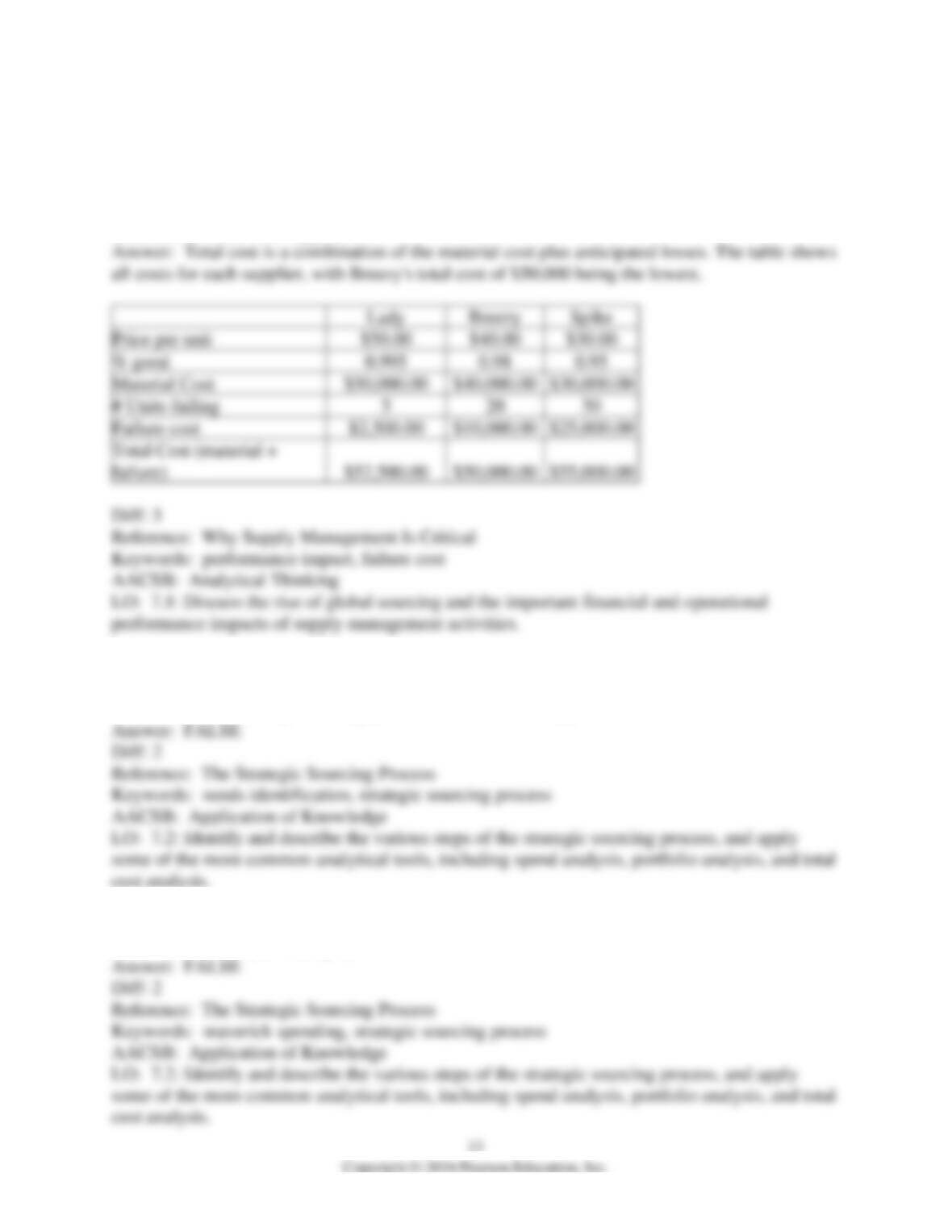
23) Dusty is evaluating three bids to supply fence hardware for the 5 acres of pasture that need to
be fenced. Breezy submits a bid of $40 per unit with a defect rate of 2%; Lady’s bid is $50 per
unit with a defect rate of 0.5%; and Spike’s bid is $30 per unit with a defect rate of 5%. If a
section of fence fails, it costs an average of $500 in losses and herding costs to round up all of
the capybaras. Dusty believes it will take 1000 units to fence in this pasture configuration; what
is the BEST choice for supplier?
Learning Objective 7-2
1) The first step of the purchasing process is to select the supplier.
2) Maverick spending is often promoted by top management as a way to improve the bottom line
and break out of a purchasing cycle.
3) Outsourcing can be risky because it decreases the firm’s strategic flexibility.
4) Total cost analysis divides costs into direct (costs that are tied to the level of operations or
supply chain activities) and indirect (costs that are not tied to the level of operations or supply
chain activity).
5) Portfolio analysis begins with assignment to a quadrant before a sourcing strategy is
formulated.
6) A company that uses portfolio analysis would probably classify things like office supplies in
the Bottleneck quadrant.
7) A manufacturer seeking to reduce the variability of the quality of purchased products should
use multiple sourcing.
8) A manufacturer that wants to make sure that suppliers do not become complacent should use
multiple sourcing.
9) Cross sourcing is a strategy in which two suppliers are used for the same purchased product or
service.
10) The weighted-point evaluation system allows for a completely objective decision to be made.
11) The request for quotation is a formal request for suppliers to deliver a product or service that
includes key terms and conditions, such as price, delivery, and quality requirements.
12) In the description of the purchasing process, the product should be described only by brand
or specification.
13) When a preferred supplier does not exist, competitive bidding and negotiation are two
methods commonly used for final supplier selection.
14) In a cost-based contract, the stated price does not change, regardless of fluctuations in the
general overall economic conditions.
15) Use of EDI in the supply chain has led to shorter lead times and lower inventory.
16) The purchasing team examined all of its purchasing patterns in order to identify any
irregularities or possible areas of cost savings in a little scheme the team liked to call:
A) internal auditing.
B) purchase consolidation.
C) spend analysis.
D) cooking the books.
17) Which of the following is required in order to execute a successful spend analysis?
A) graphics capabilities found in charting packages and Visio
B) a sophisticated statistical software package such as SPSS or SAS
C) ability to analyze large quantities of data
D) a minimum of six months uninterrupted work time
18) The use of supply chain partners to provide products or services is called:
A) outsourcing.
B) insourcing.
C) offloading.
D) partnering.
19) One advantage of outsourcing is that it:
A) gives the company a high degree of control over its operations.
B) increases the company’s access to state-of-the-art products and processes.
C) protects the company’s proprietary designs and processes.
D) discourages the development of the company’s core competencies.
20) Which of these is a direct cost associated with outsourcing?
A) direct material
B) direct labor
C) variable overhead
D) price from invoice