CHAPTER 7—ASSET PRICING MODELS: CAPM and APT
TRUE/FALSE
1. One of the assumptions of capital market theory is that investors can borrow or lend at the risk free
rate.
2. Since many of the assumptions made by the capital market theory are unrealistic, the theory is not
applicable in the real world.
3. A risk-free asset is one in which the return is completely guaranteed, there is no uncertainty.
4. The market portfolio consists of all risky assets.
5. The introduction of lending and borrowing severely limits the available risk/return opportunities.
6. The capital market line is the tangent line between the risk free rate of return and the efficient frontier.
7. The portfolios on the capital market line are combinations of the risk-free asset and the market
portfolio.
8. If you borrow money at the RFR and invest the money in the market portfolio, the rate of return on
your portfolio will be higher than the market rate of return.
9. Studies have shown that a well diversified investor needs as few as five stocks.
10. Beta is a measure of unsystematic risk.
11. The betas of those companies compiled by Value Line Investment Services tend to be almost identical
to those compiled by Merrill Lynch.
2
12. Securities with returns that lie above the security market line are undervalued.
13. Securities with returns that lie below the security market line are undervalued.
14. Under the CAPM framework, the introduction of lending and borrowing at differential rates leads to a
non-linear capital market line.
15. Correlation of the market portfolio and the zero-beta portfolio will be linear.
16. There can be only one zero-beta portfolio.
17. The existence of transaction costs indicates that at some point the additional cost of diversification
relative to its benefit would be excessive for most investors.
18. Studies have shown the beta is more stable for portfolios than for individual securities.
19. If the market portfolio is mean-variance efficient it has the lowest risk for a given level of return
among the attainable set of portfolios.
20. Using the S&P/TSX composite index as the proxy market portfolio when evaluating a portfolio
manager relative to the SML will tend to underestimate the manager’s performance.
21. If an incorrect proxy market portfolio such as the S&P/TSX composite index is used when developing
the security market line, the slope of the line will tend to be underestimated.
22. Since the market portfolio is reasonable in theory, it is easy to implement when testing or using the
CAPM.
3
23. The planning period for the CAPM is the same length of time for every investor.
24. The only way to estimate a beta for a security is to calculate the covariance of the security with the
market.
25. The “true” market portfolio is unknown.
26. The standard deviation for the risk-free security is equal to zero.
27. The Capital Market Line (CML) can be thought of as the new Efficient Frontier.
28. Studies strongly suggest that the CAPM be abandoned and replaced with the APT.
29. The APT does not require a market portfolio.
30. Studies indicate that neither firm size nor the time interval used are important when computing beta.
31. Findings by Fama and French that stocks with high Book Value to Market Price ratios tended to
produce larger risk adjusted returns than stocks with low Book Value to Market Price ratios challenge
the efficacy of the CAPM.
32. Findings by Basu that stocks with high P/E ratios tended to stocks with low P/E ratios challenge the
efficacy of the CAPM.
33. The APT assumes that capital markets are perfectly competitive.
34. The APT assumes that security returns are normally distributed.

4
35. In the APT model, the identity of all the factors is known.
36. According to the APT model all securities should be priced such that riskless arbitrage is possible.
MULTIPLE CHOICE
1. Which of the following is not an assumption of the Capital Market Theory?
a.
All investors are Markowitz efficient investors.
b.
All investors have homogeneous expectations.
c.
There are no taxes or transaction costs in buying or selling assets.
d.
All investments are indivisible so it is impossible to buy or sell fractional shares.
e.
All investors have the same one period time horizon.
2. The rate of return on a risk free asset should equal the
a.
Long run real growth rate of the economy.
b.
Long run nominal growth rate of the economy.
c.
Short run real growth rate of the economy.
d.
Short run nominal growth rate of the economy.
e.
Prime rate of interest.
3. Which of the following statements about the risk-free asset is correct?
a.
The risk-free asset is defined as an asset for which there is uncertainty regarding the
expected rate of return.
b.
The standard deviation of return for the risk-free asset is equal to zero.
c.
The standard deviation of return for the risk-free asset cannot be zero, since division by
zero is undefined.
d.
Choices a and b
e.
Choices a and c
4. What does WRF = −0.50 mean?
a.
The investor can borrow money at the risk-free rate.
b.
The investor can lend money at the current market rate.
c.
The investor can borrow money at the current market rate.
d.
The investor can borrow money at the prime rate of interest.
e.
The investor can lend money at the prime rate of interest.

5
5. The market portfolio consists of all
a.
Toronto Stock Exchange stocks.
b.
High grade stocks and bonds.
c.
Stocks and bonds.
d.
Canadian and non-Canadian. stocks and bonds.
e.
Risky assets.
6. The separation theorem divides decisions on ____ from decisions on ____.
a.
Lending, borrowing
b.
Risk, return
c.
Investing, financing
d.
Risky assets, risk free assets
e.
Buying stocks, buying bonds
7. When identifying undervalued and overvalued assets, which of the following statements is false?
a.
An asset is properly valued if its estimated rate of return is equal to its required rate of
return.
b.
An asset is considered overvalued if its estimated rate of return is below its required rate
of return.
c.
An asset is considered undervalued if its estimated rate of return is above its required rate
of return.
d.
An asset is considered overvalued if its required rate of return is below its estimated rate
of return.
e.
None of the above (that is, all are true statements)
8. The line of best fit for a scatter diagram showing the rates of return of an individual risky asset and the
market portfolio of risky assets over time is called the
a.
Security market line.
b.
Capital asset pricing model.
c.
Characteristic line.
d.
Line of least resistance.
e.
Market line.
9. Utilizing the security market line an investor owning a stock with a beta of −2 would expect the stock’s
return to ____ in a market that was expected to decline 15%.
a.
Rise or fall an indeterminate amount
b.
Fall by 3%
c.
Fall by 30%
d.
Rise by 13%
e.
Rise by 30%

6
10. All of the following questions remain to be answered in the real world except
a.
What is a good proxy for the market portfolio?
b.
What happens when you cannot borrow or lend at the risk free rate?
c.
How good is the capital asset model as a predictor?
d.
What is the beta of the market portfolio of risky assets?
e.
What is the stability of beta for individual stocks?
11. What is the correlation coefficient between the market return and a risk-free asset?
a.
+
b.
−
c.
+1
d.
−1
e.
Zero
12. As the number of securities in a portfolio increases, the amount of systematic risk
a.
Remains constant.
b.
Decreases.
c.
Increases.
d.
Changes.
e.
None of the above
13. Theoretically, what is the correlation coefficient between a completely diversified portfolio and the
market portfolio?
a.
−1.0
b.
+1.0
c.
0.0
d.
−0.5
e.
+0.5
14. All portfolios on the capital market line are
a.
Perfectly positively correlated.
b.
Perfectly negatively correlated.
c.
Unique from each other.
d.
Weakly correlated.
e.
Unrelated except that they contain the risk free asset.

7
15. The fact that tests have shown the CAPM intercept to be greater than the RFR is consistent with a
a.
Zero beta model.
b.
An unstable beta or a higher borrowing rate.
c.
Zero beta model or a higher borrowing rate.
d.
higher borrowing rate.
e.
An unstable beta.
16. If the assumption that there are no transaction costs is relaxed, the SML will be a
a.
Straight line.
b.
Band of securities.
c.
Convex curve.
d.
Concave curve.
e.
Parabolic curve.
17. Which of the following is not a relaxation of the assumptions for the CAPM?
a.
Differential lending and borrowing rates
b.
A zero beta model
c.
Transaction costs
d.
Taxes
e.
Homogeneous expectations and fixed planning periods
18. Which of the following variables were found to be important in explaining return based upon a study
of Fama and French (covering the period 1963 to 1990)?
a.
Size
b.
Book-to-market value
c.
Beta
d.
Choices a and b.
e.
All of the above.
19. Which of the following would most closely resemble the true market portfolio?
a.
Stocks
b.
Stocks and bonds
c.
Stocks, bonds and foreign securities
d.
Stocks, bonds, foreign securities and options
e.
Stocks, bonds, foreign securities options and coins
8
20. The ____ the number of stocks in a portfolio and the ____ the time period the ____ the portfolio beta.
a.
Larger, longer, less stable
b.
Larger, longer, more stable
c.
Larger, shorter, less stable
d.
Larger, shorter, more stable
e.
Smaller, longer, more stable
21. A completely diversified portfolio would have a correlation with the market portfolio that is
a.
Equal to zero because it has only unsystematic risk.
b.
Equal to one because it has only systematic risk.
c.
Less than zero because it has only systematic risk.
d.
Less than one because it has only unsystematic risk.
e.
Less than one because it has only systematic risk.
22. In the presence of transactions costs, the SML will be
a.
A single straight line.
b.
A kinked line.
c.
A set of lines rather than a single straight line.
d.
A curve rather than a single straight line.
e.
Impossible to determine.
23. If the wrong benchmark (or market portfolio) is selected then
a.
Computed betas would be wrong.
b.
The SML would be wrong.
c.
Computed betas would be correct.
d.
Choices a and b.
e.
Choices b and c.
24. All of the following are assumptions of the Capital Asset Pricing Model (CAPM) except
a.
Investors can borrow and lend any amount at the risk-free rate.
b.
Investors all have homogeneous expectations regarding expected returns.
c.
Investors can have different time horizons, daily, weekly, annual, or some other period.
d.
All investments are infinitely divisible.
e.
Capital markets are in equilibrium.
25. What does Beta measure?
a.
Company specific risk
b.
Industry risk
c.
Diversifiable risk
d.
Systematic risk
e.
Unique risk

9
26. The Efficient Frontier refers to a set of portfolios that
a.
Have the highest expected return for a given level of risk.
b.
Have the lowest risk for a given level of return.
c.
Are dominant to all other portfolios.
d.
All of the above.
e.
None of the above.
27. If an individual owns only one security, what is the most appropriate measure of risk?
a.
Standard deviation
b.
Correlation
c.
Beta
d.
Covariance
e.
All of the above.
28. The betas for the market portfolio and risk-free security are:
Market
Risk-free
I.
0
1
II.
1
0
III.
−1
1
IV.
1
−1
V.
2
1
a.
I
b.
II
c.
III
d.
IV
e.
V
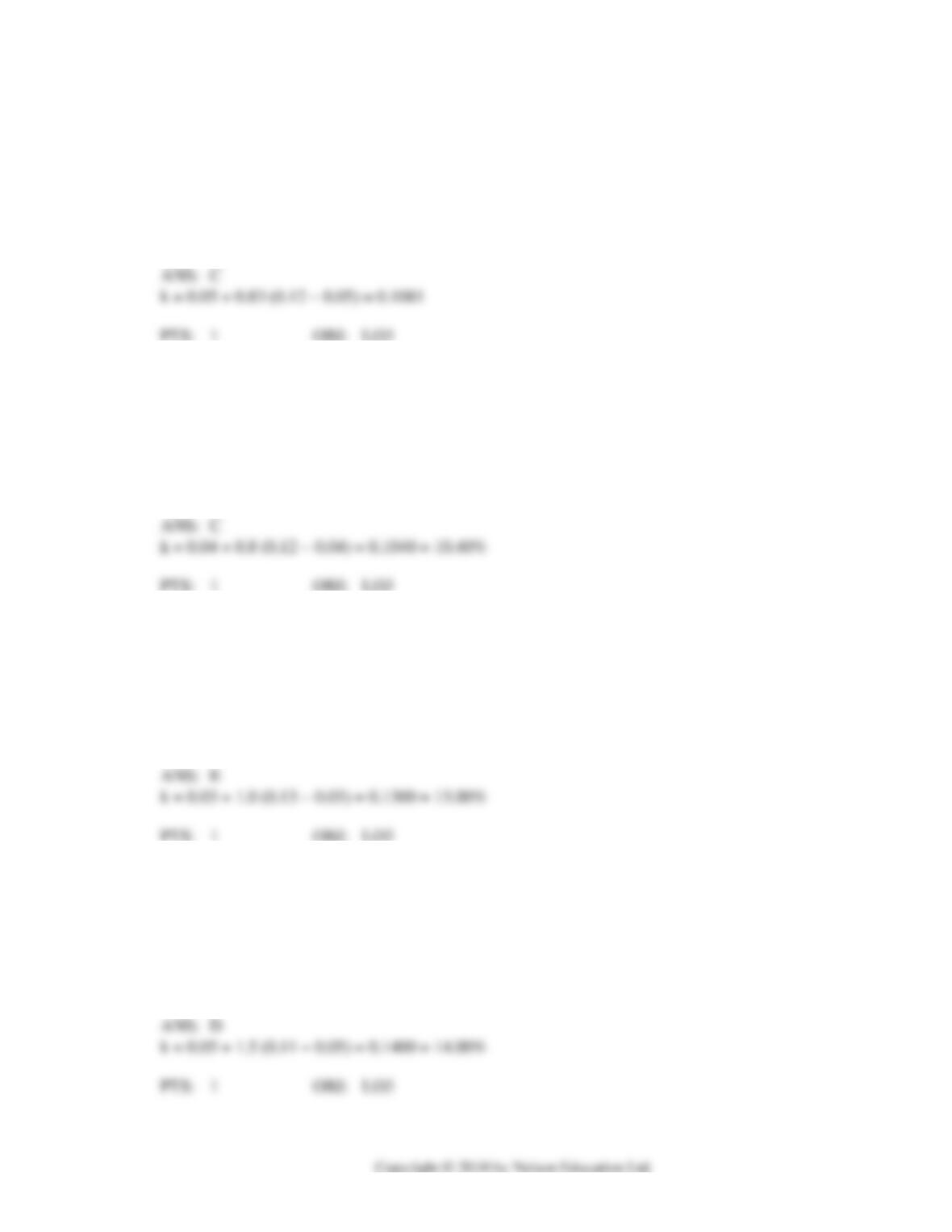
29. Calculate the expected return for A Industries which has a beta of 1.75 when the risk free rate is 0.03
and you expect the market return to be 0.11.
a.
11.13%
b.
14.97%
c.
16.25%
d.
22.25%
e.
17.0%
10
30. Calculate the expected return for B Services which has a beta of 0.83 when the risk free rate is 0.05
and you expect the market return to be 0.12.
a.
14.96%
b.
16.15%
c.
10.81%
d.
17.00%
e.
15.25%
31. Calculate the expected return for C Inc. which has a beta of 0.8 when the risk free rate is 0.04 and you
expect the market return to be 0.12.
a.
8.10%
b.
9.60%
c.
10.40%
d.
11.20%
e.
12.60%
32. Calculate the expected return for D Industries which has a beta of 1.0 when the risk free rate is 0.03
and you expect the market return to be 0.13.
a.
8.6%
b.
9.2%
c.
11.0%
d.
12.0%
e.
13.0%
33. Calculate the expected return for E Services which has a beta of 1.5 when the risk free rate is 0.05 and
you expect the market return to be 0.11.
a.
10.6%
b.
12.1%
c.
13.6%
d.
14.0%
e.
16.2%
11
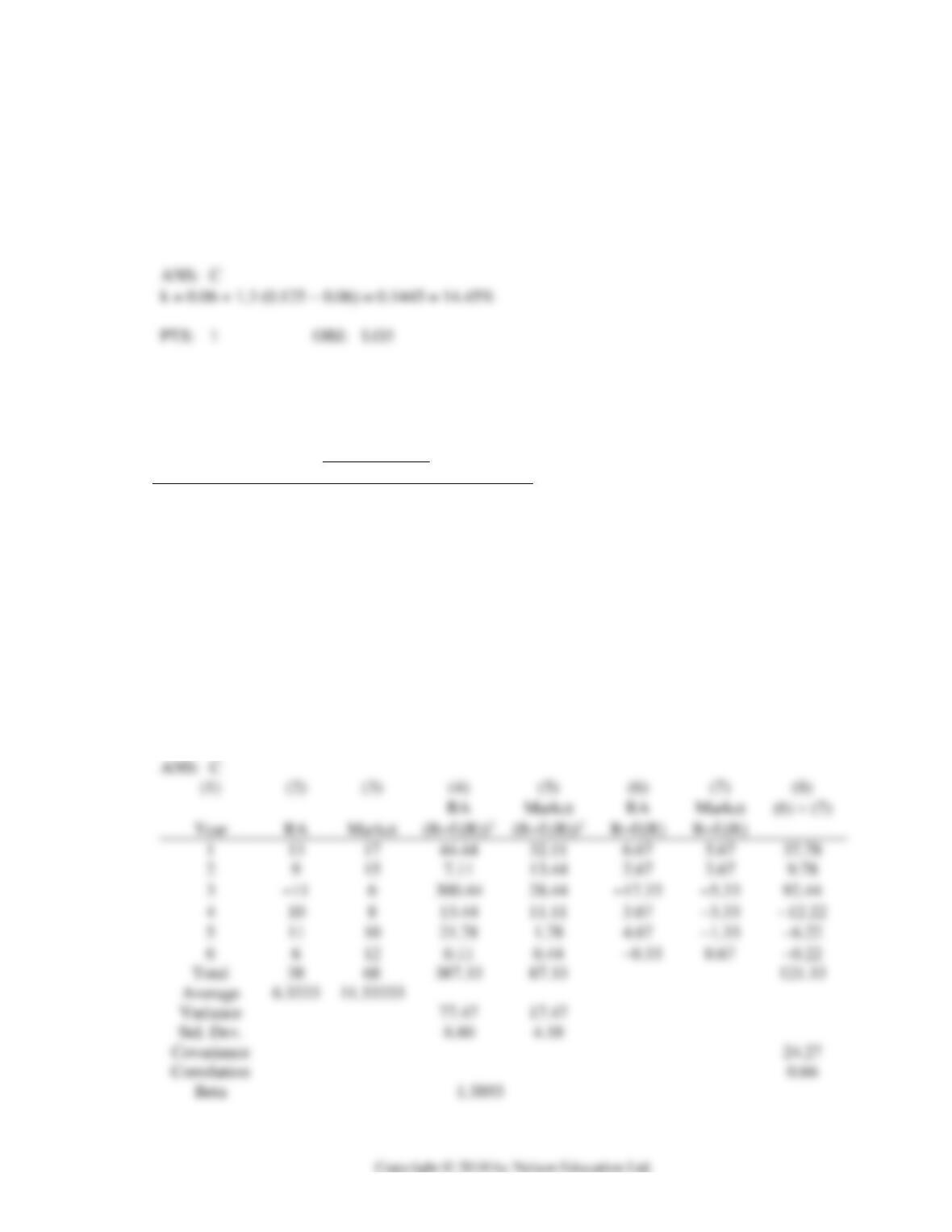
34. Calculate the expected return for F Inc. which has a beta of 1.3 when the risk free rate is 0.06 and you
expect the market return to be 0.125.
a.
12.65%
b.
13.55%
c.
14.45%
d.
15.05%
e.
16.34%
Exhibit 7-1
USE THE FOLLOWING INFORMATION FOR THE NEXT PROBLEM(S)
Rates of Return
Year
RA Computer
Market Index
1
13
17
2
9
15
3
−11
6
4
10
8
5
11
10
6
6
12
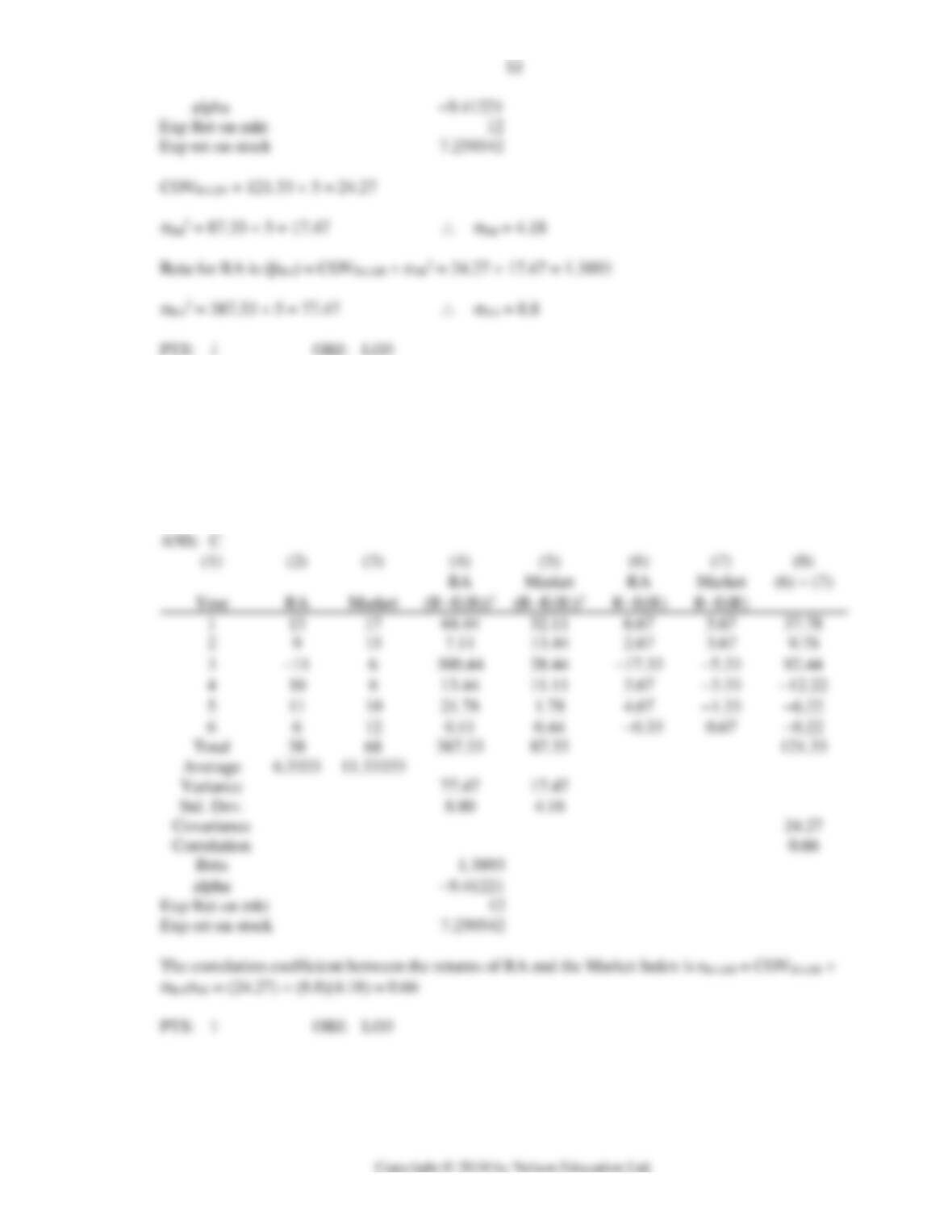
35. Refer to Exhibit 7-1. Compute the beta for RA Computer using the historic returns presented above.
a.
0.7715
b.
1.2195
c.
1.3893
d.
1.1023
e.
−0.7715
(3)
Year
17
6.67
9
15
7.11
2.67
9.78
3.67
1.78
4.67
6
12
0.11
0.44
Total
68
8.80
4.18
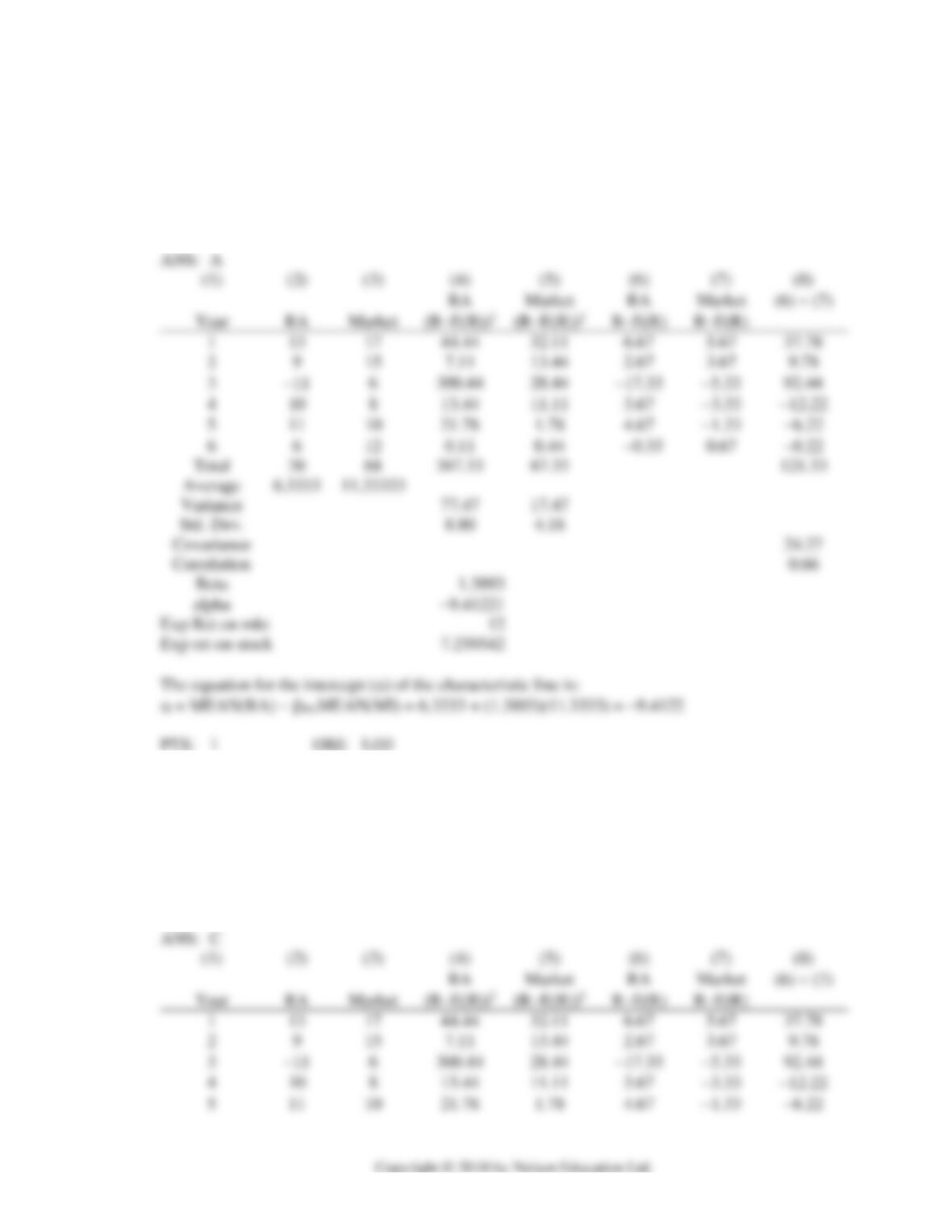
36. Refer to Exhibit 7-1. Compute the correlation coefficient between RA Computer and the Market
Index.
a.
−0.32
b.
0.78
c.
0.66
d.
0.58
e.
0.32
13
37. Refer to Exhibit 7-1. Compute the intercept of the characteristic line for RA Computer.
a.
−9.41
b.
11.63
c.
4.92
d.
−4.92
e.
−7.98
38. Refer to Exhibit 7-1. The equation of the characteristic line for RA is
a.
RRA = 11.63 + 1.2195RMI
b.
RRA = −7.98 + 1.1023RMI
c.
RRA = −9.41 + 1.3893RMI
d.
RRA = −4.92 − 0.7715RMI
e.
RRA = 4.92 + 0.7715RMI
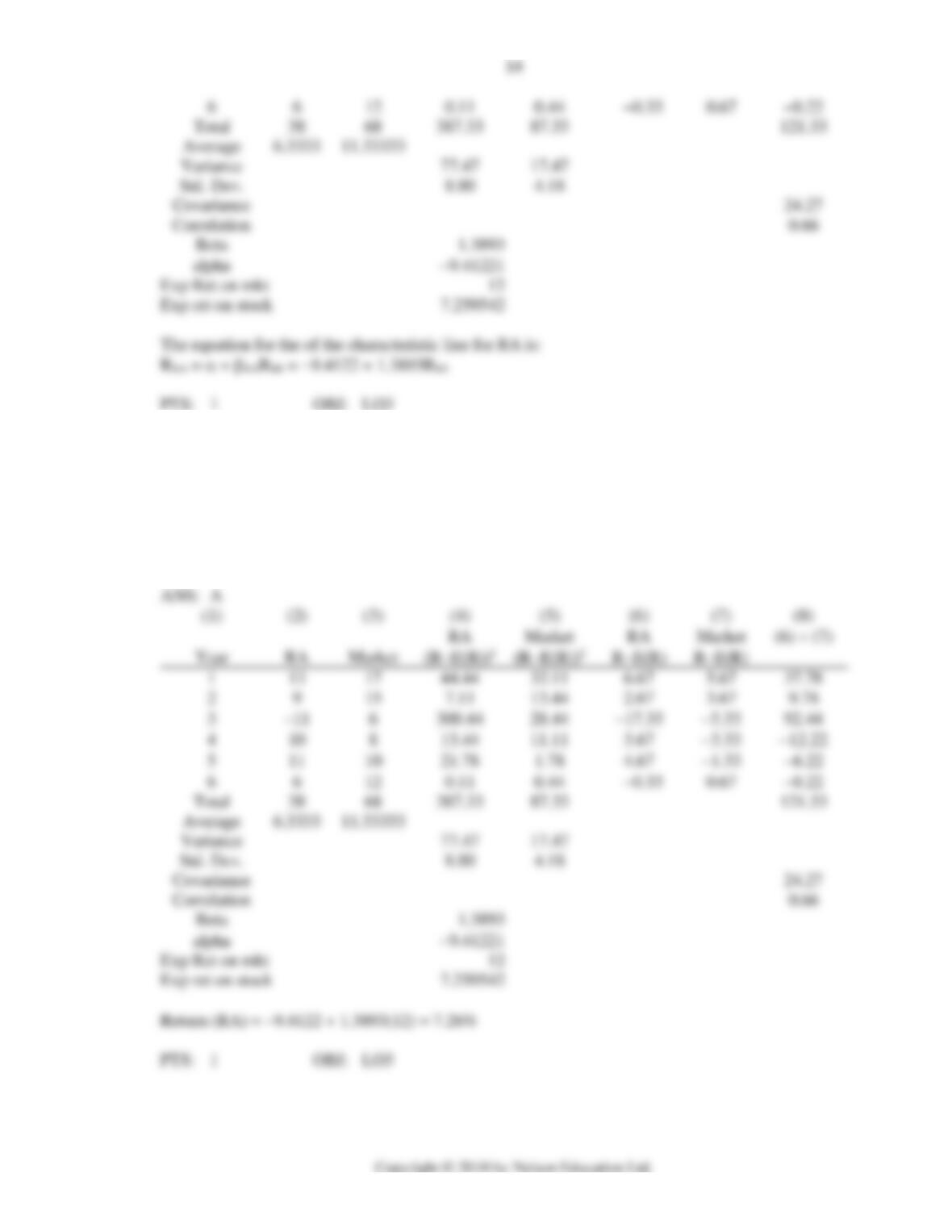
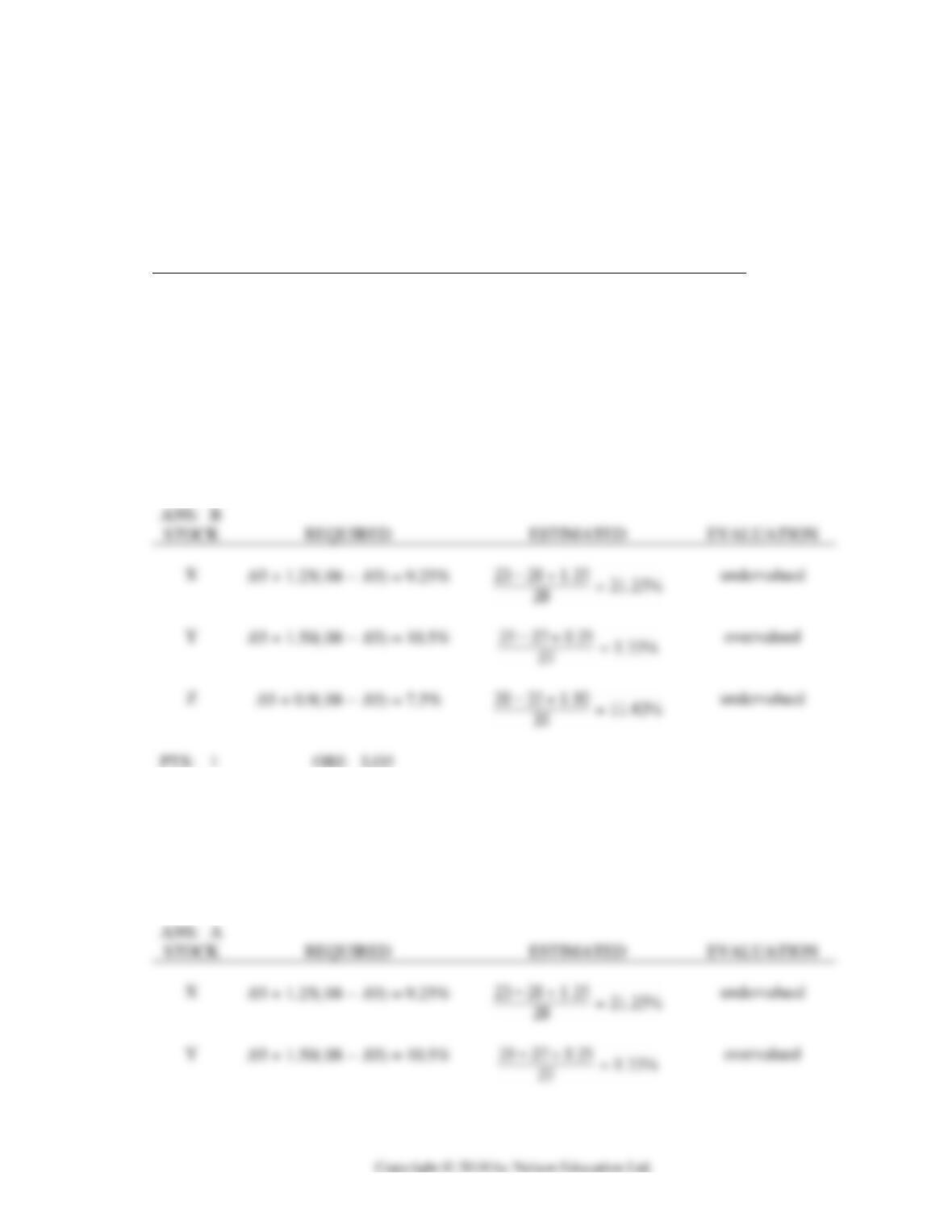
39. Refer to Exhibit 7-1. If you expected return on the Market Index to be 12%, what would you expect
the return on RA Computer to be?
a.
7.26%
b.
6.75%
c.
8.00%
d.
9.37%
e.
−3.29%
15
Exhibit 7-2
USE THE FOLLOWING INFORMATION FOR THE NEXT PROBLEM(S)
You expect the risk-free rate (RFR) to be 3% and the market return to be 8%. You also have the
following information about three stocks.
CURRENT
EXPECTED
EXPECTED
STOCK
BETA
PRICE
PRICE
DIVIDEND
X
1.25
$20
$23
$1.25
Y
1.50
$27
$29
$0.25
Z
0.90
$35
$38
$1.00
40. Refer to Exhibit 7-2. What are the expected (required) rates of return for the three stocks (in the order
X, Y, Z)?
a.
16.50%, 5.50%, 22.00%
b.
9.25%, 10.5%, 7.5%
c.
21.25%, 8.33%, 11.43%
d.
6.20%, 2.20%, 8.20%
e.
15.00%, 3.50%, 7.30%
41. Refer to Exhibit 7-2. What are the estimated rates of return for the three stocks (in the order X, Y, Z)?
a.
21.25%, 8.33%, 11.43%
b.
6.20%, 2.20%, 8.20%
c.
16.50%, 5.50%, 22.00%
d.
9.25%, 10.5%, 7.5%
e.
15.00%, 3.50%, 7.30%
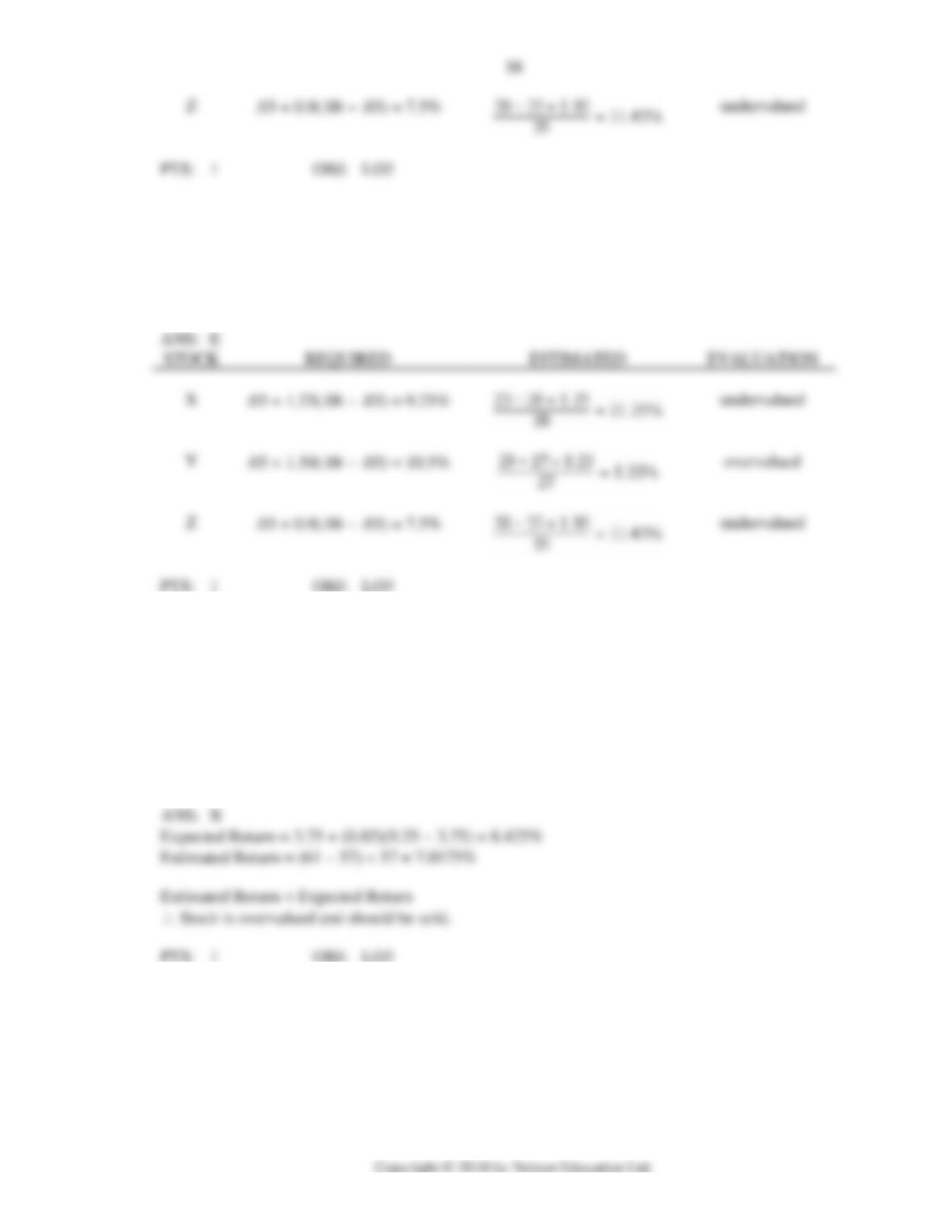
42. Refer to Exhibit 7-2. What is your investment strategy concerning the three stocks?
a.
Buy X and Y, sell Z.
b.
Sell X, Y and Z.
c.
Sell X and Z, buy Y.
d.
Buy X, Y and Z.
e.
Buy X and Z, sell Y.
43. Recently you have received a tip that the stock of Bubbly Incorporated is going to rise from $57 to $61
per share over the next year. You know that the annual return on the S&P/TSX composite index has
been 9.25% and the 90-day T-bill rate has been yielding 3.75% per year over the past 10 years. If beta
for Bubbly is 0.85, will you purchase the stock?
a.
Yes, because it is overvalued.
b.
No, because it is overvalued.
c.
No, because it is undervalued.
d.
Yes, because it is undervalued.
e.
Yes, because the expected return equals the estimated return.
44. Your broker has advised you that he believes that the stock of Brat Inc. is going to rise from $20 to
$22.15 per share over the next year. You know that the annual return on the S&P/TSX composite
index has been 11.25% and the 90-day T-bill rate has been yielding 4.75% per year over the past 10
years. If beta for Brat is 1.25, will you purchase the stock?
a.
Yes, because it is overvalued
b.
No, because it is overvalued
17
c.
No, because it is undervalued
d.
Yes, because it is undervalued
e.
Yes, because the expected return equals the estimated return
45. Recently you have received a tip that the stock of Buttercup Industries is going to rise from $76.00 to
$85.00 per share over the next year. You know that the annual return on the S&P/TSX composite
index has been 13% and the 90-day T-bill rate has been yielding 3% per year over the past 10 years. If
beta for Buttercup is 1.0, will you purchase the stock?
a.
Yes, because it is overvalued.
b.
Yes, because it is undervalued.
c.
No, because it is undervalued.
d.
No, because it is overvalued.
e.
Yes, because the expected return equals the estimated return.
46. A friend has some reliable information that the stock of Puddles Company is going to rise from $43.00
to $50.00 per share over the next year. You know that the annual return on the S&P/TSX composite
index has been 11% and the 90-day T-bill rate has been yielding 5% per year over the past 10 years. If
beta for Puddles is 1.5, will you purchase the stock?
a.
Yes, because it is overvalued.
b.
Yes, because it is undervalued.
c.
No, because it is undervalued.
d.
No, because it is overvalued.
e.
Yes, because the expected return equals the estimated return.
18
47. Assume that as a portfolio manager the beta of your portfolio is 0.85 and that your performance is
exactly on target with the SML data under condition 1. If the true SML data is given by condition 2,
how much does your performance differ from the true SML?
1)
RFR = 0.0475
Rm(proxy) = 0.0975
2)
RK = 0.0325
Rm(true) = 0.0845
a.
1.33% higher
b.
2.35% lower
c.
8% lower
d.
1.33% lower
e.
2.35% higher
48. Assume that as a portfolio manager the beta of your portfolio is 1.15 and that your performance is
exactly on target with the SML data under condition 1. If the true SML data is given by condition 2,
how much does your performance differ from the true SML?
1)
RFR = 0.0625
Rm(proxy) = 0.12
2)
RK = 0.078
Rm(true) = 0.10
a.
2.53% lower
b.
3.85% lower
c.
2.53% higher
d.
4.4% higher
e.
3.85% higher
19
49. Assume that as a portfolio manager the beta of your portfolio is 1.3 and that your performance is
exactly on target with the SML data under condition 1. If the true SML data is given by condition 2,
how much does your performance differ from the true SML?
1)
RFR = .08
Rm(proxy) = .11
2)
RK = .07
Rm(true) = .14
a.
4.2% lower
b.
3.6% lower
c.
3.8% lower
d.
4.2% higher
e.
3.6% higher
50. Assume that as a portfolio manager the beta of your portfolio is 1.2 and that your performance is
exactly on target with the SML data under condition 1. If the true SML data is given by condition 2,
how much does your performance differ from the true SML?
1)
RFR = .09
Rm(proxy) = .12
2)
RK = .10
Rm(true) = .13
a.
2% lower
b.
1% lower
c.
5% lower
d.
1% higher
e.
2% higher
20
Exhibit 7-3
USE THE FOLLOWING INFORMATION FOR THE NEXT PROBLEM(S)
Return
Proxy
True
Period
of Radtron
Specific Index
General Index
(Percent)
(Percent)
(Percent)
1
10
12
15
2
12
10
13
3
−10
−8
−8
4
−4
−10
0
51. Refer to Exhibit 7-3. What is the average true return?
a.
1%
b.
2%
c.
3%
d.
4%
e.
5%
52. Refer to Exhibit 7-3. What is the average proxy return?
a.
1%
b.
2%
c.
3%
d.
4%
e.
5%
53. Refer to Exhibit 7-3. What is the average return for Radtron?
a.
1%
b.
2%
c.
3%
d.
4%
e.
5%