63. {Number of Birds Narrative} Compute the mean and variance of Y.
64. {Number of Birds Narrative} Assume that X and Y are independent and find their bivariate
distribution.
65. {Number of Birds Narrative} Compute the covariance between X and Y.
66. {Number of Birds Narrative} Compute the coefficient of correlation between X and Y. Did you expect
this result? Why?
67. {Number of Birds Narrative} Determine the probability distribution of the random variable X + Y.
ANS:
68. {Number of Birds Narrative} Calculate E(X + Y) directly by using the probability distribution of X + Y.
69. {Number of Birds Narrative} Calculate V(X + Y) directly by using the probability distribution of X + Y.
70. {Number of Birds Narrative} Verify that V(X + Y) = V(X) + V(Y). Did you expect this result? Why?
71. {Number of Birds Narrative} Find the probability distribution of the random variable XY.
72. {Number of Birds Narrative} Calculate E(XY) directly by using the probability distribution of XY.
73. {Number of Birds Narrative} Verify that E(XY) = E(X)E(Y). Did you expect this result? Why?
Golfing Store
The joint probability distribution of variables X and Y is shown in the table below, where X is the
number of drivers and Y is the number of putters sold daily in a small golfing store.
X
Y
1
2
3
1
0.30
0.18
0.12
2
0.15
0.09
0.06
3
0.05
0.03
0.02
74. {Golfing Store Narrative} Calculate E(XY).
75. {Golfing Store Narrative} Determine the marginal probability distributions of X and Y.
1
2
3
1
2
3
76. {Golfing Store Narrative} Are X and Y independent? Explain.
77. {Golfing Store Narrative} Find P(Y = 2 | X = 1)
78. {Golfing Store Narrative} Calculate the expected values of X and Y.
79. {Golfing Store Narrative} Calculate the variances of X and Y.
80. {Golfing Store Narrative} Calculate COV(X,Y). Did you expect this answer? Why?
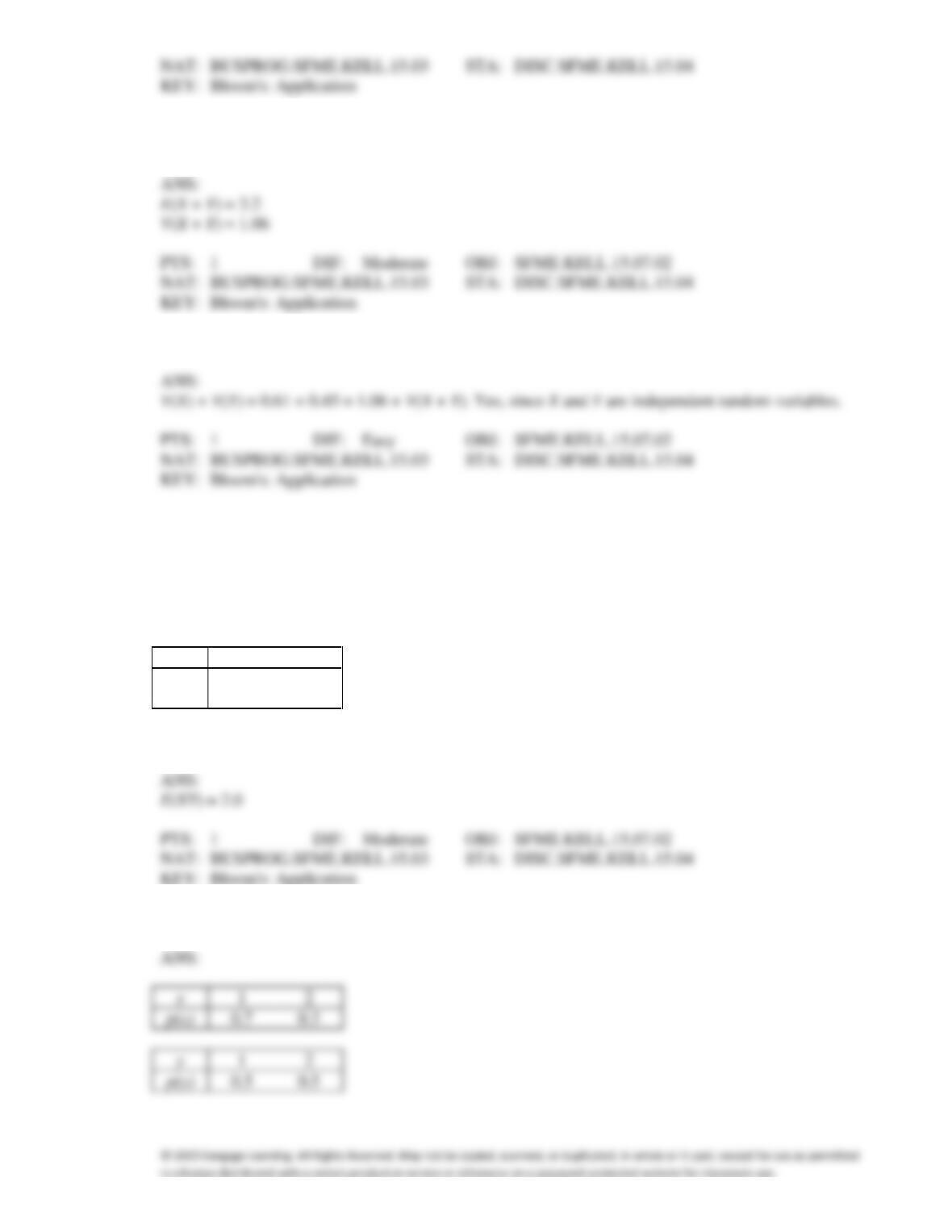
81. {Golfing Store Narrative} Find the probability distribution of the random variable X + Y.
ANS:
82. {Golfing Store Narrative} Calculate E(X + Y) and V(X + Y) directly by using the probability
distribution of X + Y.
83. {Golfing Store Narrative} Verify that V(X + Y) = V(X) + V(Y). Did you expect this result? Why?
Number of Hamsters
The joint probability distribution of X and Y is shown in the accompanying table, where X denotes the
number of hamsters that Quinn may have next year, and Y denotes the number of hamsters that her
boyfriend, Jason, may have when she moves in with him next year.
X
Y
1
2
1
0.4
0.1
2
0.3
0.2
84. {Number of Hamsters Narrative} Calculate E(XY).
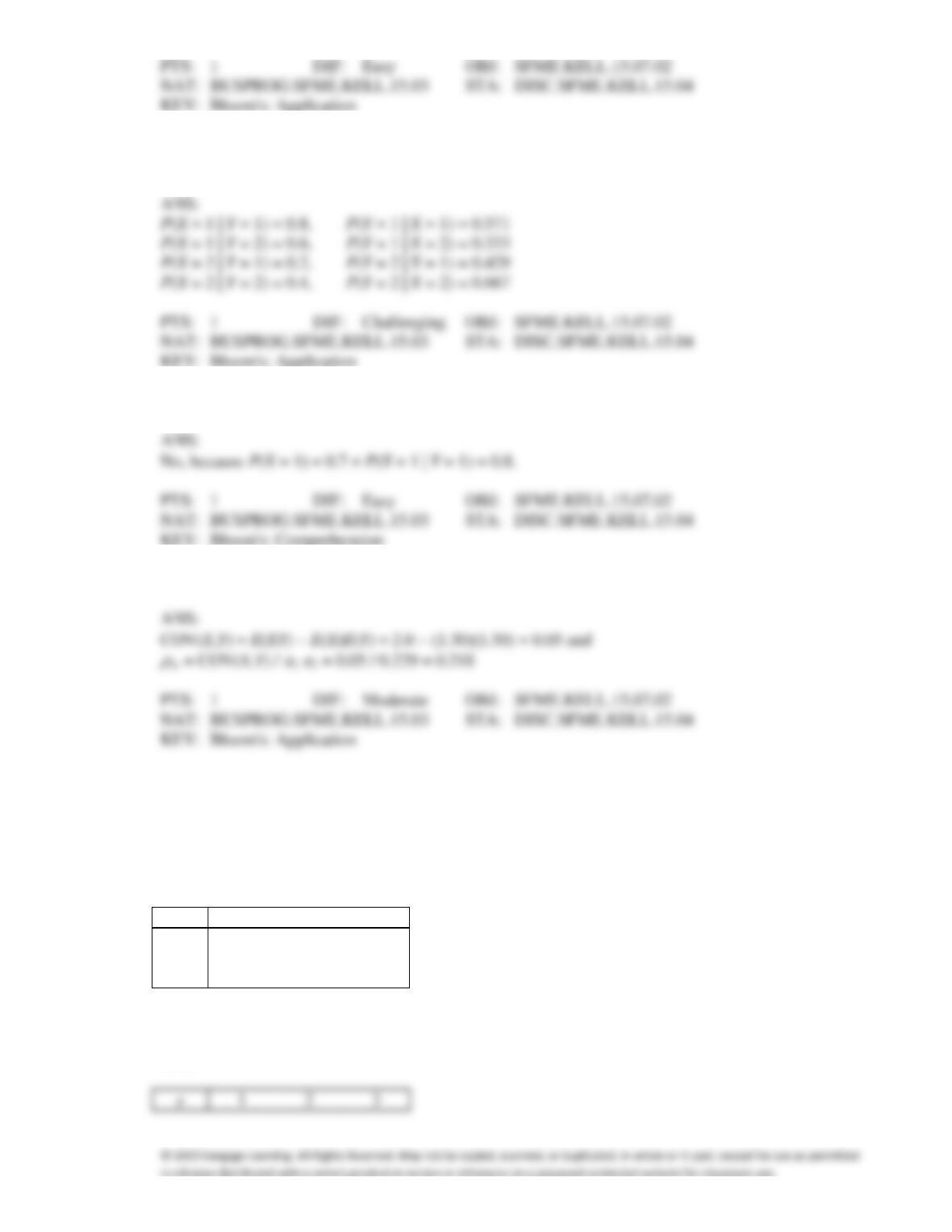
85. {Number of Hamsters Narrative} Determine the marginal probability distributions of X and Y.
0.7
0.3
86. {Number of Hamsters Narrative} Calculate all possible values of the conditional probabilities, for X
given Y and for Y given X.
87. {Number of Hamsters Narrative} Are X and Y independent? Explain.
88. {Number of Hamsters Narrative} Compute the covariance and the coefficient of correlation.
Car Sales
The joint probability distribution of variables X and Y is shown in the table below. Rebecca and Rachel
are car salespeople. Let X denote the number of cars that Rebecca will sell in a month, and let Y denote
the number of cars Rachel will sell in a month.
X
Y
1
2
3
1
0.30
0.18
0.12
2
0.15
0.09
0.06
3
0.05
0.03
0.02
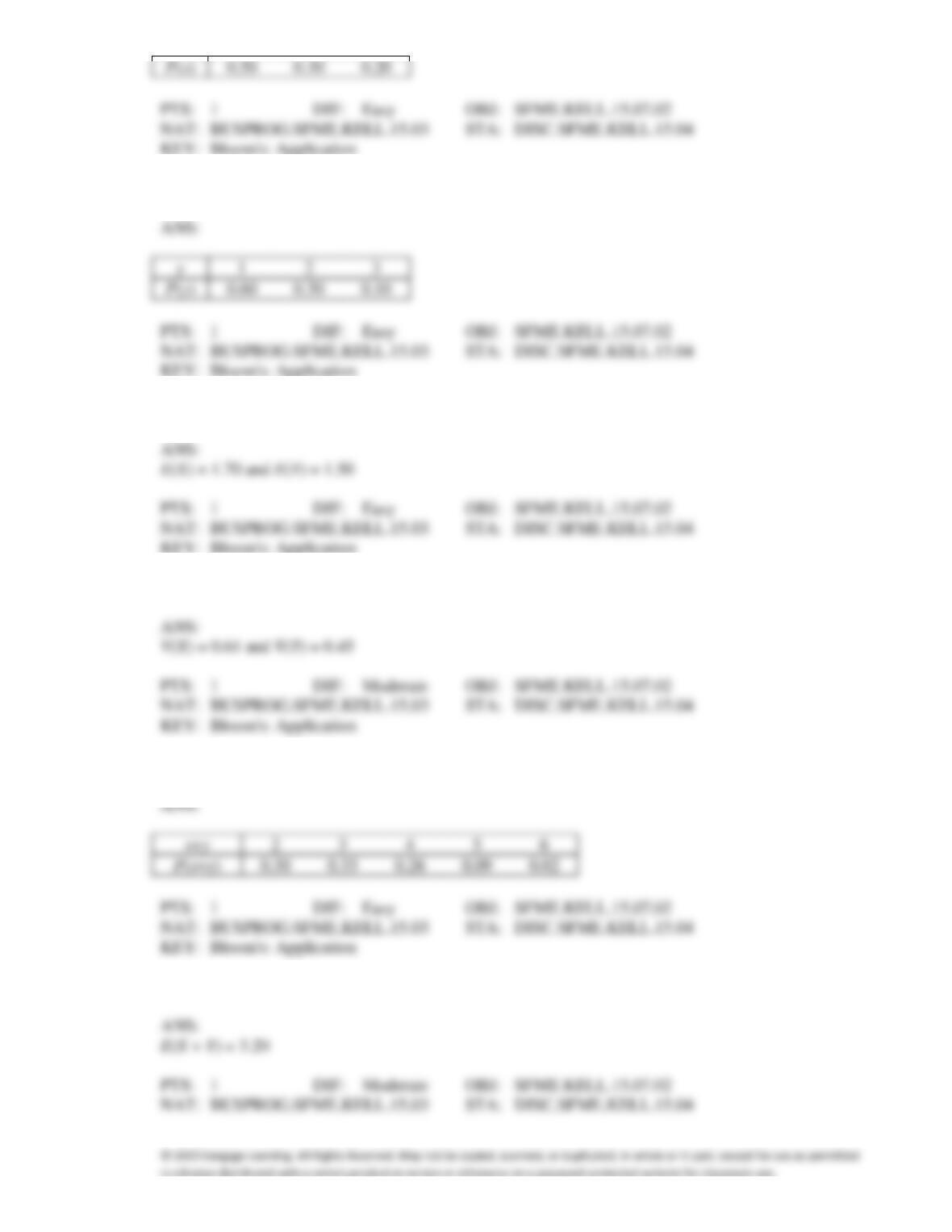
89. {Car Sales Narrative} Determine the marginal probability distribution of X.
ANS:
90. {Car Sales Narrative} Determine the marginal probability distribution of Y.
91. {Car Sales Narrative} Calculate E(X) and E(Y).
92. {Car Sales Narrative} Calculate V(X) and V(Y).
93. {Car Sales Narrative} Develop the probability distribution of X + Y.
94. {Car Sales Narrative} Calculate E(X + Y) directly by using the probability distribution of X + Y.

95. {Car Sales Narrative} Calculate V(X + Y) directly by using the probability distribution of X + Y.
96. {Car Sales Narrative} Verify that E(X + Y) = E(X) + E(Y).
97. {Car Sales Narrative} Verify that V(X + Y) = V(X) + V(Y). Did you expect this result? Why?
Mobile Phones Sales
After analyzing sales data, the owner of a Mobile Phone store produced the following joint probability
distribution of the number of iPhones (X) and Blackberries (Y) sold daily.
X
Y
1
2
1
0.4
0.1
2
0.3
0.2
98. {Mobile Phones Sales Narrative} Find the marginal probability distribution of the number of iPhones
sold daily.
99. {Mobile Phones Sales Narrative} Compute the expected number of iPhones sold daily.
100. {Mobile Phones Sales Narrative} Compute the variance of the number of iPhones sold daily.
101. {Mobile Phones Sales Narrative} Find the marginal probability distribution of the number of
Blackberries sold daily.
102. {Mobile Phones Sales Narrative} Find the marginal probability distribution of the number of
Blackberries sold daily.
103. {Mobile Phones Sales Narrative} Compute the variance of the number of Blackberries sold daily.
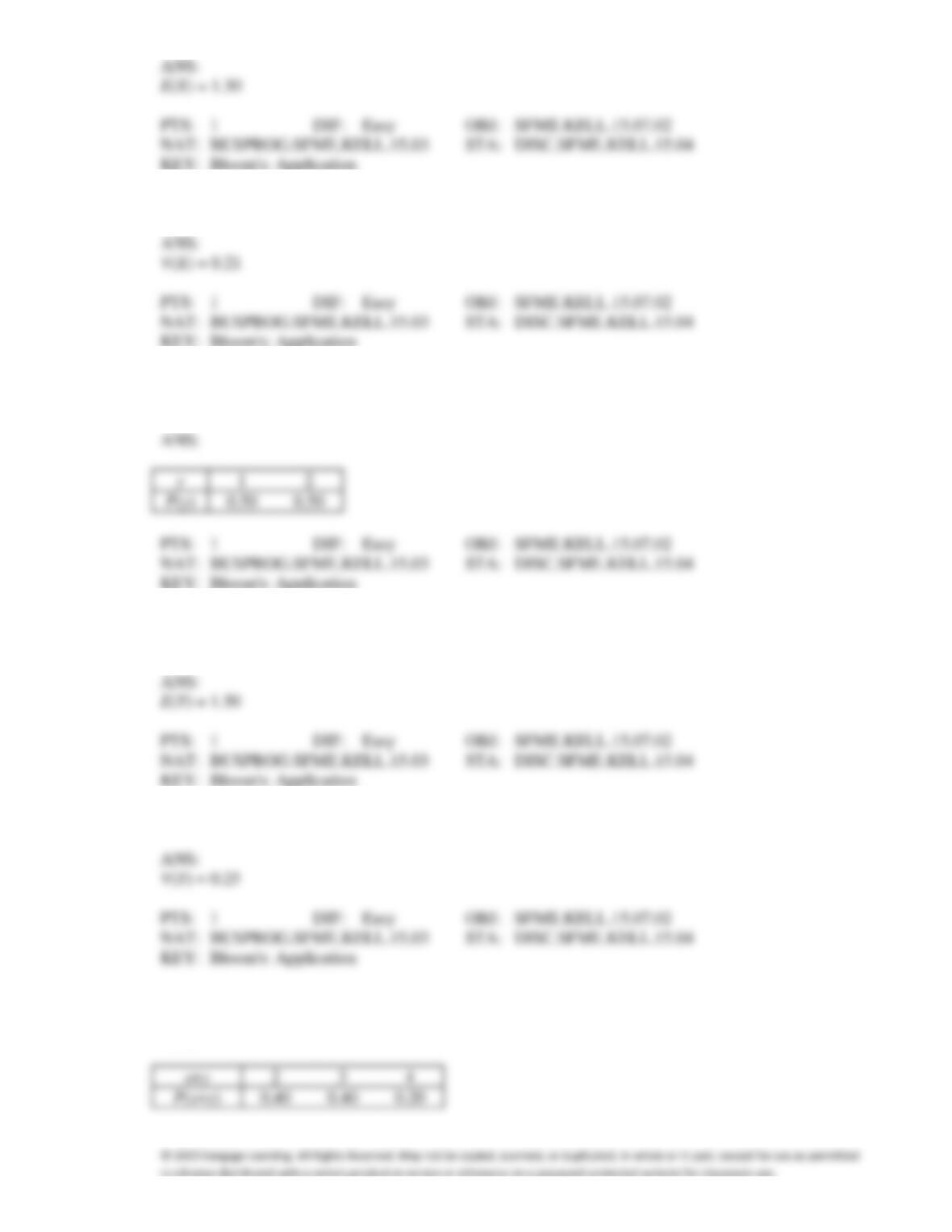
104. {Mobile Phones Sales Narrative} Find the probability distribution of X + Y.
ANS:
105. {Mobile Phones Sales Narrative} Calculate E(X + Y) directly by using the probability distribution of X
+ Y.
106. {Mobile Phones Sales Narrative} Calculate V(X + Y) directly by using the probability distribution of X
+ Y.
107. {Mobile Phones Sales Narrative} Compare V(X) + V(Y) to V(X + Y). What is your conclusion?
108. One of the ways in which financial analysts lower the risk that is associated with the stock market is
through diversification.
109. The expected return of a portfolio of two investments will be equal to the sum of the expected returns
of the two investments plus twice the covariance between the investments.
110. The expected return of a two-asset portfolio is equal to the product of the weight assigned to the first
asset and the expected return of the first asset plus the product of the weight assigned to the second
asset and the expected return of the second asset.
111. A portfolio return, Rp, of two stocks with individual returns, R1 and R2, is, in general, given by Rp = R1
+ R2.
112. A portfolio expected return E(Rp) of 3 stocks with the quantities w1 = .40, w2 = .50, w3 = .10, E(R1) =
.10, E(R2) = .15, and E(R3) = .02 is equal to 0.117.
113. The covariance between two investments of a portfolio is equal to the sum of the variances of the
investments.
114. If the covariance between two investments of a portfolio is zero, the variance of the portfolio will be
equal to the sum of the variances of the investments.
115. The variance of a portfolio of two investments will be equal to the sum of the variances of the two
investments plus twice the covariance between the investments.
116. The variance of a portfolio of two investments will be equal to the sum of the variances of the two
investments when the covariance between the investments is zero.
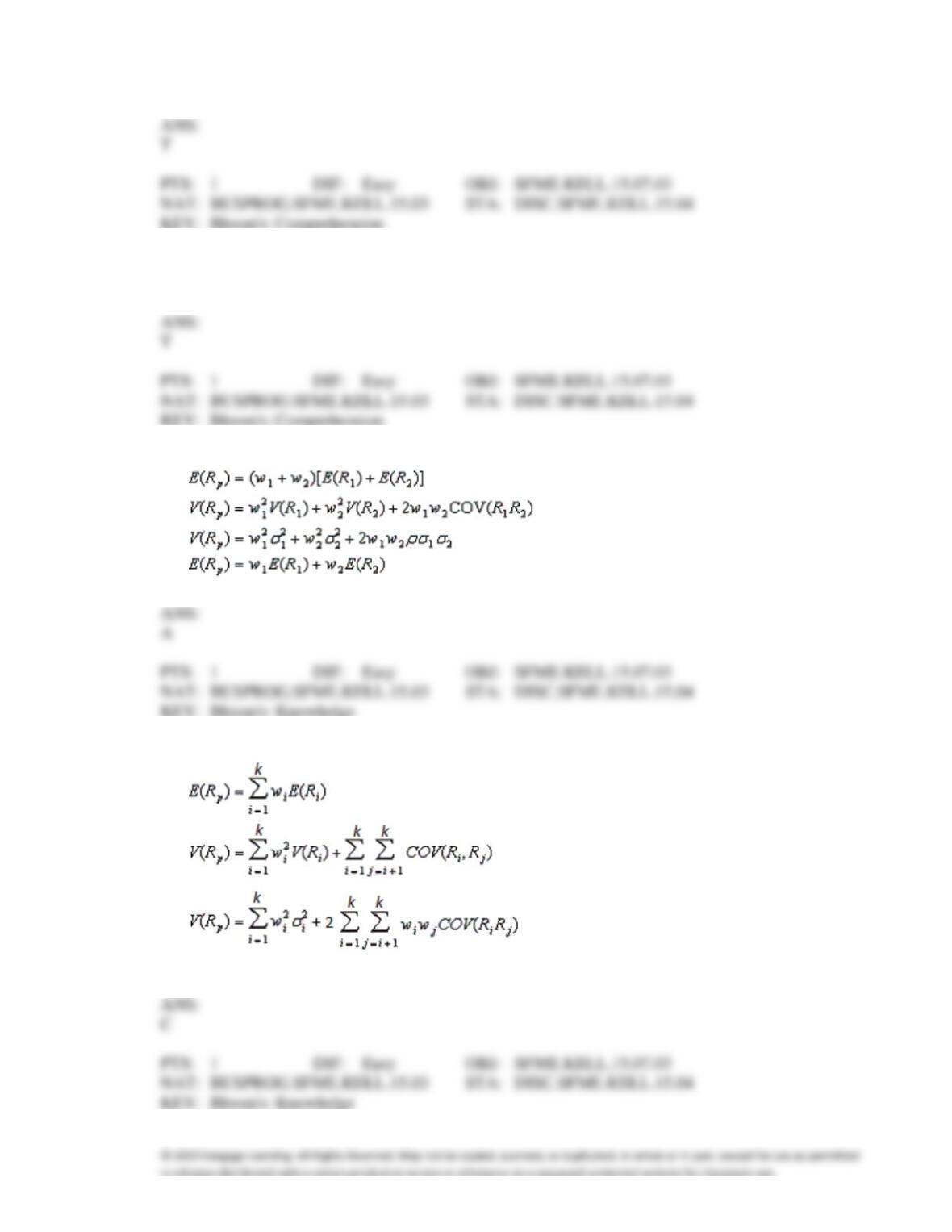
117. Which of the following regarding the mean and variance of a portfolio of two stocks is false?
a.
b.
c.
d.
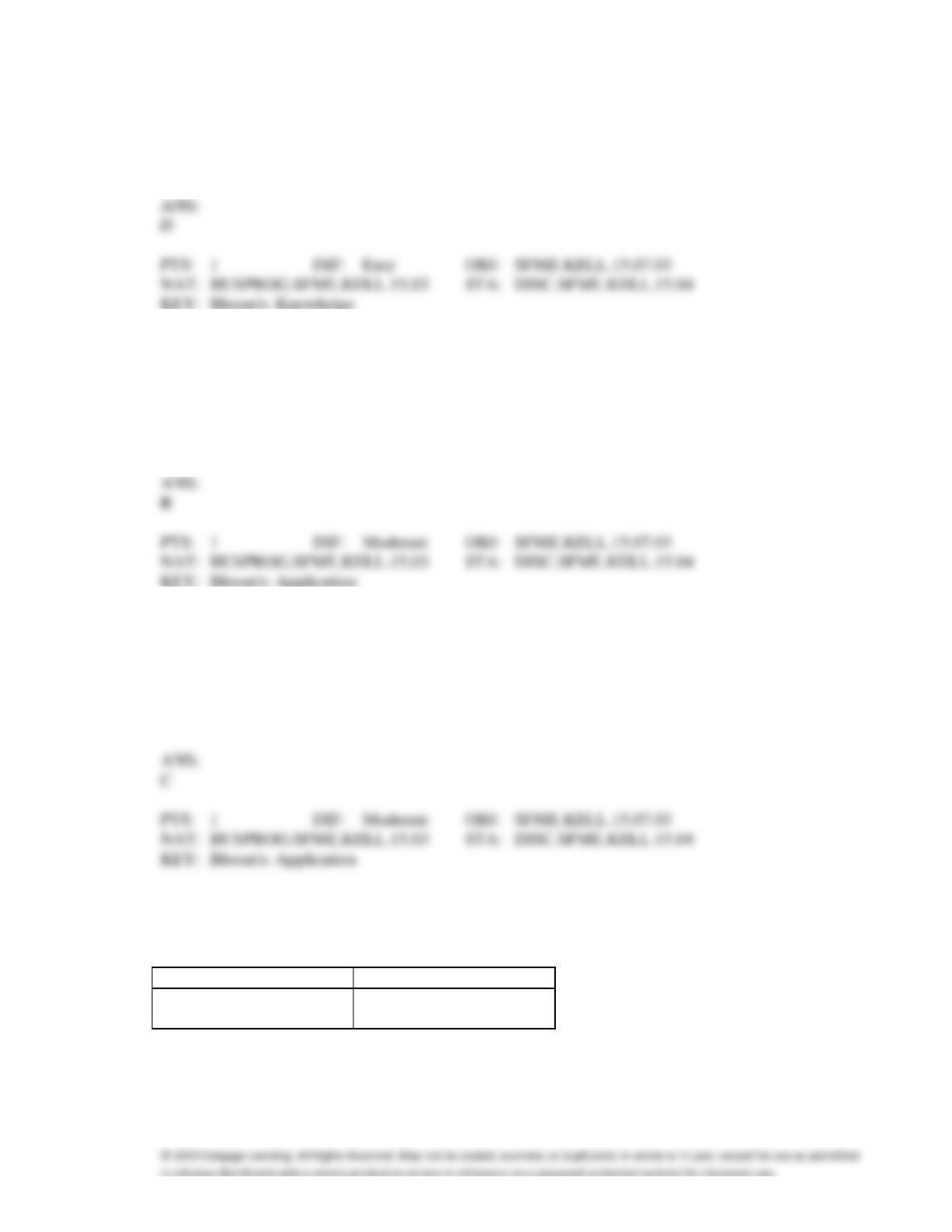
118. Which of the following regarding the mean and variance of a portfolio of k stocks is false?
a.
b.
c.
d.
None of these choices.
119. The portfolio expected return of two investments:
a.
will be higher when the covariance is zero.
b.
will be higher when the covariance is negative.
c.
will be higher when the covariance is positive.
d.
does not depend on the covariance.
120. The following information regarding a portfolio of two stocks are given: w1 = .65, w2 = .35, E(R1) =
.12, and E(R2) = .14. Which of the following regarding the portfolio expected return, E(Rp), is correct?
a.
.260
b.
.127
c.
.346
d.
.374
121. The following information regarding a portfolio of two stocks are given: w1 = .25, w2 = .75, E(R1) =
.08, and E(R2) = .15. Which of the following regarding the portfolio expected return, E(Rp), is correct?
a.
.3640
b.
.2300
c.
.1325
d.
.1699
Returns on Investment
An analysis of the stock market produces the following information about the returns of two stocks.
Stock 1
Stock 2
Expected Returns
15%
18%
Standard Deviations
20
32
Assume that the returns are positively correlated with correlation coefficient of 0.80.
122. {Returns on Investment Narrative} Find the mean of the return on a portfolio consisting of an equal
investment in each of the two stocks.
123. {Returns on Investment Narrative} Find the standard deviation of the return on a portfolio consisting
of an equal investment in each of the two stocks.
124. {Returns on Investment Narrative} Suppose that you wish to invest $1 million. Discuss whether you
should invest your money in stock 1, stock 2, or a portfolio composed of an equal amount of
investments on both stocks.
Risky Undertaking
Suppose you make a $2,000 investment in a risky undertaking. There is a 50% chance that the payoff
from the investment will be $5,000, a 20% chance that you will just get your money back, and a 30%
chance that you will receive nothing at all from your investment.
125. {Risky Undertaking Narrative} Find the expected value of the payoff from your investment of $2,000.
126. {Risky Undertaking Narrative} Find the expected value of the net profit from your investment of
$2,000.
127. {Risky Undertaking Narrative} If you invest $6,000 in the risky undertaking instead of $2,000 and the
possible payoffs triple accordingly, what are the expected value of the net profit from the $6,000
investment?
Elizabeth’s Portfolio
Elizabeth has decided to form a portfolio by putting 30% of her money into stock 1 and 70% into stock
2. She assumes that the expected returns will be 10% and 18%, respectively, and that the standard
deviations will be 15% and 24%, respectively.
128. {Elizabeth’s Portfolio Narrative} Find the expected mean of the portfolio.
129. {Elizabeth’s Portfolio Narrative} Compute the standard deviation of the returns on the portfolio
assuming that the two stocks’ returns are perfectly positively correlated.