Chapter 07 – Work Design and Measurement
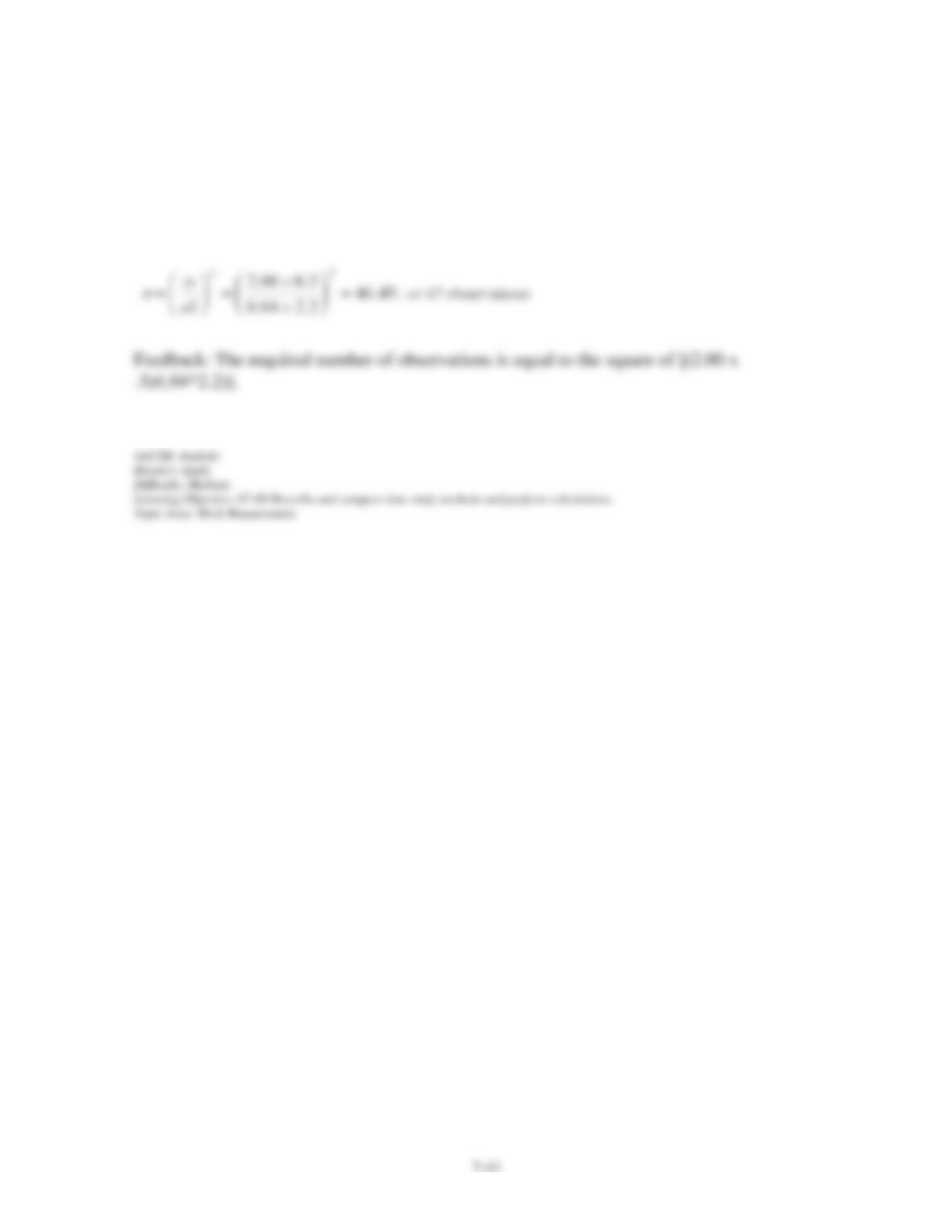
100. An initial time study resulted in an average observed time of 2.2 minutes per cycle, and a
standard deviation of 0.3 minutes per cycle. The performance rating was 1.20. What sample
size, including the 20 observations in the initial study, would be necessary to have a
confidence of 95.44 percent that the observed time was within 4 percent of the true value?
Chapter 07 – Work Design and Measurement
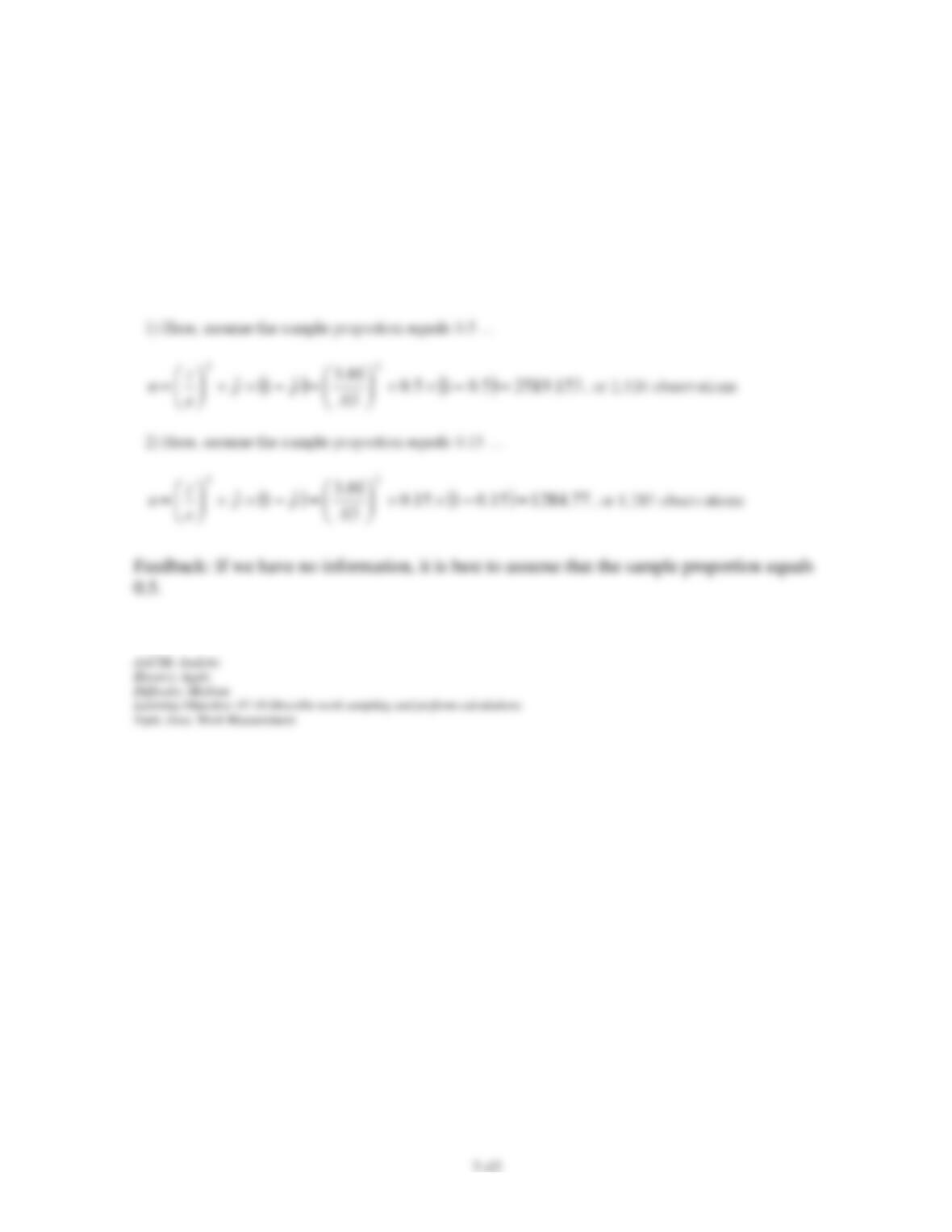
101. A work sampling study is needed that will estimate the percentage of time a postal clerk
spends selling stamps as opposed to other duties. Determine the necessary sample size to
estimate that proportion with a confidence of 99.74 percent to within 3 percent, for these
cases:
1) No information is currently available concerning that proportion.
2) The proportion is probably no more than 15 percent.
Chapter 07 – Work Design and Measurement
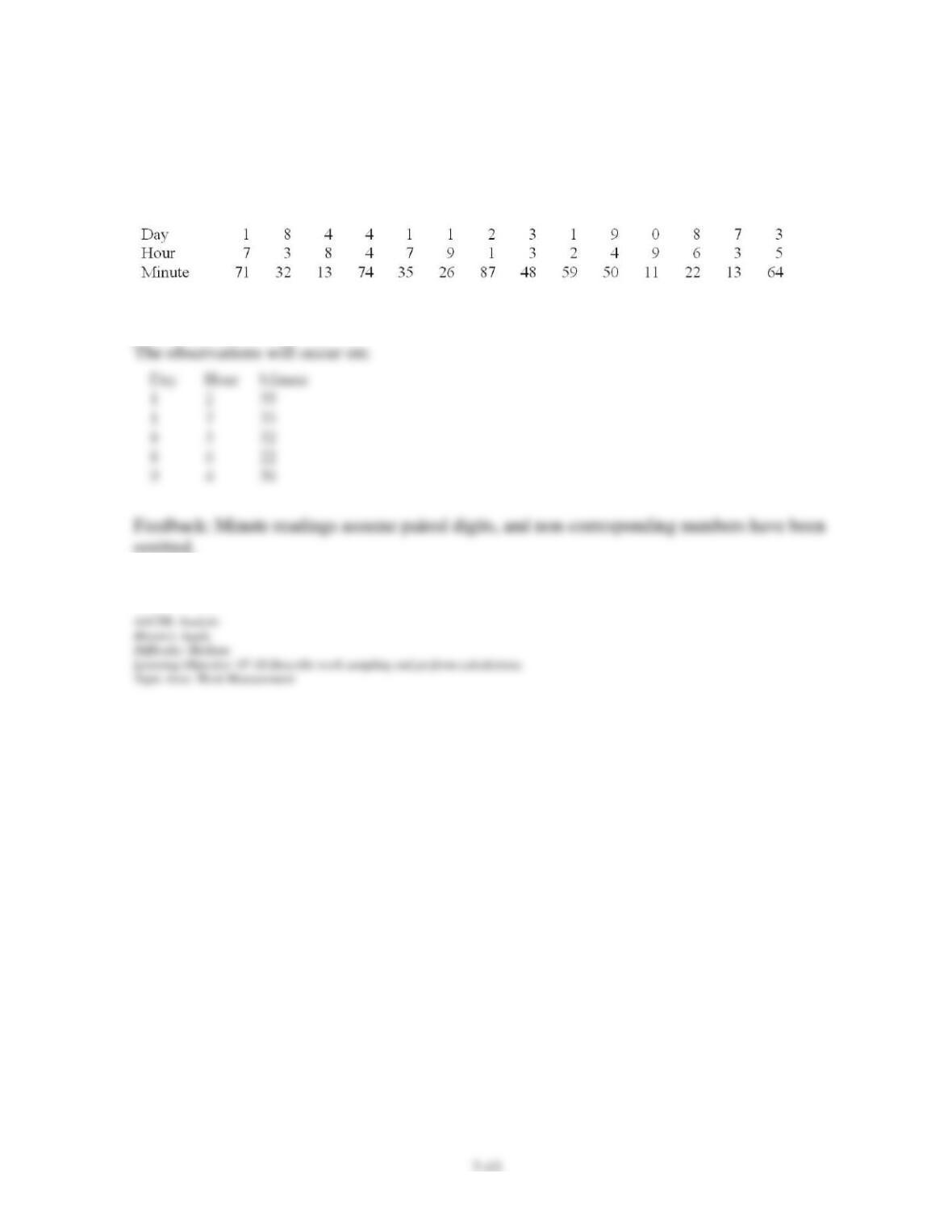
102. A work sampling study of kitchen help is to be designed. The study will be conducted
over a nine-day period. The kitchen help works a seven-hour shift. Determine the day, hour,
and minute of five observations using the random digits listed below.
Arrange observations chronologically.
Chapter 07 – Work Design and Measurement
7-44
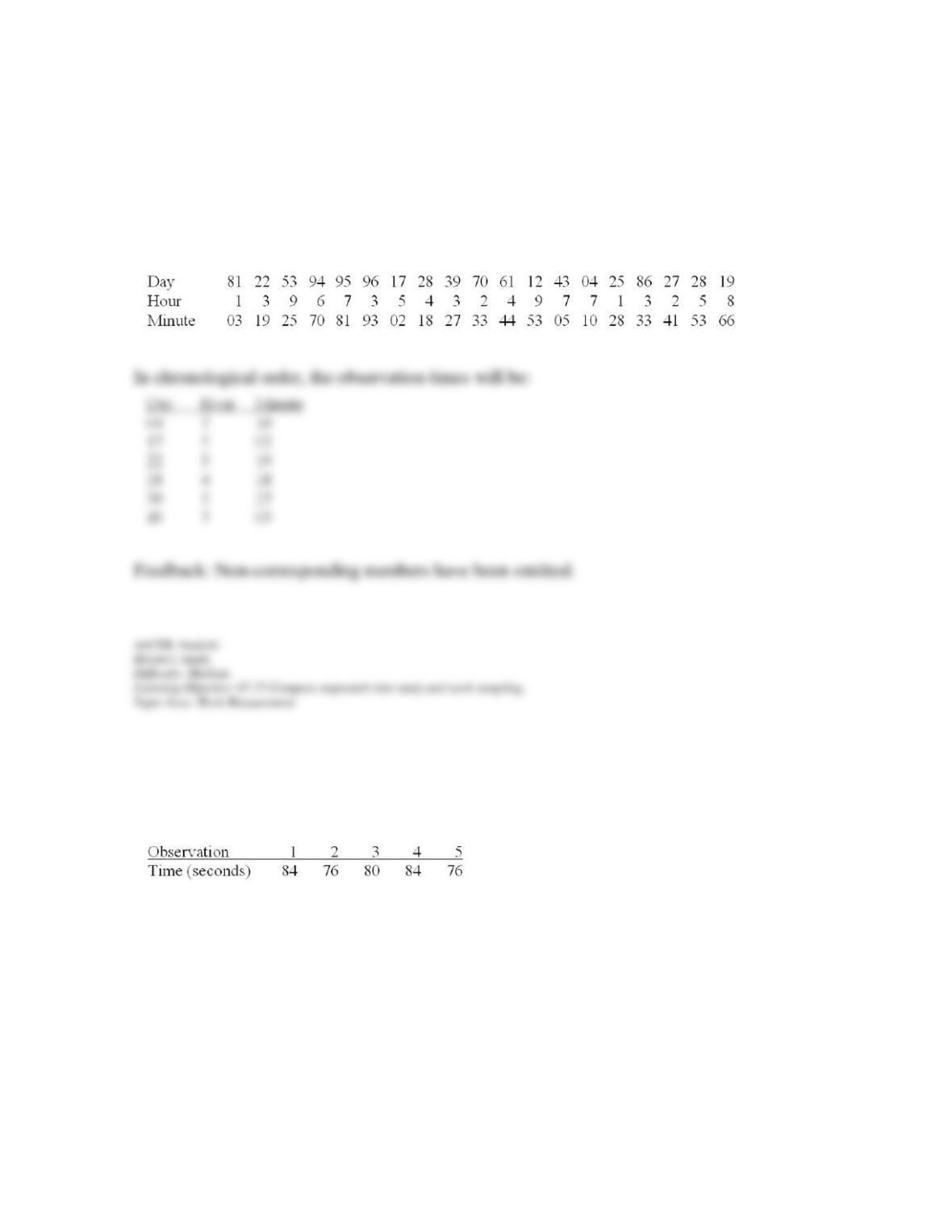
103. A work sampling study of dockworkers must be set up. There will be a large number of
random observations. However, for this exercise, determine an observation schedule
(arranged chronologically) for six observations. Assume workers are on the docks for eight
hours a day, and that the study will be done over a 60-day period. Use the random digits listed
below.
A Methods and Measurements Analyst needs to develop a time standard for a certain task. In
a preliminary study, he observed one of his workers perform this task five times, with the
following results:
Chapter 07 – Work Design and Measurement
104. What is the observed time (OT) for this task?
105. What is the normal time (NT) for this task if the employee worked at a twenty-five
percent faster pace than average?
Chapter 07 – Work Design and Measurement
106. What is the standard time (ST) for this task if the employee worked at a twenty-five
percent faster pace than is average and an allowance of twenty percent of the workday is
used?
107. What is the standard time (ST) for this task if the employee worked at a twenty-five
percent faster pace than is average and an allowance of twenty percent of job time is used?
Chapter 07 – Work Design and Measurement
108. How many observations should be made if the analyst wants to be 99.74 percent
confident that the maximum error in the observed time is two seconds? Assume that the
standard deviation of each task time is 4 seconds.
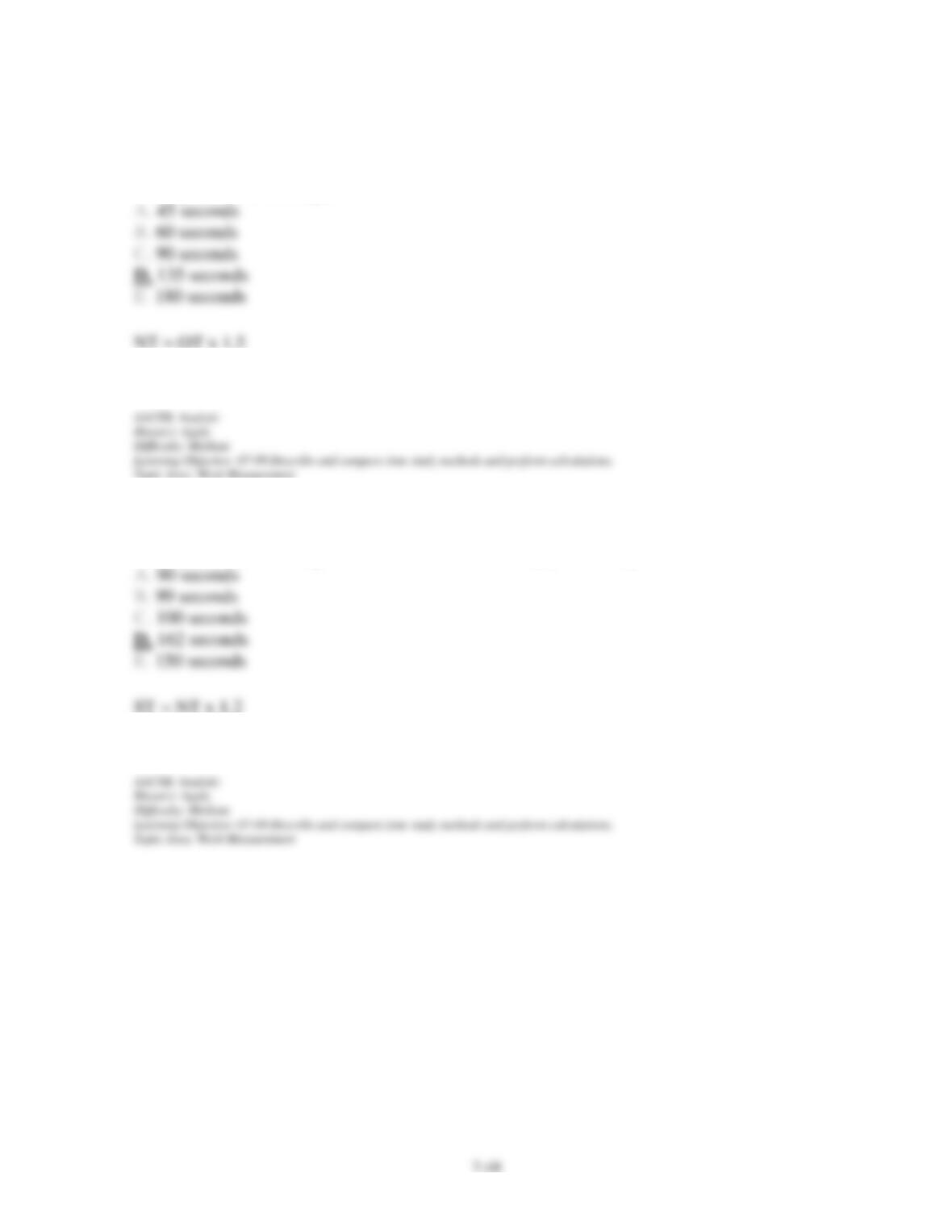
The owner of Kat Motel wants to develop a time standard for the task of cleaning a cat cage.
In a preliminary study, she observed one of her workers perform this task six times, with the
following results:
109. What is the observed time (OT) for this task?
Chapter 07 – Work Design and Measurement
110. What is the normal time (NT) for this task if the employee worked at a fifty-percent
faster pace than is average?
111. What is the standard time (ST) for this task if the employee worked at a fifty-percent
faster pace than is average, and an allowance of twenty percent of job time is used?
Chapter 07 – Work Design and Measurement
112. What is the standard time (ST) for this task if the employee worked at a fifty-percent
faster pace than is average, and an allowance of ten percent of the workday is used?
113. How many observations should be made if she wants to be 95.44 percent confident that
the maximum error in the observed time is two seconds? Assume that the standard deviation
of the task time is 6 seconds.
Chapter 07 – Work Design and Measurement
114. What is the observed time (OT) for this task?
115. What is the normal time (NT) for this task if the employee worked at a twenty-percent
faster pace than is average?
Chapter 07 – Work Design and Measurement
116. What is the standard time (ST) for this task if the employee worked at a twenty-percent
faster pace than is average, and an allowance of twenty percent of the workday is used?
117. What is the standard time (ST) for this task if the employee worked at a twenty-percent
faster pace than is average, and an allowance of twenty percent of job time is used?
Chapter 07 – Work Design and Measurement
118. How many observations should be made if he wants to be 95.44 percent confident that
the maximum error in the observed time is one second? Assume that the standard deviation of
the task time is 5 seconds.
A Methods and Measurement Analyst wants to develop a time standard for a certain task. In
a preliminary study, he observed one worker perform the task six times with an average
observed time of 20 seconds and a standard deviation of 2 seconds.
119. What is the normal time (NT) for this task if the employee worked at a twenty percent
faster pace than is average?
Chapter 07 – Work Design and Measurement
120. What is the standard time (ST) for this task if the employee worked at a twenty percent
faster pace than is average, and an allowance of twenty-five percent of the workday is used?
121. What is the standard time (ST) for this task if the employee worked at a twenty percent
faster pace than is average, and an allowance of twenty-five percent of job time is used?