Chapter 7 – Intro to Linear Programming
True / False
1. Increasing the right-hand side of a nonbinding constraint will not cause a change in the optimal solution.
a. True
b. False
2. In a linear programming problem, the objective function and the constraints must be linear functions of the decision
variables.
a. True
b. False
3. In a feasible problem, an equal-to constraint cannot be nonbinding.
a. True
b. False
4. Only binding constraints form the shape (boundaries) of the feasible region.
a. True
b. False
5. The constraint 5x1 − 2x2 ≤ 0 passes through the point (20, 50).
a. True
b. False
6. A redundant constraint is a binding constraint.
a. True
b. False
7. Because surplus variables represent the amount by which the solution exceeds a minimum target, they are given
positive coefficients in the objective function.
a. True
Chapter 7 – Intro to Linear Programming
b. False
8. Alternative optimal solutions occur when there is no feasible solution to the problem.
a. True
b. False
9. A range of optimality is applicable only if the other coefficient remains at its original value.
a. True
b. False
10. Because the dual price represents the improvement in the value of the optimal solution per unit increase in right-hand-
side, a dual price cannot be negative.
a. True
b. False
11. Decision variables limit the degree to which the objective in a linear programming problem is satisfied.
a. True
b. False
12. No matter what value it has, each objective function line is parallel to every other objective function line in a problem.
a. True
13. The point (3, 2) is feasible for the constraint 2x1 + 6x2 ≤ 30.
a. True
b. False
Chapter 7 – Intro to Linear Programming
14. The constraint 2x1 − x2 = 0 passes through the point (200,100).
a. True
b. False
15. The standard form of a linear programming problem will have the same solution as the original problem.
a. True
b. False
16. An optimal solution to a linear programming problem can be found at an extreme point of the feasible region for the
problem.
a. True
b. False
17. An unbounded feasible region might not result in an unbounded solution for a minimization or maximization problem.
a. True
b. False
18. An infeasible problem is one in which the objective function can be increased to infinity.
a. True
b. False
19. A linear programming problem can be both unbounded and infeasible.
a. True
b. False
20. It is possible to have exactly two optimal solutions to a linear programming problem.
a. True
b. False
Chapter 7 – Intro to Linear Programming
21. The corner points of the feasible region represent alternative optimal solutions.
a. True
b. False
22. When you encounter infeasibility, making changes in the coefficients of the objective function will not help.
a. True
b. False
Multiple Choice
23. The maximization or minimization of a quantity is the
a. goal of management science.
b. decision for decision analysis.
c. constraint of operations research.
d. objective of linear programming.
24. Decision variables
a. tell how much or how many of something to produce, invest, purchase, hire, etc.
b. represent the values of the constraints.
c. measure the objective function.
d. must exist for each constraint.
25. Which of the following is a valid objective function for a linear programming problem?
a. Max 5xy
b. Min 4x + 3y + (2/3)z
c. Max 5x2 + 6y2
d. Min (x1 + x2)/x3
26. Which of the following statements is NOT true?
a. A feasible solution satisfies all constraints.
b. An optimal solution satisfies all constraints.
c. An infeasible solution violates all constraints.
Chapter 7 – Intro to Linear Programming
d. A feasible solution point does not have to lie on the boundary of the feasible region.
27. A solution that satisfies all the constraints of a linear programming problem except the nonnegativity constraints is
called
a. optimal.
b. feasible.
c. infeasible.
d. semi-feasible.
28. Slack
a. is the difference between the left and right sides of a constraint.
b. is the amount by which the left side of a ≤ constraint is smaller than the right side.
c. is the amount by which the left side of a ≥ constraint is larger than the right side.
d. exists for each variable in a linear programming problem.
29. To find the optimal solution to a linear programming problem using the graphical method
a. find the feasible point that is the farthest away from the origin.
b. find the feasible point that is at the highest location.
c. find the feasible point that is closest to the origin.
d. None of the alternatives is correct.
30. Which of the following special cases does not require reformulation of the problem in order to obtain a solution?
a. alternate optimality
b. infeasibility
c. unboundedness
d. each case requires a reformulation.
31. The improvement in the value of the objective function per unit increase in a right-hand side is the
a. sensitivity value.
b. dual price.
c. constraint coefficient.
d. slack value.
Chapter 7 – Intro to Linear Programming
32. As long as the slope of the objective function stays between the slopes of the binding constraints
a. the value of the objective function won’t change.
b. there will be alternative optimal solutions.
c. the values of the dual variables won’t change.
d. there will be no slack in the solution.
33. Infeasibility means that the number of solutions to the linear programming models that satisfies all constraints is
a. at least 1.
b. 0.
c. an infinite number.
d. at least 2.
34. A constraint that does not affect the feasible region is a
a. non-negativity constraint.
b. redundant constraint.
c. standard constraint.
d. slack constraint.
35. Whenever all the constraints in a linear program are expressed as equalities, the linear program is said to be written in
a. standard form.
b. bounded form.
c. feasible form.
d. alternative form.
36. All of the following statements about a redundant constraint are correct EXCEPT
a. A redundant constraint does not affect the optimal solution.
b. A redundant constraint does not affect the feasible region.
c. Recognizing a redundant constraint is easy with the graphical solution method.
d. At the optimal solution, a redundant constraint will have zero slack.
37. All linear programming problems have all of the following properties EXCEPT
a. a linear objective function that is to be maximized or minimized.
Chapter 7 – Intro to Linear Programming
b. a set of linear constraints.
c. alternative optimal solutions.
d. variables that are all restricted to nonnegative values.
38. If there is a maximum of 4,000 hours of labor available per month and 300 ping-pong balls (x1) or 125 wiffle balls (x2)
can be produced per hour of labor, which of the following constraints reflects this situation?
a. 300x1 + 125x2 > 4,000
b. 300x1 + 125x2 < 4,000
c. 425(x1 + x2) < 4,000
d. 300x1 + 125x2 = 4,000
39. In what part(s) of a linear programming formulation would the decision variables be stated?
a. objective function and the left-hand side of each constraint
b. objective function and the right-hand side of each constraint
c. the left-hand side of each constraint only
d. the objective function only
40. The three assumptions necessary for a linear programming model to be appropriate include all of the following except
a. proportionality
b. additivity
c. divisibility
d. normality
41. A redundant constraint results in
a. no change in the optimal solution(s)
b. an unbounded solution
c. no feasible solution
d. alternative optimal solutions
42. A variable added to the left-hand side of a less-than-or-equal-to constraint to convert the constraint into an equality is
a. a standard variable
b. a slack variable
c. a surplus variable
d. a non-negative variable
Chapter 7 – Intro to Linear Programming
43. Solve the following system of simultaneous equations.
6X + 2Y = 50
2X + 4Y = 20
44. Solve the following system of simultaneous equations.
6X + 4Y = 40
2X + 3Y = 20
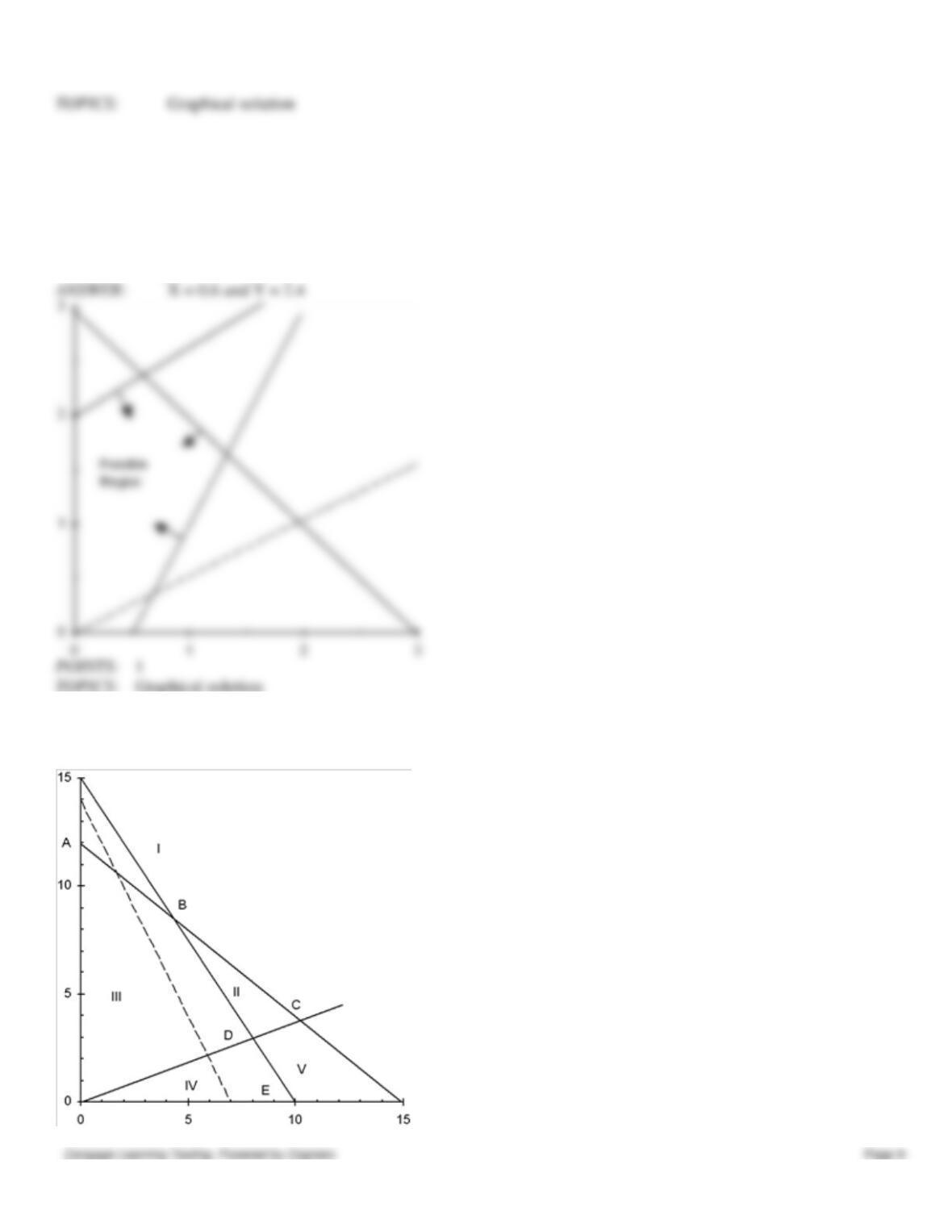
45. Consider the following linear programming problem
Max 8X + 7Y
s.t. 15X + 5Y ≤ 75
10X + 6Y ≤ 60
X + Y ≤ 8
X, Y ≥ 0
a. Use a graph to show each constraint and the feasible region.
b. Identify the optimal solution point on your graph. What are the values of X and Y at the optimal solution?
c. What is the optimal value of the objective function?
Chapter 7 – Intro to Linear Programming
46. For the following linear programming problem, determine the optimal solution by the graphical solution method
Max −X + 2Y
s.t. 6X − 2Y ≤ 3
−2X + 3Y ≤ 6
X + Y ≤ 3
X, Y ≥ 0
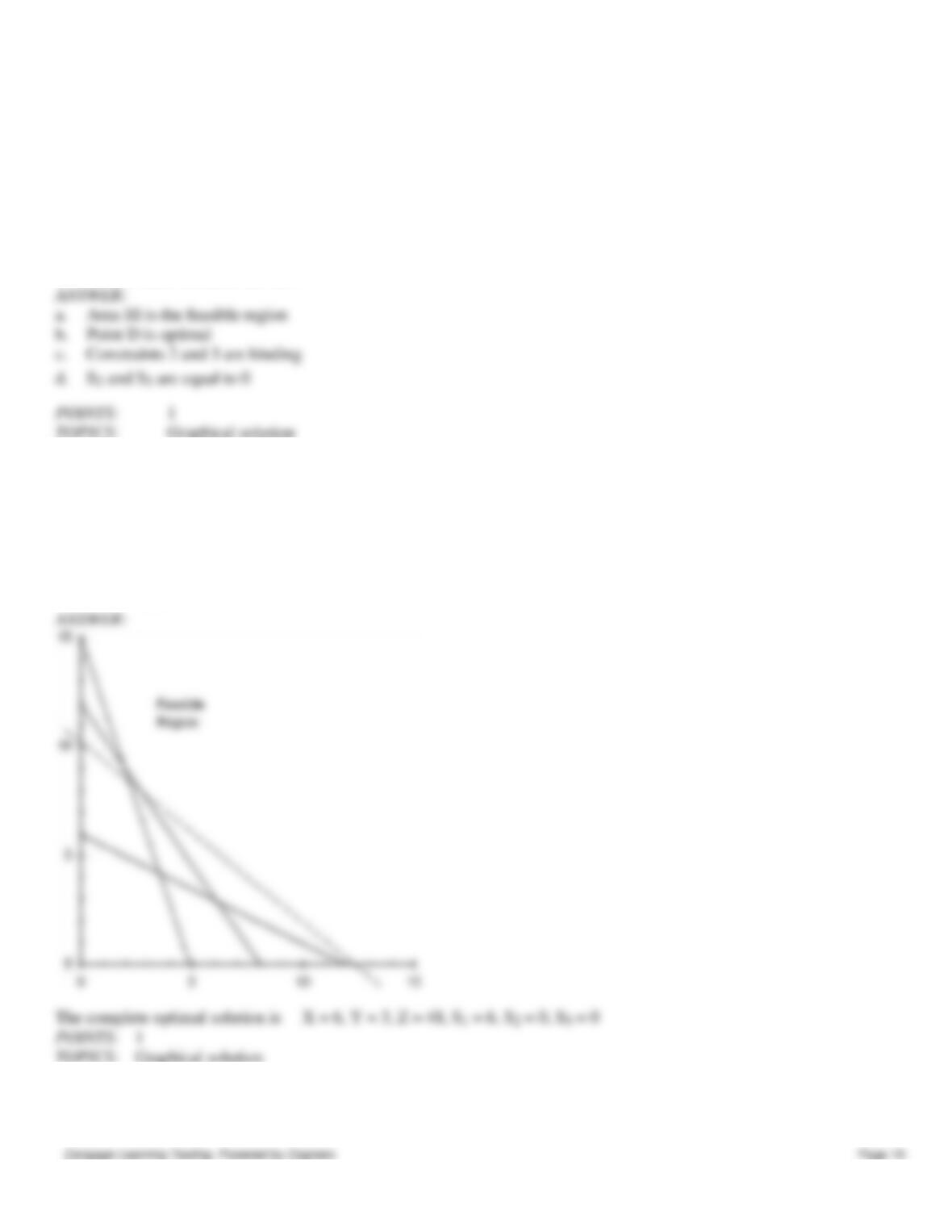
47. Use this graph to answer the questions.
Chapter 7 – Intro to Linear Programming
Max 20X + 10Y
s.t. 12X + 15Y ≤ 180
15X + 10Y ≤ 150
3X − 8Y ≤ 0
X , Y ≥ 0
a. Which area (I, II, III, IV, or V) forms the feasible region?
b. Which point (A, B, C, D, or E) is optimal?
c. Which constraints are binding?
d. Which slack variables are zero?
48. Find the complete optimal solution to this linear programming problem.
Min 5X + 6Y
s.t. 3X + Y ≥ 15
X + 2Y ≥ 12
3X + 2Y ≥ 24
X , Y ≥ 0
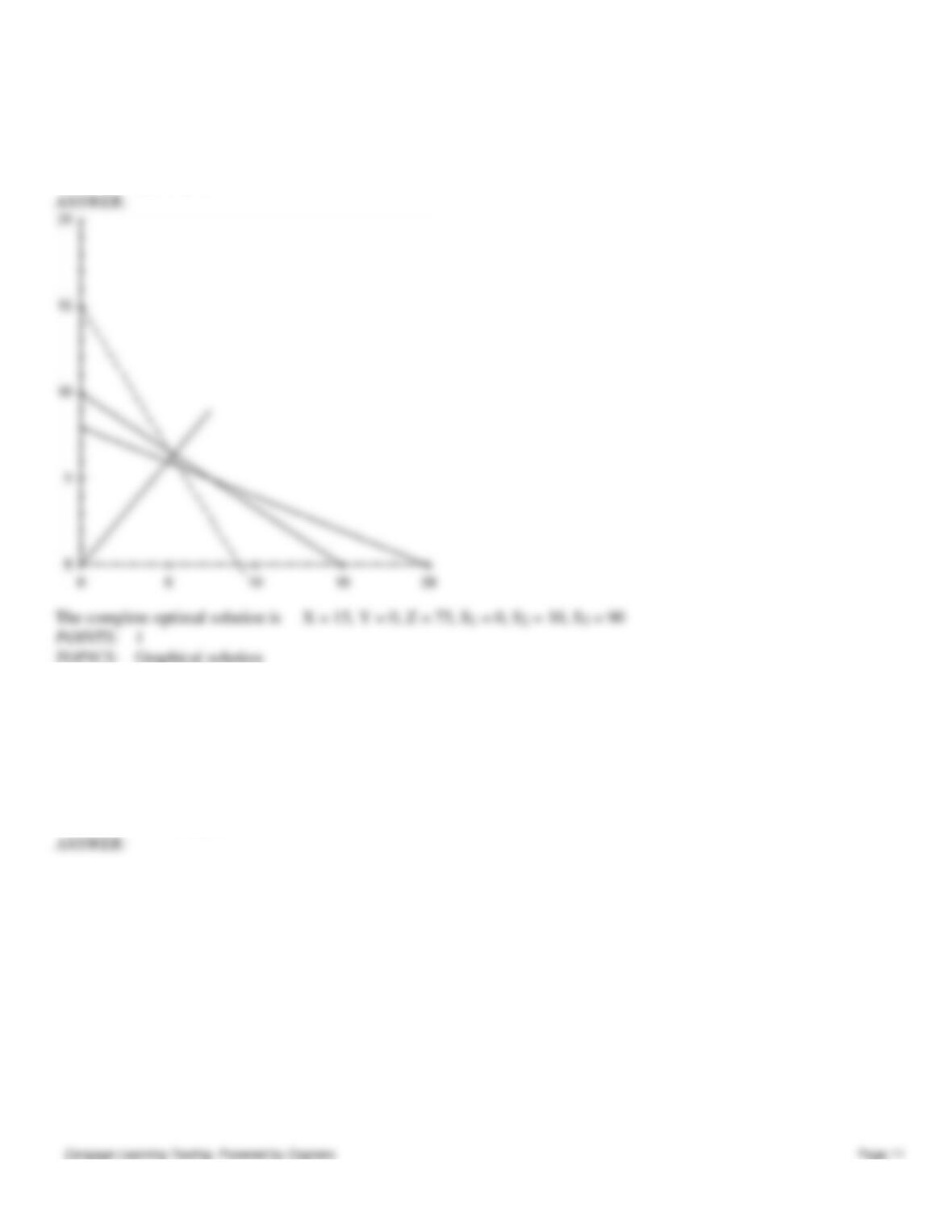
49. Find the complete optimal solution to this linear programming problem.
Chapter 7 – Intro to Linear Programming
Max 5X + 3Y
s.t. 2X + 3Y ≤ 30
2X + 5Y ≤ 40
6X − 5Y ≤ 0
X , Y ≥ 0
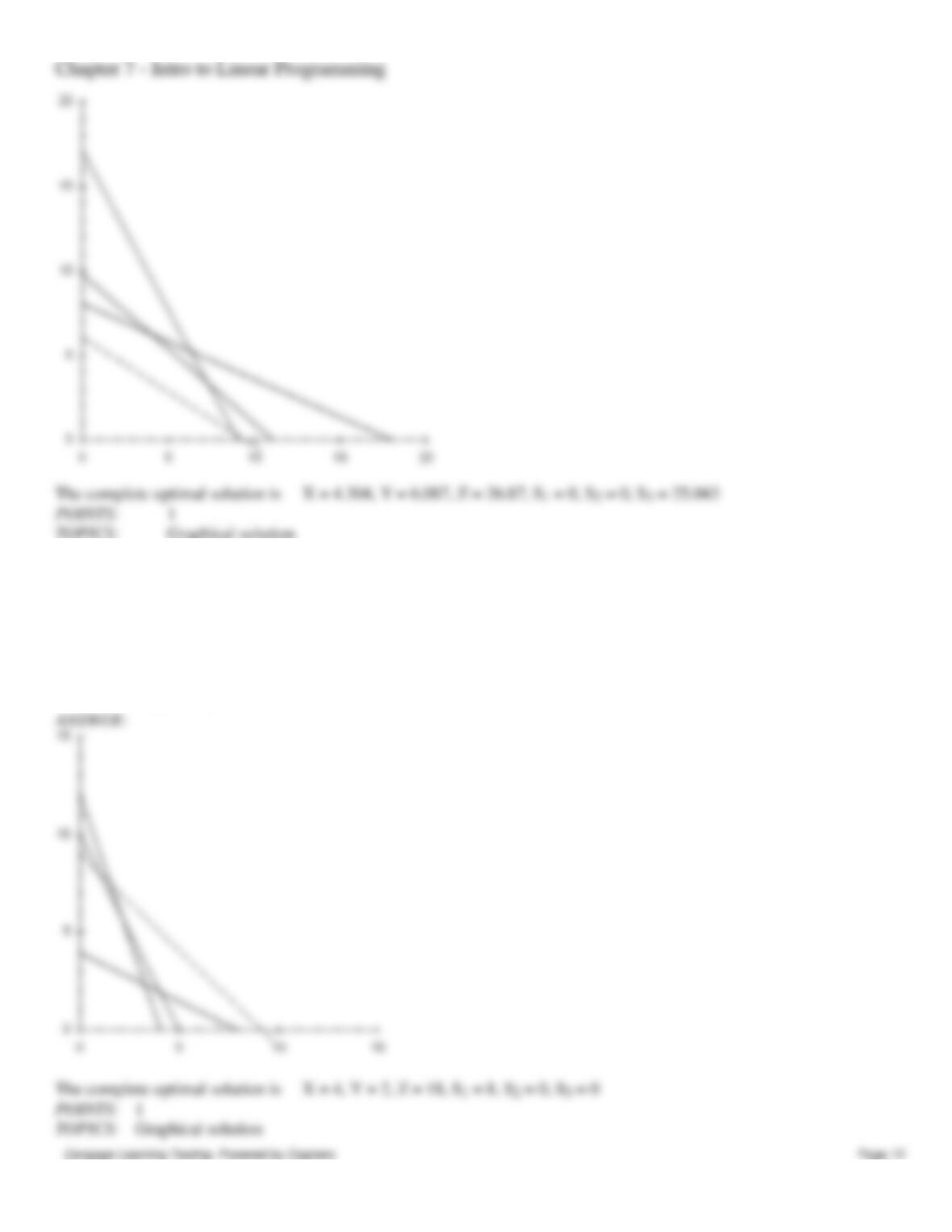
50. Find the complete optimal solution to this linear programming problem.
Max 2X + 3Y
s.t. 4X + 9Y ≤ 72
10X + 11Y ≤ 110
17X + 9Y ≤ 153
X , Y ≥ 0
51. Find the complete optimal solution to this linear programming problem.
Min 3X + 3Y
s.t. 12X + 4Y ≥ 48
10X + 5Y ≥ 50
4X + 8Y ≥ 32
X , Y ≥ 0
Chapter 7 – Intro to Linear Programming
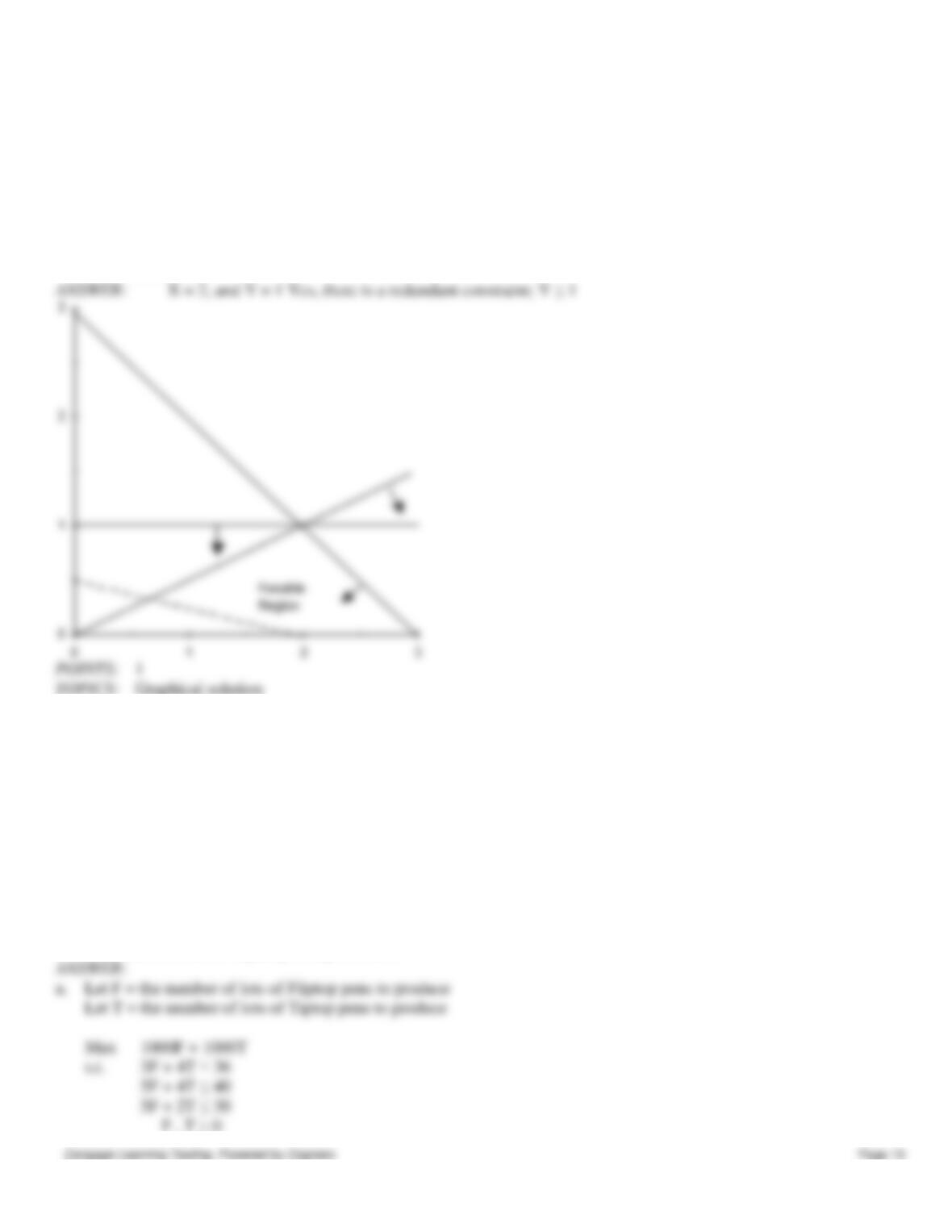
52. For the following linear programming problem, determine the optimal solution by the graphical solution method. Are
any of the constraints redundant? If yes, then identify the constraint that is redundant.
Max X + 2Y
s.t. X + Y ≤ 3
X − 2Y ≥ 0
Y ≤ 1
X, Y ≥ 0
53. Maxwell Manufacturing makes two models of felt tip marking pens. Requirements for each lot of pens are given
below.
Fliptop Model Tiptop Model Available
Plastic 3 4 36
Ink Assembly 5 4 40
Molding Time 5 2 30
The profit for either model is $1000 per lot.
a. What is the linear programming model for this problem?
b. Find the optimal solution.
c. Will there be excess capacity in any resource?