Introduction to Operations & Supply Chain Management, 5e (Bozarth)
Chapter 6S Advanced Waiting Line Theory and Simulation Modeling
6S.1 Alternative Waiting Lines
1) A customer enters a business and has the opportunity to select any one of three lines to receive service.
The service is performed by one customer service representative after which the customer leaves the
establishment. Which description of this waiting line system is appropriate?
A) single channel, single phase
B) single channel, multiple phase
C) multiple channel, single phase
D) multiple channel, multiple phase
2) A customer enters a business and joins the one line that snakes back and forth through the lobby in
order to receive service. The initial part of the service is performed by one customer service
representative, after which the customer enters a second, shorter line to complete the service before
leaving the establishment. Which description of this waiting line system is appropriate?
A) single channel, single phase
B) single channel, multiple phase
C) multiple channel, single phase
D) multiple channel, multiple phase
3) Customer arrivals at a dry cleaning service occur randomly throughout the day. The distribution that is
usually used to model the interval between arrivals is the:
A) Poisson distribution.
B) uniform distribution.
C) random distribution.
D) normal distribution.
4) The department chair is out of town at a conference and you, as the assistant department chair, find
yourself besieged by dozens of students needing permission to get into a very popular (but closed) class.
Student arrivals are governed by the Poisson distribution with a mean of 10 minutes. Telling the students
that they can’t get into the closed class takes about 3 minutes, and this average is exponentially
distributed. About how many students are waiting outside your office door?
A) 0.13 students
B) 0.43 students
C) 1.25 students
D) 2.25 students
5) The department chair is out of town at a conference and you, as the assistant department chair, find
yourself besieged by dozens of students needing permission to get into a very popular (but closed) class.
Student arrivals are governed by the Poisson distribution with a mean of 10 minutes. Telling the students
that they can’t get into the closed class takes about 5 minutes, and this average is exponentially
distributed. About how long do students wait outside your office door?
A) 0.083 minutes
B) 0.083 hours
C) 0.50 minutes
D) 0.50 hours
6) The department chair is out of town at a conference and you, as the assistant department chair, find
yourself besieged by dozens of students needing permission to get into a very popular (but closed) class.
Student arrivals are governed by the Poisson distribution with a mean of 5 minutes. Telling the students
that they can’t get into the closed class takes about 3 minutes, and this average is exponentially
distributed. About how many students are waiting outside your office door and in your office?
A) 0.5
B) 1.0
C) 1.5
D) 2.0
7) The department chair is out of town at a conference and you, as the assistant department chair, find
yourself besieged by dozens of students needing permission to get into a very popular (but closed) class.
Student arrivals are governed by the Poisson distribution with a mean of 5 minutes. Telling the students
that they can’t get into the closed class takes about 3 minutes, and this average is exponentially
distributed. About how long does it take a student to wait in line and receive your valuable service?
A) 0.125 minutes
B) 0.075 hours
C) 4.5 minutes
D) 7.5 minutes
8) Anxious cruise vacationers besiege Tatiana, their excursion coordinator, at the Port of Cozumel when
they realize that all water excursions have been cancelled for no reason in particular. It takes her 2.5
minutes to find the customers an alternative excursion activity and customers cluster around her at the
rate of 20 per hour. About how long does a customer wait in line to receive her valuable service if the
service times are exponentially distributed and the arrivals follow a Poisson distribution?
A) 12.5 minutes
B) 5 minutes
C) 21 minutes
D) 15 minutes
9) Nervous cruise vacationers besiege Tatiana, their excursion coordinator, at the Port of Cozumel when
they realize that all water excursions have been cancelled for no reason in particular. It takes her 2.5
minutes to find the customers an alternative excursion activity and customers cluster around her at the
rate of 20 per hour. About how many customers are waiting in line to receive her valuable service if the
service times are exponentially distributed and the arrivals follow a Poisson distribution?
A) 2.78
B) 4.17
C) 3.25
D) 5.00
10) Nervous cruise vacationers besiege Tatiana, their excursion coordinator, at the Port of Cozumel when
they realize that all water excursions have been cancelled for no reason in particular. It takes her 2.5
minutes to find the customers an alternative excursion activity and customers cluster around her at the
rate of 20 per hour. About how long does a customer spend waiting in line and receiving her valuable
service if the service times are exponentially distributed and the arrivals follow a Poisson distribution?
A) 12.5 minutes
B) 4.17 minutes
C) 5 minutes
D) 15 minutes
11) Anxious cruise vacationers besiege Tatiana, their excursion coordinator, at the Port of Cozumel when
they realize that all water excursions have been cancelled for no reason in particular. It takes her 2.5
minutes to find the customers an alternative excursion activity and customers cluster around her at the
rate of 20 per hour. About how many customers are clustered around her, either receiving service or
waiting in line to receive her valuable service if the service times are exponentially distributed and the
arrivals follow a Poisson distribution?
A) 2.78
B) 4.17
C) 3.25
D) 5.00
12) Anxious cruise vacationers besiege Tatiana, their excursion coordinator, and her fourteen assistants at
the Port of Cozumel when they realize that all water excursions have been cancelled for no reason in
particular. It takes them 4 minutes to find the customers an alternative excursion activity and customers
cluster around them at the rate of 200 per hour. About how long does a customer wait in line to receive
their valuable service if the service times are exponentially distributed and the arrivals follow a Poisson
distribution?
A) 6.50 minutes
B) 5.00 minutes
C) 2.13 minutes
D) 1.36 minutes
13) Hysterical cruise vacationers besiege Tatiana, their excursion coordinator, and her fourteen assistants
at the Port of Cozumel when they realize that all water excursions have been cancelled for no reason in
particular. It takes them 4 minutes to find the customers an alternative excursion activity and customers
cluster around them at the rate of 200 per hour. About how many customers are waiting in line to receive
their valuable service if the service times are exponentially distributed and the arrivals follow a Poisson
distribution?
A) 2.78
B) 3.17
C) 4.52
D) 5.00
14) Hysterical cruise vacationers besiege Tatiana, their excursion coordinator, and her fourteen assistants
at the Port of Cozumel when they realize that all water excursions have been cancelled for no reason in
particular. It takes them 4 minutes to find the customers an alternative excursion activity and customers
cluster around them at the rate of 200 per hour. About how long does a customer spend waiting in line
and receiving their valuable service if the service times are exponentially distributed and the arrivals
follow a Poisson distribution?
A) 7.50 minutes
B) 5.36 minutes
C) 4.17 minutes
D) 3.67 minutes
15) Frenzied cruise vacationers besiege Tatiana, their excursion coordinator, and her fourteen assistants at
the Port of Cozumel when they realize that all water excursions have been cancelled for no reason in
particular. It takes them 4 minutes to find the customers an alternative excursion activity and customers
cluster around them at the rate of 200 per hour. About how many customers are clustered around them,
either receiving service or waiting in line to receive their valuable service if the service times are
exponentially distributed and the arrivals follow a Poisson distribution?
A) 17.86
B) 14.17
C) 13.25
D) 19.66
16) Frenzied cruise vacationers besiege Tatiana, their excursion coordinator, and her fourteen assistants at
the Port of Cozumel when they realize that all water excursions have been cancelled for no reason in
particular. It takes them 4 minutes to find the customers an alternative excursion activity and customers
cluster around them at the rate of 200 per hour. What is the probability that there are no customers
awaiting service or being served if the service times are exponentially distributed and the arrivals follow
a Poisson distribution?
A) 0.000
B) 0.043
C) 0.025
D) 0.066
17) The bank manager of a busy downtown location found herself unable to find good teller help so she
invested in an ATM to handle the routine withdrawals that tended to occupy an inordinate amount of the
teller’s time. Before she installed the ATM she found that customers were arriving on average every 2
minutes (Poisson distributed) and it took a teller 30 seconds (exponentially distributed) to process their
request. The ATM is able to maintain a constant 30 second service time. What is the impact on system
utilization?
A) There is no change.
B) Utilization has dropped by 15%.
C) Utilization has dropped by 30%.
D) Utilization has dropped by 45%.
18) The bank manager of a busy downtown location found herself unable to find good teller help so she
invested in an ATM to handle the routine withdrawals that tended to occupy an inordinate amount of the
teller’s time. Before she installed the ATM she found that customers were arriving on average every 2
minutes (Poisson distributed) and it took a teller 30 seconds (exponentially distributed) to process their
request. The ATM is able to maintain a constant 30 second service time. What is the impact on the
number of customers waiting in line?
A) There is no change.
B) The ATM line is half as long as the teller line.
C) The ATM line is twice as long as the teller line.
D) The ATM line is 25% shorter than the teller line.
19) The bank manager of a busy downtown location found herself unable to find good teller help so she
invested in an ATM to handle the routine withdrawals that tended to occupy an inordinate amount of the
teller’s time. Before she installed the ATM she found that customers were arriving on average every 60
seconds (Poisson distributed) and it took a teller 20 seconds (exponentially distributed) to process their
request. The ATM is able to maintain a constant 30 second service time. What is the impact on the waiting
time for the customers?
A) There is no change.
B) The wait in the ATM line is 50% shorter than the wait in the teller line.
C) The wait in the ATM line is 50% higher than the wait in the teller line.
D) The wait in the ATM line is 25% shorter than the teller line.
20) Patrons line up to spin the giant slot machine at the entrance to Ace Rothstein’s Tangiers casino. They
pour in the door at the rate of 300 per hour and it takes exactly ten seconds every time for the wheels to
spin and inform the unlucky patron that they have lost a dollar rather than win a new Corvette. How
many customers are in line on average?
A) 2.08 customers
B) 1.93 customers
C) 1.67 customers
D) 1.50 customers
21) Regulars line up to spin the giant slot machine at the entrance to Ace Rothstein’s Tangiers casino.
They pour in the door at the rate of 300 per hour and it takes exactly ten seconds every time for the
wheels to spin and inform the unlucky patron that they have lost a dollar rather than win a new Corvette.
How long do customers wait in line on average?
A) 10 seconds
B) 15 seconds
C) 20 seconds
D) 25 seconds
22) Hopeful patrons line up to spin the giant slot machine at the entrance to Ace Rothstein’s Tangiers
casino. They pour in the door at the rate of 300 per hour and it takes exactly ten seconds every time for
the wheels to spin and inform the unlucky patron that they have lost a dollar rather than win a new
Corvette. How long do customers spend waiting in line and finding out the unhappy news on average?
A) 35 seconds
B) 30 seconds
C) 25 seconds
D) 20 seconds
23) Barber College is the best deal in town! For only $5, you can get a shampoo and cut by any one of four
untrained stylists completed in 7.5 minutes on average. Perhaps this is why customers show up on
average two minutes apart (both arrival times and service times are exponentially distributed).
What percentage of the time are the four stylists working with customers?
A) 94%
B) 90%
C) 84%
D) 80%
24) Barber College is the best deal in town! For only $5, you can get a shampoo and cut by any one of four
untrained stylists completed in 7.5 minutes on average. Perhaps this is why customers show up on
average two minutes apart (both arrival times and service times are exponentially distributed).
On average, how many customers are waiting in line?
A) 9
B) 11
C) 13
D) 15
25) Barber College is the best deal in town! For only $5, you can get a shampoo and cut by any one of four
untrained stylists completed in 7.5 minutes on average. Perhaps this is why customers show up on
average two minutes apart (both arrival times and service times are exponentially distributed).
How long does a customer spend waiting for a haircut?
A) 17 minutes
B) 20 minutes
C) 23 minutes
D) 26 minutes
26) Barber College is the best deal in town! For only $5, you can get a shampoo and cut by any one of four
untrained stylists completed in 7.5 minutes on average. Perhaps this is why customers show up on
average two minutes apart (both arrival times and service times are exponentially distributed).
Management is concerned about the waiting time for customers and decides to train one more student. If
the arrival and service rates remain the same as in the original scenario, what happens to the number of
customers in the system?
A) There are about half as many as in the original scenario.
B) There are about a third as many as in the original scenario.
C) There are about a fourth as many as in the original scenario.
D) There are about a fifth as many as in the original scenario.
27) In waiting line theory, the number of channels refers to the number of customer waiting lines in the
system.
28) In most waiting line models, customers are assumed to arrive at random intervals, based on a normal
distribution.
29) The Greek letter lambda (λ) is used to represent the service rate of a waiting line system.
30) A waiting line cannot be both multiple-channel and multiple-phase.
31) All waiting line formulas assume that customers are served on a first–come first-served (FCFS) basis.
32) With only a half hour for lunch I screamed into the parking lot of the nearest Golden Arches Supper
Club at 40 miles an hour. When I saw the drive-through line was 15 cars deep, I didn’t bother getting in
line; I was off to visit the Colonel. This behavior might be described as balking.
33) One of the differences between a waiting line system with a constant service time and one with
exponentially distributed service times. Customers using the system with the constant service time will
have half the waiting time of the customers using the system with Poisson distributed service times.
34) Customers pass by any one of forty ticket takers on their way in the arena for a WWE event. This is a
single ________ system.
35) The only way to enter Jellystone Park is past Ranger Smith, who checks your camping gear and warns
you about the bears in the park. The next step of the entrance process is to pay your site fee to Ranger
Dwayne. This is a single ________ system.
36) One assumption in most waiting line analyses is that the number of customers is ________.
37) Customers that leave the system after waiting in line for a while are ________ but customers that don’t
even join the line because it looks too long are ________.
38) If 5 minutes passes between customer arrivals then the ________ is 12/hour.
39) Many complex waiting line situations cannot be analyzed through neatly derived formulas. In these
cases, ________ is the best method of analysis.
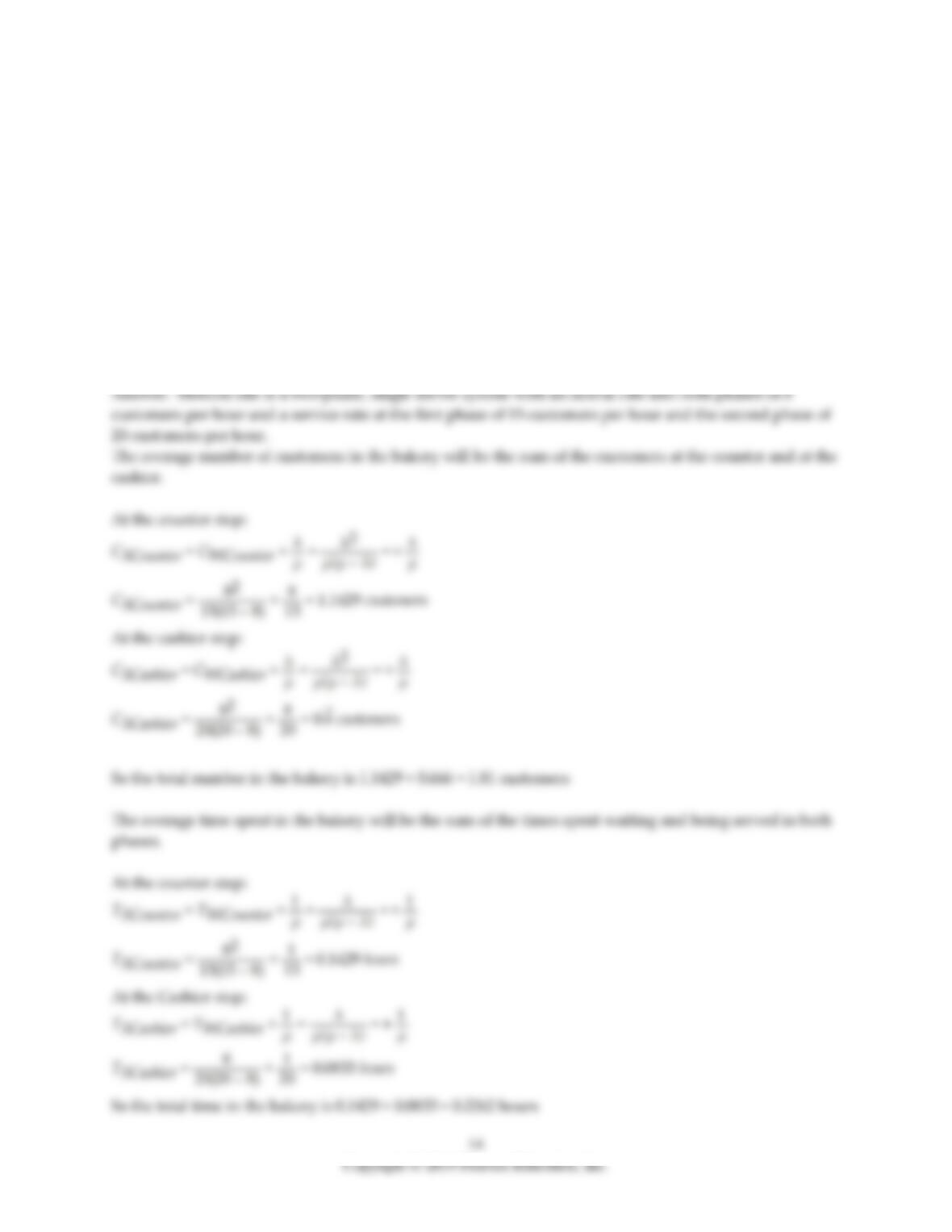
40) Gerard is choosing between two methods of organizing his bakery. Method one will require a counter
person to wait on each customer individually before they proceed to the cashier to pay for their
purchases. In this system, customers will arrive at the rate of 8 per hour and can be served by the counter
person at the rate of 15 per hour. The cashier will be capable of serving customers at the rate of 20 per
hour. For simplification purposes, assume that the arrival rate at the cashier phase is identical to the
arrival rate at the first phase and that these waiting lines can be analyzed independently and combined.
Method two will have the two employees wait on customers as they selected their pastries and also
collect their money once their selections have been made. Customers still arrive at the rate of 8 per hour
but now the total service time (pastry selection and payment collection) takes 5 minutes per customer.
Calculate the average number of customers in the bakery and the average time spent in the bakery for
both systems and make your recommendations to Gerard. Assume that service times are exponentially
distributed and arrivals follow a Poisson distribution.