Introduction to Operations & Supply Chain Management, 5e (Bozarth)
Chapter 6 Managing Capacity
6.1 Capacity
1) Which of the following is NOT an appropriate measure of capacity?
A) square yards of carpet installed per hour
B) number of cars assembled per month
C) thickness of laminate on a desktop
D) printed pages per minute
2) Which of the following statements about theoretical capacity is best?
A) Theoretical capacity allows adjustments for preventive maintenance.
B) Running a factory at its theoretical capacity for a short time is often better than permanently raising
resource levels.
C) Theoretical capacity levels are usually lower than rated capacity levels.
D) Theoretical capacity levels take into account that machines occasionally break and that workers
occasionally call in sick.
3) A bottling machine has a theoretical capacity of 100 bottles per minute. During every ten hour shift it
operates continuously but is shut down once for 30 minutes for cleaning, inspection, and lubrication.
What is its rated capacity?
A) 100 bottles/minute
B) 95 bottles/minute
C) 90 bottles/minute
D) 85 bottles/minute
4) Capacity is the capability of a worker, machine, work center, plant, or organization to produce output
per time period.
5) A traditional university classroom has room for 30 students and is scheduled for use during 12
consecutive one hour periods from 8:00 a.m. to 8:00 p.m. in the spring semester. Its theoretical capacity is
therefore half of its rated capacity.
6) In general, higher conformance quality reduces capacity since the extra care taken during production
slows the output rate.
7) A firm’s capacity can be limited by members of its supply chain.
8) The maximum output capability of a system, allowing for no adjustments for preventive maintenance
or unplanned downtime is the ________.
9) The long-term, expected output capability of a resource or system is the ________.
10) ________ capacity is always greater than or equal to ________ capacity.
11) Define theoretical and rated capacity and name four factors that affect a company’s capacity. Indicate
how each factor impacts rated capacity.
12) How could the following service organizations measure capacity — a university, a restaurant, and pet
groomer?
13) How does conformance quality impact capacity?
6.2 Three Common Capacity Strategies
1) Which of the following statements about capacity strategies is NOT correct?
A) Lead capacity strategy can be used to preempt competitors who might be planning to expand their
own capacity.
B) A lag capacity strategy tends to have greater productivity due to higher utilization levels.
C) A match capacity strategy tends to avoid periods of high under– or overutilization.
D) A lag capacity strategy would be well-suited for a period of high growth.
2) A lead capacity strategy has the advantage of:
A) a reduced risk of overbuilding.
B) greater productivity due to high utilization levels.
C) ensuring adequate capacity during all types of growth.
D) the ability to put off large investments as long as possible.
3) Which of these capacity strategies has the benefit of the greatest level of productivity?
A) lead capacity strategy
B) lag capacity strategy
C) match capacity strategy
D) flux capacity strategy
4) Which of these capacity strategies has the benefit of a good balance of productive resources?
A) lead capacity strategy
B) lag capacity strategy
C) match capacity strategy
D) flux capacity strategy
5) Which is a benefit of a virtual supply chain?
A) stronger long-term relationships
B) lower costs
C) increased efficiency
D) increased flexibility
6) A firm is able to meet current demand. If it adopts a lead capacity strategy, then it is probably making
the assumption that demand will increase in the future.
7) Virtual supply chains have the advantage of efficiency, but this advantage is gained in a trade-off with
decreased flexibility.
8) A fiscally conservative firm is more likely to adopt a match capacity strategy than any other capacity
strategy.
9) The ________ capacity strategy attempts to adjust the current capacity to a level equivalent to the
current demand.
10) A collection of companies decides to work together for a while to provide service for what they see as
a short term window of opportunity. These firms plan to coordinate their activities by deploying
sophisticated information systems to share critical data. Each of these companies is skilled at one or two
core activities – design, manufacturing, distribution, marketing, and so on. This association of companies
can be described as a(n) ________.
11) The ________ capacity strategy is better positioned to avoid adding extra costs as long as possible.
12) Describe the three capacity strategies and the advantages of each.
13) What is a virtual supply chain and how is it different from a traditional supply chain?
6.3 Methods of Evaluating Capacity Alternatives
1) An example of a variable cost is:
A) a payment to your raw materials supplier.
B) a lease payment on a piece of equipment.
C) a mortgage payment on buildings.
D) a monthly licensing fee for a software package.
2) If a firm cannot make a profit regardless of output volume, then:
A) FC > VC.
B) VC > FC.
C) VC > R.
D) BEP > VC.
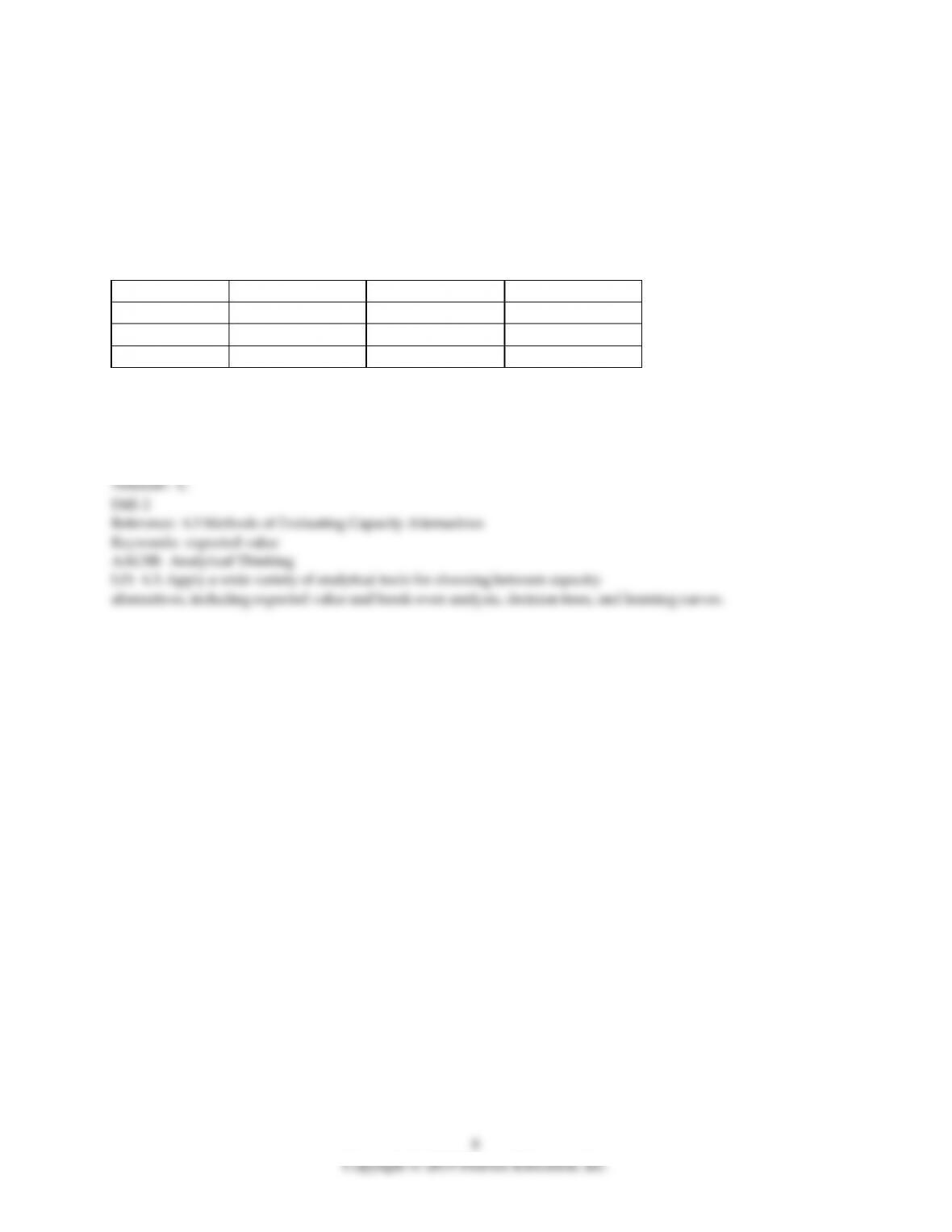
3) Four entrepreneurial students want to open a shaved ice business during the coming summer. Maxine
thinks that demand will be high and therefore they should purchase a large stand and acquire a premium
ice shaving machine. Minnie feels strongly that demand will be low and that they should purchase a tarp
and some basic hand tools to work the ice. Midelia is pretty sure that demand will fall in-between these
two extremes, so they can get by with a shack and a used ice shaving machine. Their financial wizard of
the bunch, Probableah, has estimated the costs, revenues, and likelihoods of each level of demand and
created the table shown below. What is the expected profit for this venture?
Demand
Total Revenue
Total Expenses
Probability
Low
$500
$15
.2
Medium
$2,000
$125
.3
High
$5,000
$519
.5
A) $1700
B) $2300
C) $2900
D) $3300
4) The MBA program at the University of Central Oregon features seven team-taught courses, five credit
hours apiece. Each team is composed of somewhat reluctant professors in two distinct disciplines, each of
which brings his own perspective to the topic du jour. The program is difficult to coordinate and makes
transferring course credit in and out of the program near impossible, so the MBA Redesign Committee
spends three years crafting a new program that features twenty-one courses, two credit hours each, that
will unfortunately take 18 months to complete compared to the current program’s 12 months. The current
MBA program brings in about 60 students each semester with the main selling point being the integration
between disciplines. It is thought that if the new program can be successfully marketed as an easy fit with
other MBA programs in the area, the ability to transfer credits in might attract as many as 70 new
students each semester. If the new program is unveiled but the market is still interested in integrated
courses, enrollment in the new program might drop to 40 students per semester. If this were the case, the
new courses could be scheduled at the same time in the same room and might attract 65 students each
semester (with a 0.6 probability) or might attract as few as 50 students with a 0.4 probability. If the
existing program is retained but the market is seeking courses that are more transferable, then enrollment
in the existing program might fall to 45 new students per semester. If this happens, then the existing
courses might be broken in half each night into two classes back to back. Doing so has a .7 probability of
increasing new student demand to 65 but has a .3 probability of increasing demand to 55. The MBA
Director believes that the market is ready for a less integrated program, and she pegs the probability of
that hunch at 0.6, with a 0.4 probability that the market prefers the current integrated program. What is
the difference in expected outcomes between the two alternatives?
A) 2.2 new students per semester
B) 3.2 new students per semester
C) 3.4 new students per semester
D) 4.4 new students per semester
5) A company with fixed costs of $200,000 per month believes that they have this holiday season’s hot
selling item, a towel that folds itself into a variety of shapes so you can turn your own home into a cruise
ship cabin. They believe they can sell 100,000 units and need to determine a minimum price that will
cover their fixed and variable costs, with the latter being $45 per unit.
A) $45.20
B) $46.50
C) $46.80
D) $47.00
6) A company with fixed costs of $10,000 per month has a target price of $165 for their sole product, a
heat shield for masonry fireplaces. What level of output represents their break-even point if their variable
cost for producing is $35 per unit?
A) between 60 and 70 units
B) between 70 and 80 units
C) between 80 and 90 units
D) between 90 and 100 units
7) An entrepreneur identifies a product that she knows will sell like crazy if she can only figure out a way
to bring it to her area. The idea is so fantastic that I can’t tell you what it is, so we will just refer to it as X.
The entrepreneur has identified four ways to bring X to the masses; she can import it, she can smuggle it,
she can try to produce it on her own, and she can have a local reputable producer make it for her. The
fixed and variable costs for each of these alternatives are shown below. What is her best course of action if
she believes the demand will be 55,000 units?
Import
Produce
Smuggle
Outsource
Fixed Cost
$0
$500,000
$200,000
$0
Variable Cost
$30
$10
$15
$37
A) Import
B) Produce
C) Smuggle
D) Outsource
11
8) An entrepreneur identifies a product that she knows will sell like crazy if she can only figure out a way
to bring it to her area. The idea is so fantastic that I can’t tell you what it is, so we will just refer to it as X.
The entrepreneur has identified four ways to bring X to the masses; she can import it, she can smuggle it,
she can try to produce it on her own, and she can have a local reputable producer make it for her. The
fixed and variable costs for each of these alternatives are shown below. Which of these methods is never
the preferred alternative?
Import
Produce
Smuggle
Outsource
Fixed Cost
$25,000
$500,000
$200,000
$0
Variable Cost
$30
$10
$15
$32
A) Import
B) Produce
C) Smuggle
D) Outsource
9) A haberdashery conducts an exhaustive analysis and calculates their profit function as 4x2 + 3x – 57.
What is their fixed cost?
A) 4
B) 4x2
C) 57
D) 3x
10) Saul Goodman represents several clients and bills by the hour at a reasonable $500 per hour. He
forgot to record the time it took to complete each activity, but he knows his eight-hour day was spent
representing 13 clients involved in one high profile case. He also remembers that Walt told him once that
his learning curve percentage was 80%. How many hours should Saul bill his first client?
A) one hour eight minutes and forty five seconds
B) one hour two minutes and thirty six seconds
C) fifty six minutes and twenty eight seconds
D) fifty minutes and five seconds
11) Saul Goodman represents several clients and bills at $400 per hour. He forgot to record the time it
took to complete each activity, but he knows his eight hour day was spent representing three clients
involved in one high profile case. He also remembers that Walt told him once that his learning curve
percentage was 85%. How much more should Saul bill his first client than his third client?
A) about $267
B) about $292
C) about $303
D) about $280
12) A subdivision is planned for forty houses, each with its own in-ground swimming pool. A contractor
estimates it will take him 30 hours to build the first pool and that there is a 90% learning curve associated
with this process. How long will it take to build the last pool?
A) 27.2 hours
B) 23.9 hours
C) 20.5 hours
D) 17.1 hours
13) The first three rooms took The Painter a total of 9 hours to paint. If the learning curve rate is 85%, how
long will it take The Painter to paint all 20 rooms in Stately Wayne Manor?
A) less than 20 hours
B) between 20 and 30 hours
C) between 31 and 40 hours
D) more than 40 hours
14) Which of the following statements about learning curves is best?
A) Learning improvements always follow a constant pattern.
B) Frequent design changes have no effect on learning rates.
C) Underestimated learning effects may cause overestimation of capacity needs.
D) An eighty percent learning curve means that each unit takes twenty percent less time to produce than
its immediate predecessor.
15) Building rental and depreciation on capital equipment are examples of fixed costs.
16) For a given fixed cost and revenue, as the variable cost rises, the break-even point also rises.