
132. Suppose P(A) = 0.50, P(B) = 0.40, and P(B|A) = 0.30.
a.
Find P(A and B).
b.
Find P(A or B).
c.
Find P(A|B).
a.
0.15
b.
0.75
c.
0.375
133. A survey of a magazine’s subscribers indicates that 50% own a house, 80% own a car, and 90% of the
homeowners also own a car. What proportion of subscribers:
a.
own both a car and a house?
b.
own a car or a house, or both?
c.
own neither a car nor a house?
a.
0.45
b.
0.85
c.
0.15
134. Suppose A and B are two mutually exclusive events for which P(A) = 0.30 and P(B) = 0.40.
a.
Find P(A and B).
b.
Find P(A or B).
c.
Are A and B independent events? Explain using probabilities.
a.
0
events, you would have P(A and B) = P(A) * P(B) = 0.12.
135. Suppose P(A) = 0.30, P(B) = 0.50, and P(B|A) = 0.60.
a.
Find P(A and B).

b.
Find P(A or B).
c.
Find P(A|B).
a.
0.18
b.
0.62
c.
0.36
136. Is it possible to have two events for which P(A) = 0.40, P(B) = 0.50, and P(A or B) = 0.30? Explain.
137. A pharmaceutical firm has discovered a new diagnostic test for a certain disease that has infected 1%
of the population. The firm has announced that 95% of those infected will show a positive test result,
while 98% of those not infected will show a negative test result.
a.
What proportion of people don’t have the disease?
b.
What proportion who have the disease test negative?
c.
What proportion of those who don’t have the disease test positive?
d.
What proportion of test results are incorrect?
e.
What proportion of test results are correct?
a.
0.99
b.
0.05
c.
0.02
d.
0.0203
e.
0.9797
138. {Marital Status Narrative} Find the probability that the customer selected is female or divorced.

139. {Marital Status Narrative} Are gender and marital status mutually exclusive? Explain using
probabilities.
140. {Marital Status Narrative} Is marital status independent of gender? Explain using probabilities.
Construction Bids
A construction company has submitted bids on two separate state contracts, A and B. The company
feels that it has a 60% chance of winning contract A, and a 50% chance of winning contract B.
Furthermore, the company believes that it has an 80% chance of winning contract A if it wins contract
B.
141. {Construction Bids Narrative} What is the probability that the company will win both contracts?
142. {Construction Bids Narrative} What is the probability that the company will win at least one of the
two contracts?
143. {Construction Bids Narrative} If the company wins contract B, what is the probability that it will not
win contract A?

144. {Construction Bids Narrative} What is the probability that the company will win at most one of the
two contracts?
145. {Construction Bids Narrative} What is the probability that the company will win neither contract?
Condo Sales and Interest Rates
The probability that condo sales will increase in the next 6 months is estimated to be 0.30. The
probability that the interest rates on condo loans will go up in the same period is estimated to be 0.75.
The probability that condo sales or interest rates will go up during the next 6 months is estimated to be
0.90.
146. {Condo Sales and Interest Rates Narrative} What is the probability that both condo sales and interest
rates will increase during the next six months?
ANS:
147. {Condo Sales and Interest Rates Narrative} What is the probability that neither condo sales nor interest
rates will increase during the next six months?
ANS:
148. {Condo Sales and Interest Rates Narrative} What is the probability that condo sales will increase but
interest rates will not during the next six months?
149. Bayes’ Law is a formula for revising an initial subjective (prior) probability value on the basis of new
results, thus obtaining a new (posterior) probability value.
150. Although there is a formula defining Bayes’ law, you can also use a probability tree to conduct
calculations.
151. Bayes’ Law allows us to compute conditional probabilities from other forms of probability.
152. Bayes’ Law says that P(A|B) = P(B|A)P(A).
153. Conditional probabilities are also called likelihood probabilities.
154. In applying Bayes’ Law, as the prior probabilities increase, the posterior probabilities decrease.
155. Prior probability of an event is the probability of the event before any information affecting it is given.
156. Bayes’ Law can be used to calculate posterior probabilities, prior probabilities, as well as new
conditional probabilities.
157. Posterior probability of an event is the revised probability of the event after new information is
available.
158. Prior probability is also called likelihood probability.
159. In general, a posterior probability is calculated by adding the prior and likelihood probabilities.
160. We can use the joint and marginal probabilities to compute conditional probabilities, for which a
formula is available.
161. In problems where the joint probabilities are given, we can compute marginal probabilities by adding
across rows and down columns.
162. If joint, marginal, and conditional probabilities are available, only joint probabilities can be used to
determine whether two events are dependent or independent.
163. Suppose we have two events A and B. We can apply the addition rule to compute the probability that at
least one of these events occurs.
164. Posterior probabilities can be calculated using the addition rule for mutually exclusive events.
165. Prior probabilities can be calculated using the multiplication rule for mutually exclusive events.
166. We can apply the multiplication rule to compute the probability that two events occur at the same time.
167. Which of the following statements is false?
a.
Thomas Bayes first employed the calculation of conditional probability in the eighteenth
century.
b.
There is no formula defining Bayes’ Law.
c.
We use a probability tree to conduct all necessary calculations for Bayes’ Law.
d.
None of these choices.
168. A posterior probability value is a prior probability value that has been:
a.
modified on the basis of new information.
b.
multiplied by a conditional probability value.
c.
divided by a conditional probability value.
d.
added to a conditional probability value.
169. Initial estimates of the probabilities of events are known as:
a.
joint probabilities
b.
posterior probabilities
c.
prior probabilities
d.
conditional probabilities

170. Which of the following statements is false regarding a scenario using Bayes’ Law?
a.
Prior probabilities are called likelihood probabilities.
b.
Conditional probabilities are called posterior probabilities.
c.
Posterior probabilities are calculated by using prior probabilities that have been modified
based on new information.
d.
None of these choices.
171. Bayes’ Law is used to compute:
a.
prior probabilities.
b.
joint probabilities.
c.
union probabilities.
d.
posterior probabilities.
172. Thomas ____________________ first employed the calculation of conditional probability.
173. Bayes’ Law involves three different types of probabilities: 1) prior probabilities; 2) likelihood
probabilities; and 3) ____________________ probabilities.
174. Bayes’ Law involves three different types of probabilities: 1) ____________________ probabilities; 2)
likelihood probabilities; and 3) posterior probabilities.

175. Bayes’ Law involves three different types of probabilities: 1) prior probabilities;
2) ____________________ probabilities; and 3) posterior probabilities.
176. There are situations where we witness a particular event and we need to compute the probability of one
of its possible causes. ____________________ is the technique we use to do this.
177. In the scenario of Bayes’ Law, P(A|B) is a(n) ____________________ probability, while P(B|A) is a
posterior probability.
178. In the scenario of Bayes’ Law, P(A|B) is a posterior probability, while P(B|A) is a(n)
____________________ probability.
179. ____________________ can find the probability that someone with a disease tests positive by using
(among other things) the probability that someone who actually has the disease tests positive for it.

Certification Test
A standard certification test was given at three locations. 1,000 candidates took the test at location A,
600 candidates at location B, and 400 candidates at location C. The percentages of candidates from
locations A, B, and C who passed the test were 70%, 68%, and 77%, respectively. One candidate is
selected at random from among those who took the test.
180. {Certification Test Narrative} What is the probability that the selected candidate passed the test?
181. {Certification Test Narrative} If the selected candidate passed the test, what is the probability that the
candidate took the test at location B?
182. {Certification Test Narrative} What is the probability that the selected candidate took the test at
location C and failed?
Cysts
After researching cysts of a particular type, a doctor learns that out of 10,000 such cysts examined,
1,500 are malignant and 8,500 are benign. A diagnostic test is available which is accurate 80% of the
time (whether the cyst is malignant or not). The doctor has discovered the same type of cyst in a
patient.
183. {Cysts Narrative} In the absence of any test, what is the probability that the cyst is malignant?

184. {Cysts Narrative} In the absence of any test, what is the probability that the cyst is benign?
185. {Cysts Narrative} What is the probability that the patient will test positive?
186. {Cysts Narrative} What is the probability that the patient will test negative?
187. {Cysts Narrative} What is the probability that the patient has a benign tumor if he or she tests
positive?
188. {Cysts Narrative} What is the probability that the patient has a malignant cyst if he or she tests
negative?
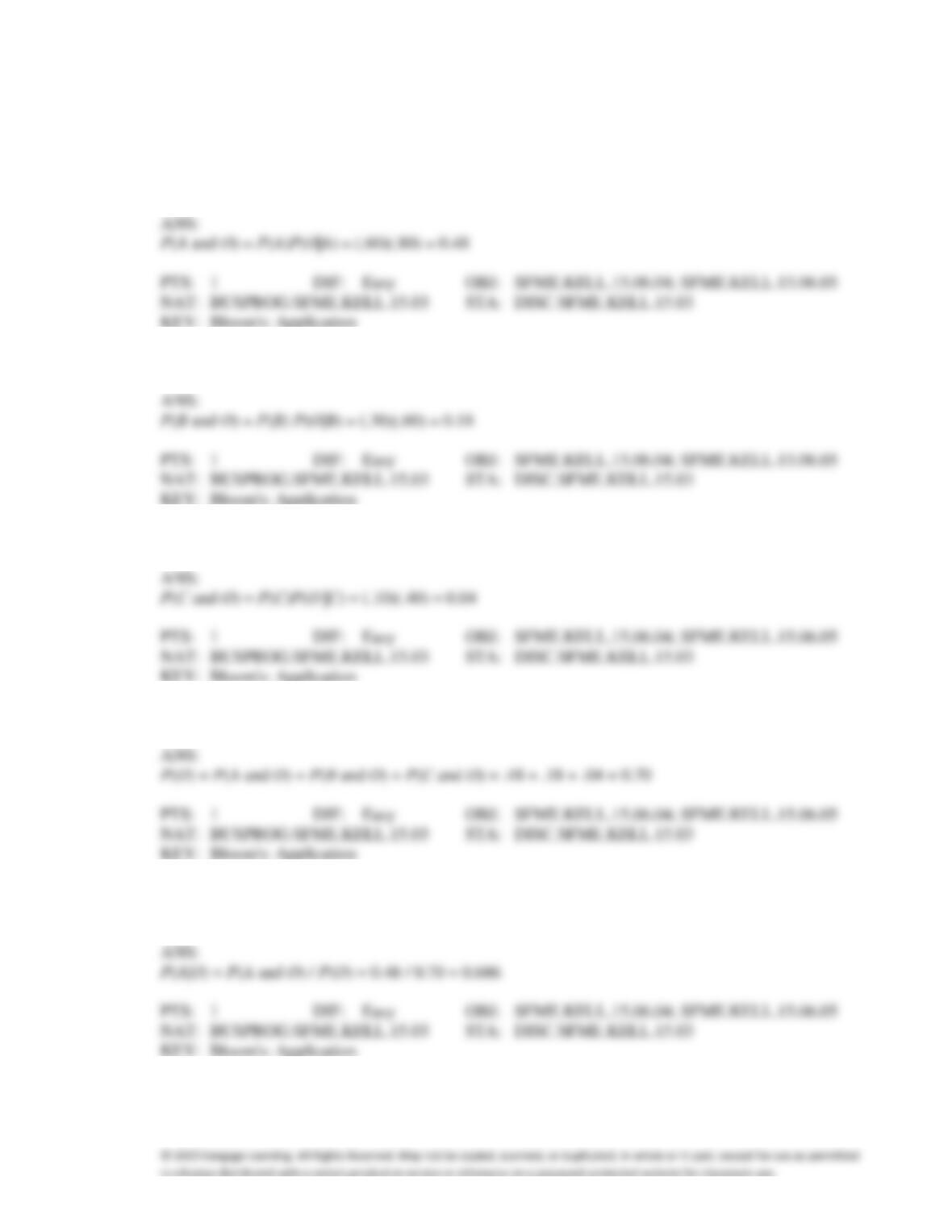
Messenger Service
Three messenger services deliver to a small town in Oregon. Service A has 60% of all the scheduled
deliveries, service B has 30%, and service C has the remaining 10%. Their on-time rates are 80%,
60%, and 40% respectively. Define event O as a service delivers a package on time.
189. {Messenger Service Narrative} Calculate P(A and O).
190. {Messenger Service Narrative} Calculate P(B and O).
191. {Messenger Service Narrative} Calculate P(C and O).
192. {Messenger Service Narrative} Calculate the probability that a package was delivered on time.
193. {Messenger Service Narrative} If a package was delivered on time, what is the probability that it was
service A?
194. {Messenger Service Narrative} If a package was delivered on time, what is the probability that it was
service B?

195. {Messenger Service Narrative} If a package was delivered on time, what is the probability that it was
service C?
196. {Messenger Service Narrative} If a package was delivered 40 minutes late, what is the probability that
it was service A?
197. {Messenger Service Narrative} If a package was delivered 40 minutes late, what is the probability that
it was service B?
198. {Messenger Service Narrative} If a package was delivered 40 minutes late, what is the probability that
it was service C?