17) In a decision tree, outcome points are under direct control of the decision maker and show the results
of choices.
18) A firm is more likely to develop the internal capacity to perform activities that are strategically
important to its success than it is to outsource those activities.
19) A ninety percent learning curve is steeper than an eighty percent learning curve.
20) Learning curve theory suggests that productivity will increase as people and systems learn to perform
tasks more efficiently.
21) Total cost to produce is the sum of expenses incurred regardless of output plus the variable cost per
unit of business activity multiplied by ________.
22) When demand is uncertain, the expected value criterion may be used. To do so, demand-level
scenarios and their ________ must be identified.
23) The ________ is the output volume level where the firm realizes a $0 net profit.
24) A learning percentage of 80 means that each time output is doubled, it takes ________ percent less
time to produce than before.
25) Saul Goodman represents several clients and bills at $400 per hour. He forgot to record the time it
took to complete each activity, but he knows his eight-hour day was spent representing three consecutive
clients involved in one high profile case. He also remembers that Walt told him once that his learning
curve percentage was 85%. How much should Saul bill each of his three clients?
26) A major computer manufacturer is interested in establishing a customer service center to handle
business for the next decade. They conduct exhaustive research on land and construction costs, utilities,
tax breaks, and wages at three sites, Oklahoma City, Austin, and Nashville. Answer these questions using
these costs as displayed in the table below.
Costs
Austin
Nashville
Oklahoma City
Fixed ($)
200,000
150,000
300,000
Variable ($/unit)
7
10
4
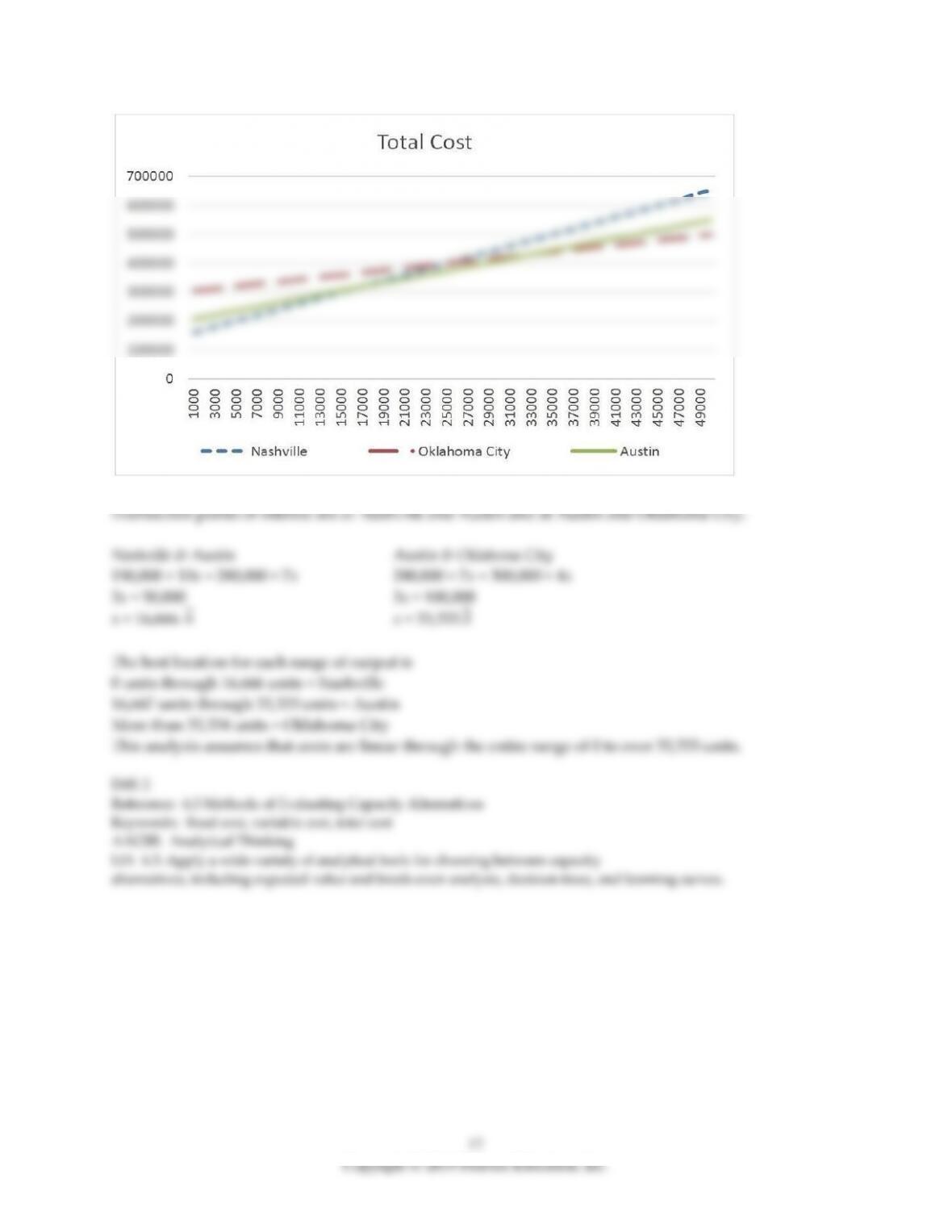
Graph the total cost curves and indicate the range of output that is best for each prospective site. What
are the assumptions you have made in this analysis?
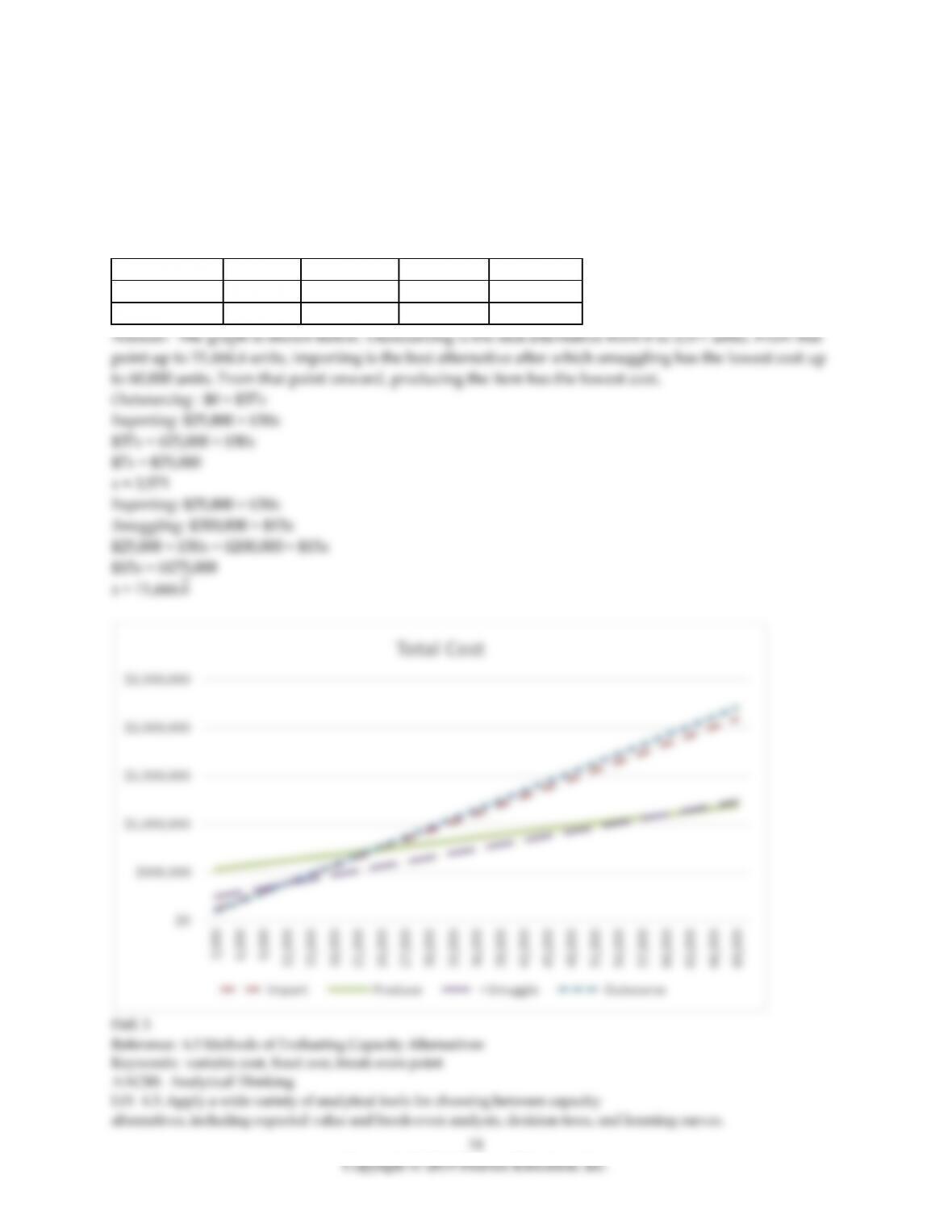
27) An entrepreneur identifies a product that she knows will sell like crazy if she can only figure out a
way to bring it to her area. The idea is so fantastic that I can’t tell you what it is, so we will just refer to it
as X. The entrepreneur has identified four ways to bring X to the masses; she can import it, she can
smuggle it, she can try to produce it on her own, and she can have a local reputable producer make it for
her. The fixed and variable costs for each of these alternatives are shown below. Develop a graph
showing the ideal alternative across a range of demand that reflects all decision points.
Import
Produce
Smuggle
Outsource
Fixed Cost
$25,000
$500,000
$200,000
$0
Variable Cost
$30
$10
$15
$37
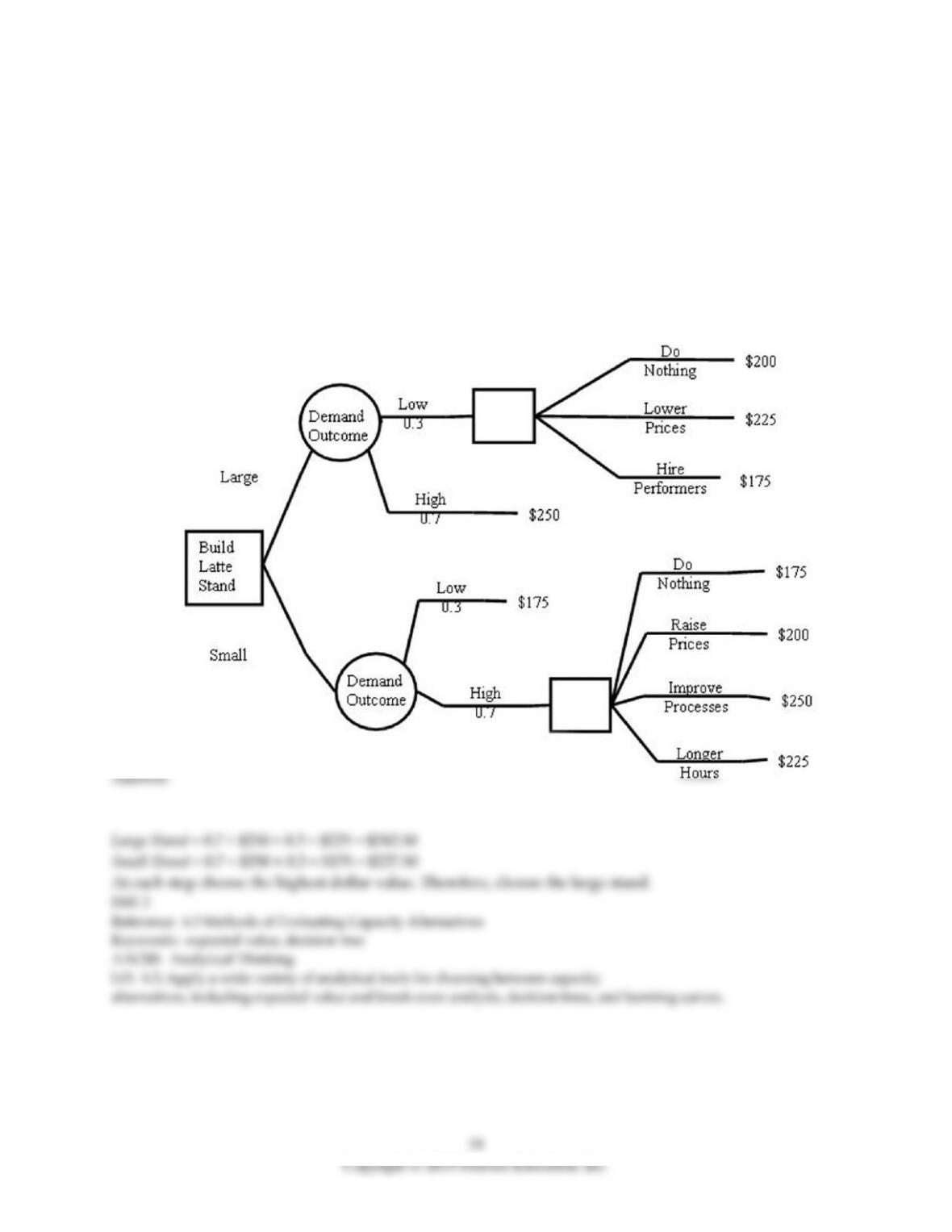
28) A Seattle entrepreneur must decide on the size of a latte stand to construct. The manager has
narrowed the choice down to large or small. If he builds large and experiences low demand he could grin
and bear it for a $200 daily profit, lower prices ($225 daily profit), or hire street performers to attract
attention ($175 daily profit). If he builds small and experiences high demand he could do nothing ($175
profit per day), stay open longer hours (profit of $225/day), improve processes ($250/day profit), or raise
prices ($200/day profit). Building large for high demand has an expected payoff of $250/day and building
small for low demand has an expected payoff of $175/day. There is a 0.7 probability of high demand and
0.3 probability of low demand. Sketch a decision tree for this scenario and determine what size stand
should be constructed to slake the unquenchable thirst of caffeine addicts.
29) A wise professor crafts a midterm that is beautiful to behold, painful to take, and a chore to grade.
The first exam takes almost an hour and a half to grade (89 minutes and 24.7 seconds to be precise) but
the second one takes only seventy-six minutes to complete. Realizing that learning effects are at work, the
professor looks at his social calendar and spots an important social engagement at this time on the
following day, exactly 24 hours from now. How long will it take to grade the third exam? How long will
it take to finish grading exams for the entire class of 30 students?
6.4 Understanding and Analyzing Process Capacity
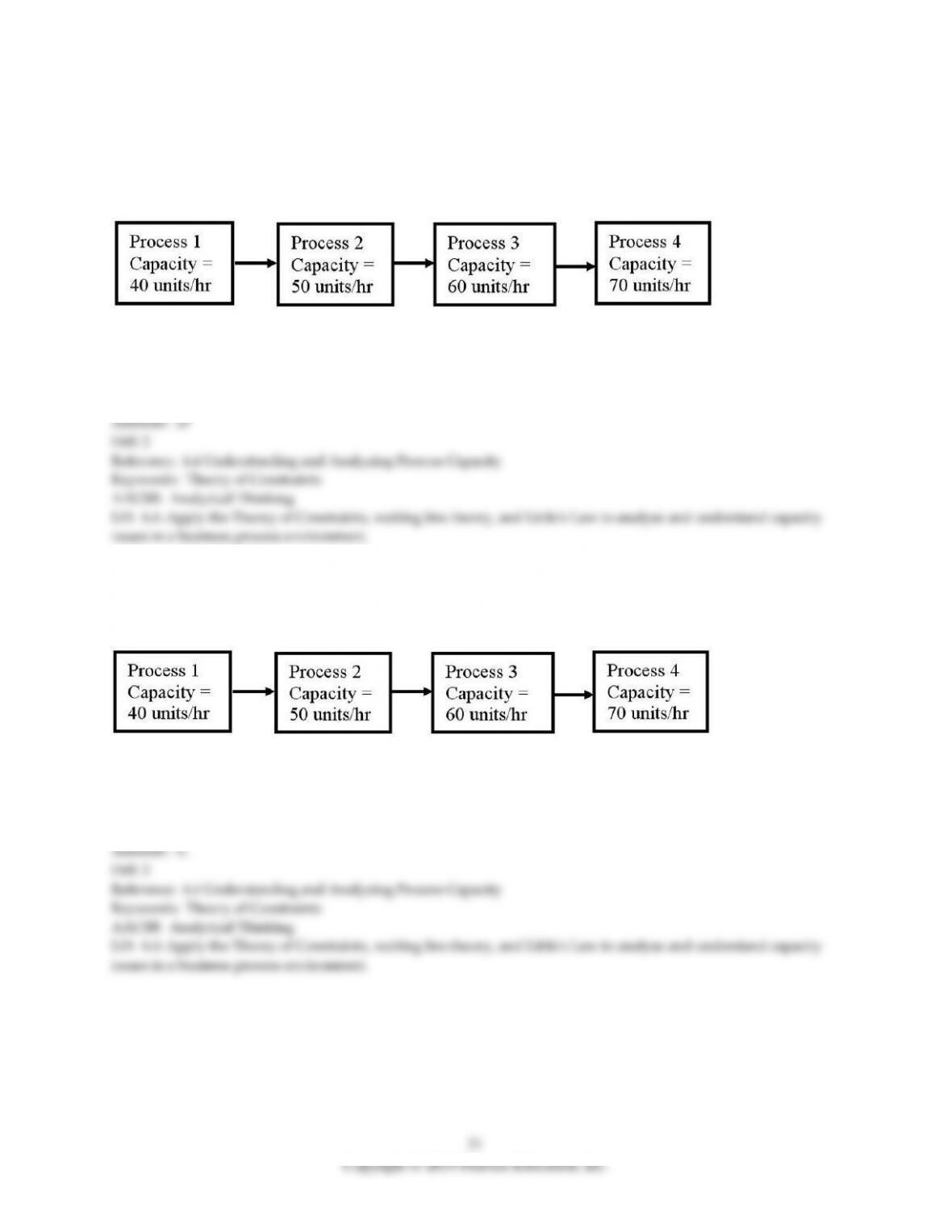
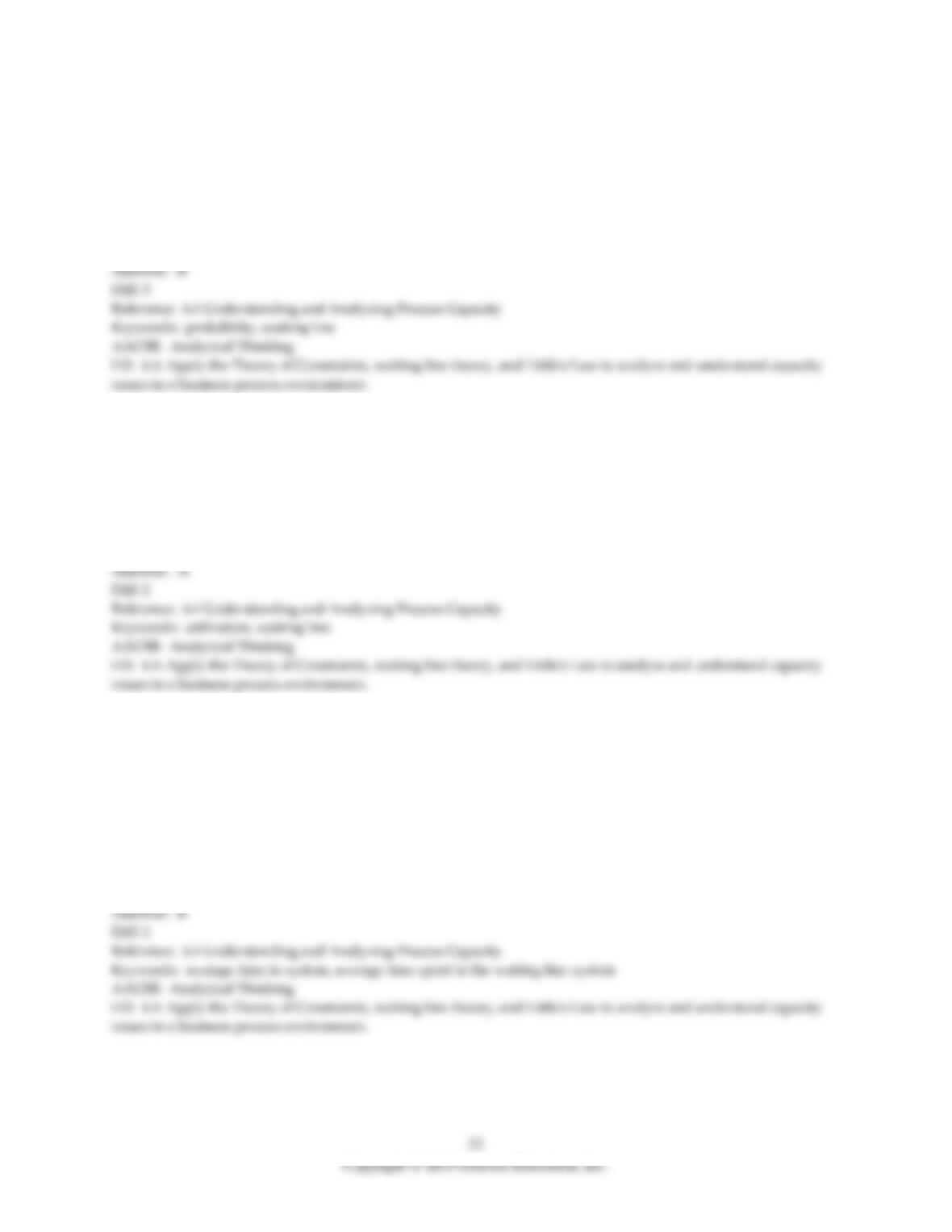
1) Consider the system composed of four processes linked by a conveyor belt. There is no storage
between these processes pictured below. Which statement is best?
A) The overall system output is 220 units/hr.
B) The process that determines the system’s capacity is process 4.
C) If process 3 experiences 5 minutes of unplanned downtime, the system’s overall output is diminished.
D) Overall system improvement efforts should focus on process 1.
2) Consider the system composed of four processes linked by a conveyor belt. There is no storage
between these processes pictured below and market demand exceeds the company’s ability to produce.
Which statement is best?
A) The overall system output is 220 units/hr.
B) The overall system output is 70 units/hr.
C) The overall system output is 40 units/hr.
D) The overall system output is 55 units/hr.
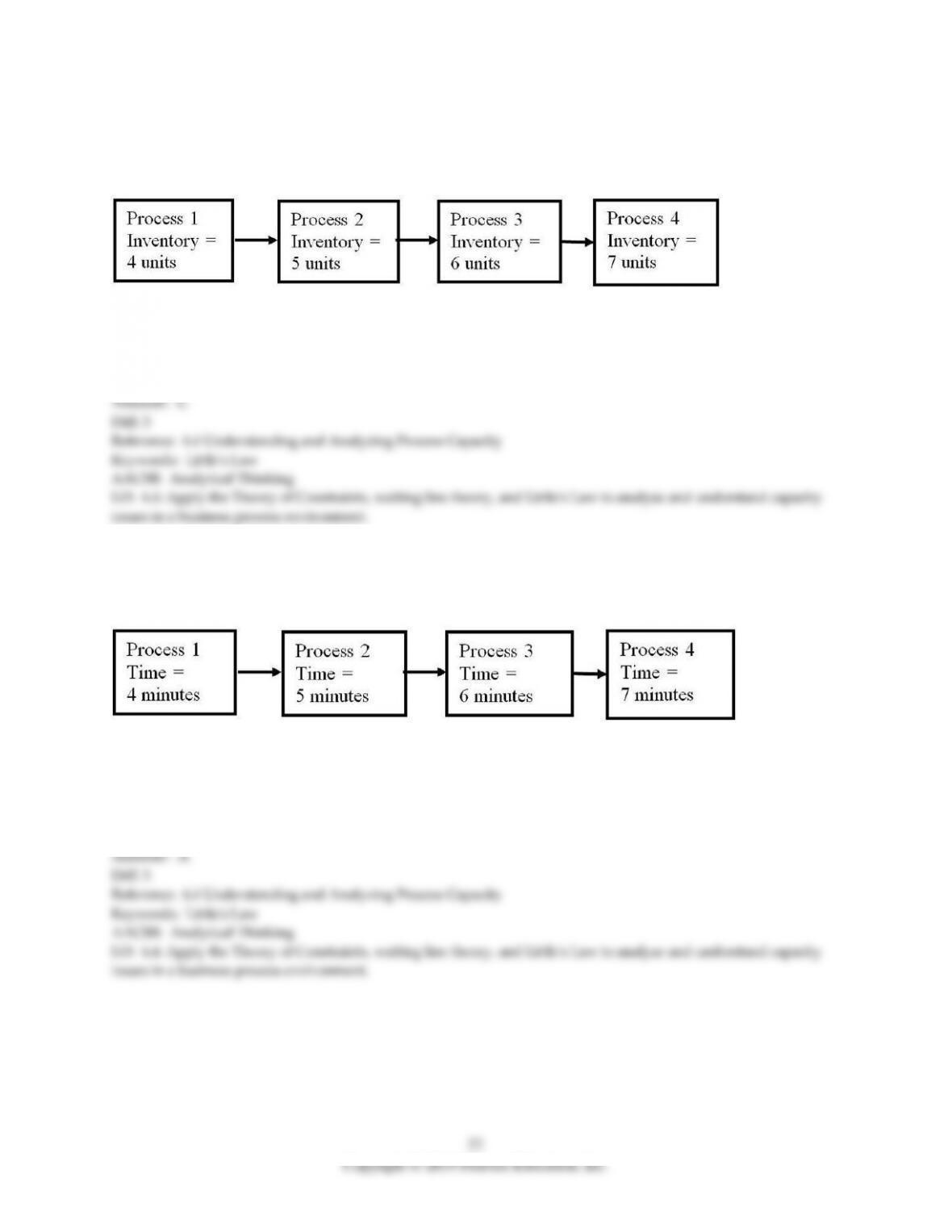
3) Consider the system composed of four processes linked by a conveyor belt. There is no storage
between these processes pictured below and market demand of 40 units per hour drives the conveyor
belt. Assume that no defective units are made. Which statement is best?
A) The average time a unit spends in Process 1 is 2 and a half minutes.
B) The average time a unit spends in Process 2 is 5 minutes.
C) The flow time for a unit through the entire process is 33 minutes.
D) The flow rate through the entire process is 160 units per hour.
4) Consider the system composed of four processes linked by a conveyor belt. There is no storage
between these processes pictured below and market demand of 50 units per hour drives the conveyor
belt. Assume that no defective units are made. Which statement is best?
A) There are about 18 units in the process at any given time.
B) There is more actual time spent in Process 2 and Process 3 combined than in Process 1 and Process 4
combined.
C) The flow rate through Process 1 is the highest.
D) The flow rate through Process 4 is the highest.
5) Students arrive at a professor’s office every 20 minutes during final exam week according to a Poisson
distribution. What is the probability that the professor’s one hour afternoon nap will not be disrupted by
any student arrivals?
A) 0.00
B) 0.05
C) 0.15
D) 0.45
6) Wally’s Filling Station is manned by one capable attendant that can fill your tank and check your tires,
oil, and water in 5 minutes. If four customers arrive each hour, and the service and arrival rates are
governed by the Poisson distribution, what is the utilization of the attendant?
A) 0.33
B) 0.50
C) 0.66
D) 0.80
7) Customers arrive at Rent a Wreck and hope to score an inexpensive and unsightly vehicle to use for
what typically is a short period of time. About twenty customers show up in any hour of the day and it
takes the customer service representative about two minutes to photocopy their driver’s license and
insurance card and take an impression of a credit card. Assume that the service and arrival rates are
governed by the Poisson distribution; how long does it take for the average customer to clear the system?
A) 10 minutes
B) 6 minutes
C) 3.33 minutes
D) 3 minutes
8) Business at the Kwik-E-Mart is brisk, with one customer arriving at a rate of six per hour on average.
Ringing up purchases is an easy matter for owner/operator Apu; he can usually do so in 2 minutes. If
both arrival and service rates are Poisson distributed, how many customers are in the store on average?
A) 0.05
B) 0.16
C) 0.25
D) 0.50
9) The average waiting time on a Thursday night for a table at a popular Chinese restaurant is 30 minutes.
If customers arrive at the rate of four per hour and both the service and arrival rates are Poisson
distributed, what is the average service time?
A) greater than 3 but less than 4 per hour
B) greater than 4 but less than 5 per hour
C) greater than 5 but less than 6 per hour
D) cannot be determined from the information provided.
10) The Theory of Constraints would support the statement that a chain is only as strong as its weakest
link.
11) A busy toll highway that has four toll collectors for northbound traffic is an example of a single-
channel, single-phase system.
12) In operations and supply chain environments that must deal with random demand and variable
processing times, it is virtually impossible to achieve very high capacity utilization levels and still
provide acceptable customer service.
13) The process step that limits throughput for the entire process chain is the ________.
14) In waiting line theory, a customer service attendant is a(n) ________.
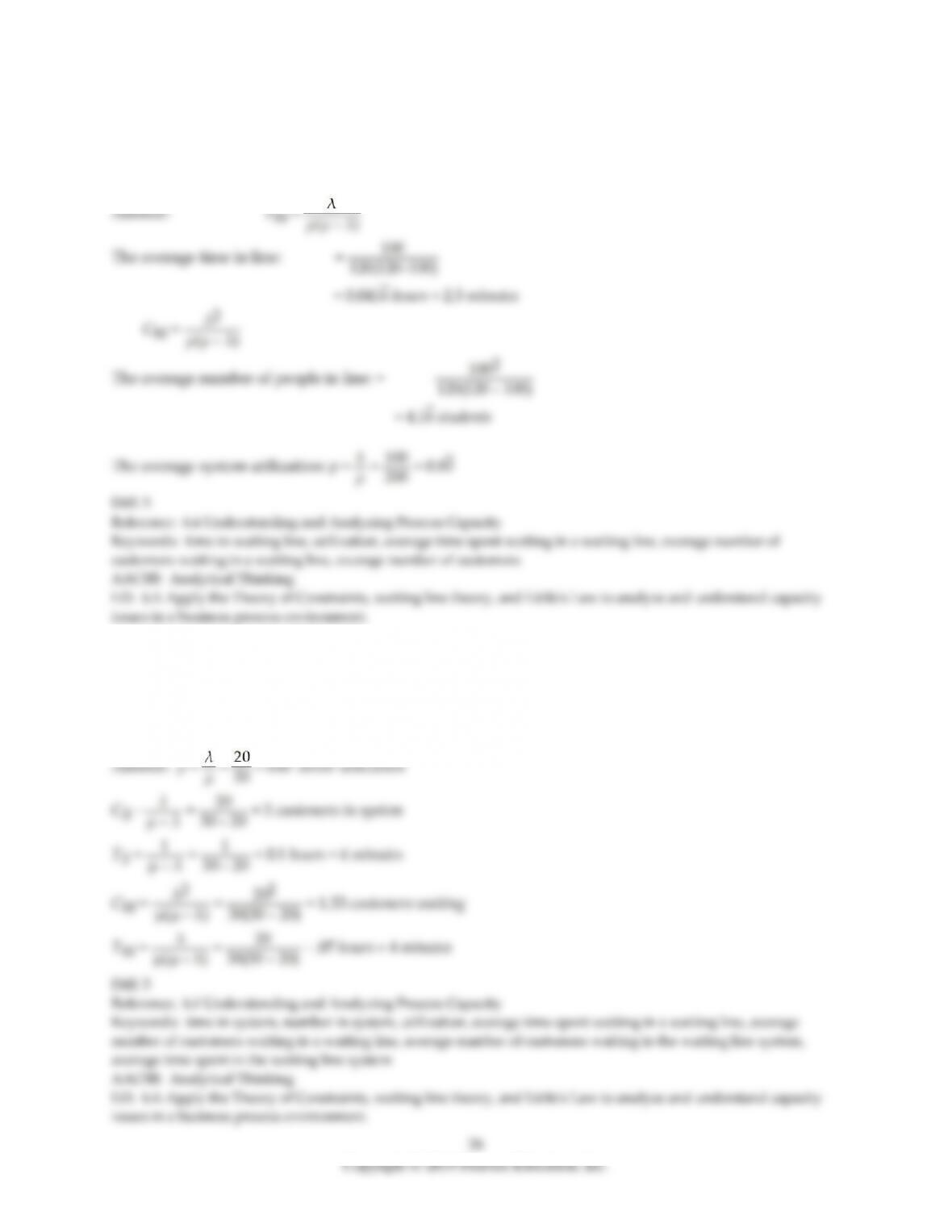
15) A steady stream of eager fresh-faced students waits in line to register for spring semester classes.
Students arrive at the rate of 100 per hour and it takes the registrar 30 seconds to check their schedule and
verify they have paid in full. What is the average time waiting in line and the average number of people
in line? How busy is the registrar?
16) Customers arrive at Rent a Wreck and hope to score an inexpensive and unsightly vehicle to use for
what typically is a short period of time. About twenty customers show up in any hour of the day and it
takes the customer service representative about two minutes to photocopy their driver’s license and
insurance card and take an impression of a credit card. Assume that the service and arrival rates are
governed by the Poisson distribution. Calculate the system’s vital statistics.