Chapter 06 – Process Selection and Facility Layout
120. Without regard to projected demand, what is the minimum possible cycle time for this
assembly line?
121. For output to equal projected demand, what should be the actual cycle time for this
assembly line?
Chapter 06 – Process Selection and Facility Layout
122. For output to equal projected demand, what is the minimum number of workstations
needed?
123. For output to equal projected demand, what will be the efficiency of the assembly line
that uses the minimum number of workstations?
Chapter 06 – Process Selection and Facility Layout
124. For output to equal projected demand, what will be the idle time at the second
workstation of the assembly line that uses the minimum number of workstations?
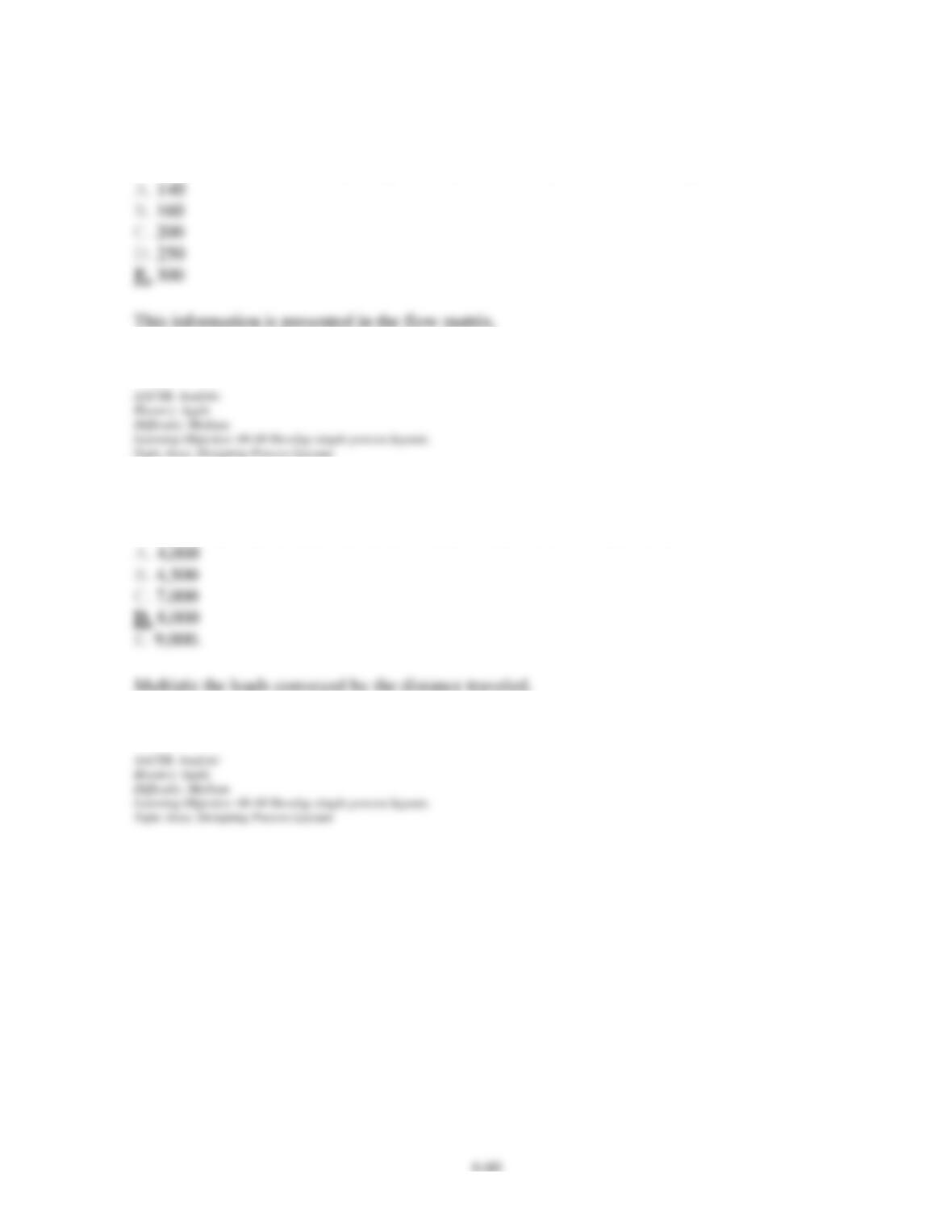
A company needs to locate three departments (X, Y, and Z) in the three areas (I, II, and III)
of a new facility. They want to minimize interdepartmental transportation costs, which are
expected to be $.50 per load per meter moved. An analyst has prepared the following
distances and flow matrices:
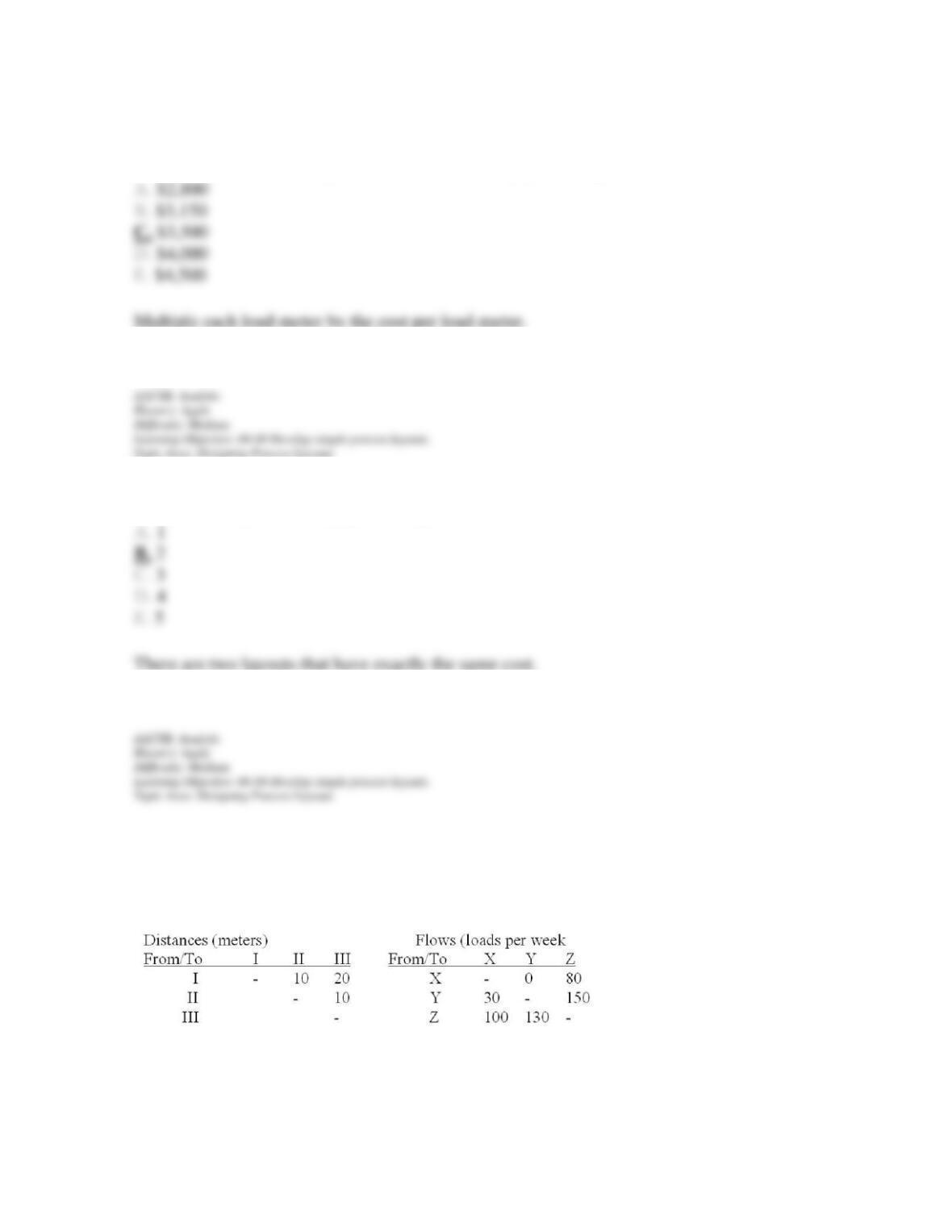
125. What is the distance (in meters) from area III to area I in this new facility?
Chapter 06 – Process Selection and Facility Layout
126. What is the total flow (loads per week) between department Y and department Z?
127. If departments X, Y, and Z were to be located in areas I, II, and III, respectively, what
would be the total distance (in meters) loads would be moved each week?
Chapter 06 – Process Selection and Facility Layout
6-61
128. What are total weekly costs for the least costly process layout?
129. How many least costly process layouts are there?
A company needs to locate three departments (X, Y, and Z) in the three areas (I, II, and III)
of a new facility. They want to minimize interdepartmental transportation costs, which are
expected to be $.50 per load meter moved. An analyst has prepared the following flow and
distance matrices:
Chapter 06 – Process Selection and Facility Layout
130. What is the distance (in meters) from area III to area I of this new facility?
131. What is the total flow (loads per week) between department Y and department Z?
Chapter 06 – Process Selection and Facility Layout
132. If the company were to locate departments X, Y, and Z in areas 1, 2, and 3, respectively,
what would be the total distance (in meters) loads would be moved each week?
133. What is the layout that will minimize the total distance loads will be moved each week?
Chapter 06 – Process Selection and Facility Layout
134. What are total weekly costs for an optimum layout?
135. Which of the following process types would be more likely to be used in the introductory
phase of a product’s life-cycle?
Chapter 06 – Process Selection and Facility Layout
136. Which of the following process types would be more likely to be used in the maturity
phase of a product’s life-cycle?
137. What is it about job shops that make them appropriate for products in the introductory
phase of their life-cycle?
Chapter 06 – Process Selection and Facility Layout
138. What is it about continuous processes that make them appropriate for products in the
maturity phase of their life-cycle?
139. Although they do not guarantee optimal solutions, ______________ are useful in finding
reasonable solutions when the number of possible options is overwhelming.
Chapter 06 – Process Selection and Facility Layout
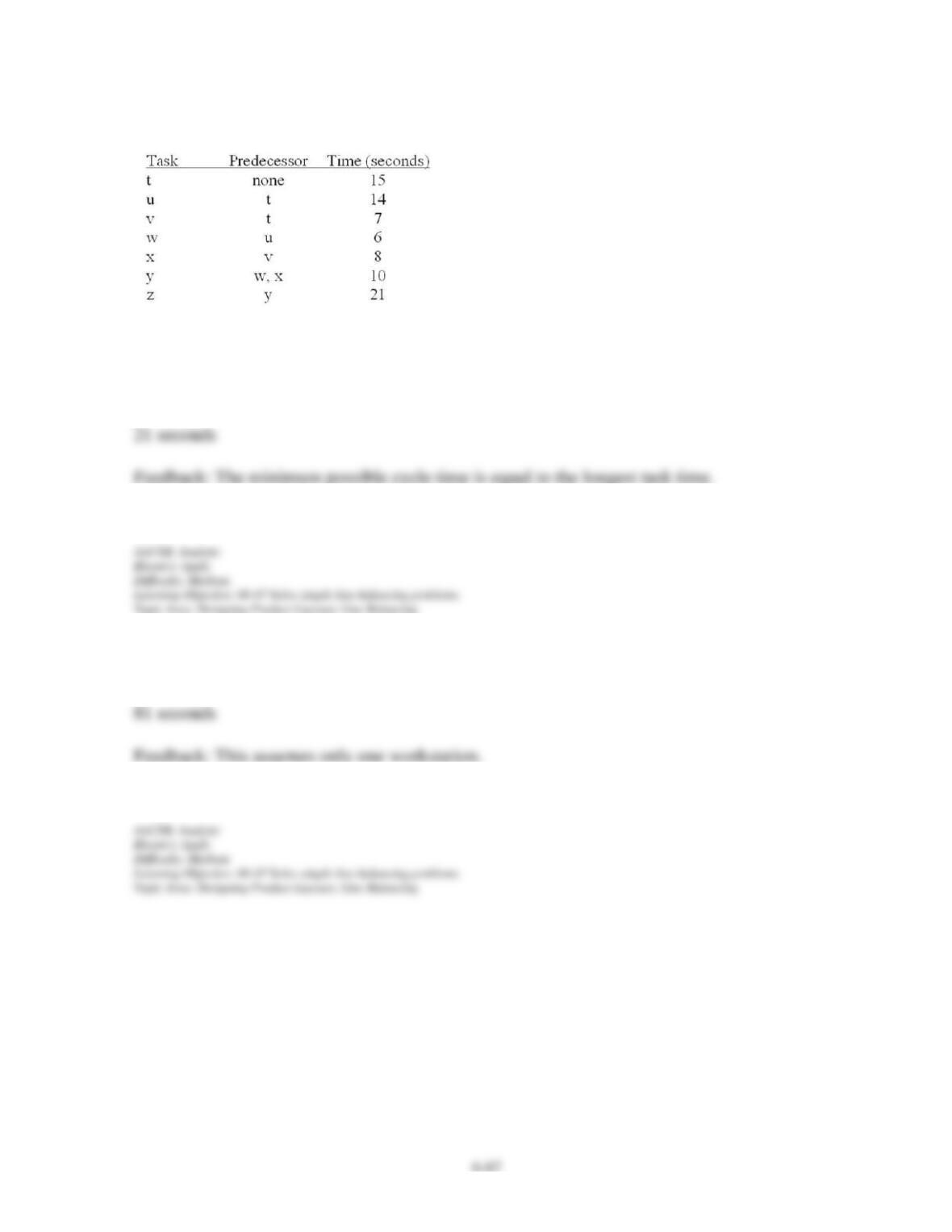
Given the following line balance data:
140. What is the minimum possible cycle time?
141. What is the maximum possible cycle time?
Chapter 06 – Process Selection and Facility Layout
142. What is the appropriate cycle time for eight hours of operating time per day and a desired
output rate of 960 units per day?
143. For eight hours of operating time per day and a desired output rate of 960 units per day,
what is the minimum number of stations needed to achieve the appropriate cycle time?
144. For eight hours of operating time per day and a desired output rate of 960 units per day,
what balance (if any) will yield the minimum number of stations?
Station #1: t, v, x; Station #2: u, w, y; Station #3: z
Chapter 06 – Process Selection and Facility Layout
6-69
145. For eight hours of operating time per day and a desired output rate of 960 units per day,
what is the percentage of idle time for the balance which uses the minimum number of
stations?
146. For eight hours of operating time per day and a desired output rate of 960 units per day,
what is the efficiency for the balance which uses the minimum number of stations?
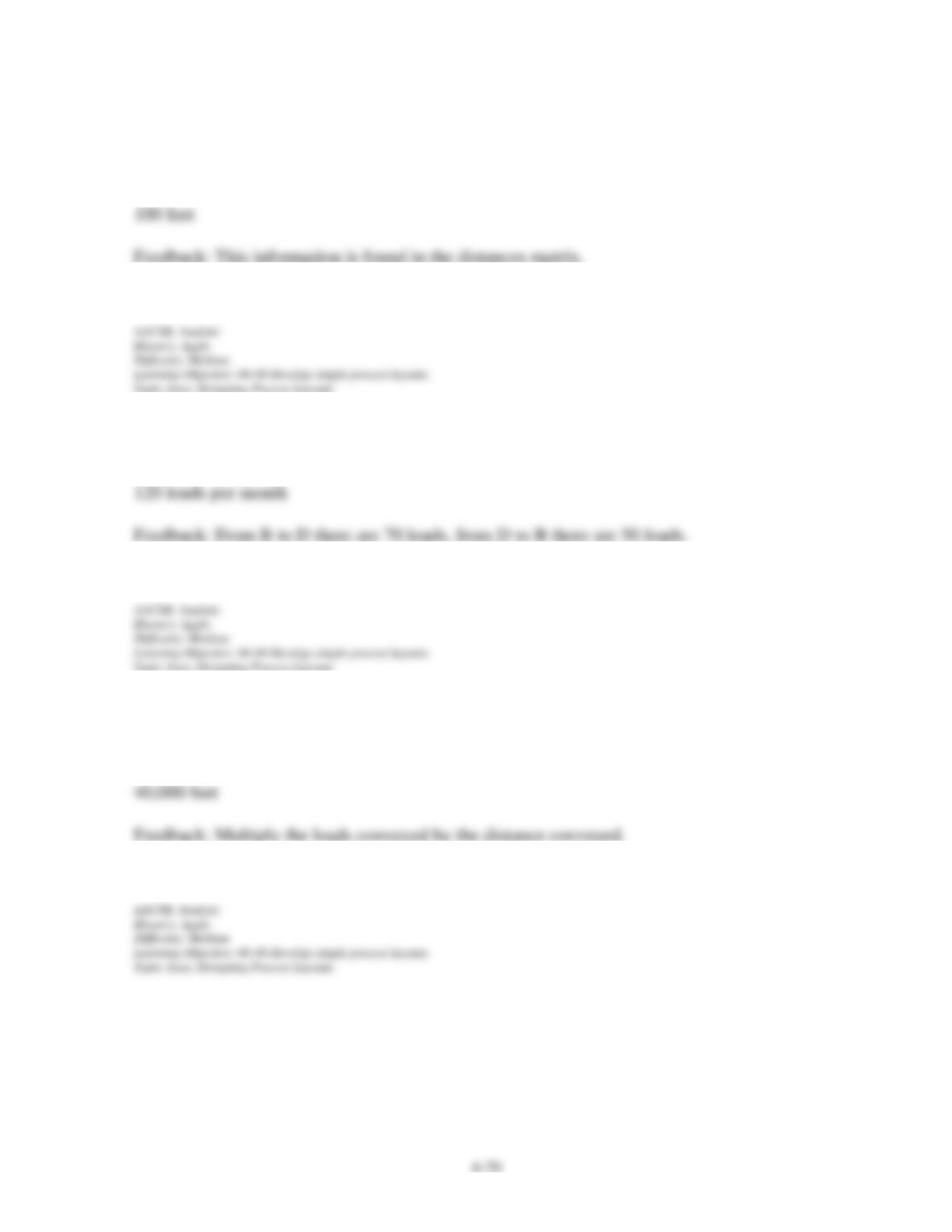
Given the following process layout data for locating four departments (A, B, C, and D) in
four areas (1, 2, 3, and 4):
Chapter 06 – Process Selection and Facility Layout
147. What is the distance from area 3 to area 1?
148. What is the total flow between departments B and D?
149. If departments A through D were to be located in areas 1 through 4, respectively, what
would be the total distance loads would be moved each month?
Chapter 06 – Process Selection and Facility Layout
150. If department C must be located in area 1, what layout will minimize the total distance
loads will be moved each month?
151. If transportation costs are $.25 per load per foot moved, what are total monthly costs for
an optimum layout?