Chapter 05S – Decision Theory
104. What would be the total payoff if the heart lab were funded in both the first and second
years?
105. What is the probability that the heart lab will be funded in both the first and second
years?
Chapter 05S – Decision Theory
106. What is the expected value for the decision alternative to select the cancer lab?
107. What is the expected value for the decision alternative to select the heart lab?
Chapter 05S – Decision Theory
108. What is the expected value for the optimum decision alternative?
Two professors at a nearby university want to co-author a new textbook in either economics
or statistics. They feel that if they write an economics book, they have a 50 percent chance of
placing it with a major publisher, and it should ultimately sell about 40,000 copies. If they
can’t get a major publisher to take it, then they feel they have an 80 percent chance of placing
it with a smaller publisher, with ultimate sales of 30,000 copies. On the other hand, if they
write a statistics book, they feel they have a 40 percent chance of placing it with a major
publisher, and it should result in ultimate sales of about 50,000 copies. If they can’t get a
major publisher to take it, they feel they have a 50 percent chance of placing it with a smaller
publisher, with ultimate sales of 35,000 copies.
109. What is the probability that the economics book would wind up being placed with a
smaller publisher?
Chapter 05S – Decision Theory
110. What is the probability that the statistics book would wind up being placed with a
smaller publisher?
111. What is the expected value for the decision alternative to write the economics book?
Chapter 05S – Decision Theory
112. What is the expected value for the decision alternative to write the statistics book?
113. What is the expected value for the optimum decision alternative?
Chapter 05S – Decision Theory
114. When a decision-making scenario involves two or more departments, if the individual
departments pursue what is optimal for them, sometimes the overall organization suffers. This
is an example of _____________.
115. Which of the following is not a stage in the decision making process?
Chapter 05S – Decision Theory
116. Option A has a payoff of $10,000 in environment 1 and $20,000 in environment 2.
Option B has a payoff of $5,000 in environment 1 and $27,500 in environment 2. Once the
probability of environment 1 exceeds ______, option A becomes the better choice.
117. Option A has a payoff of $10,000 in environment 1 and $20,000 in environment 2.
Option B has a payoff of $12,500 in environment 1 and $17,500 in environment 2. Once the
probability of environment 2 exceeds ______, option A becomes the better choice.
Chapter 05S – Decision Theory
118. Which of the following would make decision trees an especially attractive decision
making tool?
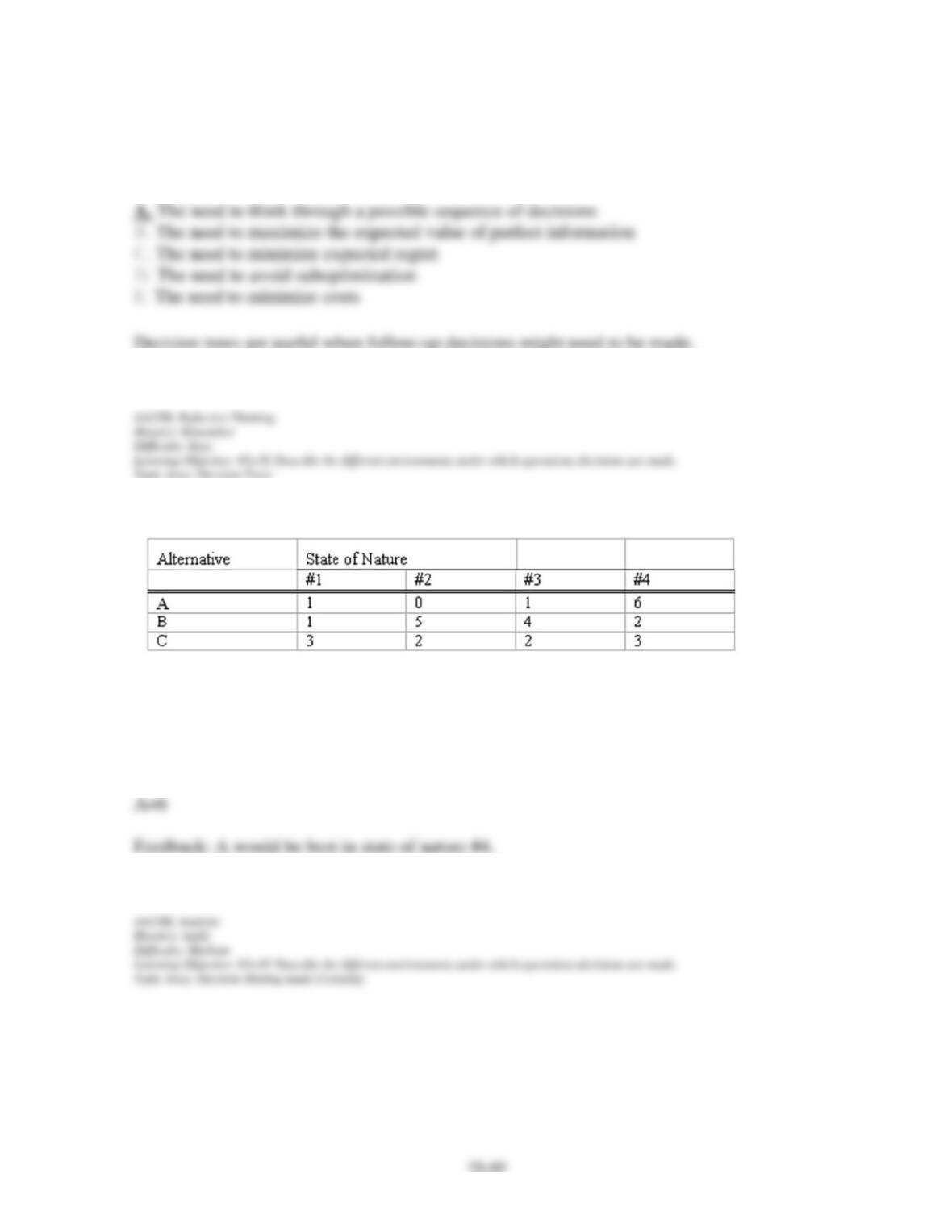
119. If somehow you find out for certain that state of nature #4 is going to occur, which
alternative will you select?
Chapter 05S – Decision Theory
120. If you are uncertain which state of nature will occur, and use the maximin criterion,
which alternative will you select?
121. If you are uncertain which state of nature will occur, and use the maximax criterion,
which alternative will you select?
122. If you are uncertain which state of nature will occur, and use the Laplace criterion, which
alternative will you select?
Chapter 05S – Decision Theory
123. If you are uncertain which state of nature will occur, and use the minimax regret
criterion, which alternative will you select?
124. If you feel that P(#1) = .4, P(#2) = .3, P(#3) = .2, and P(#4) = .1, which alternative will
you select?
125. If you feel that P(#1) = .4, P(#2) = .3, P(#3) = .2, and P(#4) = .1, what is your expected
payoff under certainty?
Chapter 05S – Decision Theory
126. If you feel that P(#1) = .4, P(#2) = .3, P(#3) = .2, and P(#4) = .1, what is your expected
value of perfect information?