Chapter 05S – Decision Theory
81. If she uses the Laplace criterion, what size outlet will she decide to lease?
82. If she uses the minimax regret criterion, what size outlet will she decide to lease?
Chapter 05S – Decision Theory
83. If she feels there is a 30% chance that demand will be high, what are the expected
monthly profits for the outlet she will decide to lease?
84. If she feels there is a 30% chance that demand will be high, what is her expected payoff
under certainty?
Chapter 05S – Decision Theory
85. If she feels there is a 30% chance that demand will be high, what is her expected value of
perfect information?
86. For what range of probability that demand will be high, will she decide to lease the small
facility?
Chapter 05S – Decision Theory
87. For what range of probability that demand will be high, will she decide to lease the
medium facility?
88. For what range of probability that demand will be high, will she decide to lease the large
facility?
Chapter 05S – Decision Theory
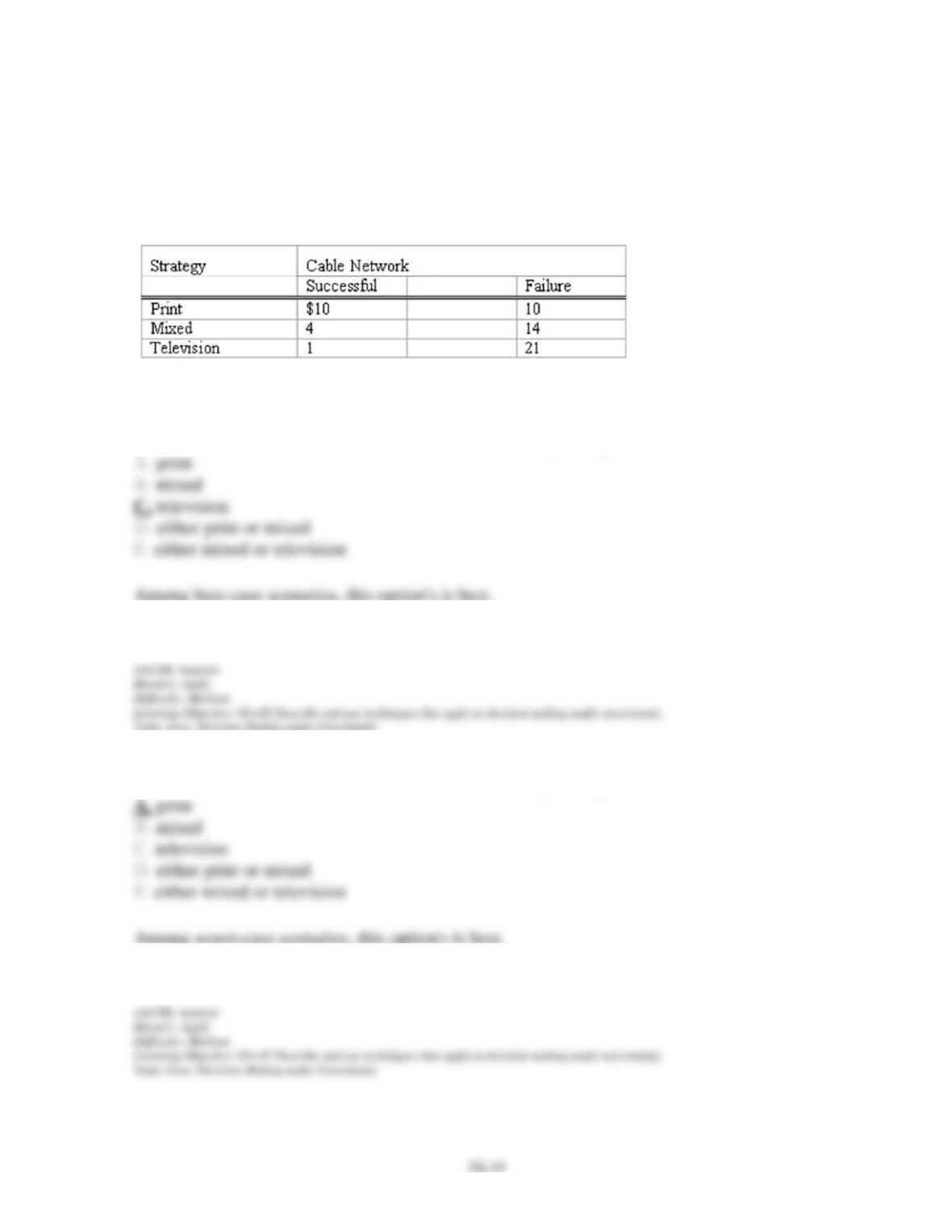
The advertising manager for Roadside Restaurants, Inc. needs to decide whether to spend this
month’s budget for advertising on print media, television, or a mixture of the two. She
estimates that the cost per thousand “hits” (readers or viewers) will vary depending upon the
success of the new cable television network she plans to use, as follows:
89. If she uses the maximax criterion, which advertising strategy will she use?
90. If she uses the maximin criterion, which advertising strategy will she use?
Chapter 05S – Decision Theory
91. If she uses the Laplace criterion, which advertising strategy will she use?
92. If she uses the minimax regret criterion, which advertising strategy will she use?
Chapter 05S – Decision Theory
93. If she feels that there is a 60% chance that the new cable network will be successful, what
is her expected cost (per thousand “hits”) for the strategy she will select?
94. If she feels that there is a 60% chance that the new cable network will be successful, what
is her expected cost (per thousand “hits”) under certainty?
Chapter 05S – Decision Theory
95. If she feels that there is a 60% chance that the new cable network will be successful, what
is her expected value (per thousand “hits”) of perfect information?
96. For what range of probability that the new cable network will be successful will she select
the print media strategy?
Chapter 05S – Decision Theory
97. For what range of probability that the new cable network will be successful will she select
the mixed media strategy?
98. For what range of probability that the new cable network will be successful will she select
the television media strategy?
Chapter 05S – Decision Theory
The head of operations for a movie studio wants to determine which of two new scripts they
should select for their next major production. (Due to budgeting constraints, only one new
picture can be undertaken at this time.) She feels that script #1 has a 70 percent chance of
earning about $10,000,000 over the long run, but a 30 percent chance of losing $2,000,000. If
this movie is successful, then a sequel could also be produced, with an 80 percent chance of
earning $5,000,000, but a 20 percent chance of losing $1,000,000. On the other hand, she
feels that script #2 has a 60 percent chance of earning $12,000,000, but a 40 percent chance of
losing $3,000,000. If successful, its sequel would have a 50 percent chance of earning
$8,000,000, but a 50 percent chance of losing $4,000,000. Of course, in either case, if the
original movie were a “flop,” then no sequel would be produced.
99. What would be the total payoff if script #1 were a success, but its sequel were not?
100. What is the probability that script #1 will be a success, but its sequel will not?
Chapter 05S – Decision Theory
101. What is the expected value of selecting script #1?
102. What is the expected value of selecting script #2?
Chapter 05S – Decision Theory
5S-52
103. What is the expected value for the optimum decision alternative?
One local hospital has just enough space and funds presently available to start either a cancer
or heart research lab. If administration decides on the cancer lab, there is a 20 percent chance
of getting $100,000 in outside funding from the American Cancer Society next year, and an
80 percent chance of getting nothing. If the cancer research lab is funded the first year, no
additional outside funding will be available the second year. However, if it is not funded the
first year, then management estimates the chances are 50 percent it will get $100,000 the
following year, and 50 percent that it will get nothing again. If, however, Merciless’s
management decides to go with the heart lab, then there’s a 50 percent chance of getting
$50,000 in outside funding from the American Heart Association the first year and a 50
percent change of getting nothing. If the heart lab is funded the first year, management
estimates a 40 percent chance of getting another $50,000 and a 60 percent chance of getting
nothing additional the second year. If it is not funded the first year, then management
estimates a 60 percent chance for getting $50,000 and a 40 percent chance for getting nothing
in the following year. For both the cancer and heart research labs, no further possible funding
is anticipated beyond the first two years.