Chapter 05S – Decision Theory
1. Decision trees, with their predetermined analysis of a situation, are really not useful in
making health care decisions since every person is unique.
2. Bounded rationality refers to the limits imposed on decision-making because of costs,
human abilities, time, technology, and/or availability of information.
3. In reaching a decision, the alternative with the lowest cost should be ranked #1.
Chapter 05S – Decision Theory
4. The expected monetary value approach is most appropriate when the decision-maker is
risk-neutral.
5. The value of perfect information is inversely related to losses predicted.
6. Expected monetary value gives the long-run average payoff if a large number of identical
decisions could be made.
Chapter 05S – Decision Theory
7. Among decision environments, risk implies that certain parameters have probabilistic
outcomes.
8. Among decision environments, uncertainty implies that states of nature have wide ranging
probabilities associated with them.
9. In decision theory, states of nature refer to possible future conditions.
Chapter 05S – Decision Theory
10. The maximin approach involves choosing the alternative with the highest payoff.
11. The maximin approach involves choosing the alternative that has the “best worst” payoff.
12. The Laplace criterion treats states of nature as being equally likely.
Chapter 05S – Decision Theory
13. The maximax approach is a pessimistic strategy.
14. A weakness of the maximin approach is that it loses some information.
15. The expected value approach applies to decision-making under uncertainty.
Chapter 05S – Decision Theory
16. The expected value approach is used for decision-making under risk.
17. The EVPI indicates an upper limit on the amount a decision-maker should be willing to
spend to obtain additional information.
18. Graphical sensitivity analysis is limited to cases with no more than two alternatives.
Chapter 05S – Decision Theory
19. Graphical sensitivity analysis is used for decision-making under risk.
20. An advantage of decision trees compared to payoff tables is that they permit us to analyze
situations involving sequential decisions.
21. The term sub-optimization is best described as the:
Chapter 05S – Decision Theory
22. Which phrase best describes the term bounded rationality?
23. Testing how a problem solution reacts to changes in one or more of the model parameters
is called:
Chapter 05S – Decision Theory
24. Sensitivity analysis is required because _______.
25. A tabular presentation that shows the outcome for each decision alternative under the
various possible states of nature is called a/an:
Chapter 05S – Decision Theory
26. Which of the following characterizes decision-making under uncertainty?
27. Which of the following is not an approach for decision-making under uncertainty?
Chapter 05S – Decision Theory
28. Determining the worst payoff for each alternative and choosing the alternative with the
“best worst” is the approach called:
29. Determining the average payoff for each alternative and choosing the alternative with the
highest average is the approach called:
Chapter 05S – Decision Theory
30. The maximin approach to decision-making refers to:
31. Which one of these is not used in decision-making under risk?
Chapter 05S – Decision Theory
32. The term opportunity loss or regret is most closely associated with:
33. The expected monetary value criterion (EMV) is the decision-making approach used with
Chapter 05S – Decision Theory
34. A decision tree is:
35. The difference between expected payoff under certainty and expected payoff under risk is
the expected:
Chapter 05S – Decision Theory
36. If the minimum expected regret is computed, it indicates to a decision-maker the
expected:
37. The term sensitivity analysis is most closely associated with:
Chapter 05S – Decision Theory
5S-16
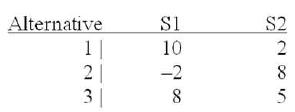
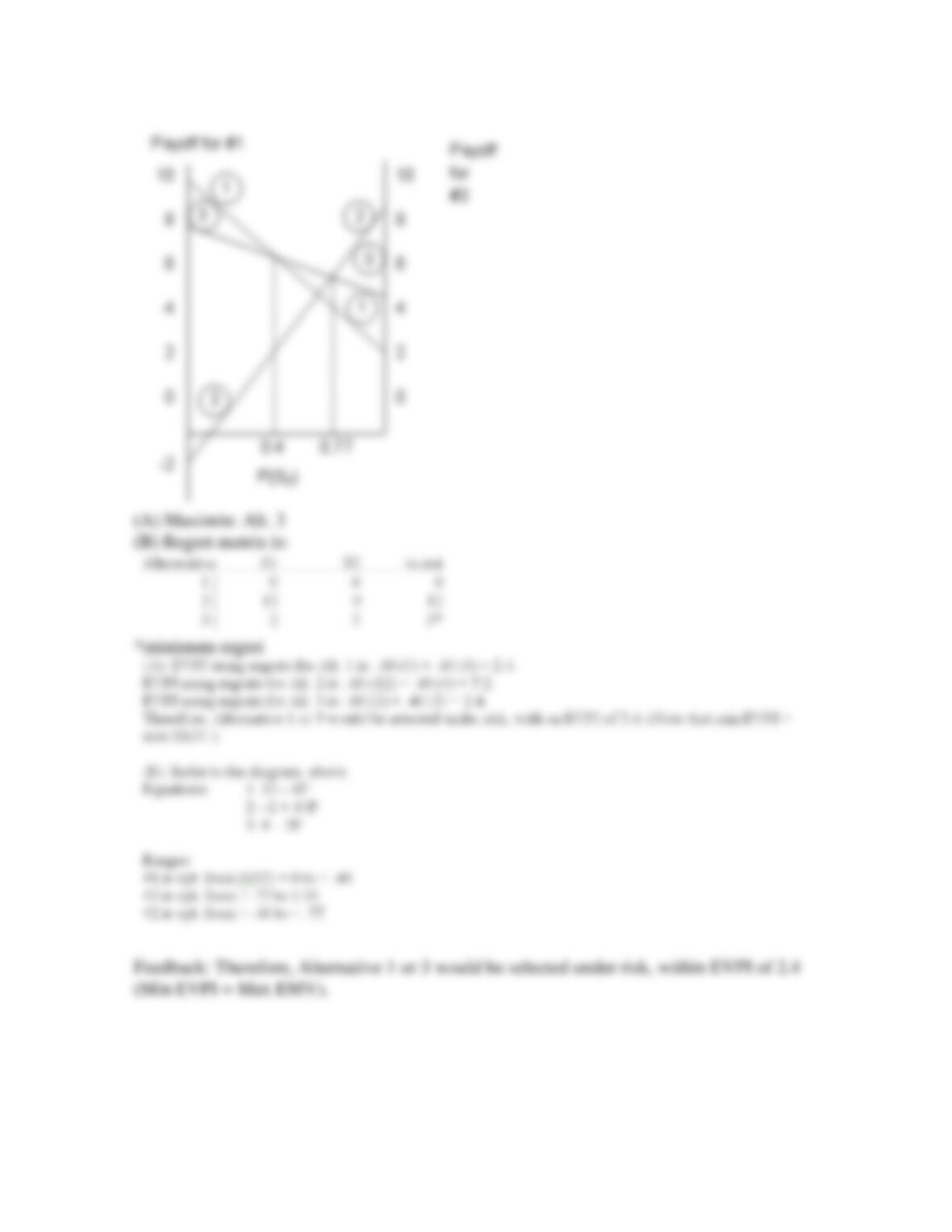
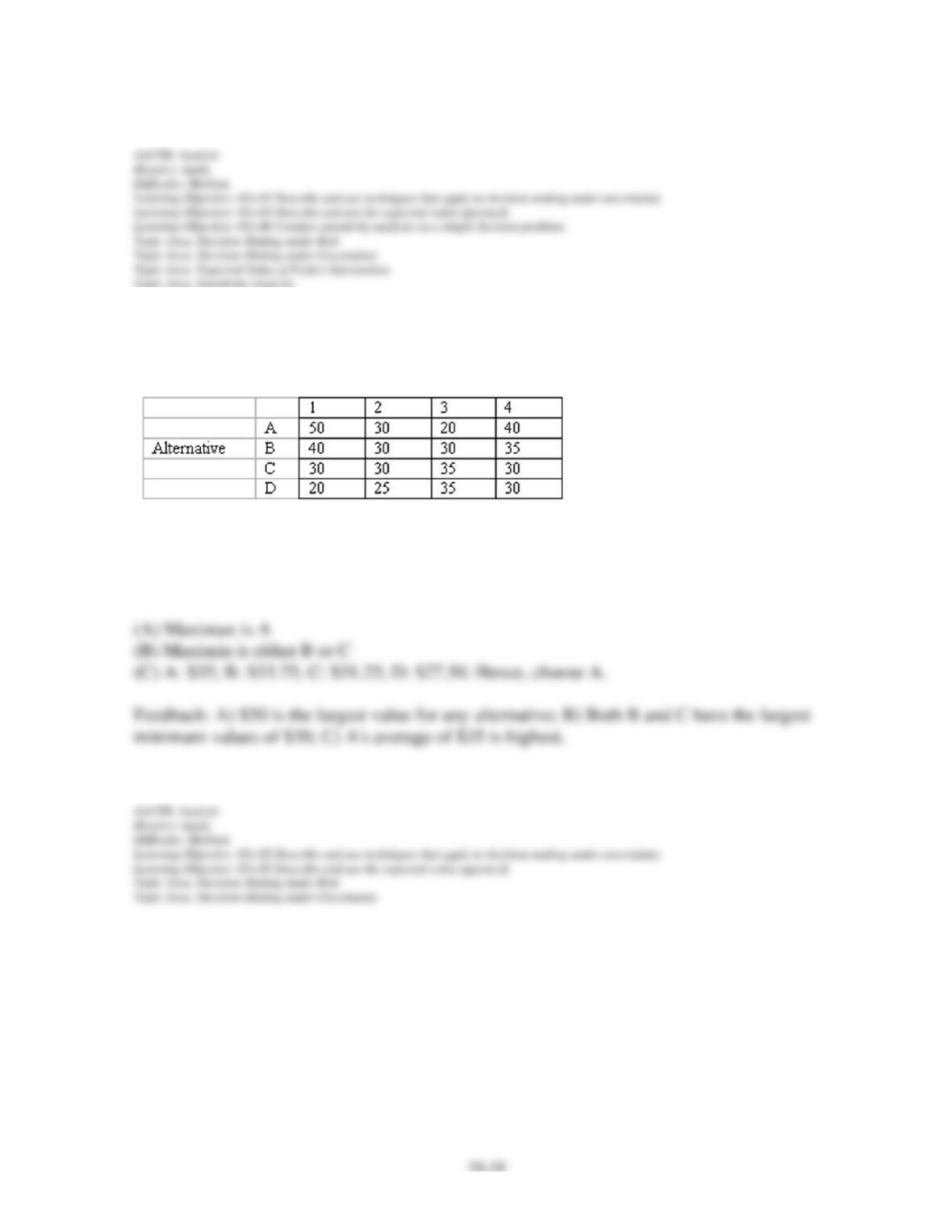
38. A manager has developed the following payoff table that indicates the profits associated
with a set of alternatives under two possible states of nature.
Answer the following questions:
(A) If the manager uses maximin as the decision criterion, which of the alternatives would be
indicated?
(B) If the manager uses minimax regret as the criterion, which alternative would be indicated?
(C) Determine the expected value of perfect information if P(S2) = .40.
(D) Determine the range of P(S2) for which each alternative would be optimal.
Chapter 05S – Decision Theory
5S-17
Chapter 05S – Decision Theory
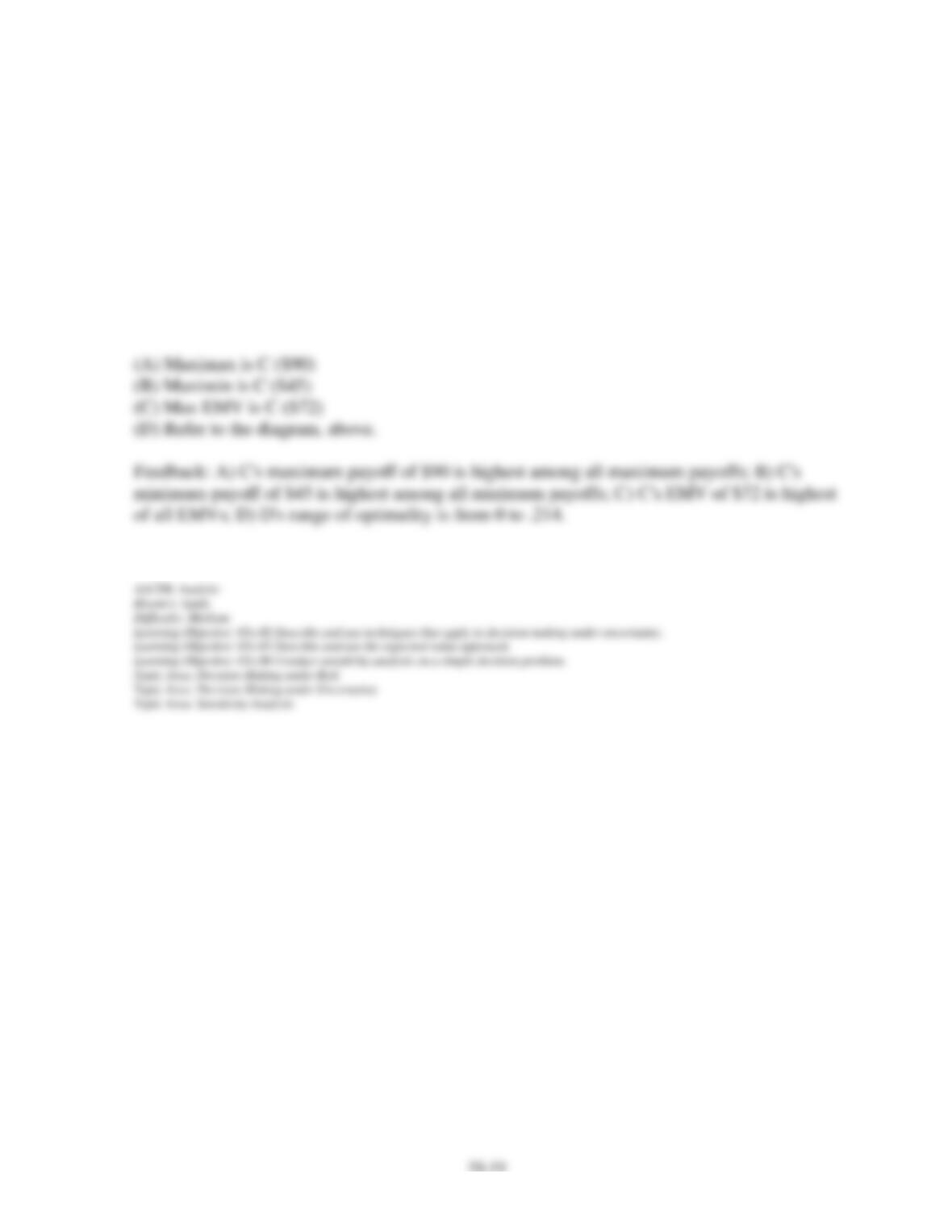
39. A manager’s staff has compiled the information below which pertains to four capacity
alternatives under four states of nature. Values in the matrix are present value in thousands of
dollars.
(A) Assuming a maximax strategy, which alternative would be chosen?
(B) If maximin were used, which alternative would be chosen?
(C) If states of nature are equally likely and an expected value criterion of maximization is
used, which alternative would be chosen?
Chapter 05S – Decision Theory
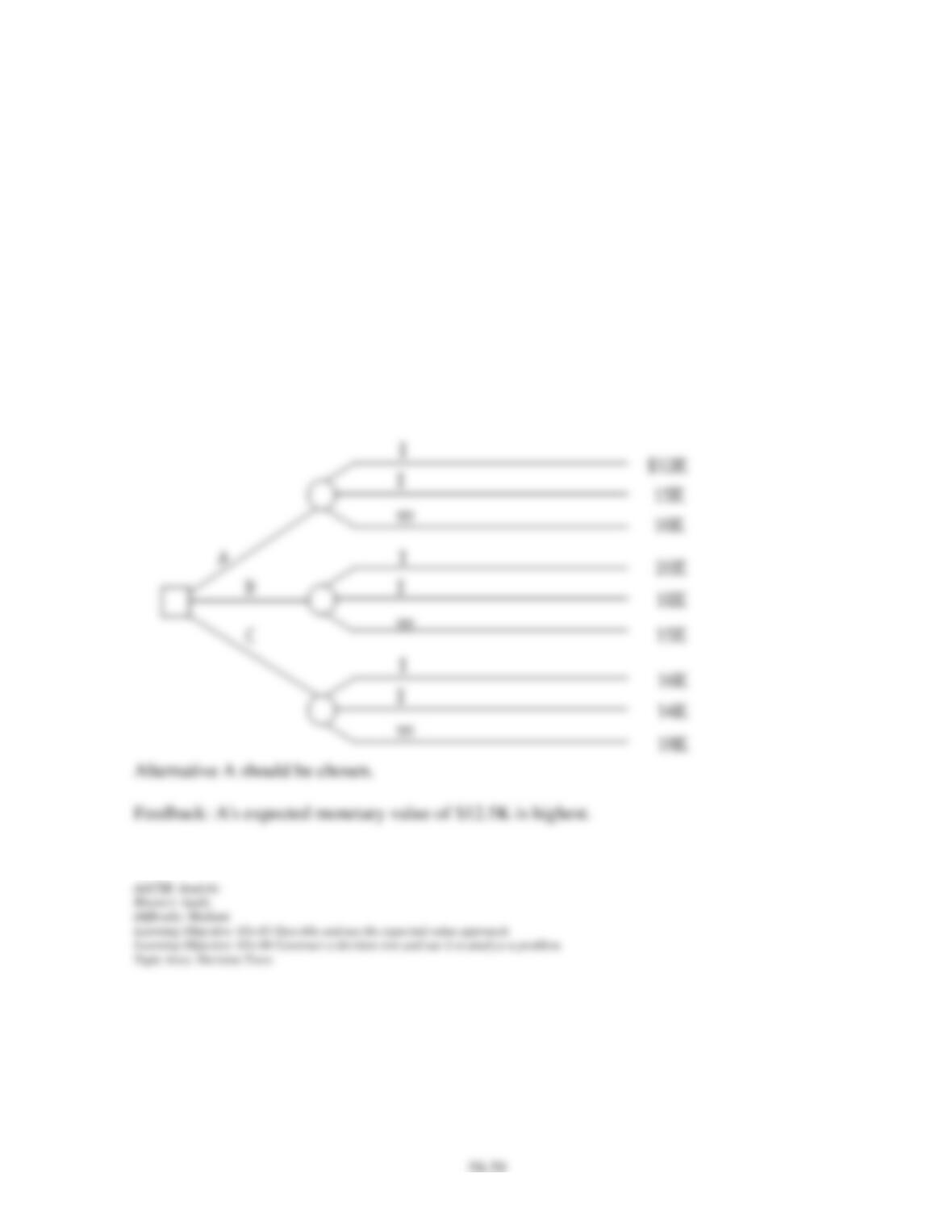
40. A manager has learned that annual profits from four alternatives being considered for
solving a capacity problem are projected to be $15,000 for A, $30,000 for B, $45,000 for C,
and $60,000 for D if state of nature 1 occurs; and $60,000 for A, $80,000 for B, $90,000 for
C, and $35,000 for D if state of nature 2 occurs.
(A) Assuming maximax is used, what alternative would be chosen?
(B) Assuming maximin is used, what alternative would be chosen?
(C) If P(State of Nature 1) is .40, what alternative has the highest expected monetary value?
(D) Determine the range of P(S2) for which each alternative would be optimal.
Chapter 05S – Decision Theory
41. A manager is quite concerned about the recent deterioration of a section of the roof on a
building that houses her firm’s computer operations. According to her assistant there are three
options which merit consideration: A, B, and C. Moreover, there are three possible future
conditions that must be included in the analysis: I, which has a probability of occurrence of .5;
II, which has a probability of .3; and III, which has a probability of .2.
If condition I materializes, A will cost $12,000, B will cost $20,000, and C will cost $16,000.
If condition II materializes, the costs will be $15,000 for A, $18,000 for B, and $14,000 for C.
If condition III materializes, the costs will be $10,000 for A, $15,000 for B, and $19,000 for
C.
(A) Draw a decision tree for this problem.
(B) Using expected monetary value, which alternative should be chosen?