
CHAPTER 5
PROJECT SCHEDULING MODELS
TRUE/FALSE QUESTIONS
1. A disadvantage of Gantt chart methodology is that an earliest
possible completion date for the project cannot be determined.
2. Using the Critical Path Method, the normal time to complete
activity D is 10 weeks, and its normal cost is $500. Under maximum
crashing, activity D can be completed is 4 weeks for $2,300.
Therefore, if $1,100 is spent on activity D, its completion time
3. The earliest start (ES) time for an activity is the latest
4. The “forward pass” determines the earliest start and finish
5. The critical path shows the earliest project completion date
7. Any attempt at resource leveling always will involve
lengthening the project completion time beyond its “non–leveled”
8. In PERT, the acceptance of a Beta distribution for activity
completion times and the presence of a sufficient number of
activities, lead to the assumption of a normal distribution of
9. Overall project completion time will not be affected if an
activity possessing slack time is started at any time between its
10. Since PERT allows randomness, it is not necessary to know the
11. A PERT/CPM network can be represented as a linear programming
model by letting the decision variables be the activity start times.
12. GANTT stands for “Generalized Activity Normalization Time
13. A Gantt chart, by definition, does not show precedence
relations. However, you could add precedence relations by drawing

14. Resource leveling can apply to either costs or to the time of
15. If a critical task is delayed, we either must add resources,

MULTIPLE CHOICE QUESTIONS
1. In project scheduling, activities:
a. must be completed sequentially.
b. are the tasks of a project.
c. are work packages.
d. are not represented on Gantt charts.
2. Typically, the first step in project scheduling is the
construction of a:
a. Gantt chart.
b. Critical path chart.
c. PERT chart.
d. set of precedence relationships between the activities.
3. PERT (Program Evaluation and Review Technique) generally
treats activity completion times as probabilistic and:
a. is used to construct a Gantt chart.
b. is used to determine the probability that a project will
be complete within a given time frame.
c. can be used to determine the exact completion time of an
activity.
d. can be used to determine the exact completion time of a
project.
4. The earliest start time (ES) of an activity:
a. equals its earliest finish time (EF) minus task time.
b. equals the minimum earliest finish time (EF) of all
immediate predecessors.
c. equals the latest start time (LS) for non-critical
activities.
d. may not be the same for two or more activities.
5. The critical path:
a. is the shortest path through the network.
b. is necessarily unique.
c. Is defined by activities with zero slack.
d. Shows, by elimination, which activities management can
safely ignore.

6. In the PERT probabilistic approach, statisticians have found
which distribution most helpful in describing possible activity
times?
a. Beta
b. Gamma
c. normal
d. uniform
7. Which of the following is not a fundamental, inherent weakness
in the probabilistic approach to PERT?
a. One may have difficulty in obtaining three reliable time
estimates for each activity.
b. There is the possibility of large variances for non–
critical activities.
c. The assumption that activity times are independent of
each other.
d. The assumption that possible overall project completion
times are Beta-distributed.
8. In the critical path method (CPM), crashing does not:
a. deal with accelerating a project’s overall completion
time.
b. assume that every activity completion time can be
crashed.
c. require two time estimates for each activity’s duration
time.
d. take into account the possibility of creating multiple
critical paths.
9. Which of the following is true?
a. Slack = (LF – LS)
b. (LF – LS) > (EF – ES)
c. Slack is never “shared.”
d. (LS – ES) 0
10. A “forward pass” in network analysis of a project, determines:
a. earliest times.
b. latest times.
c. slack times.
d. most likely times.
11. PERT/Cost is a cost-center based system, where the “centers”

are:
a. locations.
b. work packages of groups of related activities.
c. activities.
d. departments.
12. PERT/Cost:
a. allows for activity interruption.
b. assumes costs are evenly spread over time.
c. monitors project performance relation to cost, not time.
d. cannot help identify cost under-runs.
13. The probabilistic approach characterized by PERT does not use:
a. optimistic activity times.
b. median activity times.
c. pessimistic activity times.
d. most likely activity times.
14. Activity C is an immediate predecessor of activity G. Both
activities have 4 hours of slack time. If both activities are
delayed 3 hours, and these are the only delays, the overall effect
of these delays is to delay the minimum project completion time by:
a. 0 hours.
b. 2 hours.
c. 6 hours.
d. The overall delay cannot be determined with only this
information.
15. A project contains activities D and K. Activity D has 5 hours
of slack, and activity K has 7 hours of slack. If activity D is
delayed 4 hours, activity K is delayed 6 hours, and these are the
only delays, then the overall effect of these delays is to delay the
minimum project completion time by:
a. 0 hours.
b. 2 hours.
c. 11 hours.
d. The overall delay cannot be determined with only this
information.
16. Which of the following is true?
a. PERT gives a better solution than the expected value

criterion.
b. To use the expected value criterion, we must know every
possible outcome.
c. The expected value criterion determines the optimal
decision by choosing the best expected payoff.
d. Adding resources will decrease the project time to
completion.
17. Which of the following is false?
a. Crashing an activity on the critical path can cause
another path to become the critical path.
b. The maximum crash time reduction for each and every
activity is limited.
c. CPM assumes that adding resources to crash an activity
from its normal time to its crash time will reach a
point of diminishing returns.
d. Crashing non-critical activities will not reduce the
project time.
18. Let Ti = normal completion time for task i
Ri = crash completion time for task i
Ci = normal cost for task i
Hi = crash cost for task i
Xi = start time for task i
Yi = amount of time by which task i is to be crashed.
What is the objective function of a linear programming model for
project crashing?
a. all i Yi(Hi – Ci)/(Ti – Ri)
b. all i on critical path Yi(Hi – Ci)/(Ti – Ri)
c. all i XiYi
d. all i YiHi
19. Which statement does not represent a set of constraints for a
linear programming approach to project crashing?
a. There is a limit to the time reduction for each
activity.
b. No activity can be reduced more than its slack time.
c. Activity start time must be greater than the finish time
of all immediate predecessors.
d. The project must be completed by the deadline (or within
budget).
20. Let B = budgeted total cost for a work package
T = estimated completion time for a work package
P = percent complete

A = actual expenses to date
M = time used to date
What is the definition of cost overrun, C?
a. C = A – PB
b. C = A – (1 – P)TB
c. C = A – PTB
d. C = A – MB/T

SHORT ANSWER QUESTIONS
1. When attempting to use PERT methodology, how do you estimate
the mean completion time and standard deviation when, for a given
activity, the time estimates a, b, and m (pessimistic, optimistic,
and most likely) are all identical? What implications does this
have if several activities have this property?
2. Ajax is about to embark on a project involving the design,
manufacture, and introduction of a new microwave oven. The first
three activities and the immediate predecessors are:
Activity
Predecessor
A
Prototype Design
none
B
Acquisition of Materials
A
C
Prototype Construction
B
However, it has not yet been decided whether the prototype materials
will be purchased from a vendor (taking two weeks) or produced in
another Ajax division (four weeks). What are the implications of
this regarding usage of any standard project scheduling technique?
3. Activity T has a single immediate predecessor, activity S.
However, T may actually be initiated anytime after S is 50%
complete. Can this situation be accommodated using standard project
scheduling techniques? Explain.
4. In using PERT/CPM, why does management need to pay any
attention at all to non-critical path activities?

5. Discuss the assumptions required for determining the
probability that a project will be completed within a certain time
period by using a normal distribution of the activity time along the
critical path determined by mean completion times of the critical
activities. Do you think they are realistic for most projects?
6. Explain the Excel functions
NORMINV(0.98,200,10)
NORMDIST(190,200,10,TRUE).
7. Using PERT, we have determined the mean completion time for
each activity (j) and the standard deviation for each activity
completion time (j). How do we use these data to determine the
overall project completion time?
8. What type of distribution does PERT assume for the activity
completion times?
9. Why must we solve two linear programming models to model a
PERT/CPM network?

10. Activity A is critical. Activity B has a slack time of 5
days. What is the impact of a 7 day delay in either A or B?

FORMULATION/SOLUTION/ANALYSIS QUESTIONS
1. A project consists of the following seven activities and
immediate predecessors:
Activity
Predecessor
A
None
B
A
C
A
D
B
E
B, C
F
D, E
G
F
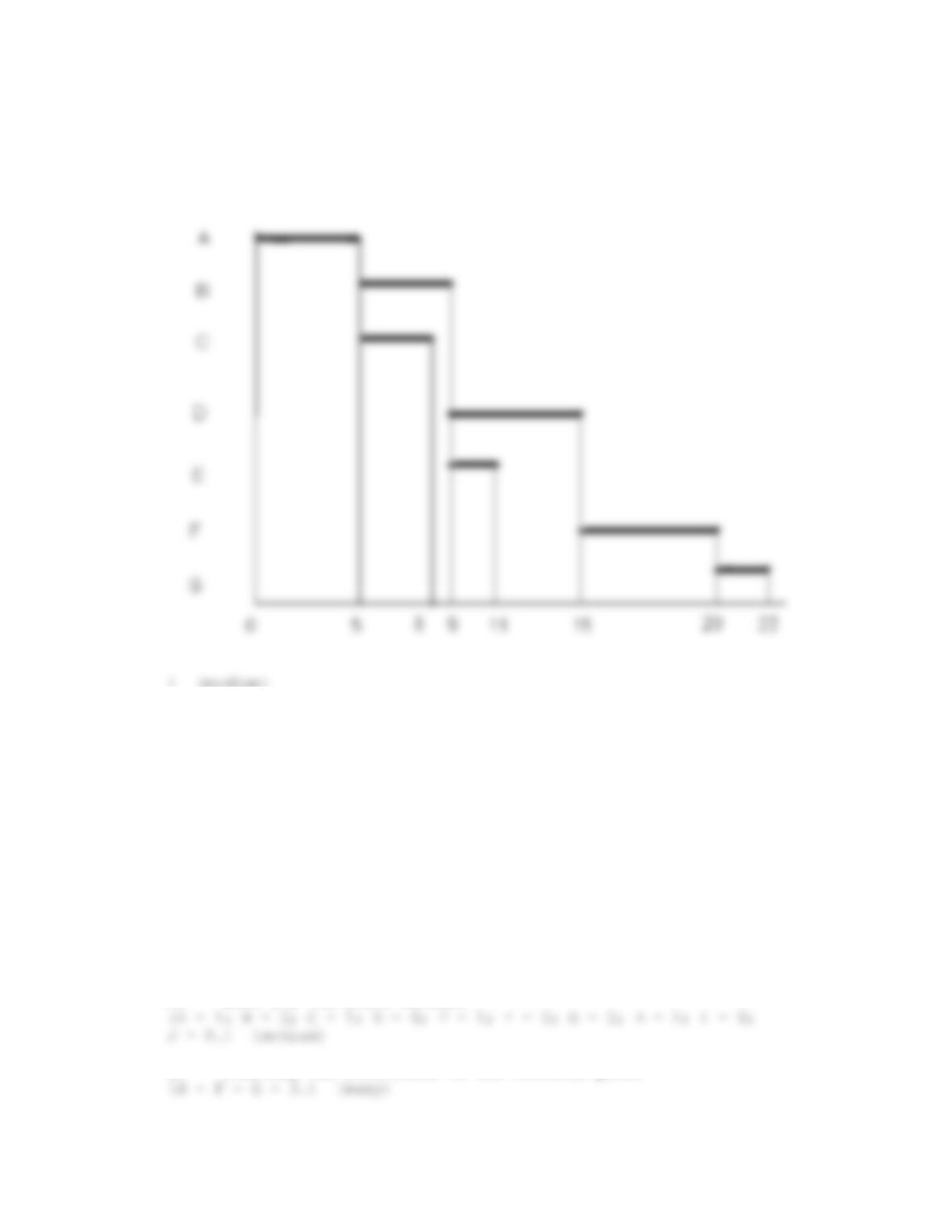
2. Suppose the estimated completion times for activities A
through G in problem 1 were 5, 4, 3, 6, 2, 5, 2 respectively. Draw
an earliest completion Gantt chart for the data.
(
) (medium)
3. Consider the following activity schedule chart for a
maintenance project.
Activity
ES
EF
LS
LF
A
0
6
1
7
B
0
5
0
5
C
6
14
7
15
D
6
10
14
18
E
14
16
15
17
F
5
14
5
14
G
14
17
14
17
H
14
19
16
21
I
10
13
18
21
J
17
21
17
21
A. What are the slack values?
B. Identify the activities on the critical path.

C. If the time is in weeks, what is the impact of a two week
delay in activity D, H, or C?
4. Consider the following information for the activities
comprising a small construction project which is scheduled to
complete in 26 days. (Costs are in $1000’s.)
Normal Schedule
Crash Schedule
Activity
Slack
Time
Cost
Time
Cost
M
0
7
10
4
19
N
2
5
6
5
6
O
0
4
7
2
12
P
0
5
9
3
13
Q
2
2
5
1
6
R
0
4
9
4
9
S
0
6
12
5
15
A. If the project must be completed in 25 days, which activity
should be accelerated? Why?
B. Will the critical path be altered?
C. What is the total estimated cost of the project on the
accelerated 25 day schedule?
5. In a PERT network, you are given the following data with times
in weeks.
Activity
Immediate
Predecessors
Optimistic
Time
Most Likely
Time
Pessimistic
Time
A
—
9
11
13
B
—
4
9
20
C
A
2
11
14
D
A, B
5
6
13
E
D
3
6
11
F
C, D
9
10
11
G
E, F
7
20
21
B. What is the probability the project will be completed within
one year (52 weeks)?

6. For a CPM model, you are given the following data with time in
weeks.
Activity
Immediate
Predecessors
Normal
Time
Normal Cost
Crash
Time
Crash Cost
A
—
9
3200
5
6000
B
—
7
1400
5
2400
C
A
6
1500
5
2000
D
B
5
2500
3
4000
E
A, B
4
1800
3
2800
F
D, E
3
1800
1
4800
A. If activity A needed to be completed in 6 weeks, what would
its cost be?
B. If $3000 were allocated to activity D, how long would it take
to complete?
7. For the data in problem 6,
A. Write a linear programming model that will give the minimum
cost solution for completing the project in 14 weeks.
B. How would your model change if the objective were to complete
the project in minimum time given a budget of $15,000?

8. For the data in problem 6,
A. Using the normal times, prepare a chart giving the earliest
and latest start and finish times and slack for each activity.
(
Activity
ES
EF
LS
LF
Slack
A
0
9
0
9
0
B
0
7
1
8
1
C
9
15
10
16
1
D
7
12
8
13
1
E
9
13
9
13
0
F
13
16
13
16
0
) (medium)
B. What is the critical path and the project completion time
using normal times?
C. What is the effect of a 2 week delay to activity B? What is
the effect of a 2 week delay to activity B combined with a 2 week
delay to activity D?
9. Given the following data for work packages in a PERT/Cost
network at week 18:
Activity
Immediate
Predecessors
Budgeted
Time
(weeks)
Budgeted
Value
Percent
Complete
Expense To
Date
A
—
12
$50,000
100%
$48,000
B
—
8
$20,000
100%
$21,000
C
A
6
$60,000
75%
$40,000
D
B
16
$40,000
50%
$25,000
E
C, D
16
$45,000
0%
0
F
B
28
$80,000
75%
$55,000
A. Is the project currently experiencing a cost overrun?
B. Is the project on target to be completed within 40 weeks?
C. What corrective action, if any, could you recommend?
10. For an activity, an engineer estimates
a (optimistic time) = 4

b (pessimistic time) = 11
m (most likely time) = 6
What is the mean for this activity? The variance?