58
CAPACITY MANAGEMENT
CHAPTER 5
ANSWERS TO PROBLEMS
59
5.13
5.14
5.15
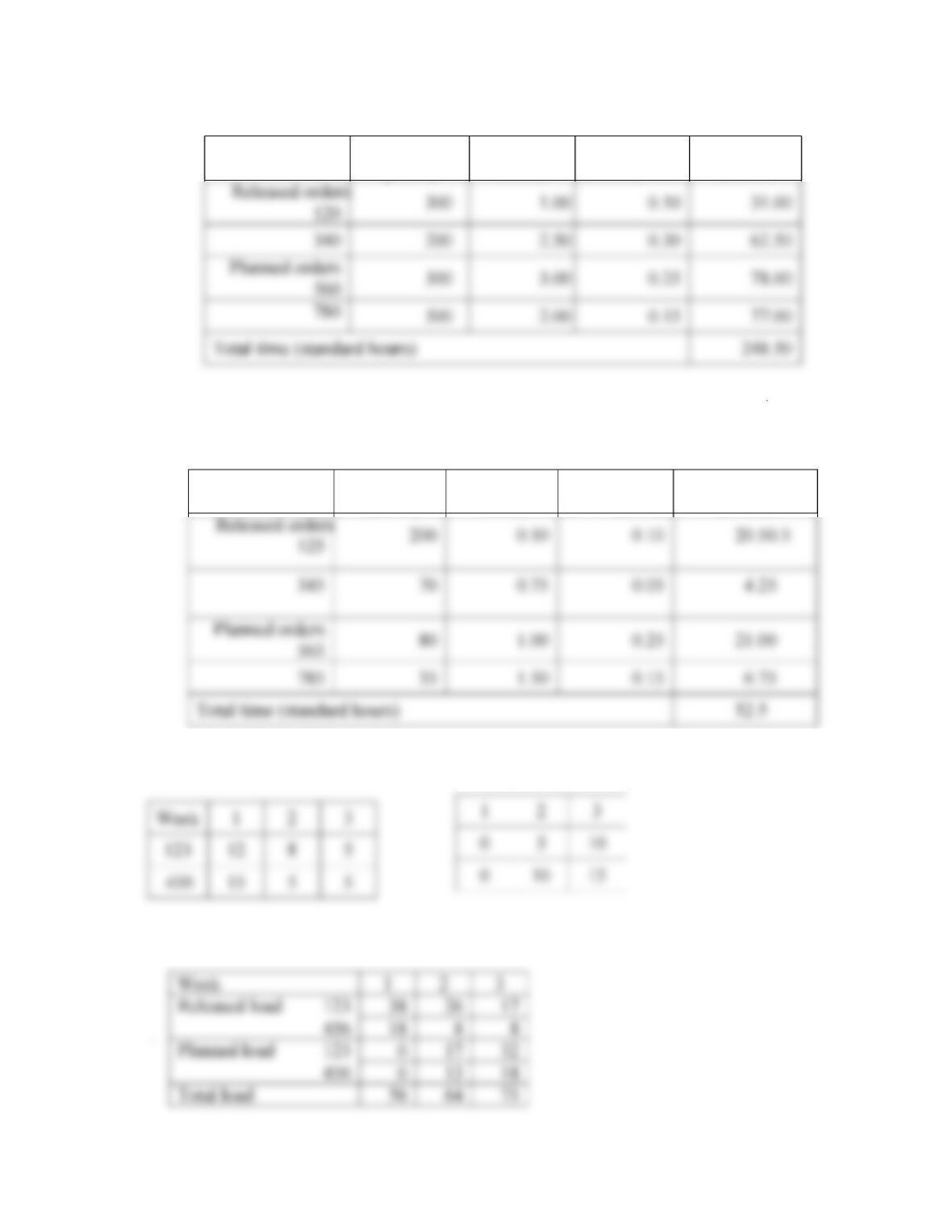
Open orders for parts Planned orders for parts
Lead report
Order
quantity
Setup time
(hours)
Run time
(hours/piece)
Total time
(hours)
Order
quantity
Setup time
(hours)
Run time
(hours/piece)
Total time
(hours)
60
5.16
5.17
5..18
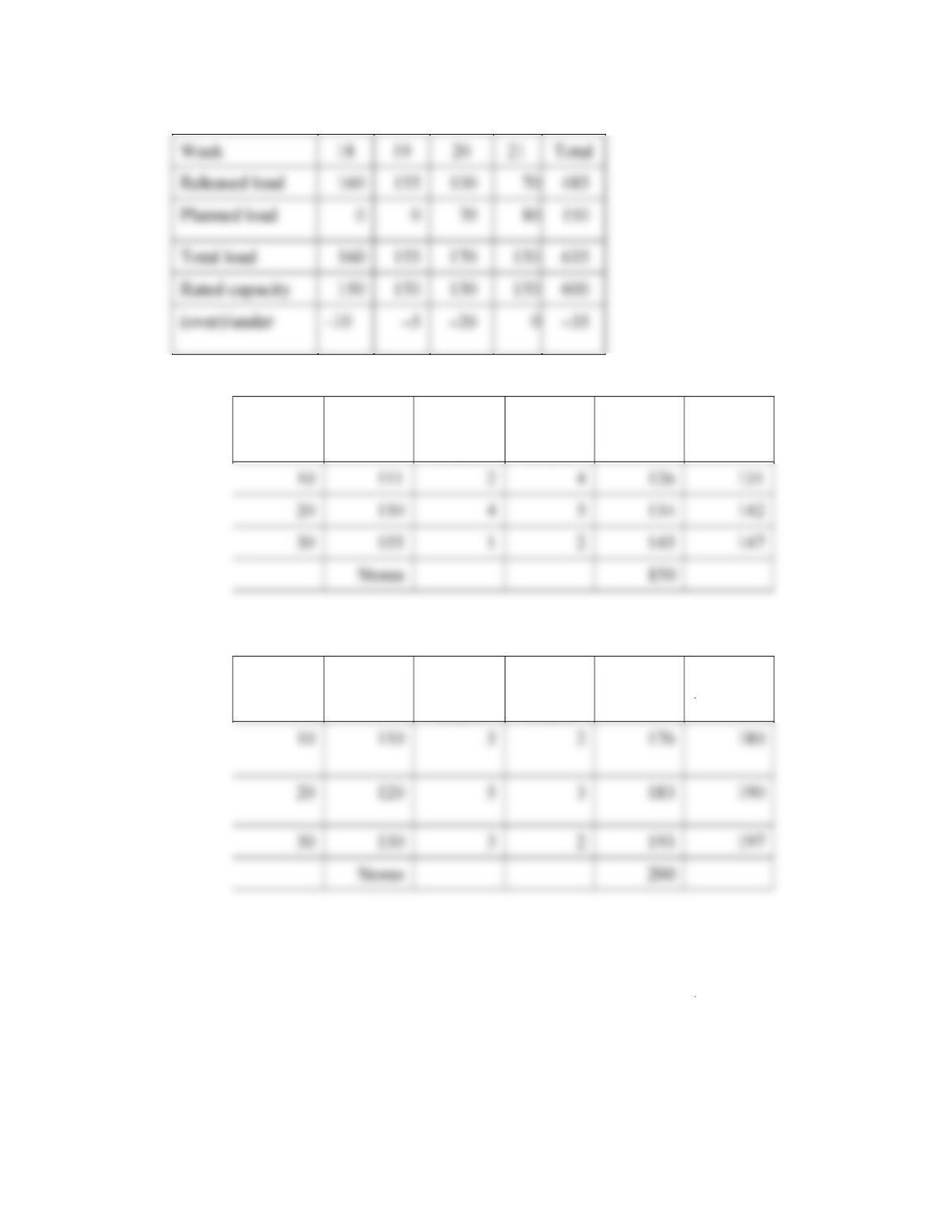
Operation
number
Work
center
Operation
time
(days)
Queue
time
(days)
Arrival
date
Finish
date
Operation
number
Work
center
Operation
time
(days)
Queue
time
(days)
Arrival
date
Finish
date
61
MULTIPLE CHOICE QUESTIONS
1
. __________ is responsible for determining the capacity required and methods of making
the capacity available.
a
. Production planning
b
. Master production scheduling
c
. Production activity control
d
. Capacity planning
e
. Material requirements planning
2
. __________ is responsible for capacity planning at the master production schedule level
and _____ at the material requirements planning level:
I
. Resource planning.
II
. Rough-cut capacity planning.
III
. Capacity requirements planning.
a
. I and II
b
. I and III
c
. II and III
d
. none of the above
3
. Available capacity in production planning is:
a
. the amount of inventory that can be held in a warehouse
b
. the quantity of work that can be performed in a given period of time
c
. a measure of the ability of a plant to consume raw materials
d
. all of the above
4
. ________ are generated by the priority planning system and involve the translation of the
priorities, generally given in units of product or some common unit, into hours of work
required at each work center in each time period:
a
. Capacity requirements
b
. Capacity bills
c
. Work center reports
d
. all of the above
5
. Rated capacity is calculated taking into account work center ________ and ________ .
I
. historical data
II
. utilization
III
. efficiency
a
. I and II
b
. I and III
c
. II and III
d
. none of the above
62
6
. A work center consists of 2 machines working 8 hours a day and 5 days a week.
Historically, utilization has been 80% and the efficiency 90%. The effective capacity, to the
nearest hour, would be:
a
. 80 hours
b
. 40 hours
c
. 30 hours
d
. 50 hours
e
. 58 hours
7
. The available capacity will be influenced by:
I
. Product specification.
II
. Product mix.
III
. Work effort.
IV. Units of measurement
a
. I, II and III only
b
. I, II and IV only
c
. II, III and IV only
d
. III only
e
. IV only
8
. The percentage of time the work center is active compared to the available time is called:
a
. efficiency
b
. effectiveness
c
. utilization
d
. up-time
9
. The ratio of standard hours of work produced to hours actually worked is called:
a
. efficiency
b
. effectiveness
c
. utilization
d
. up-time
10
. (Available time)
×
(utilization)
×
(efficiency) is called:
a
. effectiveness
b
. useful capacity
c
. demonstrated capacity
d
. rated capacity
e
. work time
11
. Which of the following is NOT an input needed in capacity requirements planning?
a
. open shop orders
b
. planned order releases
c
. routings
d
. time standards
e
. rough-cut capacity
63
12
. Information on the standard times for an operation will be found in:
a
. the work center master
b
. the routing
c. the bill of materials
d
. the product master
13
. Which of the following is the best statement?
a
. open shop orders appear as scheduled receipts in the MRP
b
. information on queue and wait time can be obtained from the work center file
c
. the Gregorian calendar is suitable for production planning
d
. a and b are true
e
. b and c are true
14
. A ________ shows the capacity required at each work center based on planned and released
orders for each time period of the plan.
a
. work center profile
b
. load profile
c
. scheduled order profile
d.
work center master
15
. One hundred units of part A are to be processed on a work center. The setup time is 2 hours
and the run time per piece is 10 minutes. The total standard time will be:
a
. 2 hours 10 minutes
b
. 3 hours 40 minutes
c
. 10 minutes
d
. 1000 minutes
e
. 1120 minutes
16
. In the short run, capacity can be altered by any of the following EXCEPT:
a
. scheduling overtime
b
. selecting alternate routings
c
. reallocating the work force
d
. purchasing new equipment
e
. subcontracting out
17
. A report that shows the future capacity requirements based on released and planned orders
for each time period of the plan is called:
a
. load report
b
. capacity report
c
. order report
d
. dispatch list
18
. Over the previous three weeks a work center produced 36, 43, and 35 standard hours of
work. What is the demonstrated capacity?
a
. 114 standard hours
b
. 36 standard hours
c
. 38 standard hours
d
. 43 standard hours

64
19
. A work center was available for work 80 hours, produced 74 standard hours of work and
actually worked 67 hours. What is the efficiency of the work center?
a
.
92.5%
b
.
110.4%
c
.
108.1%
d
.
119.4%
20. The capacity available with no regard for downtime, utilization and efficiency is:
a. Measured capacity
b. Theoretical capacity
c. Finite capacity
d. Available time
21. Available capacity planned to exceed capacity required is:
a. Alternate capacity
b. Infinite capacity
c. Safety capacity
d. Theoretical capacity
22. The difference between backward scheduling and forward scheduling is which of the
following?
a. Backward scheduling begins from the due date, forward scheduling begins with the
start date
b. Backward scheduling begins from the start date, forward scheduling begins with the
due date
c. Backward scheduling uses firm and planned orders, forward scheduling uses only
planned orders
d. Backward scheduling uses standard times, forward scheduling uses actual lead times
23
. In one week a work center produces 130 standard hours of work. The hours scheduled are
120, and 105 hours are actually worked. The utilization is:
a
.
80.8%
b
.
87.5%
c
.
92.3%
d
.
108.3%
e
.
123.8%
Answers.