Chapter 05 – Strategic Capacity Planning for Products and Services
46. Production units have an optimal rate of output where:
47. When the output is less than the optimal rate of output, the average unit cost will be:
Chapter 05 – Strategic Capacity Planning for Products and Services
48. When buying component parts, risk does not include:
49. At the break-even point:
Chapter 05 – Strategic Capacity Planning for Products and Services
50. What is the break-even quantity for the following situation?
FC = $1,200 per week
VC = $2 per unit
Rev = $6 per unit
51. An alternative will have fixed costs of $10,000 per month, variable costs of $50 per unit,
and revenue of $70 per unit. The break-even point volume is:
Chapter 05 – Strategic Capacity Planning for Products and Services
52. For fixed costs of $2,000, revenue per unit of $2, and variable cost per unit of $1.60, the
break-even quantity is:
53. Which of the following are assumptions of the break-even model?
I. Only one product is involved.
II. Everything that is produced can be sold.
III. The revenue per unit will be the same regardless of volume.
Chapter 05 – Strategic Capacity Planning for Products and Services
54. If the output rate is increased but the average unit costs also increase we are experiencing:
55. The method of financial analysis which focuses on the length of time it takes to recover
the initial cost of an investment is:
Chapter 05 – Strategic Capacity Planning for Products and Services
56. When determining the timing and degree of capacity change, one can use the approach
of:
57. The method of financial analysis which results in an equivalent interest rate is:
Chapter 05 – Strategic Capacity Planning for Products and Services
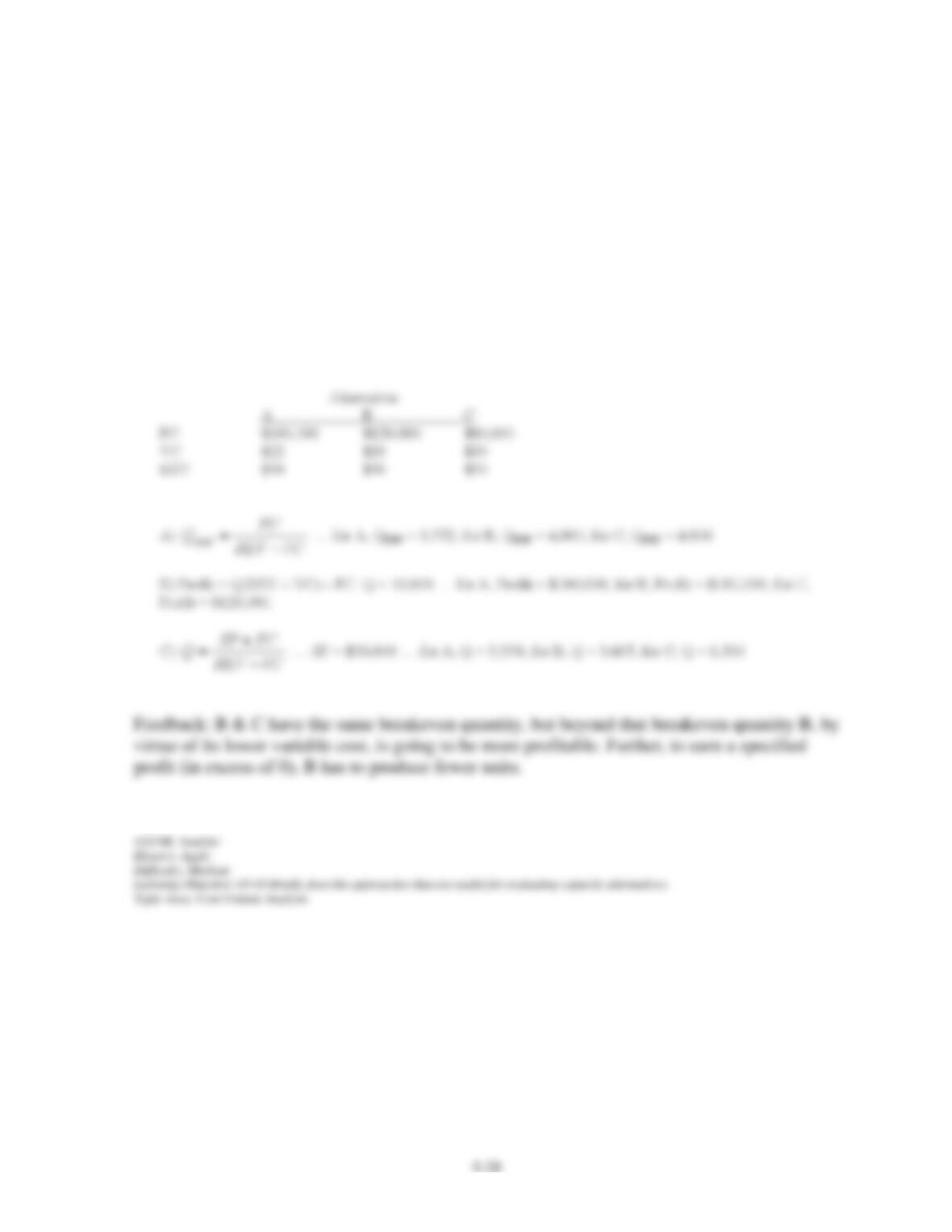
58. An investment proposal will have annual fixed costs of $60,000, variable costs of $35 per
unit of output, and revenue of $55 per unit of output.
(A) Determine the break-even quantity.
(B) What volume of output will be necessary for an annual profit of $60,000?
Chapter 05 – Strategic Capacity Planning for Products and Services
59. A firm is considering three capacity alternatives: A, B, and C. Alternative A would have
an annual fixed cost of $100,000 and variable costs of $22 per unit. Alternative B would have
annual fixed costs of $120,000 and variable costs of $20 per unit. Alternative C would have
fixed costs of $80,000 and variable costs of $30 per unit. Revenue is expected to be $50 per
unit.
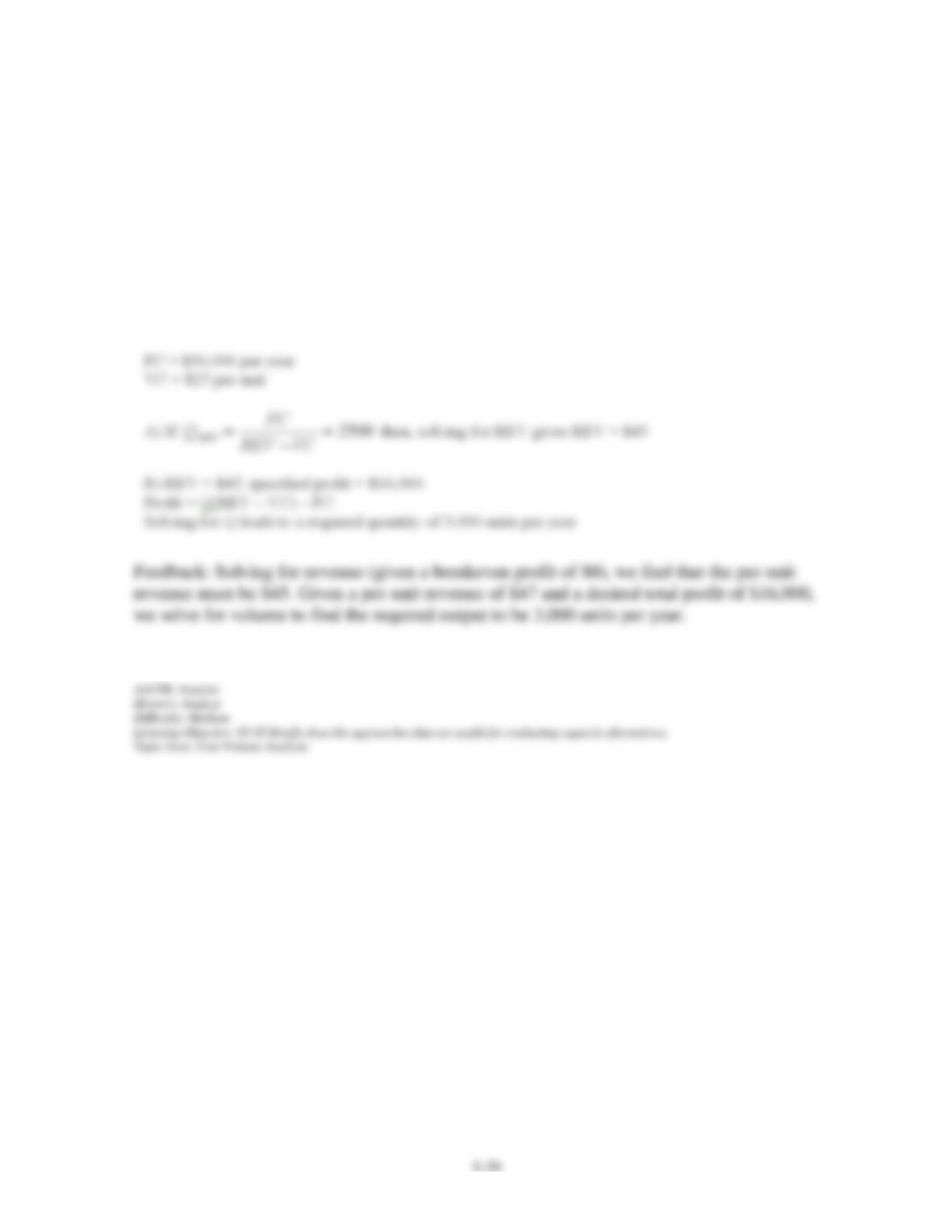
(A) Which alternative has the lowest break-even quantity?
(B) Which alternative will produce the highest profits for an annual output of 10,000 units?
(C) Which alternative would require the lowest volume of output to generate an annual profit
of $50,000?
Chapter 05 – Strategic Capacity Planning for Products and Services
60. A small business owner is contemplating the addition of another product line. Capacity
increases and equipment will result in an increase in annual fixed costs of $50,000. Variable
costs will be $25 per unit.
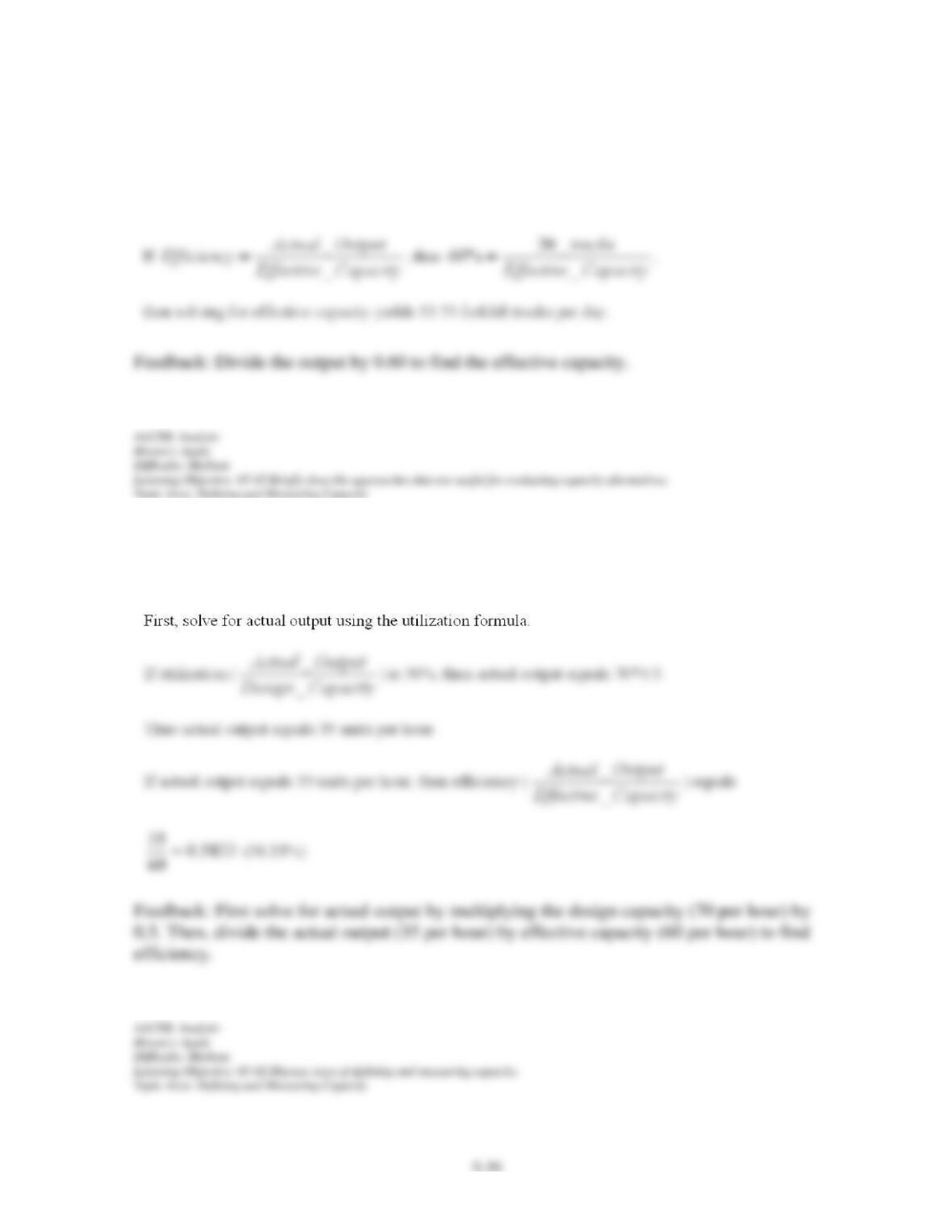
A) What unit selling price must the owner obtain to break-even on a volume of 2,500 units a
year?
B) Because of market conditions, the owner feels a revenue of $47 is preferred to the value
determined in part A. What volume of output will be required to achieve a profit of $16,000
using this revenue?
Chapter 05 – Strategic Capacity Planning for Products and Services
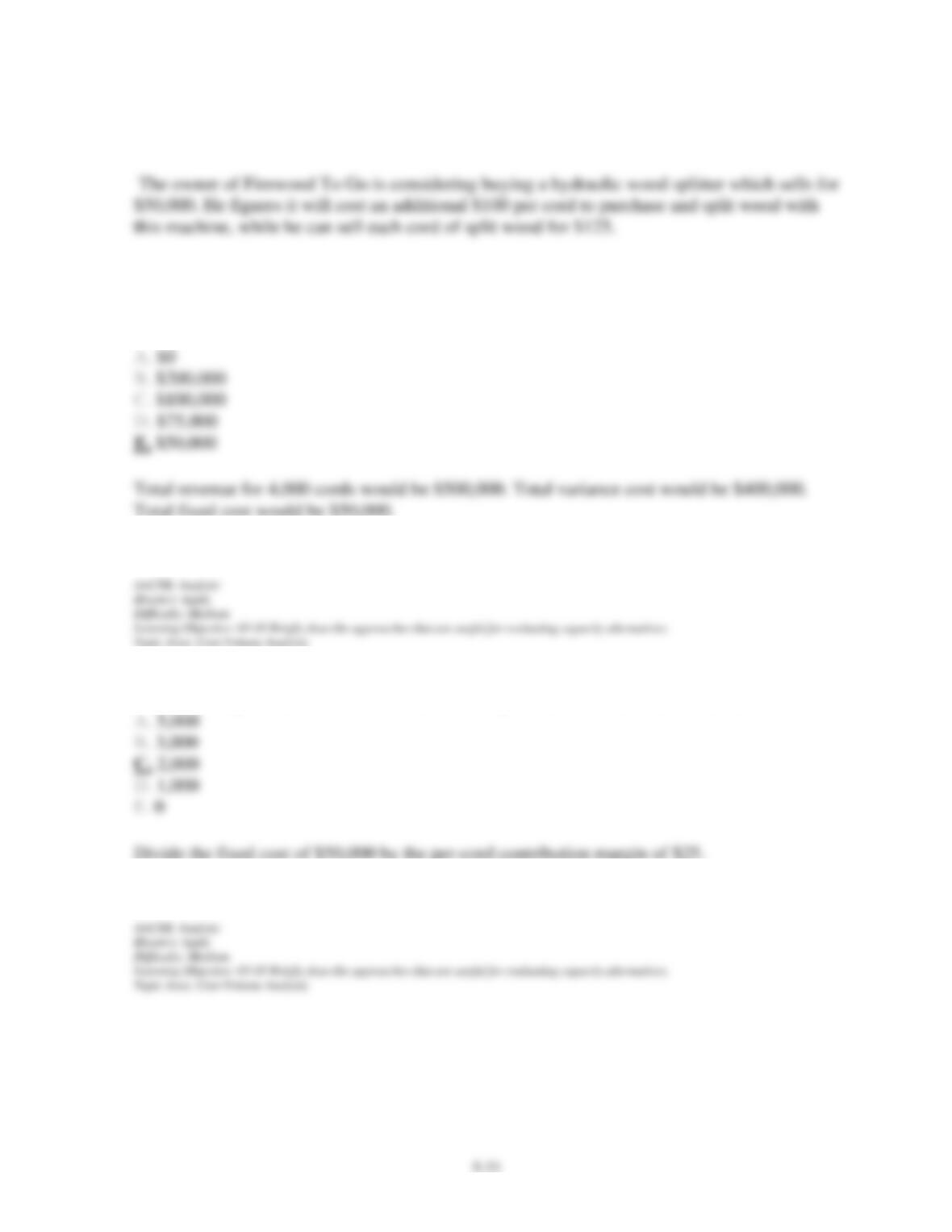
61. The efficiency of a productive unit is 60%. The unit produces an average of 20 forklift
trucks per day. Determine the effective capacity of the unit.
62. The utilization of a machine is 50%. The machine has a design capacity of 70 units per
hour and an effective capacity of 60 units per hour. Find the efficiency of the machine.
Chapter 05 – Strategic Capacity Planning for Products and Services
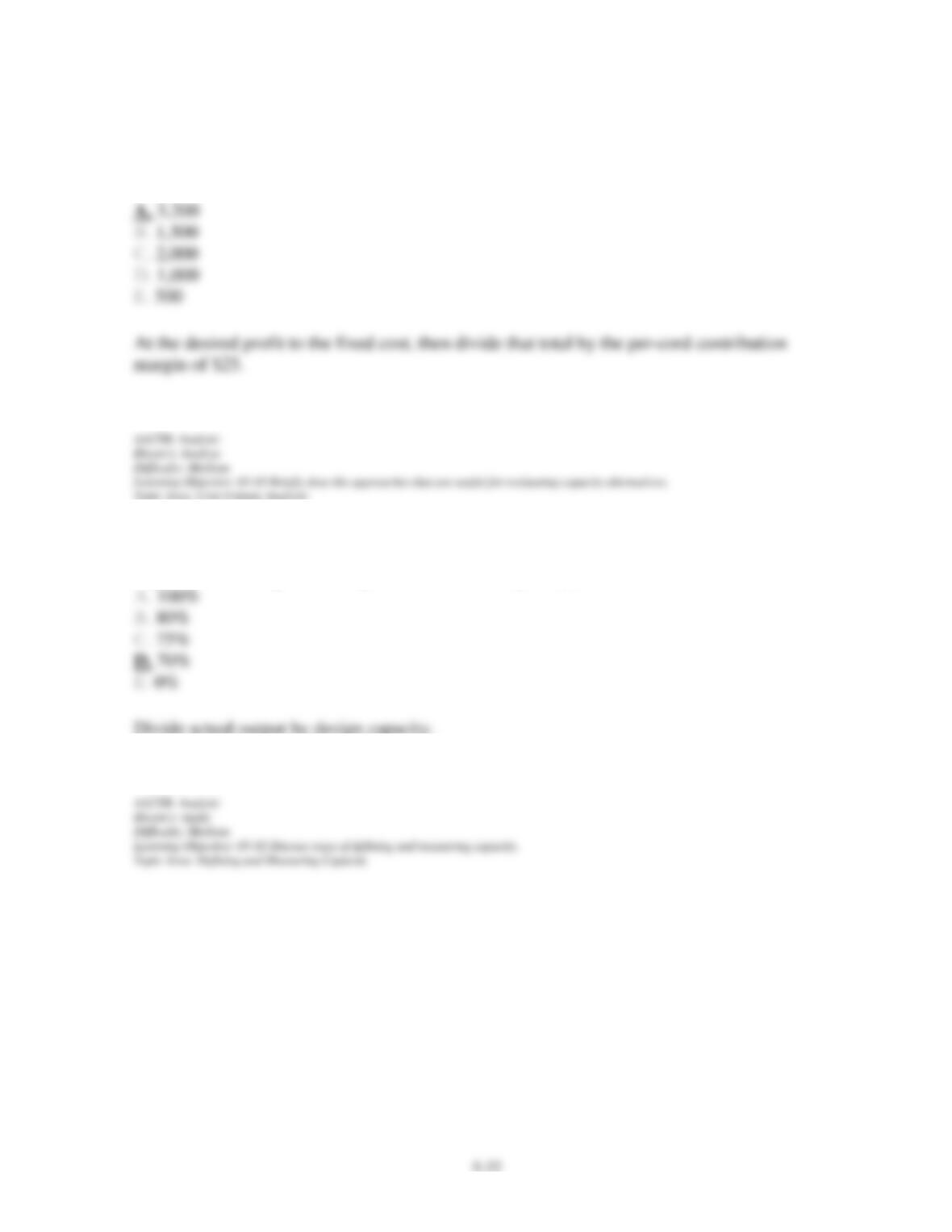
63. What would the potential profit be if he were to split 4,000 cords of wood with this
machine?
64. How many cords of wood would he have to split with this machine to break even?
Chapter 05 – Strategic Capacity Planning for Products and Services
65. How many cords of wood would he have to split with this machine to make a profit of
$30,000?
66. If, for this machine, design capacity is 50 cords per day, effective capacity is 40 cords per
day, and actual output is anticipated to be 35 cords per day, what would be its utilization?
Chapter 05 – Strategic Capacity Planning for Products and Services
67. If, for this machine, design capacity is 50 cords per day, effective capacity is 40 cords per
day, and actual output is expected to be 32 cords per day, what would be its efficiency?
The owner of a greenhouse and nursery is considering whether to spend $6,000 to acquire the
licensing rights to grow a new variety of rosebush, which she could then sell for $6 each. Per-
unit variable cost would be $3.
68. What would the profit be if she were to produce and sell 5,000 rosebushes?
Chapter 05 – Strategic Capacity Planning for Products and Services
69. How many rosebushes would she have to produce and sell in order to break even?
70. How many rosebushes would she have to produce and sell in order to make a profit of
$6,000?
Chapter 05 – Strategic Capacity Planning for Products and Services
5-35
71. If her available land has design and effective capacities of 3,000 and 2,000 rosebushes per
year respectively, and she plans to grow 1,200 rosebushes each year on this land, what will be
the utilization of this land?
72. If her available land has design and effective capacities of 3,000 and 2,000 rosebushes per
year, respectively, and she expects to be 80% efficient in her use of this land, how many
rosebushes does Rose plan to grow each year on this land?
A Virginia county is considering whether to pay $50,000 per year to lease a prisoner transfer
facility in a prime location near Washington, D.C. They estimate it will cost $50 per prisoner
to process the paperwork at this new location. The county is paid a $75 commission for each
new prisoner they process.