Chapter 5 – Utility & Game Theory
True / False
1. The decision alternative with the best expected monetary value will always be the most desirable decision.
a. True
b. False
2. When monetary value is not the sole measure of the true worth of the outcome to the decision maker, monetary value
should be replaced by utility.
a. True
b. False
3. The outcome with the highest payoff will also have the highest utility.
a. True
b. False
4. Expected utility is a particularly useful tool when payoffs stay in a range considered reasonable by the decision maker.
a. True
b. False
5. To assign utilities, consider the best and worst payoffs in the entire decision situation.
a. True
b. False
6. A risk avoider will have a concave utility function.
a. True
b. False
7. The expected utility is the utility of the expected monetary value.
a. True
b. False
Chapter 5 – Utility & Game Theory
8. The risk premium is never negative for a conservative decision maker.
a. True
b. False
9. The risk neutral decision maker will have the same indications from the expected value and expected utility approaches.
a. True
b. False
10. The utility function for a risk avoider typically shows a diminishing marginal return for money.
a. True
b. False
11. A game has a pure strategy solution when both players’ single-best strategies are the same.
a. True
b. False
12. A game has a saddle point when pure strategies are optimal for both players.
a. True
b. False
13. A game has a saddle point when the maximin payoff value equals the minimax payoff value.
a. True
b. False
14. The logic of game theory assumes that each player has different information.
a. True
Chapter 5 – Utility & Game Theory
b. False
15. With a mixed strategy, the optimal solution for each player is to randomly select among two or more of the alternative
strategies.
a. True
b. False
16. The expected monetary value approach and the expected utility approach to decision making usually result in the same
decision choice unless extreme payoffs are involved.
a. True
b. False
17. A risk neutral decision maker will have a linear utility function.
a. True
b. False
18. Given two decision makers, one risk neutral and the other a risk avoider, the risk avoider will always give a lower
utility value for a given outcome.
a. True
b. False
19. Generally, the analyst must make pairwise comparisons of the decision strategies in an attempt to identify dominated
strategies.
a. True
b. False
20. When the payoffs become extreme, most decision makers are satisfied with the decision that provides the best
expected monetary value.
a. True
b. False
Chapter 5 – Utility & Game Theory
21. Any 2 X 2 two-person, zero-sum, mixed-strategy game can be solved algebraically.
a. True
b. False
22. A dominated strategy will never be selected by the player.
a. True
Multiple Choice
23. When consequences are measured on a scale that reflects a decision maker’s attitude toward profit, loss, and risk,
payoffs are replaced by
a. utility values.
b. multicriteria measures.
c. sample information.
d. opportunity loss.
24. The purchase of insurance and lottery tickets shows that people make decisions based on
a. expected value.
b. sample information.
c. utility.
d. maximum likelihood.
25. The expected utility approach
a. does not require probabilities.
b. leads to the same decision as the expected value approach.
c. is most useful when excessively large or small payoffs are possible.
d. requires a decision tree.
26. Utility reflects the decision maker’s attitude toward
Chapter 5 – Utility & Game Theory
a. probability and profit
b. profit, loss, and risk
c. risk and regret
d. probability and regret
27. Values of utility
a. must be between 0 and 1.
b. must be between 0 and 10.
c. must be nonnegative.
d. must increase as the payoff improves.
28. If the payoff from outcome A is twice the payoff from outcome B, then the ratio of these utilities will be
a. 2 to 1.
b. less than 2 to 1.
c. more than 2 to 1.
d. unknown without further information.
29. The probability for which a decision maker cannot choose between a certain amount and a lottery based on that
probability is
a. the indifference probability.
b. the lottery probability.
c. the uncertain probability.
d. the utility probability.
30. A decision maker has chosen .4 as the probability for which he cannot choose between a certain loss of 10,000 and the
lottery p(−25000) + (1 − p)(5000). If the utility of −25,000 is 0 and of 5000 is 1, then the utility of −10,000 is
a. .5
b. .6
c. .4
d. 4
31. When the decision maker prefers a guaranteed payoff value that is smaller than the expected value of the lottery, the
decision maker is
a. a risk avoider.
Chapter 5 – Utility & Game Theory
b. a risk taker.
c. an optimist.
d. an optimizer.
32. A decision maker whose utility function graphs as a straight line is
a. conservative.
b. risk neutral.
c. a risk taker.
d. a risk avoider.
33. For a game with an optimal pure strategy, which of the following statements is false?
a. The maximin equals the minimax.
b. The value of the game cannot be improved by either player changing strategies.
c. A saddle point exists.
d. Dominated strategies cannot exist.
34. Which of the following statements about a dominated strategy is false?
a. A dominated strategy will never be selected by a player.
b. A dominated strategy exists if another strategy is at least as good regardless of what the opponent does.
c. A dominated strategy is superior to a mixed strategy.
d. A dominated strategy can be eliminated from the game.
35. A 3 x 3 two-person zero-sum game that has no optimal pure strategy and no dominated strategies
a. can be solved using a linear programming model.
b. can be solved algebraically.
c. can be solved by identifying the minimax and maximin values.
d. cannot be solved.
36. For a two-person zero-sum game, which one of the following is false?
a. The gain for one player is equal to the loss for the other player.
b. A payoff of 2 for one player has a corresponding payoff of −2 for the other player.
c. The sum of the payoffs in the payoff table is zero.
d. What one player wins, the other player loses.
Chapter 5 – Utility & Game Theory
37. If the maximin and minimax values are not equal in a two-person zero-sum game,
a. a mixed strategy is optimal.
b. a pure strategy is optimal.
c. a dominated strategy is optimal.
d. one player should use a pure strategy and the other should use a mixed strategy.
38. If it is optimal for both players in a two-person, zero-sum game to select one strategy and stay with that strategy
regardless of what the other player does, the game
a. has more than one equilibrium point.
b. will have alternating winners.
c. will have no winner.
d. has a pure strategy solution.
39. For a two-person, zero-sum, mixed-strategy game, each player selects its strategy according to
a. what strategy the other player used last.
b. a fixed rotation of strategies.
c. a probability distribution.
d. the outcome of the previous game.
40. When the utility function for a risk-neutral decision maker is graphed (with monetary value on the horizontal axis and
utility on the vertical axis), the function appears as
a. a straight line
b. a convex curve
c. a concave curve
d. an ‘S’ curve
41. If a game larger than 2 X 2 requires a mixed strategy, we attempt to reduce the size of the game by
a. identifying saddle points
b. looking for dominated strategies
c. inverting the payoff matrix
d. eliminating negative payoffs
Chapter 5 – Utility & Game Theory
42. To select a strategy in a two-person, zero-sum game, Player A follows a ______ procedure and Player B follows a
______ procedure.
a. maximax, minimin
b. maximax, minimax
c. maximax, maximax
d. maximin, minimax
Subjective Short Answer
43. For the payoff table below, the decision maker will use P(s1) = .15, P(s2) = .5, and P(s3) = .35.
State of Nature
Decision s1 s2 s3
d1 −5000 1000 10,000
d2 −15,000 −2000 40,000
a. What alternative would be chosen according to expected value?
b. For a lottery having a payoff of 40,000 with probability p and −15,000 with probability (1 − p), the
decision maker expressed the following indifference probabilities.
Payoff Probability
10,000 .85
1000 .60
−2000 .53
−5000 .50
Let U(40,000) = 10 and U(−15,000) = 0 and find the utility value for each payoff.
c. What alternative would be chosen according to expected utility?
44. A decision maker who is considered to be a risk taker is faced with this set of probabilities and payoffs
State of Nature
Decision s1 s2 s3
d1 5 10 20
Chapter 5 – Utility & Game Theory
d2 −25 0 50
d3 −50 −10 80
Probability .30 .35 .35
For the lottery p(80) + (1 − p)(−50), this decision maker has assessed the following indifference probabilities
Payoff Probability
50 .60
20 .35
10 .25
5 .22
0 .20
−10 .18
−25 .10
Rank the decision alternatives on the basis of expected value and on the basis of expected utility.
45. Three decision makers have assessed utilities for the problem whose payoff table appears below.
State of Nature
Decision s1 s2 s3
d1 500 100 −400
d2 200 150 100
d3 −100 200 300
Probability .2 .6 .2
Indifference Probability for Person
Payoff A B C
300 .95 .68 .45
200 .94 .64 .32
150 .91 .62 .28
100 .89 .60 .22
−100 .75 .45 .10
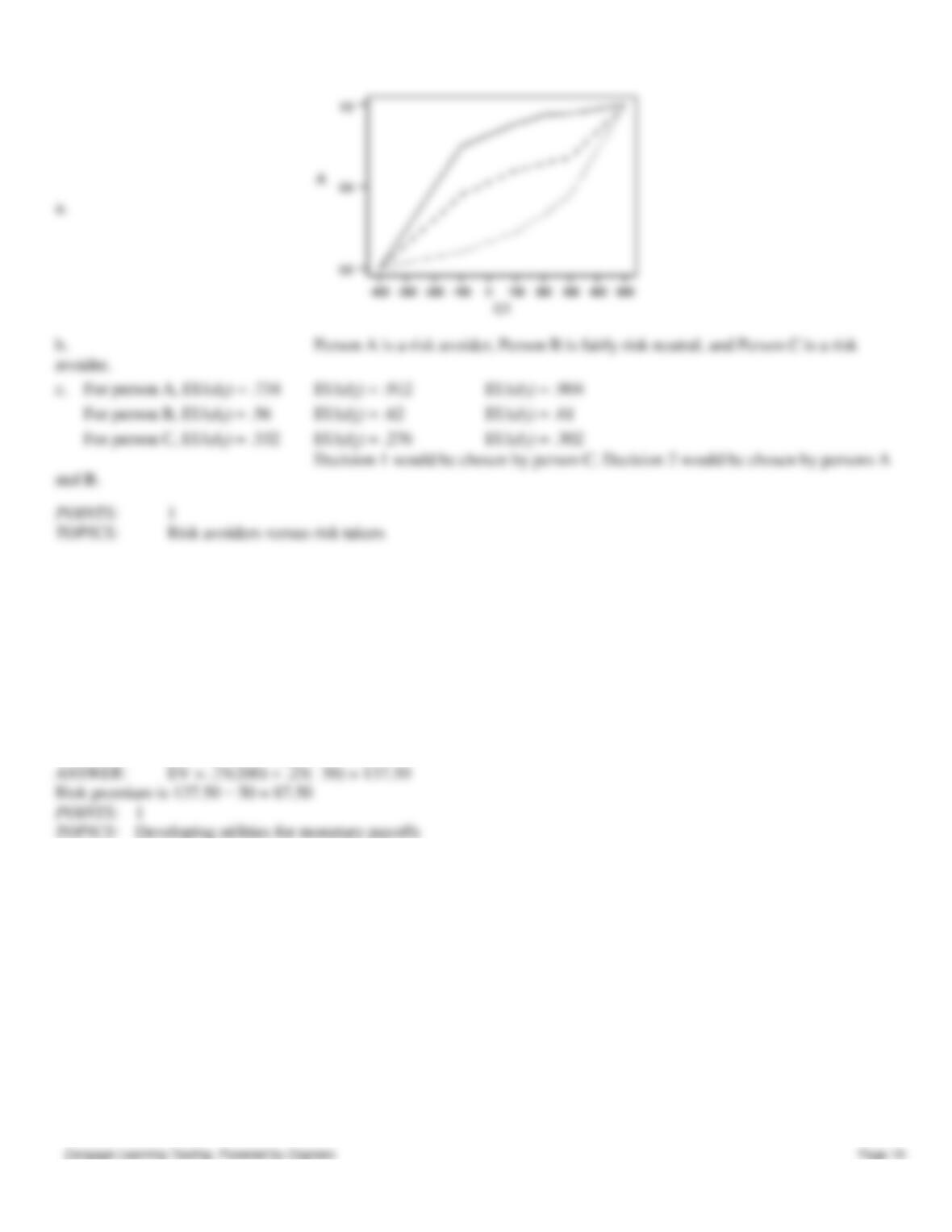
a. Plot the utility function for each decision maker.
b. Characterize each decision maker’s attitude toward risk.
c. Which decision will each person prefer?
Chapter 5 – Utility & Game Theory
46. A decision maker has the following utility function
Payoff Indifference Probability
200 1.00
150 .95
50 .75
0 .60
−50 0
What is the risk premium for the payoff of 50?
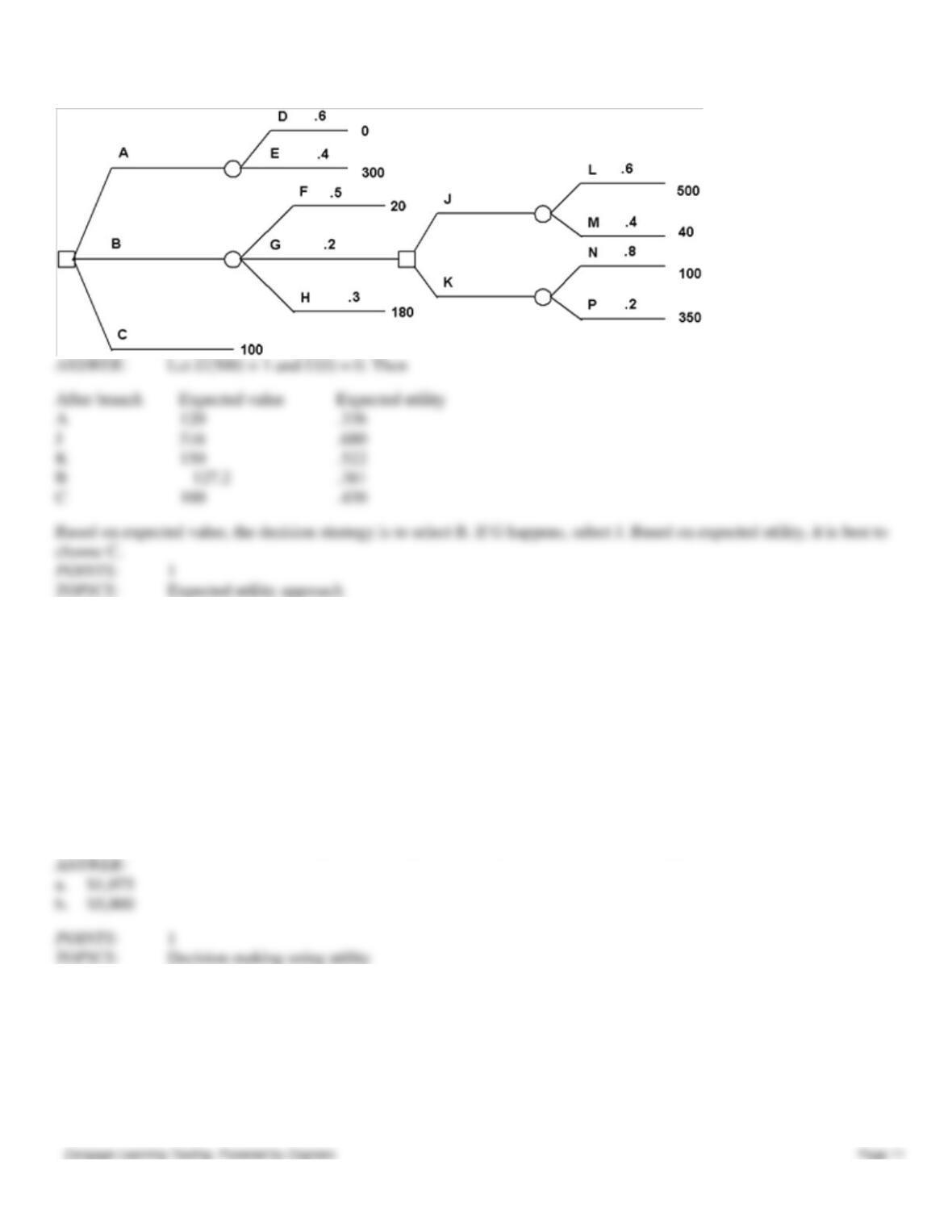
47. Determine decision strategies based on expected value and on expected utility for this decision tree. Use the utility
function
Payoff Indifference Probability
500 1.00
350 .89
300 .84
180 .60
100 .43
40 .20
20 .13
0 0
Chapter 5 – Utility & Game Theory
48. Burger Prince Restaurant is considering the purchase of a $100,000 fire insurance policy. The fire statistics indicate
that in a given year the probability of property damage in a fire is as follows:
Fire Damage $100,000 $75,000 $50,000 $25,000 $10,000 $0
Probability .006 .002 .004 .003 .005 .980
a. If Burger Prince was risk neutral, how much would they be willing to pay for fire insurance?
b. If Burger Prince has the utility values given below, approximately how much would they be willing to pay for fire
insurance?
Loss $100,000 $75,000 $50,000 $25,000 $10,000 $5,000 $0
Utility 0 30 60 85 95 99 100
49. Super Cola is considering the introduction of a new 8 oz. root beer. The probability that the root beer will be a success
is believed to equal .6. The payoff table is as follows:
Success (s1) Failure (s2)
Produce $250,000 −$300,000
Do Not Produce −$50,000 −$20,000
Chapter 5 – Utility & Game Theory
Company management has determined the following utility values:
Amount $250,000 −$20,000 −$50,000 −$300,000
Utility 100 60 55 0
a. Is the company a risk taker, risk averse, or risk neutral?
b. What is Super Cola’s optimal decision?
50. Chez Paul is contemplating either opening another restaurant or expanding its existing location. The payoff table for
these two decisions is:
State of Nature
Decision s1 s2 s3
New Restaurant −$80,000 $20,000 $160,000
Expand −$40,000 $20,000 $100,000
Paul has calculated the indifference probability for the lottery having a payoff of $160,000 with probability p and
−$80,000 with probability (1−p) as follows:
Amount Indifference Probability (p)
−$40,000 .4
$20,000 .7
$100,000 .9
a. Is Paul a risk avoider, a risk taker, or risk neutral?
b. Suppose Paul has defined the utility of −$80,000 to be 0 and the utility of $160,000 to be 80. What would be the
utility values for −$40,000, $20,000, and $100,000 based on the indifference probabilities?
c. Suppose P(s1) = .4, P(s2) = .3, and P(s3) = .3. Which decision should Paul make? Compare with the decision using
the expected value approach.
51. The Dollar Department Store chain has the opportunity of acquiring either 3, 5, or 10 leases from the bankrupt Granite
Variety Store chain. Dollar estimates the profit potential of the leases depends on the state of the economy over the next
five years. There are four possible states of the economy as modeled by Dollar Department Stores and its president
estimates P(s1) = .4, P(s2) = .3, P(s3) = .1, and P(s4) = .2. The utility has also been estimated. Given the payoffs (in
Chapter 5 – Utility & Game Theory
$1,000,000’s) and utility values below, which decision should Dollar make?
Payoff Table State Of The Economy
Over The Next 5 Years
Decision s1 s2 s3 s4
d1 — buy 10 leases 10 5 0 −20
d2 — buy 5 leases 5 0 −1 −10
d3 — buy 3 leases 2 1 0 −1
d4 — do not buy 0 0 0 0
Utility Table
Payoff (in $1,000,000’s) +10 +5 +2 0 −1 −10 −20
Utility +10 +5 +2 0 −1 −20 −50
52. Consider the following two-person zero-sum game. Assume the two players have the same two strategy options. The
payoff table shows the gains for Player A.
Player B
Player A Strategy b1 Strategy b2
Strategy a1 3 9
Strategy a2 6 2
Determine the optimal strategy for each player. What is the value of the game?
53. Consider the following two-person zero-sum game. Assume the two players have the same three strategy options. The
payoff table below shows the gains for Player A.
Player B
Player A Strategy b1 Strategy b2 Strategy b3
Strategy a1 3 5 −2
Strategy a2 −2 −1 2
Strategy a3 2 1 −5
Is there an optimal pure strategy for this game? If so, what is it? If not, can the mixed-strategy probabilities be found
algebraically? What is the value of the game?
Chapter 5 – Utility & Game Theory
54. Suppose that there are only two vehicle dealerships (A and B) in a small city. Each dealership is considering three
strategies that are designed to take sales of new vehicles from the other dealership over a period of four months. The
strategies, assumed to be the same for both dealerships, are:
Strategy 1: Offer a cash rebate on a new vehicle.
Strategy 2: Offer free optional equipment on a new vehicle.
Strategy 3: Offer a 0% loan on a new vehicle.
The payoff table (in number of new vehicle sales gained per week by Dealership A (or lost by Dealership B) is shown
below.
Dealership B
Cash Rebate Free Options 0% Loan
Dealership A b1 b2 b3
Cash Rebate a1 2 2 1
Free Options a2 −3 3 −1
0% Loan a3 3 −2 0
Identify the pure strategy for this two-person zero-sum game. What is the value of the game?
55. Consider the following two-person zero-sum game. Assume the two players have the same two strategy options. The
payoff table shows the gains for Player A.
Player B
Player A Strategy b1 Strategy b2
Strategy a1 4 8
Strategy a2 11 5
Determine the optimal strategy for each player. What is the value of the game?
Chapter 5 – Utility & Game Theory
56. Consider the following two-person zero-sum game. Assume the two players have the same three strategy options. The
payoff table shows the gains for Player A.
Player B
Player A Strategy b1 Strategy b2 Strategy b3
Strategy a1 6 5 −2
Strategy a2 1 0 3
Strategy a3 3 4 −3
Is there an optimal pure strategy for this game? If so, what is it? If not, can the mixed-strategy probabilities be found
algebraically?
57. Consider the following two-person zero-sum game. Assume the two players have the same three strategy options. The
payoff table below shows the gains for Player A.
Player B
Player A Strategy b1 Strategy b2 Strategy b3
Strategy a1 3 2 −4
Strategy a2 −1 0 2
Strategy a3 4 5 −3
Is there an optimal pure strategy for this game? If so, what is it? If not, can the mixed-strategy probabilities be found
algebraically? What is the value of the game?
Chapter 5 – Utility & Game Theory
58. Two banks (Franklin and Lincoln) compete for customers in the growing city of Logantown. Both banks are
considering opening a branch office in one of three new neighborhoods: Hillsboro, Fremont, or Oakdale. The strategies,
assumed to be the same for both banks, are:
Strategy 1: Open a branch office in the Hillsboro neighborhood.
Strategy 2: Open a branch office in the Fremont neighborhood.
Strategy 3: Open a branch office in the Oakdale neighborhood.
Values in the payoff table below indicate the gain (or loss) of customers (in thousands) for Franklin Bank based on the
strategies selected by the two banks.
Lincoln Bank
Hillsboro Fremont Oakdale
Franklin Bank b1 b2 b3
Hillsboro a1 4 2 3
Fremont a2 6 −2 −3
Oakdale a3 −1 0 5
Identify the neighborhood in which each bank should locate a new branch office. What is the value of the game?
59. Consider the following problem with four states of nature, three decision alternatives, and the following payoff table
(in $’s):
s1 s2 s3 s4
d1 200 2600 –1400 200
d2 0 200 – 200 200
d3 -200 400 0 200
The indifference probabilities for three individuals are:
Payoff Person 1 Person 2 Person 3
$ 2600 1.00 1.00 1.00
$ 400 .40 .45 .55
$ 200 .35 .40 .50
$ 0 .30 .35 .45
-$ 200 .25 .30 .40
-$1400 0 0 0
a. Classify each person as a risk avoider, risk taker, or risk neutral.
b. For the payoff of $400, what is the premium the risk avoider will pay to avoid risk? What is the premium the risk taker
will pay to have the opportunity of the high payoff?
c. Suppose each state is equally likely. What are the optimal decisions for each of these three people?
Chapter 5 – Utility & Game Theory
60. Metropolitan Cablevision has the choice of using one of three DVR systems. Profits are believed to be a function of
customer acceptance. The payoff to Metropolitan for the three systems is:
System
Acceptance Level I II III
High $150,000 $200,000 $200,000
Medium $ 80,000 $ 20,000 $ 80,000
Low $ 20,000 –$ 50,000 -$100,000
The probabilities of customer acceptance for each system are:
System
Acceptance Level I II III
High .4 .3 .3
Medium .3 .4 .5
Low .3 .3 .2
The first vice president believes that the indifference probabilities for Metropolitan should be:
Amount Probability
$150,000 .90
$ 80,000 .70
$ 20,000 .50
-$ 50,000 .25
The second vice president believes Metropolitan should assign the following utility values:
Amount Utility
$200,000 125
$150,000 95
$ 80,000 55
$ 20,000 30
-$ 50,000 10
-$100,000 0
a. Which vice president is a risk taker? Which one is risk averse?
b. Which system will each vice president recommend?
c. What system would a risk neutral vice president recommend?
Chapter 5 – Utility & Game Theory
61. Consider a two-person, zero-sum game where the payoffs listed below are the winnings for Player A. Identify the pure
strategy solution. What is the value of the game?
Player B Strategies
Player A Strategies b1 b2 b3
a1 5 5 4
a2 1 6 2
a3 7 2 3
62. Consider a two-person, zero-sum game where the payoffs listed below are the winnings for Company X. Identify the
pure strategy solution. What is the value of the game?
Company Y Strategies
Company X Strategies y1 y2 y3
x1 3 5 9
x2 8 4 3
x3 7 6 7
63. Consider the following two-person, zero-sum game. Payoffs are the winnings for Company X. Formulate the linear
program that determines the optimal mixed strategy for Company X.
Company Y Strategies
Company X Strategies y1 y2 y3
x1 4 3 9
x2 2 5 1
x3 6 1 7
64. Shown below is the solution to the linear program for finding Player A’s optimal mixed strategy in a two-person, zero-
sum game.
Chapter 5 – Utility & Game Theory
OBJECTIVE FUNCTION VALUE = 3.500
VARIABLE VALUE REDUCED COSTS
PA1 0.050 0.000
PA2 0.600 0.000
PA3 0350 0.000
GAINA 3.500 0.000
CONSTRAINT SLACK/SURPLUS DUAL PRICES
1 0.000 −0.500
2 0.000 −0.500
3 0.000 0.000
4 0.000 3.500
a. What is Player A’s optimal mixed strategy?
b. What is Player B’s optimal mixed strategy?
c. What is Player A’s expected gain?
d. What is Player B’s expected loss?
Essay
65. When and why should a utility approach be followed?
66. Give two examples of situations where you have decided on a course of action that did not have the highest expected
monetary value.
67. Explain how utility could be used in a decision where performance is not measured by monetary value.
Chapter 5 – Utility & Game Theory
68. Explain the relationship between expected utility, probability, payoff, and utility.
69. Draw the utility curves for three types of decision makers, label carefully, and explain the concepts of increasing and
decreasing marginal returns for money.
70. Game theory models extend beyond two-person, zero-sum games. Discuss two extensions (or variations).