CHAPTER 4—SECURITIES MARKETS AND THE ECONOMY
TRUE/FALSE
1. A market is a means through which buyers and sellers are brought together to aid in the transfer of
goods and/or services.
2. It is required by law that a stock market must have a physical location.
3. If transaction prices are volatile, but long-term prices are stable, this is referred to as price continuity.
4. A continuous market that has price continuity requires depth of buyers and sellers.
5. A market where prices adjust rapidly to new information is considered to be internally efficient.
6. Informational efficiency is where the cost of acquiring information is very cheap.
7. The primary market is where issues are traded between current and potential owners.
8. Negotiation, competitive bids, and best efforts are three forms of underwriting arrangements.
9. A corporation wishing to raise funds will normally want the investment banker to use a “best efforts”
arrangement rather than a negotiated basis.
10. Short Form Prospectus Distribution system allows large firms to register ten years worth of financing
needs all at one time.
11. Only the stocks of large companies are traded in the primary market.
2
12. A good secondary market is important to the efficiency of the primary market.
13. The NYSE has dominated the other U.S. exchanges in trading volume.
14. In recent years there has been a trend toward the consolidation of existing exchanges in developed
markets, such as London, Frankfurt and Paris.
15. Listed stocks traded on the over-the-counter market are being traded in the third market.
16. The over-the-counter market includes all stocks not listed on one of the major exchanges but
constitutes a lesser of a dollar value than the New York Stock Exchange.
17. The over-the-counter market lists more stocks than the New York Stock Exchange.
18. The value of the stocks traded in the over-the-counter market is greater than the values of the stocks
traded on the New York Stock Exchange.
19. The NASDAQ National Market System is an order driven market.
20. Margin transaction involves borrowing part of the cost of an investment.
21. Short selling is practiced when an investor borrows part of the cost of the investment, e.g., they are
“short” on cash.
22. The TSX is a dealer market.
23. Specialists benefit from their exclusive knowledge of the limit order books.
3
24. An electronic Crossing Systems are electronic facilities that act as brokers to match large buy and sell
orders.
25. The fourth market refers to alternative trading systems such as Electronic Communication Networks
and Electronic Crossing Systems.
26. Electronic Communication Networks and Electronic Crossing Systems do provide listing services.
27. The third market has grown because of the cost factor.
28. Short Form Prospectus Distribution system allows corporations to place securities privately with large,
sophisticated institutional investors without extensive registration documents.
29. Secondary equity issues are new shares offered by firms that already have stock outstanding.
30. In a pure auction market buyers and sellers submit bid-and-ask prices for a given stock to a central
location.
31. In a dealer market trading system shares of stock are sold to the investor with the highest bid price and
bought from the seller with the lowest offering price.
32. Specialists provide added liquidity in the NASDAQ market.

4
MULTIPLE CHOICE
1. Which of the following statements about a market is true?
a.
It is not necessary for the market to have a physical location.
b.
The market does not necessarily own the goods or services involved.
c.
A market can deal in any variety of goods and services.
d.
All of the above
e.
None of the above
2. Which of the following is not a characteristic of a good market for goods and services?
a.
Timely and accurate information
b.
Liquidity
c.
Low transaction costs
d.
External efficiency
e.
All of the above are characteristics of a good market.
3. Which of the following is not a secondary equity market?
a.
Treasury market
b.
Toronto stock exchange
c.
Regional exchanges
d.
Over-the-counter market
e.
All of the above are secondary equity markets.
4. Why do regional exchanges exist?
a.
They provide trading facilities for local companies
b.
They allow local brokers to trade dual listed stocks
c.
They allow for trading of provincial government bonds
d.
Choices a and b
e.
Choices b and c
5. An order that specifies the highest buy or lowest sell price is a
a.
Limit order.
b.
Short sale.
c.
Market order.
d.
Margin call.
e.
Stop loss.

5
6. When an investor borrows part of the investment cost it is known as
a.
A short sale.
b.
A fill or kill order.
c.
A margin transaction.
d.
A limit order.
e.
Going long.
7. Which of the following is not a function of the specialist?
a.
Assists Bank of Canada in controlling the money supply
b.
Acts as a broker who handles the limit orders or special orders placed with member
brokers
c.
Buys and sells securities in order to stabilize the market
d.
Acts as a dealer in assigned stocks to maintain a fair and orderly market
e.
All of the above are functions of a specialist
8. The member of the Exchange who acts as a dealer on assigned stocks is known as a
a.
Margin broker.
b.
Commission broker.
c.
Registered broker.
d.
Non-registered broker.
e.
Specialist.
9. Which of the following is true regarding a market order?
a.
Specify the buy and sell price.
b.
Instruct the broker to return the stock to the lender.
c.
Request a loan from the broker to purchase a stock.
d.
Buy and sell a stock at the best current price.
e.
None of the above.
10. The S&P/TSX composite index is a(n)
a.
Price-weighted index.
b.
Equally weighted index
c.
Value weighted index.
d.
Unweighted index.
e.
None of the above.

6
11. A limit order book refers to a system where
a.
All limit orders are electronically matched.
b.
All limit orders are visible to the specialist only.
c.
All limit orders are visible to markets makers and specialists.
d.
Orders are routed through Super Dot.
e.
None of the above.
12. In a call market, trading for individual stocks
a.
Occurs anytime the market is open.
b.
Takes place at specific times.
c.
Takes place at the open and close of the trading day.
d.
All of the above.
e.
None of the above.
13. A pure auction market is one in which
a.
Dealers provide liquidity by buying and selling shares of stock for themselves.
b.
Dealers compete against each other to provide the highest bid and lowest asking prices.
c.
Buyers submit bid prices to sellers.
d.
Sellers submit ask prices to buyers.
e.
Buyers and sellers submit bid and ask prices to a central location to be matched.
14. In a negotiated bid, the underwriter carries out the following service(s)
a.
Origination, risk-bearing, and distribution.
b.
Origination and risk-bearing.
c.
Risk-bearing and distribution.
d.
Origination and distribution.
e.
Risk-bearing and distribution.
15. Which method(s) is used for selling municipals?
a.
Competitive bid
b.
Negotiated sale
c.
Private placement
d.
All of the above
e.
None of the above
16. When a market is externally efficient, it means that
a.
Timely and accurate information is available
b.
The market is liquid
c.
Transaction costs are low
d.
Prices adjust rapidly to new information
e.
The number of buyers and sellers are the same

7
17. When a market is internally efficient, it means that
a.
The market has price continuity.
b.
The market has minimal transactions costs
c.
The market has good depth
d.
The market has more buyers than sellers
e.
The market has more sellers than buyers
18. Trading in the secondary markets for Canadian government and municipal bonds
a.
Takes place through a network of primary dealers
b.
Takes place over the counter by dealers who buy and sell on their own account
c.
Takes place on the TSX
d.
All of the above
e.
None of the above
19. Which of the following is an underwriting function?
a.
Origination
b.
Risk-bearing
c.
Distribution
d.
Choices b and c.
e.
All of the above
20. With a best effort offering, the investment banker performs all of the following roles except:
a.
determines the fee paid to themselves for handling the issue.
b.
manages the selling group for the new issue.
c.
evaluates market conditions and determines the characteristics of the security.
d.
guarantees the selling price for the entire issue to the firm issuing the securities.
e.
All of the above are true.
21. The basic distinction between a primary and a secondary market is
a.
proceeds from sales in the primary market go to the current owner of a security; proceeds
in secondary market go to the original owner.
b.
primary markets involve direct dealings within regional exchanges.
c.
only new securities are sold in the primary market; only outstanding securities are bought
and sold in the secondary market.
d.
primary markets deal exclusively in bonds; secondary markets deal primarily in common
stock.
e.
None of the above.

8
22. Trading in the secondary markets for government bonds
a.
Takes place through a network of primary dealers
b.
Takes place over the counter by dealers who buy and sell on their own account
c.
Takes place on the TSX
d.
All of the above
e.
None of the above
23. Secondary markets are important because
a.
The prevailing market price of securities is determined in the secondary market
b.
It has an impact on price stability
c.
It has an impact on price continuity
d.
All of the above
e.
None of the above
24. Which of the following is not a characteristic of Short Form Prospectus Distribution system?
a.
All large firms to borrow money for short period of time.
b.
Allow large firms to file their annual and interim financial statements on a continuous
basis.
c.
Provide flexibility and reduce registration fees and expenses.
d.
Are typically used for the sale of straight debentures rather than common stock or
convertible issues.
e.
All of the above are characteristics of Short Form Prospectus Distribution system.
25. All of the following are advantages of secondary markets except
a.
Provide liquidity to individuals holding the securities.
b.
Support the primary market by reducing the required rate of return due to the lower
liquidity risk for securities.
c.
Provide price discovery for corporations selling seasoned securities.
d.
Impact market efficiency and price volatility.
e.
All of the above are advantages of secondary markets.
26. Which of the following is not a major category of membership in an organized stock exchange?
a.
Specialist
b.
National Association of Securities Dealers Automated Quotation System
c.
National Market System
d.
Financial analyst
e.
b and c
9
27. Investors can leverage their stock transactions with the use of
a.
Margin orders
b.
Stop loss orders
c.
Limit orders
d.
Market orders
e.
Specialists
USE THE FOLLOWING INFORMATION FOR THE NEXT PROBLEM(S)
Jackie has a margin account with a balance of $150,000. If the initial margin deposit is 60% and Turtle
Industries is currently selling at $50 per share:
28. Refer to Exhibit 4-1. How many shares of Turtle can Jackie purchase?
a.
5,000
b.
3,000
c.
1,800
d.
1,200
e.
None of the above
29. Refer to Exhibit 4-1. What is Jackie’s profit/loss if Turtle’s price after one year is $40?
a.
$50,000
b.
−$50,000
c.
$100,000
d.
−$100,000
e.
None of the above
30. Refer to Exhibit 4-1. If the maintenance margin is 25%, to what price can Turtle Industries fall before
Jackie receives a margin call?
a.
$14.56
b.
$23.17
c.
$32.42
d.
$26.67
e.
None of the above
Exhibit 4-2
USE THE FOLLOWING INFORMATION FOR THE NEXT PROBLEM(S)
Heidi Talbott has a margin account with a balance of $50,000. If the initial margin deposit is 50%, and
RC Industries is currently selling at $50 per share:
31. Refer to Exhibit 4-2. How many shares of RC can Heidi buy?
a.
2,500
b.
2,000
c.
1,000
d.
500
e.
None of the above
32. Refer to Exhibit 4-2. What is Heidi’s profit if RC’s price rises to $80?
a.
$55,000
b.
$50,000
c.
$60,000
d.
$68,270
e.
$28,570
33. Refer to Exhibit 4-2. If the maintenance margin is 25%, to what price can RC Industries stock price
fall before Heidi receives a margin call?
a.
$21.75
b.
$23.33
c.
$32.00
d.
$33.33
e.
None of the above
34. Refer to Exhibit 4-3. How many shares of Jackson can Kathy buy?
a.
1875
b.
1500
c.
1750
d.
1200
e.
None of the above
35. Refer to Exhibit 4-3. What is Kathy’s profit if Jackson’s price rises to $50?
a.
$18,750
b.
$15,750
c.
$55,000
d.
$37,750
e.
$28,570
36. Refer to Exhibit 4-3. If the maintenance margin is 25%, to what price can Jackson Industries fall
before Kathy receives a margin call?
a.
$21.75
b.
$23.00
c.
$10.67
d.
$15.93
e.
None of the above
12
Exhibit 4-4
USE THE FOLLOWING INFORMATION FOR THE NEXT PROBLEM(S)
You decide to sell 100 shares of Davis Industries short when it is selling at its yearly high of $35. Your
broker tells you that your margin requirement is 55% and that the commission on the sale is $15.
While you are short, Davis pays a $0.75 per share dividend. At the end of one year you buy your Davis
shares (cover your short sale) at $30 and are charged a commission of $15 and a 6% interest rate.
37. Refer to Exhibit 4-4. What is your dollar return on the investment?
a.
$130.50
b.
$300.50
c.
$100.00
d.
$1,773.75
e.
$3,500.00
38. Refer to Exhibit 4-4. What is your rate of return on the investment?
a.
10.48%
b.
12.87%
c.
13.98%
d.
15.49%
e.
18.87%
Exhibit 4-5
USE THE FOLLOWING INFORMATION FOR THE NEXT PROBLEM(S)
You decide to sell 100 shares of Topgun Enterprises Inc. short when it is selling at its yearly high of
$42.25. Your broker tells you that your margin requirement is 60% and that the commission on the
sale is $20. While you are short, Topgun pays a $0.85 per share dividend. At the end of one year you
buy your Topgun shares (cover your short sale) at $44 and are charged a commission of $20 and a 5%
interest rate.
13
39. Refer to Exhibit 4-5. What is your dollar return on the investment?
a.
$384.50
b.
$432.88
c.
−$432.88
d.
−$384.50
e.
−$950.55
40. Refer to Exhibit 4-5. What is your rate of return on the investment?
a.
10.48%
b.
12.87%
c.
−13.98%
d.
−24.49%
e.
−15.05%
41. Suppose you buy a round lot of DG Solutions stock on 60% margin when it is selling at $55 per share.
The broker charges a 10% annual interest rate and commissions are 3% of the total stock value on both
the purchase and the sale. If at year end you receive a $1.10 per share dividend and sell the stock for
55 5/8, what is your rate of return on the investment?
a.
−10.38%
b.
−12.84%
c.
−10.95%
d.
21.84%
e.
28.38%
14
42. Suppose you buy a round lot of HS Inc. stock on 55% margin when it is selling at $40 per share. The
broker charges a 10% annual interest rate and commissions are 4% of the total stock value on both the
purchase and the sale. If at year end you receive a $0.90 per share dividend and sell the stock for 35
5/8, what is your rate of return on the investment?
a.
−35.17%
b.
−21.84%
c.
14.74%
d.
21.84%
e.
35.17%
43. Suppose you buy a round lot of Altman Industries stock on 50% margin when it is selling at $35 per
share. The broker charges a 10% annual interest rate and commissions are 5% of the total stock value
on both the purchase and the sale. If at year end you receive a $1.00 per share dividend and sell the
stock for $42.63, what is your rate of return on the investment?
a.
15.58%
b.
11.84%
c.
14.74%
d.
21.84%
e.
28.38%
15
Exhibit 4-6
USE THE FOLLOWING INFORMATION FOR THE NEXT PROBLEM(S)
You decide to sell short 200 shares of XCorp stock at a price of $75. Your margin deposit is 65%.
Commission on the sale is 1.25%. While you are short, the stock pays a $1.75 per share dividend.
Interest on margin debt is 5.25% per year.
44. Refer to Exhibit 4-6. At the end of one year you close out your short position by purchasing share of
XCorp at $45 per share. The commission is 1.25%. What is your rate of return on the investment?
a.
−55.92%
b.
10.31%
c.
51.06%
d.
23.1%
e.
−33.05%
45. Refer to Exhibit 4-6. Suppose at the end of one year XCorp is selling at $90 per share and you cover
your short position at this price. What is your rate of return on the investment? (Assume a 1.25%
commission on the purchase.)
a.
−40.64%
b.
−25.53%
c.
5.21%
d.
72.7%
e.
−71.2%
16
Exhibit 4-7
USE THE FOLLOWING INFORMATION FOR THE NEXT PROBLEM(S)
Shares of RossCorp stock are selling for $45 per share. Brokerage commissions are 2% for purchases
and 2% for sales. The interest rate on margin debt is 6.25% per year. The maintenance margin is 30%.
46. Refer to Exhibit 4-7. At the end of one year shares of RossCorp stock are selling for $55 per share and
the company paid dividends of $0.85 per share. Assuming that you paid the full cost of the purchase,
what is your rate of return if you sell RossCorp stock?
a.
18.08%
b.
23.51%
c.
22.32%
d.
14.96%
e.
19.28%
47. Refer to Exhibit 4-7. At the end of one year shares of RossCorp stock are selling for $35 per share and
the company paid dividends of $0.85 per share. Assuming that you paid the full cost of the purchase,
what is your rate of return if you sell RossCorp stock?
a.
−33.05%
b.
−23.42%
c.
23.42%
d.
33.05%
e.
−25.35%
48. Refer to Exhibit 4-7. At the end of one year shares of RossCorp stock are selling for $55 per share and
the company paid dividends of $0.85 per share. Assuming that you borrowed 25% of cost of the
purchase, what is your rate of return?
a.
−23.51%
b.
29.35%
c.
23.51%
d.
5.21%
e.
10.06%
17
49. Refer to Exhibit 4-7. At the end of one year shares of RossCorp stock are selling for $35 per share and
the company paid dividends of $0.85 per share. Assuming that you borrowed 25% of cost of the
purchase, what is your rate of return?
a.
33.05%
b.
−33.05%
c.
−23.51%
d.
−25.35%
e.
−40.64%
50. Refer to Exhibit 4-7. Assume that you purchase 150 shares of RossCorp stock at $45 each by making a
margin deposit of 55%. At what price would you receive a margin call?
a.
$29.39
b.
$26.48
c.
$50.39
d.
$28.93
e.
$50.10
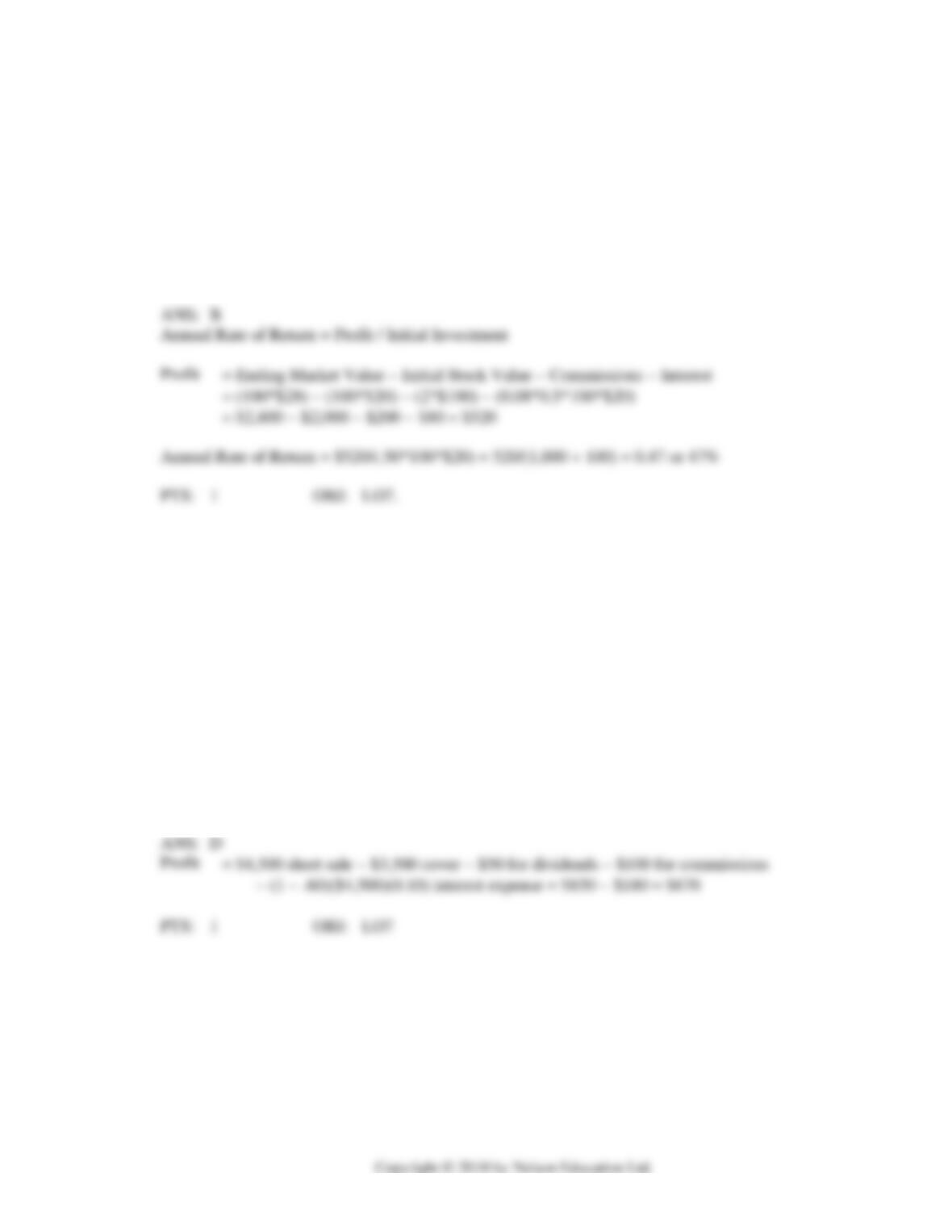
51. You own 50 shares of Auto Corporation that you purchased for $30 per share. The stock is currently
selling for $50 per share and you placed a stop loss order at $45. If the stock price drops to $35 per
share, what is your return on this investment?
a.
−30.0%
b.
16.7%
c.
50.0%
d.
66.7%
e.
150.0%
18
52. You purchased 100 shares of Highlight Company for $20 per share one year ago with a margin of
50%. The stock is currently selling for $28 per share and no dividends were ever paid. The broker
charges an annual interest rate of 8% and a $100 commission on both the purchase and sale of these
shares. What is your annual rate of return on this investment?
a.
21%
b.
47%
c.
52%
d.
60%
e.
72%
Exhibit 4-8
USE THE FOLLOWING INFORMATION FOR THE NEXT PROBLEM(S)
You sell 100 shares short of AMF Corporation when it is selling at $45 per share. Your margin
requirement is 60% and the commission on the sale is $50 and the broker charges 10% annual interest.
AMF Corporation paid a $0.50 per share dividend while you were short the stock. After one year you
cover your short sale at $35 per share with a $50 commission for the purchase.
53. Refer to Exhibit 4-8. What is your total dollar return on this investment?
a.
$1,000
b.
$900
c.
$850
d.
$670
e.
$520
19
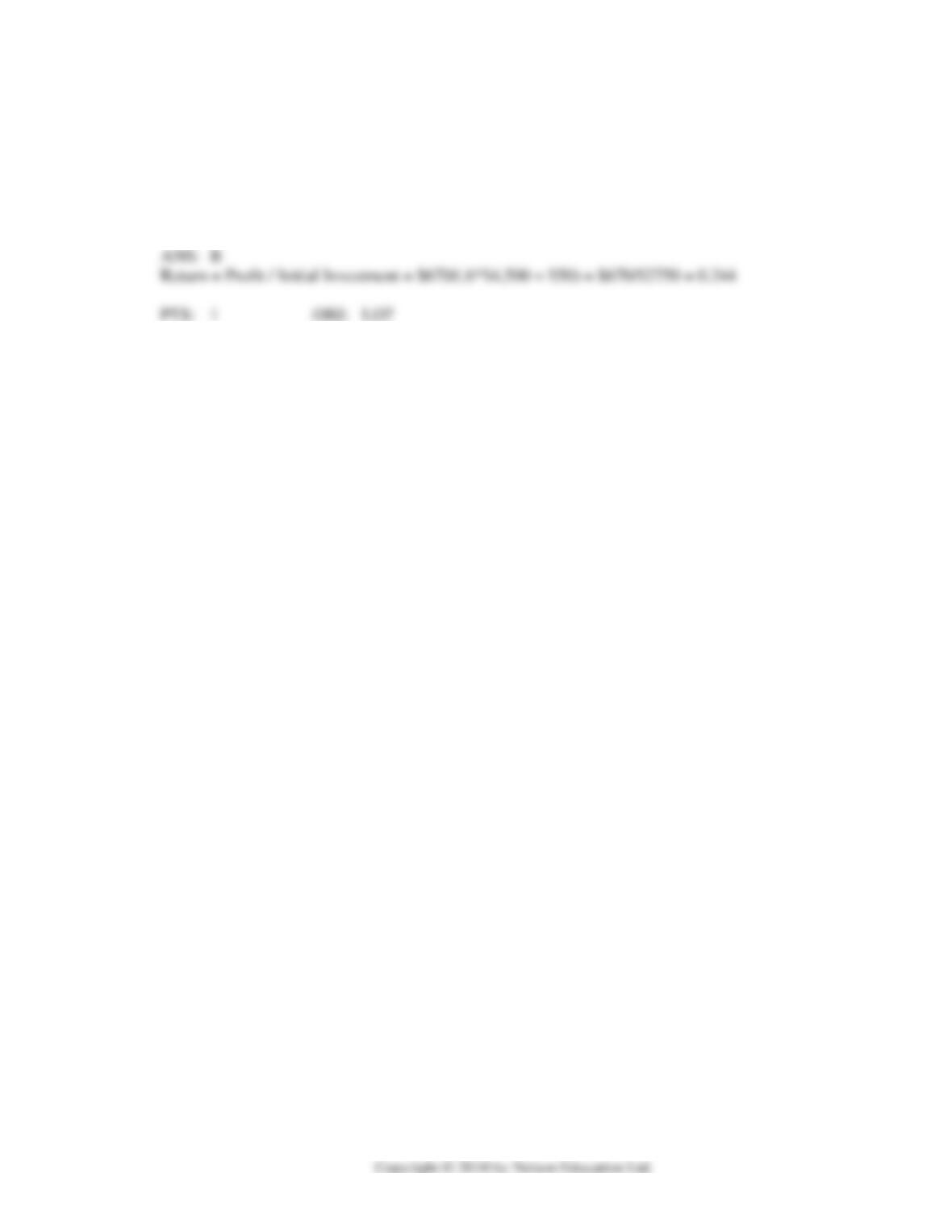
54. Refer to Exhibit 4-8. What is your annual rate of return on this investment?
a.
18%
b.
24%
c.
25%
d.
36%
e.
37%