Introduction to Operations & Supply Chain Management, 5e (Bozarth)
Chapter 4 Business Processes
4.1 Business Processes
1) A set of logically related tasks or activities performed to achieve a defined business outcome is a:
A) process.
B) primary process.
C) support process.
D) development process.
2) A set of tasks or activities that addresses the main value-added activities of an organization is a:
A) system.
B) primary process.
C) support process.
D) development process.
3) Which of the following statements best describes current thinking regarding processes?
A) If companies concentrate on how functional areas like marketing, finance, and operations are
organized, then everything will be fine.
B) Managing functional areas like marketing, finance, and operations is essentially the same thing as
managing what a business does.
C) If the individual functional strategies of marketing, finance, and accounting are aligned with the
overall business strategy, then everything will be fine.
D) Developing superior business processes requires a cross-functional and cross-organizational
perspective.
4) The majority of the total operating budget for most organizations is represented by:
A) engineering costs.
B) advertising costs.
C) supply chain costs.
D) equipment maintenance costs.
5) A support process performs necessary, value-added activities of an organization.
6) A development process creates new products or services for the supply chain.
7) A ________ process addresses the main, value-added activities of an organization.
8) A process that seeks to improve the performance of the main value-added and necessary, non-value-
added activities is a(n) ________ process.
9) Describe the three types of processes and the relationships between them.
4.2 Mapping Business Processes
1) Mapping does NOT:
A) create a common understanding of the content of a process.
B) define the boundaries of a process.
C) provide a detailed view of all elements external to the process.
D) provide a baseline against which to measure the impact of improvement efforts.
2) An arrow in a process map represents a:
A) move activity.
B) start or finish point.
C) delay.
D) creation of a document.

3) Peter prints out a cover for the TPS report he just completed. This activity would be represented on a
process map with which symbol?
A)
B)
C)
D)
4) Every customer that exited the store was subjected to close scrutiny of their shopping cart and receipt
by a highly trained inspector. This activity would be represented on a process map with which symbol?
A)
B)
C)
D)
5) Many states have a mandatory 90-day waiting period from the time a divorce is filed to when it can be
finalized. This activity would be represented on a process map with which symbol?
A)
B)
C)
D)
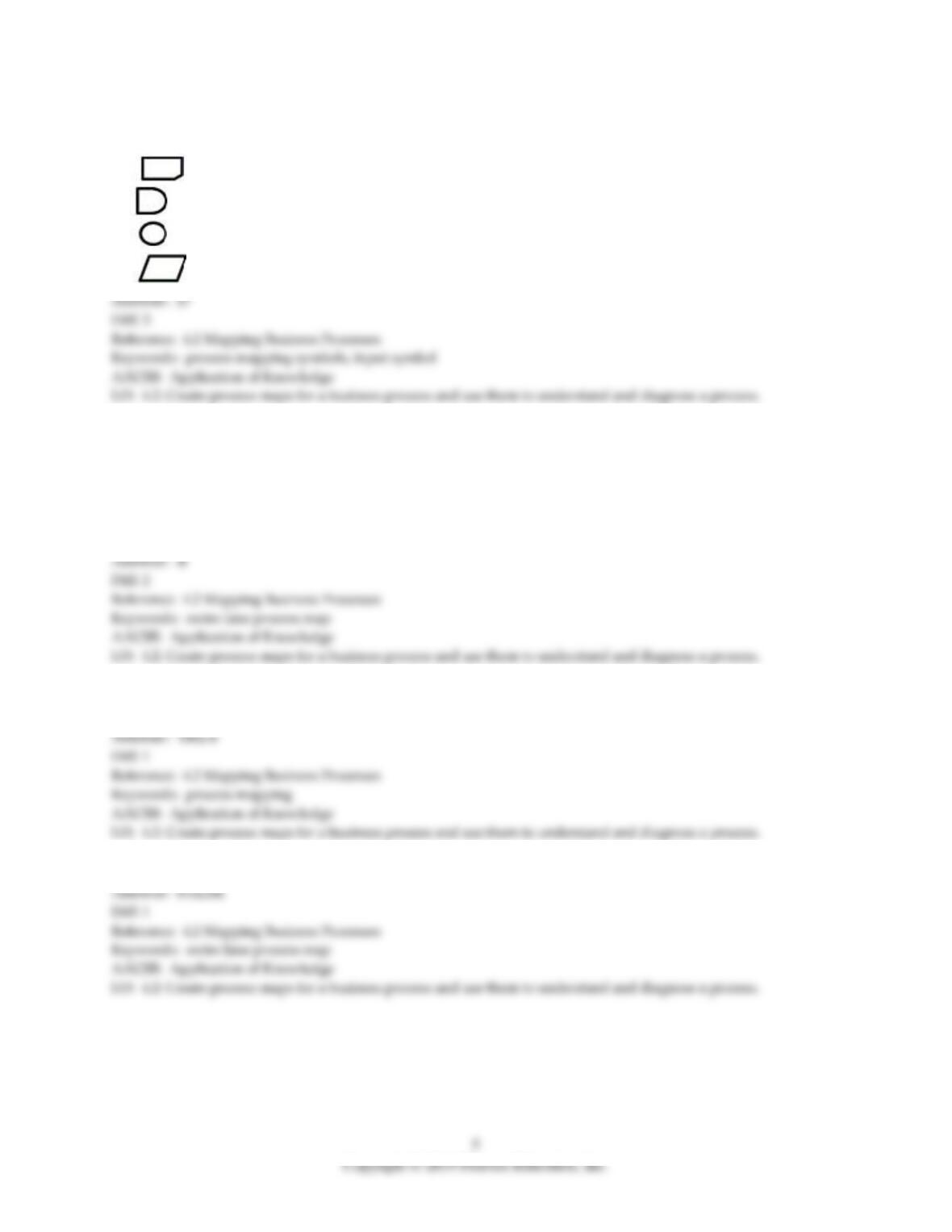
6) After calculating the applicant’s credit score, the system required the applicant to provide a health
history. This activity would be represented on a process map with which symbol?
A)
B)
C)
D)
7) Which type of process map should be used to track the movement of a customer’s complaint from one
department to the next until it is resolved?
A) input process map
B) swim lane process map
C) entity process map
D) data flow process map
8) Mapping creates a common understanding of process activities, their results, and who performs the
various steps.
9) The primary focus of a swim lane process map is to depict flows of objects, information, and money.
10) In a process map, a circle represents a step or activity in the process.
11) When an employee team develops a process map, they should document the process ________.
12) What is the general procedure for developing a swim lane process map?
13) What is the difference between a process map and a swim lane process map?
4.3 Managing and Improving Business Processes
1) A car wash services 200 customers in a 4-hour span on a lovely Saturday afternoon. The car wash
employs 5 washers at $6 per hour. An appropriate measure of productivity is:
A) 200 cars/hour.
B) 0.6 $/car.
C) 8.3 cars/$.
D) 1.7 cars/$.
2) A car wash services 200 customers in an hour on a lovely Saturday afternoon. The car wash employs 5
washers at $6 per hour and uses $50 of water and $5 of electricity per hour. An appropriate measure of
productivity is:
A) 80%.
B) 2.35 cars/$.
C) 8 cars/$.
D) 0.425 $/car.

3) A car wash services 200 customers in an hour on a lovely Saturday afternoon. The car wash employs 5
washers at $6 per hour and uses $50 of water and $5 of electricity per hour. They charge $10 per car for
their standard wash job. Which of these changes would have the greatest positive impact on their
productivity?
A) increasing their service rate so they can process 210 cars per hour
B) cutting their employee pay by $1 per hour
C) charging $11 per standard wash job
D) introducing a new waterless system
4) A car wash services 200 customers an hour on a lovely Saturday afternoon. The car wash employs 5
washers at $6 per hour and uses $50 of water and $5 of electricity per hour. They charge $10 per car for
their standard wash job. Which of these changes would have the greatest positive impact on their
productivity?
A) increasing their service rate by 10%
B) decreasing wages by 5%
C) increasing their per-car fee by 20%
D) decreasing water usage by 10%
5) A professor is expected to cover 16 chapters in an operations management text each semester. One
semester the professor dismisses class 30 minutes early every Monday and Friday and is able to cover
only 12 chapters. What is the professor’s efficiency?
A) 75%
B) 4
C) 133%
D) -4

6) A professor is expected to cover 16 chapters in an operations management text each semester. The class
is scheduled to meet for one hour three times a week for 15 weeks. One semester the professor dismisses
class 30 minutes early every Monday and Friday and is able to cover only 12 chapters using two boxes of
chalk and a fifth of scotch. What is the professor’s labor productivity?
A) 0.27 chapters per hour
B) 1.25 chapters per week
C) 1.06 chapters per week
D) 0.4 chapters per hour
7) A maintenance worker maintains an alibi sheet of all work activities performed in an 8 hour shift. If the
work standard is such that 90% efficiency is expected, what is the actual amount of time that should be
documented?
A) 8.9 hours
B) 111%
C) 7.2 hours
D) 0.8 hours
8) It takes one day for Peter Gibbons to complete a TPS report and attach the cover sheet. During that
day, Peter spends about 15 minutes a day performing actual work and the other 7 hours and 45 minutes
spacing out. Which of the following statements is correct?
A) Peter’s cycle time is 7 hours and 30 minutes.
B) Peter’s efficiency is 25%.
C) Peter’s productivity is 8 hours per TPS report.
D) Peter’s percent value-added time is just over 3%.
9) Consider a typical cycle of emailing a professor a question about class and waiting for a response.
Which of the following statements is correct?
A) The percent value-added time is low.
B) The cycle time is impossible to determine with any accuracy.
C) The efficiency of the response is easy to measure.
D) The professor’s productivity is easy to measure.
10) Which of the following approaches to process improvement could be described as process
benchmarking?
A) Employees at McDonald’s ignore the way they have always processed customer orders and design an
entirely new way to do so.
B) Employees at the campus housing and dining service visit Ritz Carlton to pick up ideas on managing
long-term guests.
C) Employees at Ford purchase automobiles from an array of car manufacturers and take them apart to
get design ideas for their next generation Taurus.
D) Employees at XEROX take classes in quality improvement and make small, incremental changes to
their order filling processes.
11) Which of the following approaches to process improvement could be described as competitive
benchmarking?
A) Employees at XEROX ignore the way they have always processed customer orders and design an
entirely new way to do so.
B) Employees at XEROX visit GM to pick up ideas on processing customer orders.
C) Employees at XEROX purchase a Canon copier and take it apart to get design ideas for their next
generation of copiers.
D) Employees at XEROX take classes in quality improvement and make small, incremental changes to
their order filling processes.

12) In statistical terms, a process that achieves Six Sigma quality will generate about:
A) zero defects per million opportunities.
B) six defects per million opportunities.
C) three defects per million opportunities.
D) thirty-four defects per million opportunities.
13) Green Belts have:
A) more Six Sigma training than Black Belts but less Six Sigma training than Champions.
B) more Six Sigma training than Champions but less Six Sigma training than Team Members.
C) more Six Sigma training than Black Belts but less Six Sigma training than Master Black Belts.
D) more Six Sigma training than Team Members but less Six Sigma training than Black Belts.
14) Which of these represent the Six Sigma process sequence to create a completely new business process
or product?
A) DMAIC
B) DMADV
C) 5W1H
D) WD40
15) Which of these elements is in the Six Sigma process sequence to create a completely new business
process or product, but NOT in the Six Sigma process, to improve an existing business process?
A) Define
B) Derive
C) Design
D) Create

16) Which of these steps is NOT part of the Six Sigma process sequence?
A) Design
B) Measure
C) Analyze
D) Improve
17) When constructing a fishbone (cause and effect) diagram, brainstorming takes place during the:
A) closed phase.
B) narrow phase.
C) wide phase.
D) open phase.
18) Which of the continuous improvement tools is used to conduct root–cause analysis?
A) statistical process control (SPC)
B) flow chart
C) Ishikawa (fishbone) diagram
D) Pareto chart
19) A professor assigns a massive homework set the first day of class that will be due the day the students
walk in to take their first exam of the semester. Over the weekend he grades the homework and the exam
papers and as he reviews the results, it occurs to him that students that worked more of the 40 problems
in the homework assignment appeared to be more successful on the exam. Which of the continuous
improvement tools would be most appropriate for displaying this phenomenon?
A) statistical process control (SPC)
B) scatter plot
C) Ishikawa diagram
D) Pareto chart

20) Which two continuous improvement tools are most similar in appearance?
A) scatter plot and check sheet
B) Pareto chart and histogram
C) histogram and fishbone diagram
D) check sheet and fishbone diagram
21) Which of these continuous improvement tools would be best suited for showing all of the steps
required to change your major to operations management?
A) process map
B) cause-and-effect diagram
C) Pareto chart
D) scatter plot
22) Productivity is measured as the ratio of inputs to outputs.
23) A laundry tracks clean linen output in pounds and their inputs of gas, water, electricity, and labor. A
productivity measure incorporating all of these inputs is a multifactor measure.
24) A person who fails to meet output standards could still have an efficiency measurement of more than
100%.
25) Cycle time is the total elapsed time needed to complete a business process.
26) While efficiency can exceed 100%, percent value-added time has a maximum of 100%.
27) Your university sends a contingent of top-ranking officials to Las Vegas hotels to study ways to
improve dormitory living conditions. This is an example of process benchmarking.
28) When McDonald‘s studies the drive-through operations of Burger King, they are engaging in
competitive benchmarking.
29) A Six Sigma Champion is a full-time Six Sigma expert that is responsible for training, mentoring,
deployment, and results.