30) Among all approaches to organizing for business process improvement, the Six Sigma methodology
arguably best represents current thinking.
31) The M in the Six Sigma DMAIC process represents the word “method”.
32) A check sheet, also called an Ishikawa diagram, is used to record how frequently a certain event
occurs.
33) The Five Whys are used during all three phases of construction of a Pareto chart.
34) ________ is a measure of process performance that is a ratio of output to two inputs.
35) The elapsed time needed to complete a business process is called ________.
36) When an organization compares their processes to those of another firm outside their industry, they
are engaging in ________.
37) Frank’s Fried Chicken sends several employees over to Clair’s Chicken Shack to divine the secret
recipe that makes her chicken spicier and crispier, they are engaging in ________.
38) The Six Sigma process sequence to improve an existing business process consists of the steps
________, ________, ________, ________, ________.
39) ________ are senior level executives of a company that own projects and have the authority and
resources needed to carry them out.
40) ________ are workers trained in the Six Sigma methodology that actually train and mentor other
workers in Six Sigma.
41) A(n) ________ is used to record how frequently a certain event occurs.
42) Lisa manages customer service representatives in a call center. The center’s computer system tracks a
number of metrics for each employee including the total number of customer calls they complete, the
amount of time the service representative spends talking to customers, and the total time the service
representative was clocked in each day. The work standard developed by the call center is to complete
150 calls in an 8-hour shift. Answer the following questions using the information provided in the table.
a. What is the productivity of employee J?
b. What is the efficiency of employee K?
c. What is the percent value added time for employee M?
Employee
# Calls Completed
Total Time on Calls
Total Time Clocked In
J
165
8 hours
8 hours
K
140
7 hours 30 minutes
8 hours
M
135
7 hours 20 minutes
8 hours
43) The provost was puzzled as he read the enrollment report for the fall semester. The seven teaching
units had all experienced a drop in enrollment, some of them were calamitous as shown in the table.
Answer the following questions using the information provided in the table. Assume the same number of
faculty taught in each college both semesters.
a. Which college has the lowest productivity in 2017 and what is their productivity?
b. Which college had the greatest productivity decline?
c. Which college is the most productive in both 2016 and 2017?
College
# Student Credit Hours
Fall 2017
# Student Credit Hours
Fall 2016
Teaching Faculty
Business
55,000
65,000
75
Education
84,000
87,460
90
Fine Arts
12,000
13,590
45
Graduate
32,000
34,325
125
Liberal Arts
78,000
80,950
105
Math/Science
51,000
53,250
48
44) What is benchmarking and how do the two types differ?
45) Why would a company choose to engage in benchmarking rather than design their own process or
product?
46) How would you describe the Six Sigma methodology?
47) Describe the constituent activities of Six Sigma’s DMAIC process.
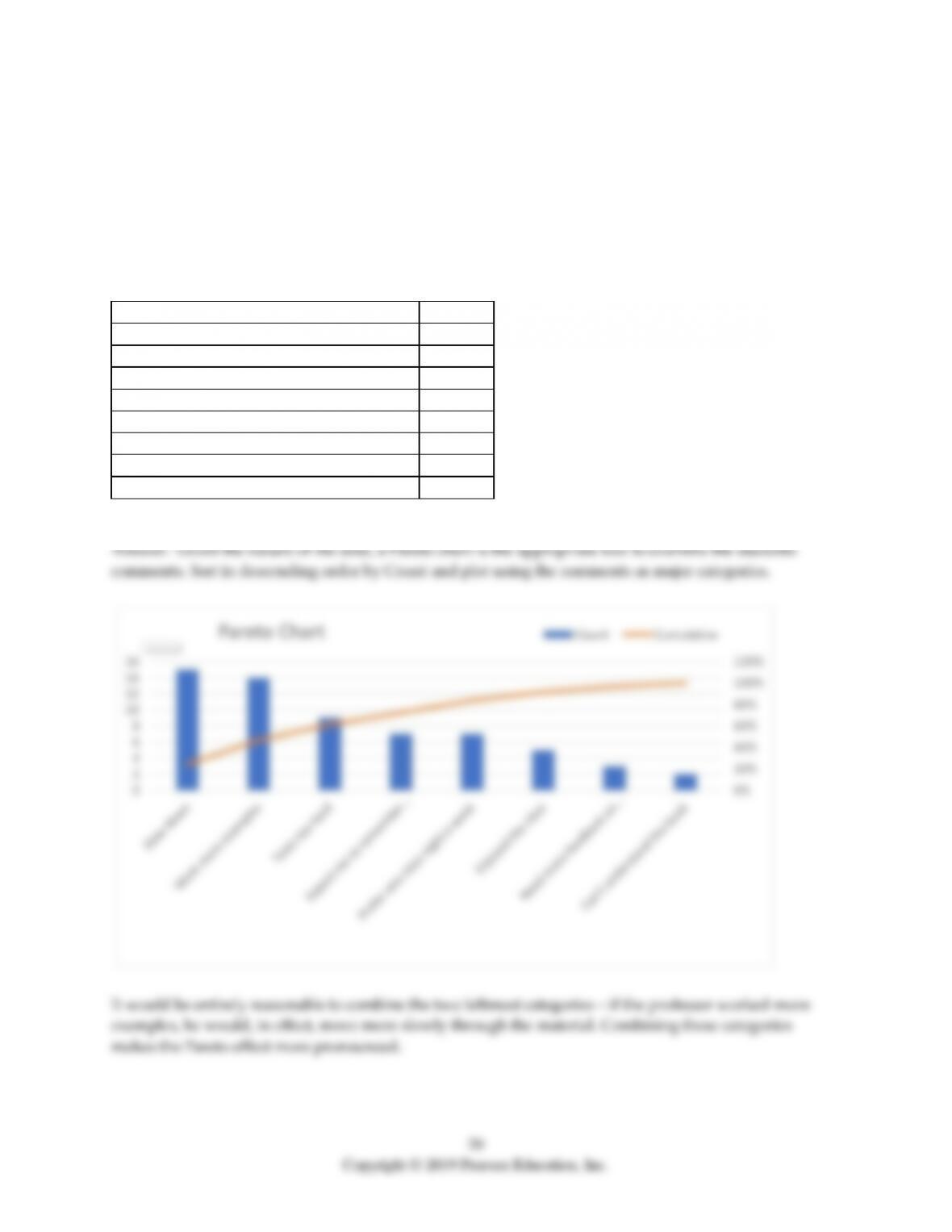
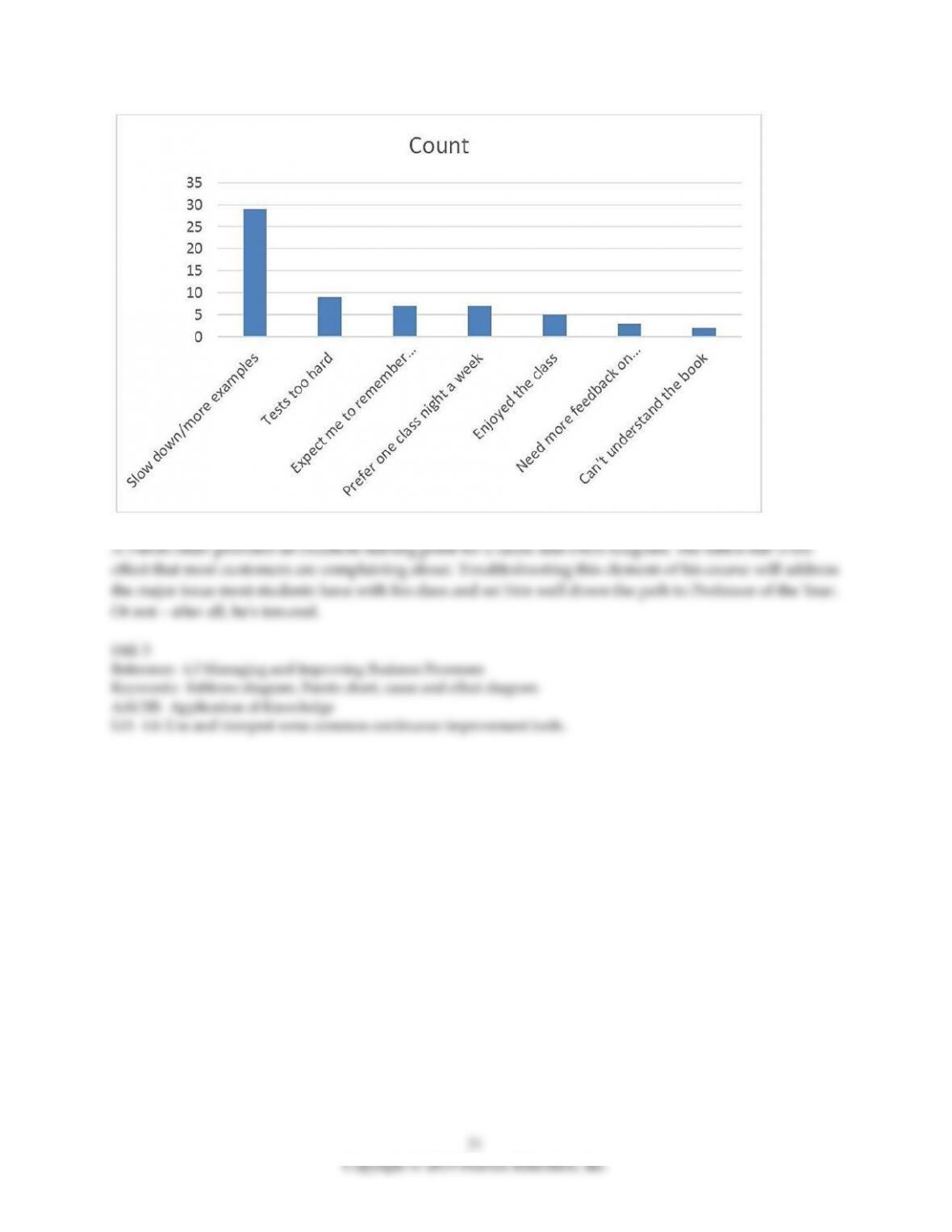
48) A tenured professor lights a cigar, cradles a snifter of brandy in his claw-like hand, and reviews his
student evaluations from the previous semester. The numbers were unspectacular, but he beamed with
pride as he read the comments. For the first time in a long time, no one responded to the “What can the
professor do to improve the course?” question with the classic response “not teach it anymore.” There
were a number of comments, and since he took his craft seriously, he set about summarizing and
organizing the comments into the alphabetical list you see here. Take this data and analyze it using the
appropriate tool for continuous improvement. Then recommend to the professor the next tool (out of the
tools for continuous improvement) that he should use to take the next step in this analysis.
Comment
Count
Can’t understand the book
2
Enjoyed the class
5
Expect me to remember prerequisites
7
Need more feedback on homework
3
Prefer one class night a week
7
Slow down
15
Tests too hard
9
Work more examples
14
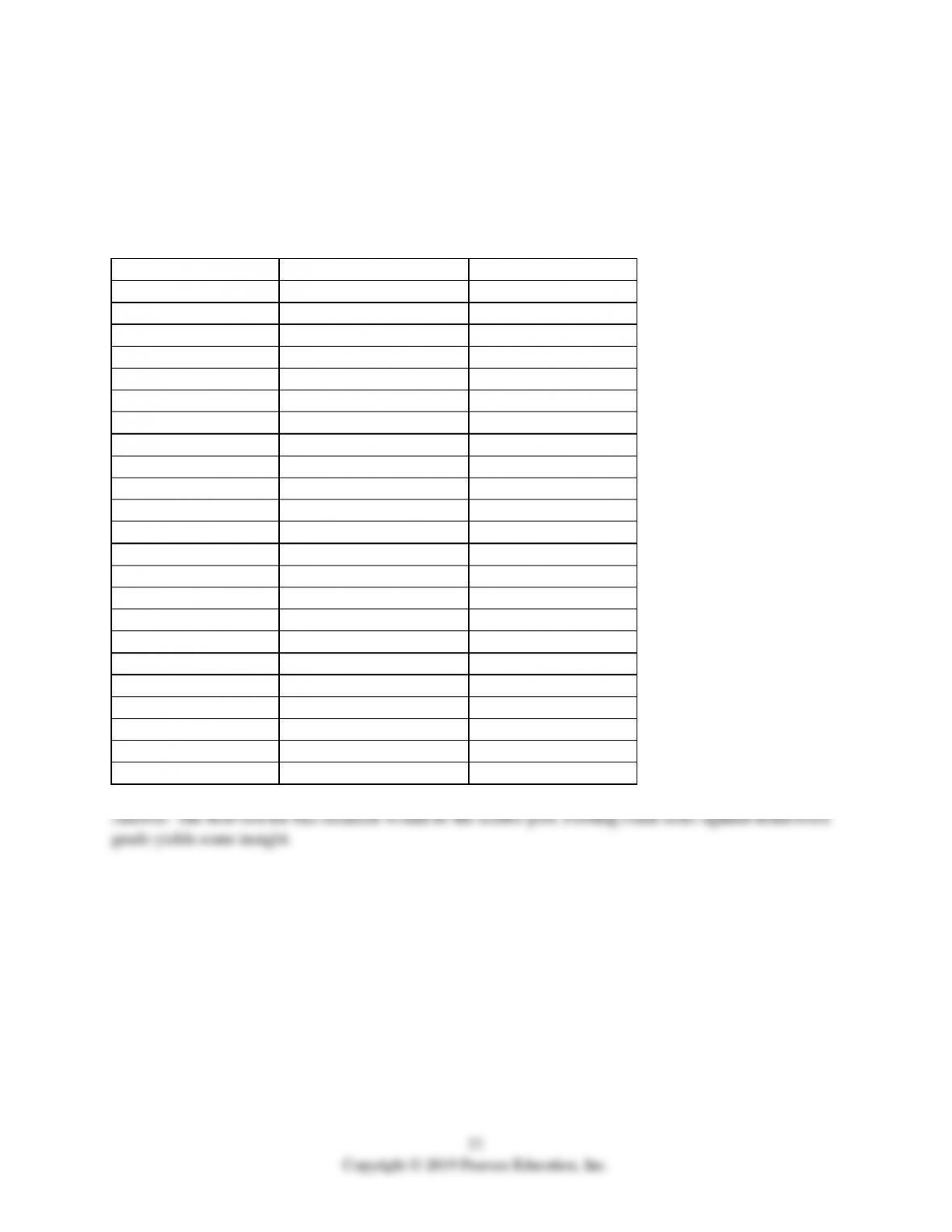
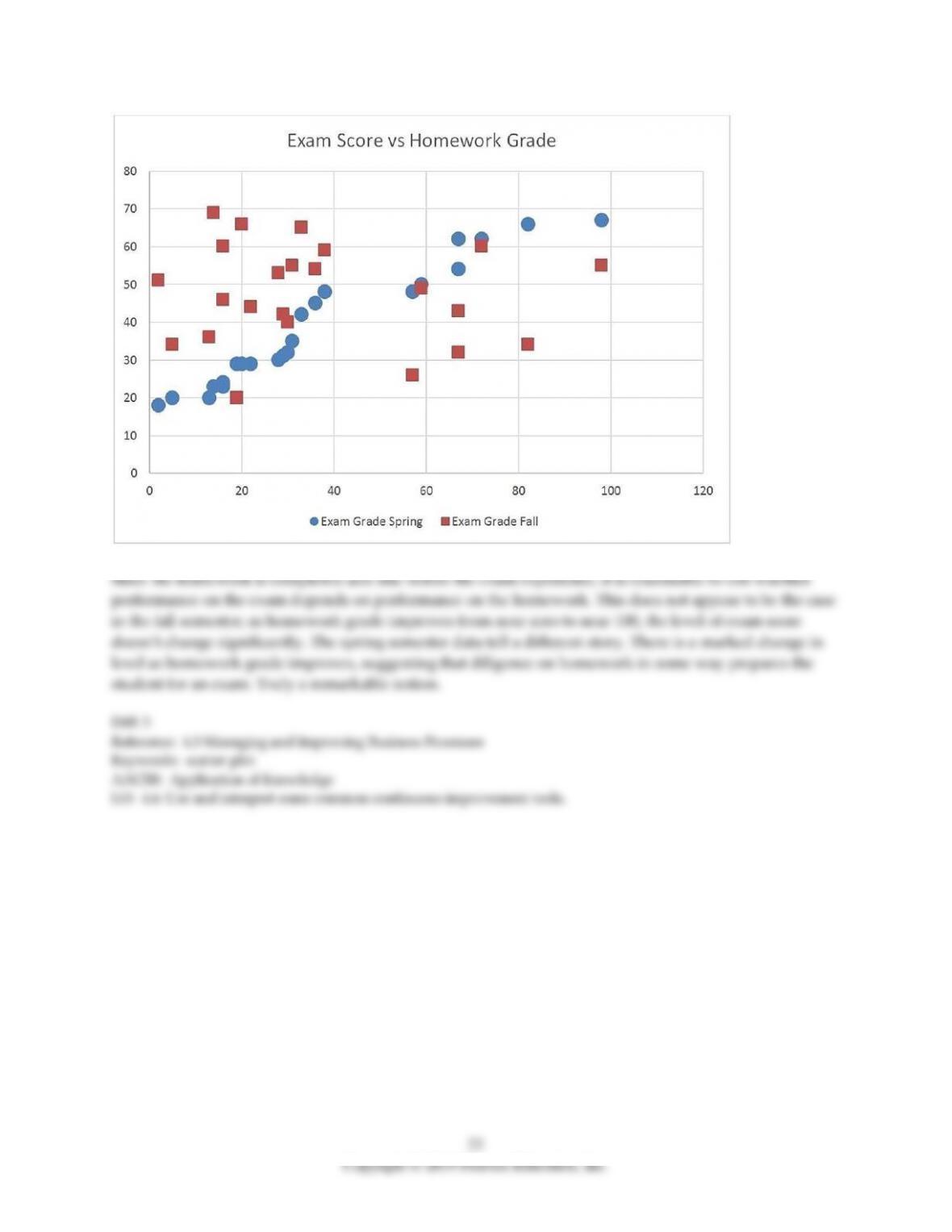
49) An assistant professor designs his fall semester class so that a major homework assignment is due the
day his students waltz into class to take their first exam. The results are mixed so he rewrites his exam for
the spring semester and repeats the process, again collecting a major homework assignment on exam day
and grading and returning both the homework assignments and exams the following class meeting. Use
an appropriate tool from the tools for continuous improvement to analyze the data. What conclusions do
you draw?
Homework grade
Exam Grade Spring
Exam Grade Fall
2
18
51
5
20
34
13
20
36
14
23
69
16
23
46
16
24
60
19
29
20
20
29
66
22
29
44
28
30
53
29
31
42
30
32
40
31
35
55
33
42
65
36
45
54
38
48
59
57
48
26
59
50
49
67
54
32
67
62
43
72
62
60
82
66
34
98
67
55
50) Describe the process of root cause analysis and include in your description the tools that it uses.
4.4 Business Process Challenges and the SCOR Model
1) The procedure of fundamental rethinking and radical redesign of business processes to achieve
dramatic organizational improvements is called:
A) competitive benchmarking.
B) continuous improvement.
C) process benchmarking.
D) business process reengineering.
2) Which of these SCOR model flows moves in the opposite direction from the others?
A) Plan
B) Return
C) Source
D) Make
3) Which of these statements about the SCOR model is best?
A) The SCOR model consists of four levels that describe supply chain processes in increasing detail.
B) The core management processes of the model are Source, Collaborate, Operations, and Return.
C) The model makes provisions for different levels of customization.
D) The process types detailed in level one are Planning, Execution, and Enable.
4) Level 1 of the SCOR model is organized around the five core management processes: plan, source,
make, deliver, and return.
5) One reason the SCOR model is widely accepted is its consistency. It mandates the same information
and physical flows for all products, regardless of the degree of customization.
6) The magnitude of changes created by a continuous improvement program is generally larger than
those created by a business process reengineering program.
7) ________ is a process improvement philosophy that results in small, incremental changes while
________ is a process improvement philosophy that results in dramatic organizational changes.
8) Level two of the SCOR model divides SCM activities into ________.
9) ________ is the SCOR model process that addresses the movement of defective product from the
customer.
10) Briefly describe the five core management processes that comprise Level 1 of the SCOR model.
11) Describe continuous improvement and business process reengineering and compare their advantages
and disadvantages in relation to each other.