Chapter 4 – Decision Analysis
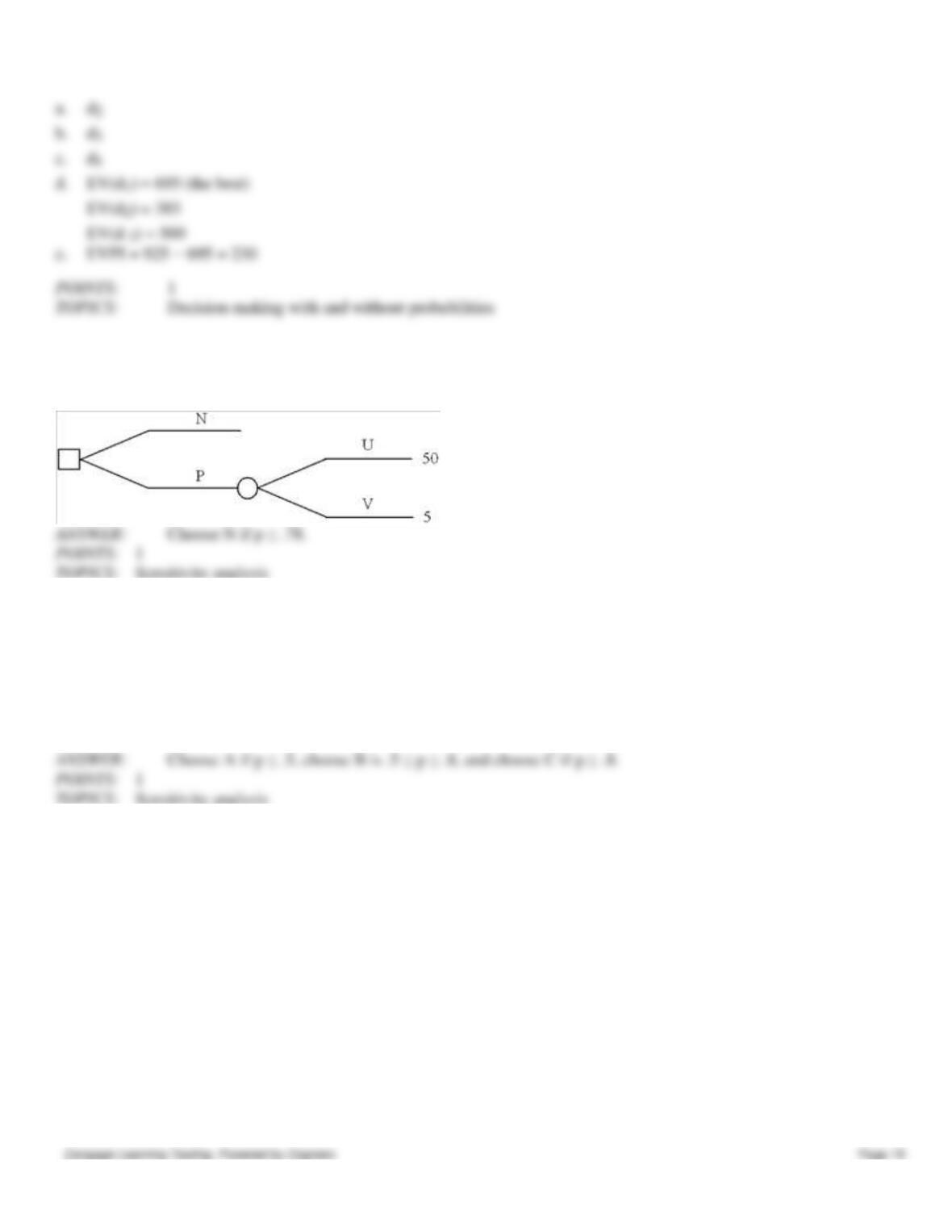
57. A decision maker has developed the following decision tree. How sensitive is the choice between N and P to the
probabilities of states of nature U and V?
58. If p is the probability of Event 1 and (1 − p) is the probability of Event 2, for what values of p would you choose A?
B? C? Values in the table are payoffs.
Choice/Event Event 1 Event 2
A 0 20
B 4 16
C 8 0
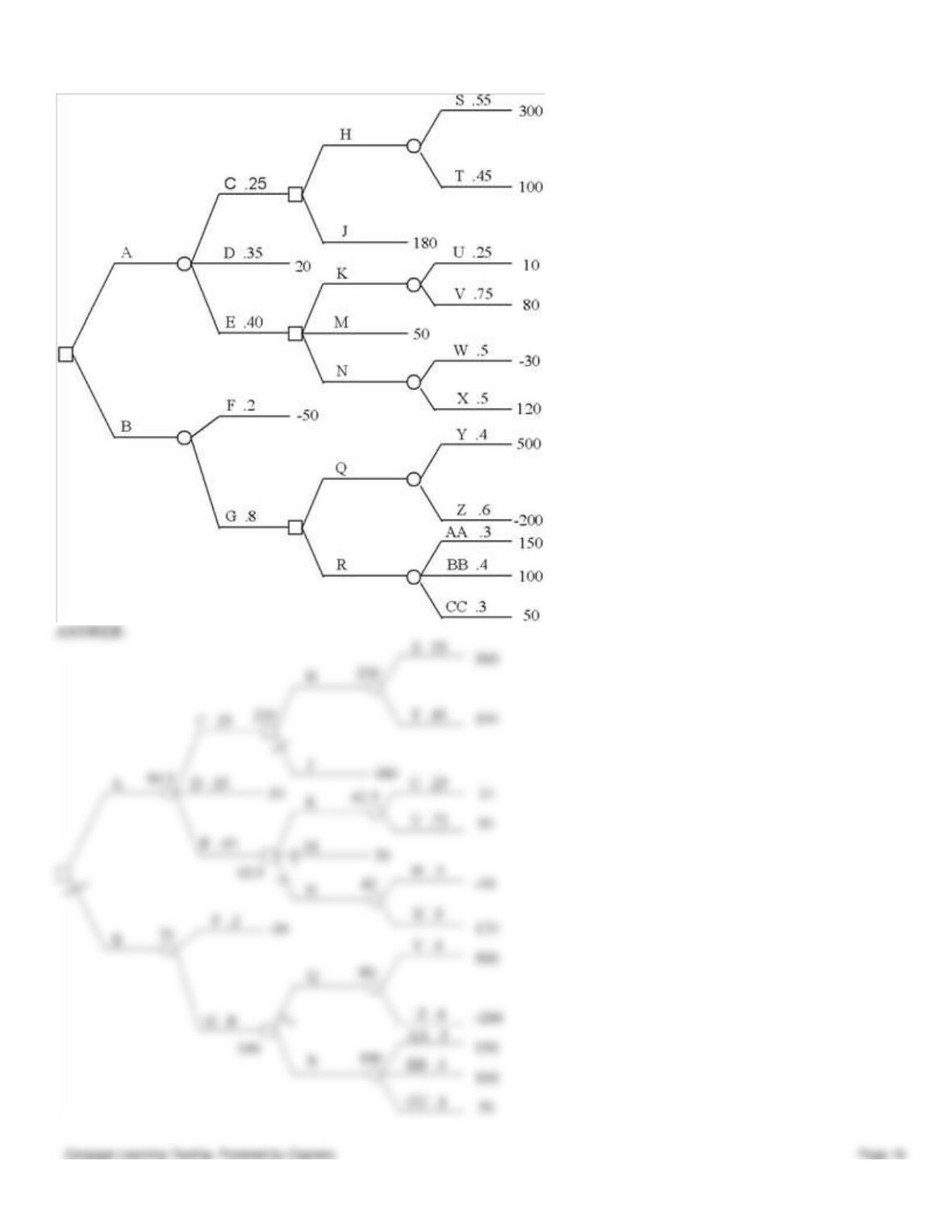
59. Fold back the decision tree and state what strategy should be followed.
Chapter 4 – Decision Analysis
Chapter 4 – Decision Analysis
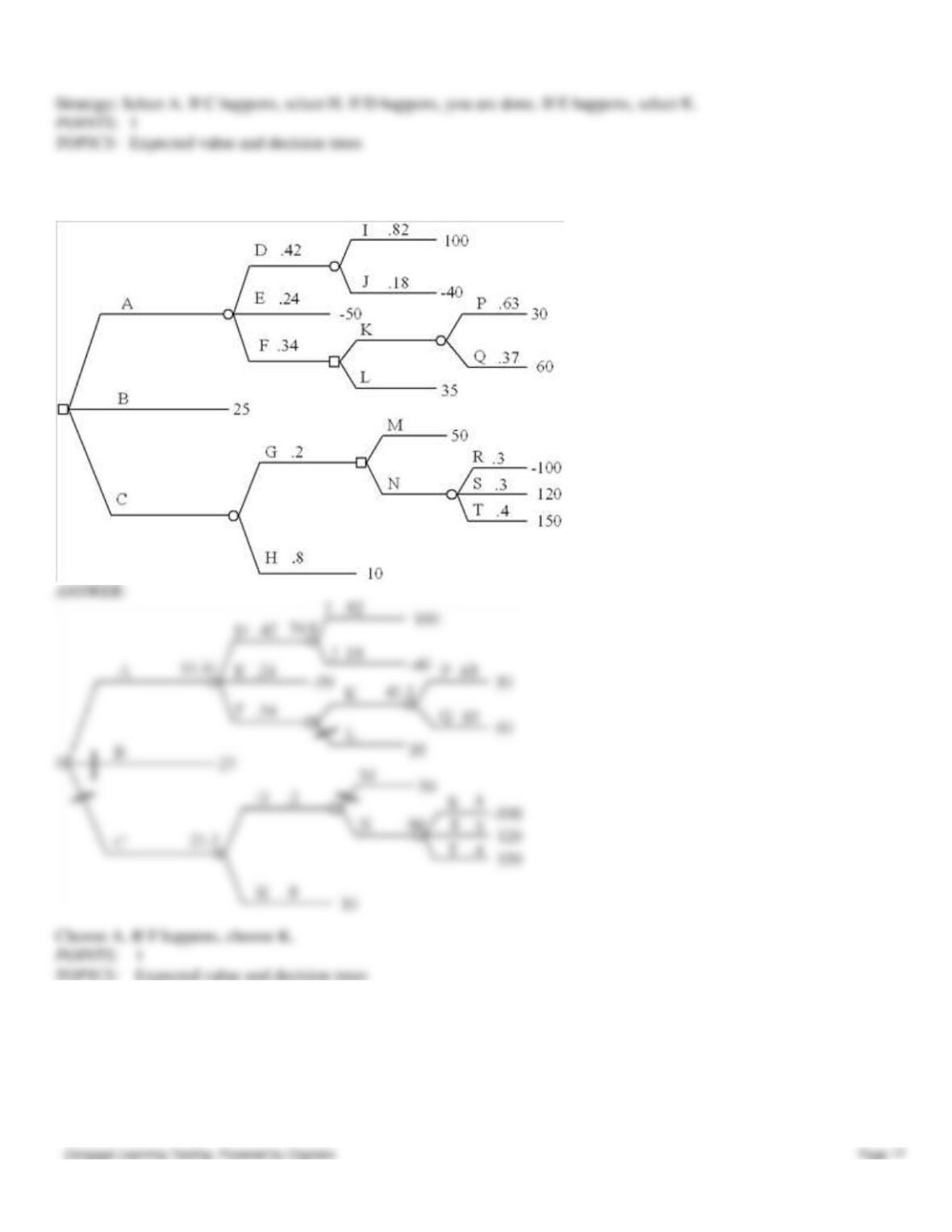
60. Fold back this decision tree. Clearly state the decision strategy you determine.
61. If sample information is obtained, the result of the sample information will be either positive or negative. No matter
which result occurs, the choice to select option A or option B exists. And no matter which option is chosen, the eventual
outcome will be good or poor. Complete the table.
Sample
Result States of
Chapter 4 – Decision Analysis
Nature Prior
Probabilities Conditional
Probabilities Joint
Probabilities Posterior
Probabilities
Positive good .7 P(positive | good) = .8
poor .3 P(positive | poor) = .1
Negative good .7 P(negative | good) =
poor .3 P(negative | poor) =
62. Use graphical sensitivity analysis to determine the range of values of the probability of state of nature s1 over which
each of the decision alternatives has its largest expected value.
State of Nature
Decision s1 s2
d1 8 10
d2 4 16
d3 10 0
Chapter 4 – Decision Analysis
63. Dollar Department Stores has received an offer from Harris Diamonds to purchase Dollar’s store on Grove Street for
$120,000. Dollar has determined probability estimates of the store’s future profitability, based on economic outcomes, as:
P($80,000) = .2, P($100,000) = .3, P($120,000) = .1, and P($140,000) = .4.
a. Should Dollar sell the store on Grove Street?
b. What is the EVPI?
c. Dollar can have an economic forecast performed, costing $10,000, that produces indicators I1 and I2, for which P(I1 |
80,000) = .1; P(I1 | 100,000) = .2; P(I1 | 120,000) = .6; P(I1 | 140,000) = .3. Should Dollar purchase the forecast?
64. A paint company has three sources for buying bright red pigment for their paints: Vietnam, Taiwan, or Thailand.
Unfortunately, the pigment is made from a bush whose annual growth is heavily dependent upon the amount of rainfall
during the growing season. The tables below show probabilities and prices for wet, dry and normal growing seasons:
Probabilities
Wet Dry Normal
Vietnam .5 .2 .3
Taiwan .6 .3 .1
Thailand .4 .4 .2
Price/Pound ($)
Wet Dry Normal
Vietnam .95 1.10 1.00
Taiwan .85 1.20 .98
Thailand .90 1.15 1.05
What country should the company select and what is the expected value (price) associated with it?
65. A regional fast‑food restaurant is considering an expansion program. The major factor influencing the success of such
a program is the future level of interest rates. It is estimated that there is a 20 percent chance that interest rates will
increase by 2 percentage points, a 50 percent chance that they will remain the same, and a 30 percent chance that they will
decrease by 2 percentage points. The alternatives they are considering and possible payoffs are shown in the table below.
Which alternative is best, based on expected value?
Rates up Rates Rates down
2 percent unchanged 2 percent
Build 50 restaurants ‑$200,000 $50,000 $150,000
Build 25 restaurants ‑$115,000 $26,000 $80,000
Do nothing ‑$70,000 0 $5,000
Chapter 4 – Decision Analysis
66. A chemical company is trying to decide whether to build a pilot plant now for a new chemical process or to build the
full plant now. If they build a pilot plant now, they could expand it later to a full plant or license the plant to another
company. It would cost them $2 million to build the pilot plant and another $2 million later to expand it. If they build the
full plant now it would cost $3.5 million to construct.
The returns they expect to get from the full production plant depend upon the market. They estimate there is a 60% chance
the market will be robust, a 30% chance it will remain stable, and a 10% chance it will become stagnate. The returns are
estimated to be $5 million if it is robust, $3 million if it is stable, and $1 million if it is stagnate.
Before they expand the pilot plant, they plan to conduct a comprehensive study. Based on past experience, they expect the
study to report a 60% chance of favorable outcome for expansion and a 40% unfavorable chance. In either case they will
have to decide whether to expand to a full plant or license the pilot plant. If the report is favorable and they license it, they
expect to get $3 million. However, if the report is unfavorable and they license it, they will only get $1 million.
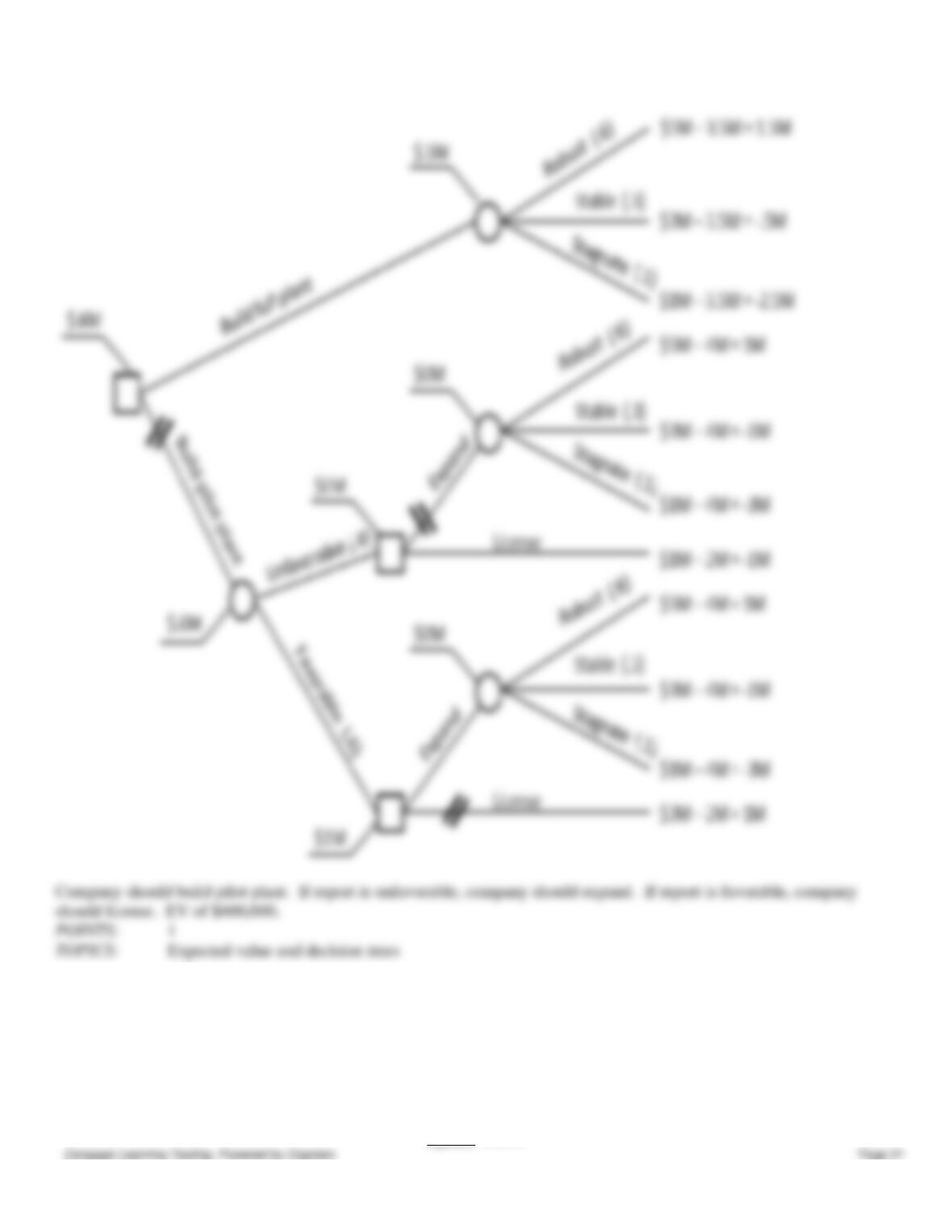
Develop a decision tree for this problem and determine the optimal decision strategy.
Chapter 4 – Decision Analysis
67. A manufacturing company is considering expanding its production capacity to meet a growing demand for its product
line of air fresheners. The alternatives are to build a new plant, expand the old plant, or do nothing. The marketing
department estimates a 35 percent probability of a market upturn, a 40 percent probability of a stable market, and a 25
percent probability of a market downturn. Georgia Swain, the firm’s capital appropriations analyst, estimates the
following annual returns for these alternatives:
Market
Upturn Stable
Chapter 4 – Decision Analysis
Market Market
Downturn
Build new plant $690,000 $(130,000) $(150,000)
Expand old plant 490,000 (45,000) (65,000)
Do nothing 50,000 0 (20,000)
a. Use a decision tree analysis to analyze these decision alternatives.
b. What should the company do?
c. What returns will accrue to the company if your recommendation is followed?
68. The Sunshine Manufacturing Company has developed a unique new product and must now decide between two
facility plans. The first alternative is to build a large new facility immediately. The second alternative is to build a small
plant initially and to consider expanding it to a larger facility three years later if the market has proven favorable.
Marketing has provided the following probability estimates for a ten-year plan:
First 3-Year Demand Next 7-Year Demand Probability
Unfavorable Unfavorable .2
Unfavorable Favorable .0
Favorable Favorable .7
Favorable Unfavorable .1
If the small plant is expanded, the probability of demands over the remaining seven years is 7/8 for favorable and 1/8 for
unfavorable. The accounting department has provided the payoff for each outcome:
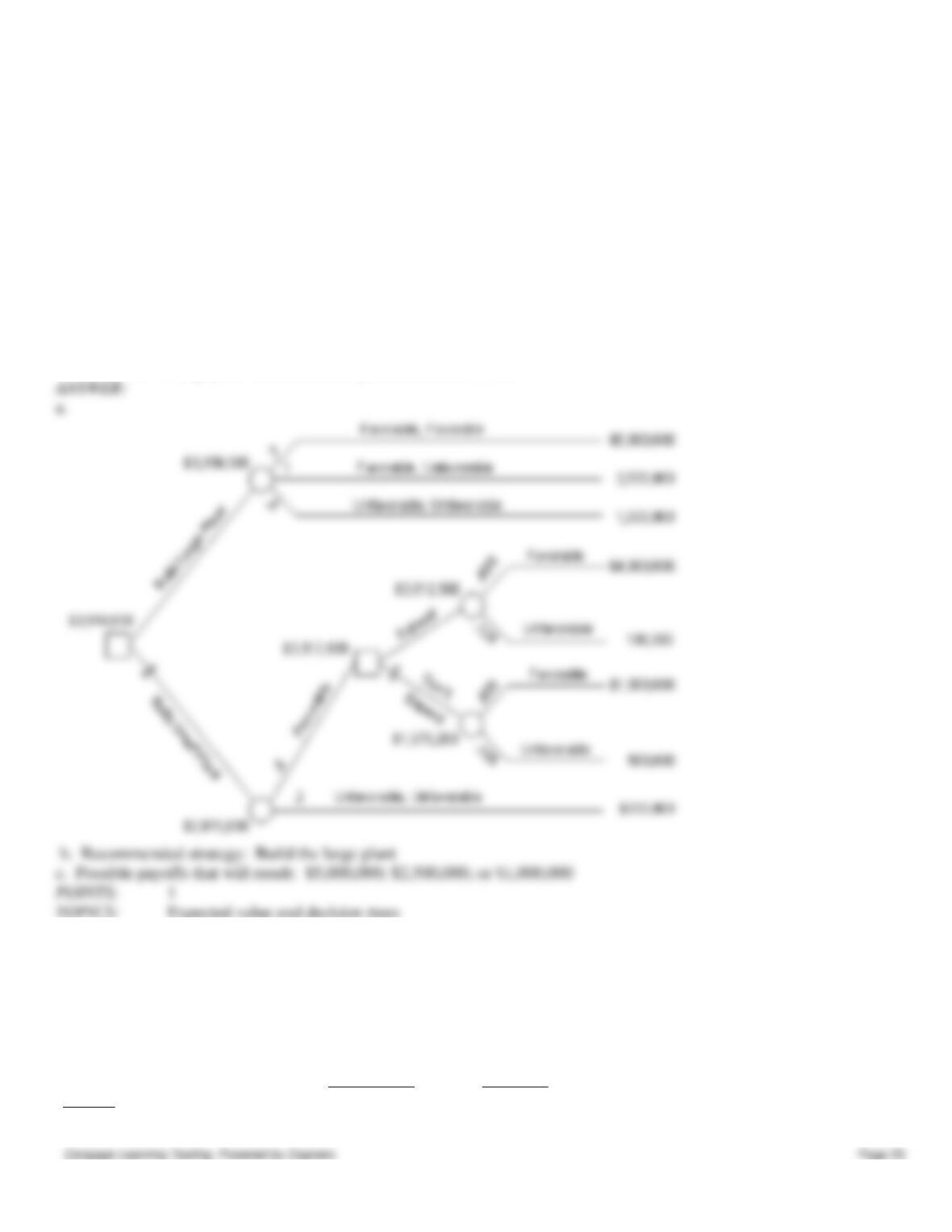
Chapter 4 – Decision Analysis
Demand Facility Plan Payoff
Favorable, favorable 1 $5,000,000
Favorable, unfavorable 1 2,500,000
Unfavorable, unfavorable 1 1,000,000
Favorable, favorable 2—expanded 4,000,000
Favorable, unfavorable 2—expanded 100,000
Favorable, favorable 2—not expanded 1,500,000
Favorable, unfavorable 2—not expanded 500,000
Unfavorable, unfavorable 2—not expanded 300,000
With these estimates, analyze Sunshine’s facility decision and:
a. Perform a complete decision tree analysis.
b. Recommend a strategy to Sunshine.
c. Determine what payoffs will result from your recommendation.
69. A Pacific Northwest lumber company is considering the expansion of one of its mills. The question is whether to do it
now, or wait for one year and re–consider. If they expand now, the major factors of importance are the state of the
economy and the level of interest rates. The combination of these two factors results in five possible situations. If they do
not expand now, only the state of the economy is important and three conditions characterize the possibilities. The
following table summarizes the situation:
Probabilities Revenues
Expand
very favorable .2 $80,000
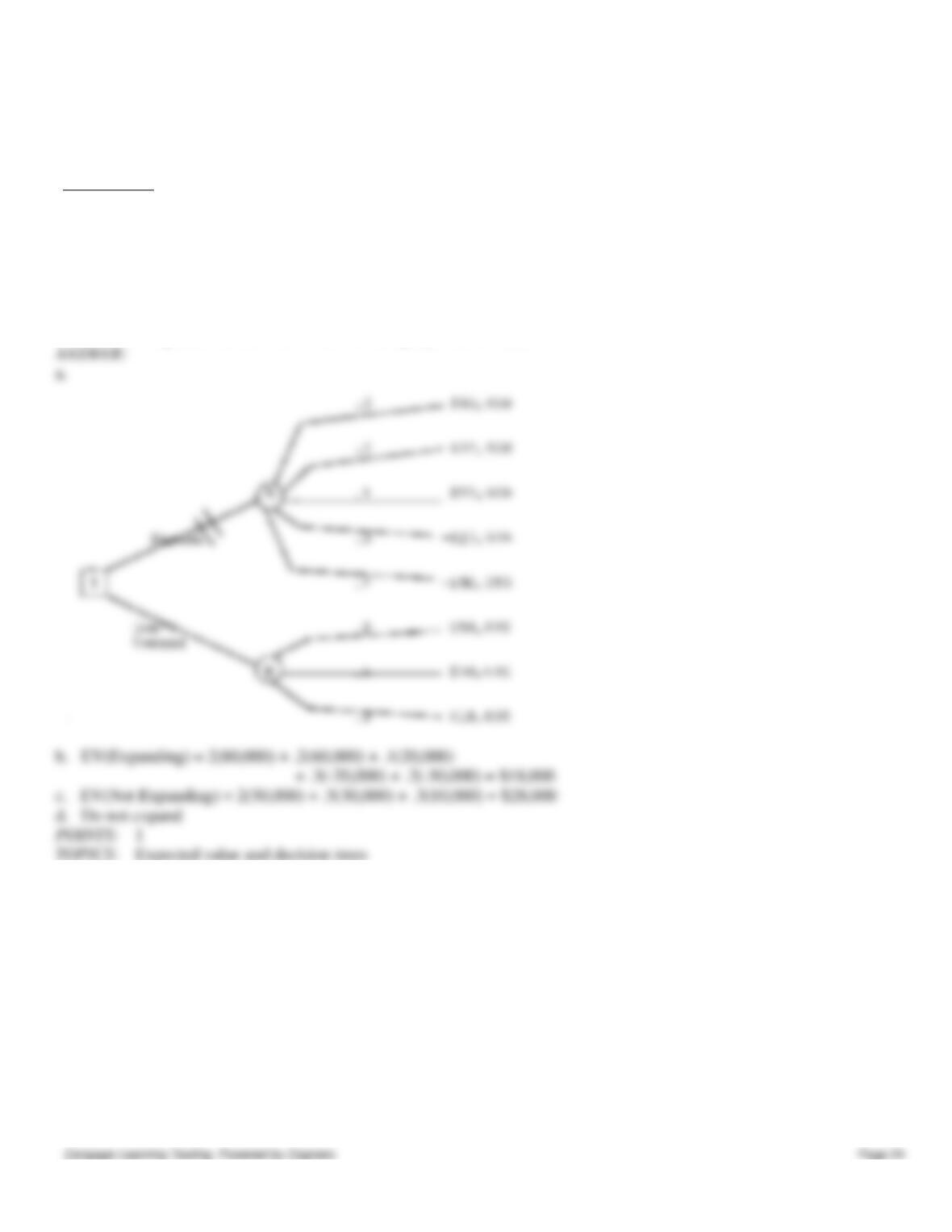
Chapter 4 – Decision Analysis
favorable .2 $60,000
neutral .1 $20,000
unfavorable .3 -$20,000
very unfavorable .2 –$30,000
Don’t expand
expansion .2 $50,000
steady .5 $30,000
contraction .3 $10,000
a. Draw the decision tree for this problem.
b. What is the expected value for expanding?
c. What is the expected value for not expanding?
d. Based on expected value, what should the company’s decision(s) be?
70. A major retail clothing store is considering whether to open a new store on the other side of town or wait one year and
then open the store. In the meantime, they have paid $10,000 for a one year option on a building. If they open the store
now it will cost $140,000 to refurbish it, but it will cost $160,000 if they wait one year.
They expect sales to depend on the economy in the area at the time they open the store. If they go ahead now, there is
a 50% chance the economy will go up, 30% it will stay the same, and 20% it will go down. They then expect the
following returns: if the economy goes up $200,000; stays the same $160,000; and goes down ‑$20,000.
If they wait one year, they can either open the store then or not open the store and let the option expire. If the option
expires, they will lose the $10,000. One year from now they expect there is a 40% chance the economy will go up, 30%
stay the same, and 30% go down. The returns they expect to get would then be: if the economy goes up $180,000; stays
the same $160,000; and goes down ‑$30,000.
Chapter 4 – Decision Analysis
a. Using decision tree analysis, what is the expected value of opening the store now?
b. Using decision tree analysis, what is the expected value of waiting one year to open the store?
c. What should the company do and what is the expected value of that decision?
71. An investor has a choice between four investments. The profitability of the investments depends upon the market. The
payoff table is given below for different market conditions.
States of Nature
Investments Market
Increases Market
Stays the Same Market
Decreases
A 100,000 50,000 -40,000
B 70,000 30,000 -10,000
C 40,000 15,000 10,000
D 20,000 20,000 20,000
a. A market economist has stated that there is a 25% chance that the market will stay the same, a 35% chance that the
market will decrease, and a 40% chance that the market will increase. Compute the expected value for each investment.
Which investment is the best?
b. Compute the expected value of perfect information.
72. A fashion designer wants to produce a new line of clothes. In the production of the clothes, expensive, medium-priced,
or inexpensive materials can be used. The profit associated with each type of material depends upon economic conditions
next year. Below you are given the payoff table.
States of Nature
Decisions Economy
Improves Economy
Stays the Same Economy
Gets Worse
Expensive 80,000 40,000 10,000
Medium 40,000 60,000 70,000
Inexpensive 10,000 30,000 60,000
Chapter 4 – Decision Analysis
An economist believes that the probability that the economy will improve is 20%, the probability that the economy will
stay the same is 70%, and the probability that the economy will get worse is 10%.
a. Compute the expected value for each investment. Which investment is the best?
b. Compute the expected value of perfect information.
73. Explain why the decision maker might feel uncomfortable with the expected value approach, and decide to use a non-
probabilistic approach even when probabilities are available.
74. Why perform sensitivity analysis? Of what use is sensitivity analysis where good probability estimates are difficult to
obtain?
75. How can a good decision maker “improve” luck?
76. Use a diagram to compare EVwPI, EVwoPI, EVPI, EVwSI, EVwoSI, and EVSI.
77. Show how you would design a spreadsheet to calculate revised probabilities for two states of nature and two
indicators.
78. Characterize each of the non-probabilistic approaches to decision making (i.e. – minimin, minimax, maximin, and
maximax) in terms of it relating to a minimization or maximization problem and whether it is a pessimistic or optimistic
approach.