
Chapter 4 – Decision Analysis
True / False
1. Sample information with an efficiency rating of 100% is perfect information.
a. True
b. False
2. States of nature should be defined so that one and only one will actually occur.
a. True
b. False
3. Decision alternatives are structured so that several could occur simultaneously.
a. True
b. False
4. Square nodes in a decision tree indicate that a decision must be made.
a. True
b. False
5. Circular nodes in a decision tree indicate that it would be incorrect to choose a path from the node.
a. True
b. False
6. Risk analysis helps the decision maker recognize the difference between the expected value of a decision alternative
and the payoff that may actually occur.
a. True
b. False
7. The expected value of an alternative can never be negative.
a. True
b. False

Chapter 4 – Decision Analysis
8. Expected value is the sum of the weighted payoff possibilities at a circular node in a decision tree.
a. True
b. False
9. EVPI is always greater than or equal to EVSI.
a. True
b. False
10. After all probabilities and payoffs are placed on a decision tree, the decision maker calculates expected values at state
of nature nodes and makes selections at decision nodes.
a. True
b. False
11. A decision strategy is a sequence of decisions and chance outcomes, where the decisions chosen depend on the yet to
be determined outcomes of chance events.
a. True
b. False
12. EVPI equals the expected regret associated with the minimax decision.
a. True
b. False
13. The expected value approach is more appropriate for a one-time decision than a repetitive decision.
a. True
b. False

Chapter 4 – Decision Analysis
14. Maximizing the expected payoff and minimizing the expected opportunity loss result in the same recommended
decision.
a. True
b. False
15. The expected value of sample information can never be less than the expected value of perfect information.
a. True
b. False
16. The minimum expected opportunity loss provides the best decision, regardless of whether the decision analysis
involves minimization or maximization.
a. True
b. False
17. The primary value of decision trees is as a useful way of organizing how operations managers think about complex
multiphase decisions.
a. True
b. False
18. A high efficiency rating indicates that the sample information is almost as good as perfect information.
a. True
b. False
19. When the expected value approach is used to select a decision alternative, the payoff that actually occurs will usually
have a value different from the expected value.
a. True
b. False
Multiple Choice

Chapter 4 – Decision Analysis
20. The options from which a decision maker chooses a course of action are
a. called the decision alternatives.
b. under the control of the decision maker.
c. not the same as the states of nature.
d. All of the alternatives are true.
21. States of nature
a. can describe uncontrollable natural events such as floods or freezing temperatures.
b. can be selected by the decision maker.
c. cannot be enumerated by the decision maker.
d. All of the alternatives are true.
22. A payoff
a. is always measured in profit.
b. is always measured in cost.
c. exists for each pair of decision alternative and state of nature.
d. exists for each state of nature.
23. Making a good decision
a. requires probabilities for all states of nature.
b. requires a clear understanding of decision alternatives, states of nature, and payoffs.
c. implies that a desirable outcome will occur.
d. All of the alternatives are true.
24. A decision tree
a. presents all decision alternatives first and follows them with all states of nature.
b. presents all states of nature first and follows them with all decision alternatives.
c. alternates the decision alternatives and states of nature.
d. arranges decision alternatives and states of nature in their natural chronological order.
25. Which of the methods for decision making best protects the decision maker from undesirable results?
a. the optimistic approach
b. the conservative approach
c. minimum regret

Chapter 4 – Decision Analysis
d. minimax regret
26. Sensitivity analysis considers
a. how sensitive the decision maker is to risk.
b. changes in the number of states of nature.
c. changes in the values of the payoffs.
d. changes in the available alternatives.
27. To find the EVSI,
a. use the EVPI to calculate sample information probabilities.
b. use indicator probabilities to calculate prior probabilities.
c. use prior and sample information probabilities to calculate revised probabilities.
d. use sample information to revise the sample information probabilities.
28. If P(high) = .3, P(low) = .7, P(favorable | high) = .9, and P(unfavorable | low) = .6, then P(favorable) =
a. .10
b. .27
c. .30
d. .55
29. The efficiency of sample information is
a. EVSI*(100%)
b. EVSI/EVPI*(100%)
c. EVwoSI/EVwoPI*(100%)
d. EVwSI/EVwoSI*(100%)
30. Decision tree probabilities refer to
a. the probability of finding the optimal strategy
b. the probability of the decision being made
c. the probability of overlooked choices
d. the probability of an uncertain event occurring
Chapter 4 – Decision Analysis
31. For a maximization problem, the conservative approach is often referred to as the
a. minimax approach.
b. maximin approach.
c. maximax approach.
d. minimin approach.
32. For a minimization problem, the optimistic approach is often referred to as the
a. minimax approach
b. maximin approach
c. maximax approach
d. minimin approach
33. For a maximization problem, the optimistic approach is often referred to as the
a. minimax approach
b. maximin approach
c. maximax approach
d. minimin approach
34. For a minimization problem, the conservative approach is often referred to as the
a. minimax approach
b. maximin approach
c. maximax approach
d. minimin approach
35. In an influence diagram, decision nodes are represented by
a. circles or ovals
b. squares or rectangles
c. diamonds
d. triangles
36. Which of the following approaches to decision making requires knowledge of the probabilities of the states of nature?
a. minimax regret
b. maximin

Chapter 4 – Decision Analysis
c. expected value
d. conservative
37. Decision tree probabilities refer to the probability of
a. an uncertain event occurring.
b. the decision being made.
c. finding an optimal value.
d. overlooked choices.
38. Which of the following is not an advantage of using decision tree analysis?
a. the ability to see clearly what decisions must be made
b. the ability to see clearly in what sequence the decisions must occur
c. the ability to see clearly the interdependence of decisions
d. the ability to see clearly the future outcome of a decision
39. A decision tree provides
a. a heuristic method for analyzing decisions.
b. a deterministic approach to decision analysis.
c. the absolute value of the decision.
d. an objective way of determining the relative value of each decision alternative.
40. The approach to determining the optimal decision strategy involves
a. a forward (left to right) pass through the decision tree.
b. a backward (right to left) pass through the decision tree.
c. choosing the outcome of a chance event with the greatest probability.
d. choosing the outcome of a chance event with the greatest payoff.
41. The difference between the expected value of an optimal strategy based on sample information and the “best”
expected value without any sample information is called the
a. information sensitivity.
b. expected value of sample information.
c. expected value of perfect information.
d. efficiency of sample information.

Chapter 4 – Decision Analysis
42. A sequence of decisions and chance outcomes that provide the optimal solution to a decision problem is called
a. a payoff table
b. the expected value approach
c. a decision strategy
d. a contingency plan
43. Application of Bayes’ theorem enables us to compute
a. the prior probability of each state of nature
b. the posterior probability of each sample outcome
c. the conditional probability of the sample outcomes given each state of nature
d. the conditional probability of the states of nature given each sample outcome
44. A posterior probability associated with sample information is of the form
a. P(a state of nature | a sample outcome)
b. P(a sample outcome | a state of nature)
c. P(a decision alternative | a sample outcome)
d. P(a sample outcome | a decision alternative)
45. When working backward through a decision tree, the analyst should
a. compute the expected value at each chance node
b. select the best chance branch at each chance node
c. select the best chance branch at each decision node
d. compute the expected value at each decision node
46. Jim has been employed at Gold Key Realty at a salary of $2,000 per month during the past year. Because Jim is
considered to be a top salesman, the manager of Gold Key is offering him one of three salary plans for the next year: (1) a
25% raise to $2,500 per month; (2) a base salary of $1,000 plus $600 per house sold; or, (3) a straight commission of
$1,000 per house sold. Over the past year, Jim has sold up to 6 homes in a month.
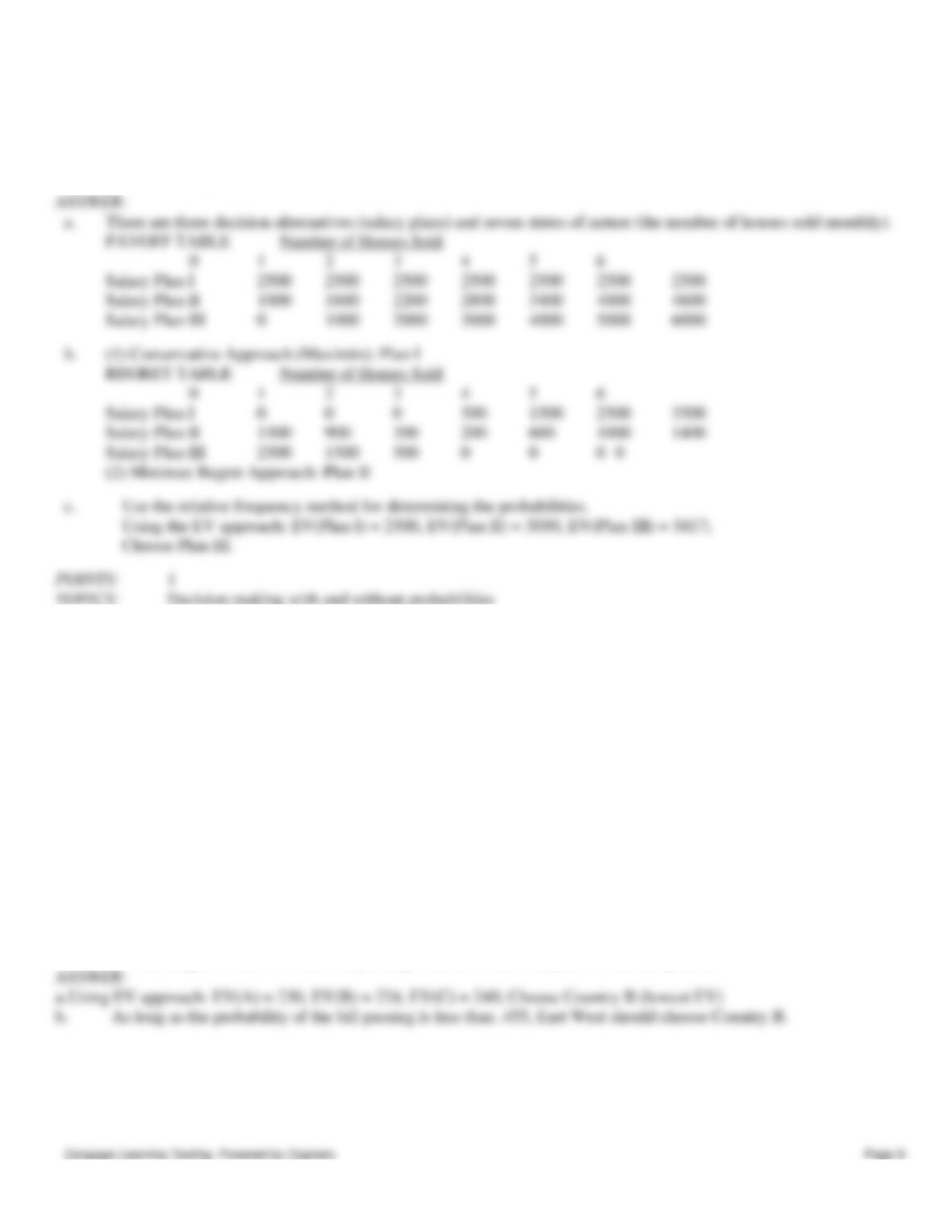
a. Compute the monthly salary payoff table for Jim.
b. For this payoff table find Jim’s optimal decision using: (1) the conservative approach, (2) minimax regret approach.
c. Suppose that during the past year the following is Jim’s distribution of home sales. If one assumes that this a typical
distribution for Jim’s monthly sales, which salary plan should Jim select?
Home Sales Number of Months
0 1
1 2
Chapter 4 – Decision Analysis
2 1
3 2
4 1
5 3
6 2
47. East West Distributing is in the process of trying to determine where they should schedule next year’s production of a
popular line of kitchen utensils that they distribute. Manufacturers in four different countries have submitted bids to East
West. However, a pending trade bill in Congress will greatly affect the cost to East West due to proposed tariffs, favorable
trading status, etc.
After careful analysis, East West has determined the following cost breakdown for the four manufacturers (in $1,000’s)
based on whether or not the trade bill passes:
Bill Passes Bill Fails
Country A 260 210
Country B 320 160
Country C 240 240
Country D 275 210
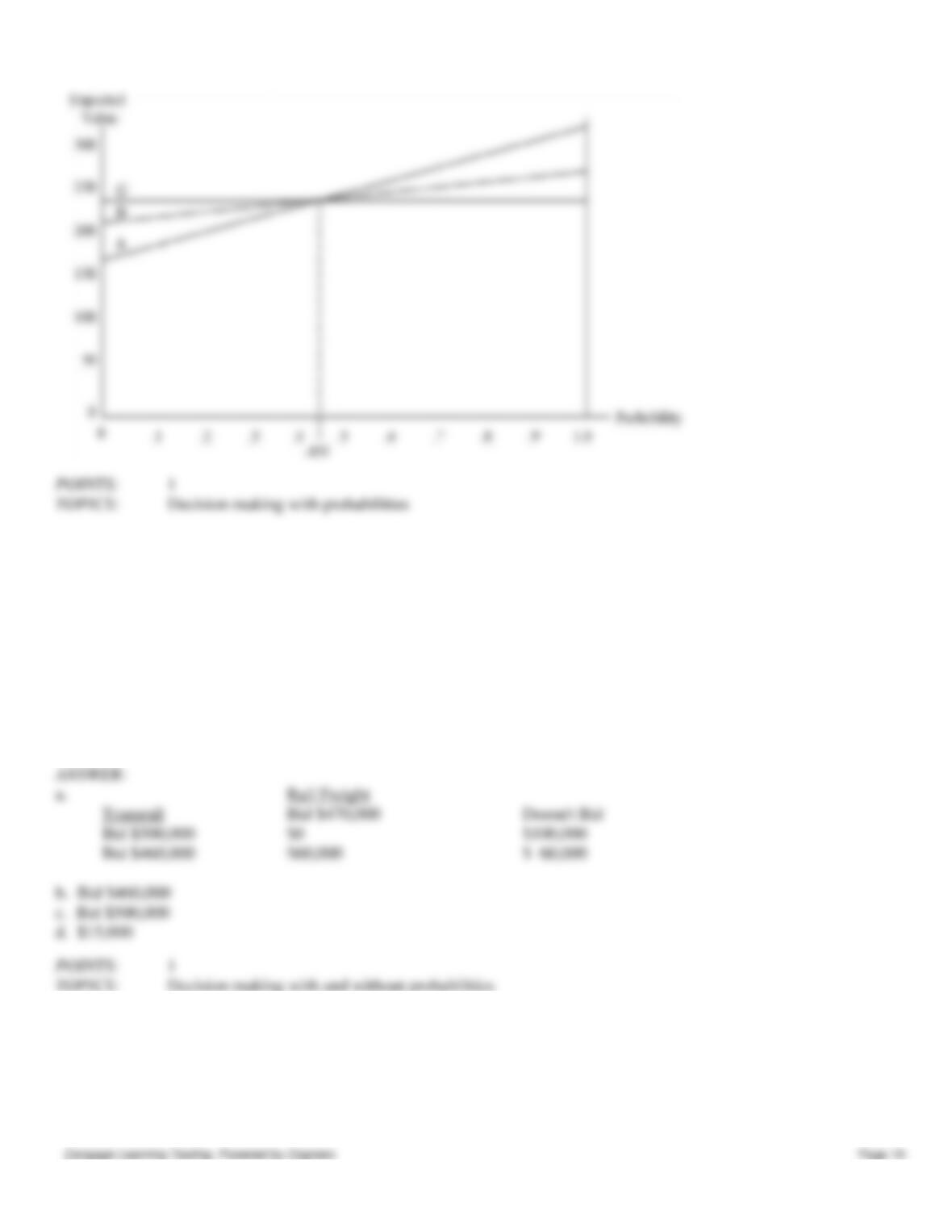
a. If East West estimates that there is a 40% chance of the bill passing, which country should they choose for
manufacturing?
b. Over what range of values for the “bill passing” will the solution in part (a) remain optimal?
Chapter 4 – Decision Analysis
48. Transrail is bidding on a project that it figures will cost $400,000 to perform. Using a 25% markup, it will charge
$500,000, netting a profit of $100,000. However, it has been learned that another company, Rail Freight, is also
considering bidding on the project. If Rail Freight does submit a bid, it figures to be a bid of about $470,000. Transrail
really wants this project and is considering a bid with only a 15% markup to $460,000 to ensure winning regardless of
whether or not Rail Freight submits a bid.
a. Prepare a profit payoff table from Transrail’s point of view.
b. What decision would be made if Transrail were conservative?
c. If Rail Freight is known to submit bids on only 25% of the projects it considers, what decision should Transrail
make?
d. Given the information in (c), how much would a corporate spy be worth to Transrail to find out if Rail Freight will
bid?
49. The Super Cola Company must decide whether or not to introduce a new diet soft drink. Management feels that if it
does introduce the diet soda it will yield a profit of $1 million if sales are around 100 million, a profit of $200,000 if sales
are around 50 million, or it will lose $2 million if sales are only around 1 million bottles. If Super Cola does not market
the new diet soda, it will suffer a loss of $400,000.
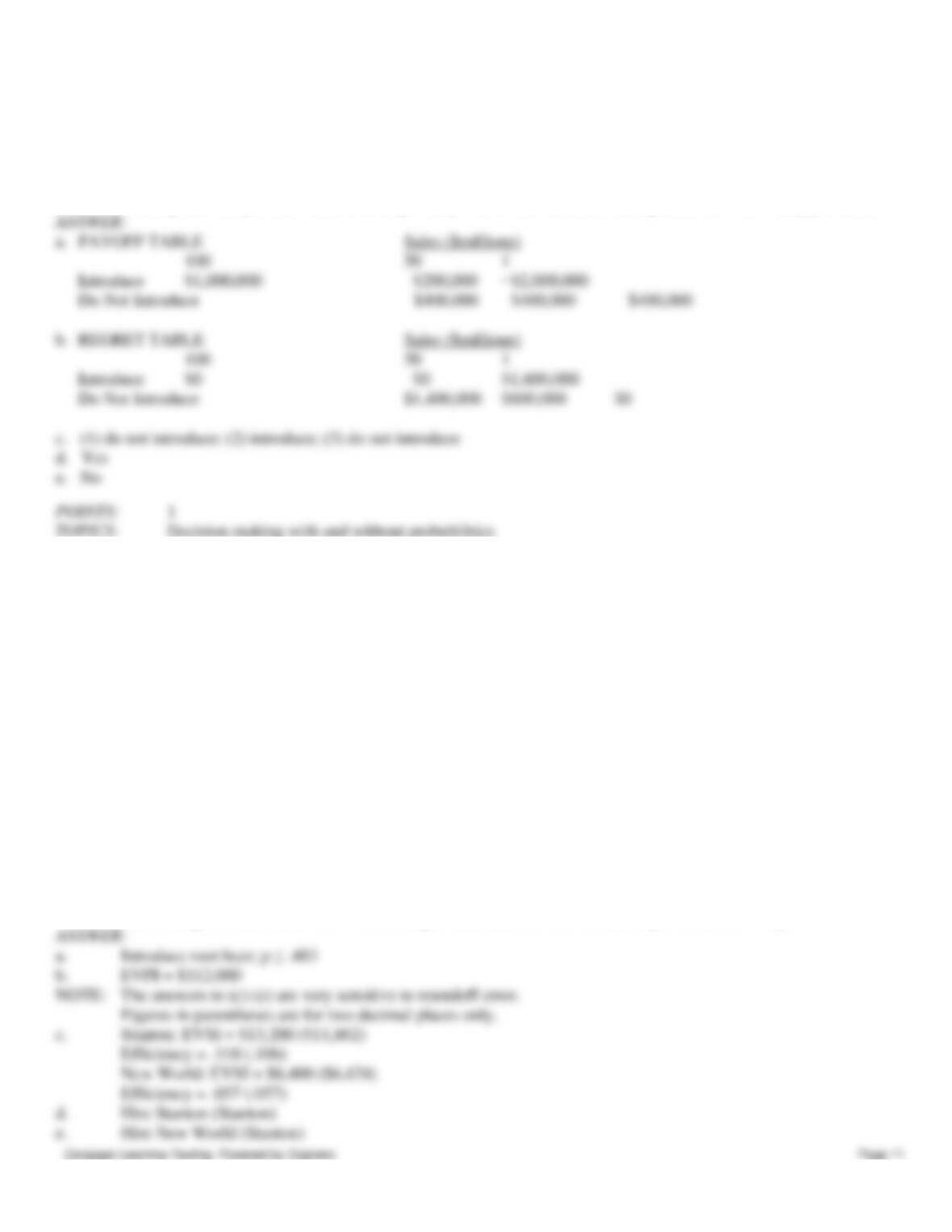
a. Construct a payoff table for this problem.
Chapter 4 – Decision Analysis
b. Construct a regret table for this problem.
c. Should Super Cola introduce the soda if the company: (1) is conservative; (2) is optimistic; (3) wants to minimize its
maximum disappointment?
d. An internal marketing research study has found P(100 million in sales) = 1/3; P(50 million in sales) = 1/2; P(1
million in sales) = 1/6. Should Super Cola introduce the new diet soda?
e. A consulting firm can perform a more thorough study for $275,000. Should management have this study performed?
50. Super Cola is also considering the introduction of a root beer drink. The company feels that the probability that the
product will be a success is .6. The payoff table is as follows:
Success (s1) Failure (s2)
Produce (d1) $250,000 −$300,000
Do Not Produce (d2) −$ 50,000 −$ 20,000
The company has a choice of two research firms to obtain information for this product. Stanton Marketing has market
indicators, I1 and I2 for which P(I1 | s1) = .7 and P(I1 | s2) = .4. New World Marketing has indicators J1 and J2 for which
P(J1 | s1) = .6 and P(J1 | s2) = .3.
a.
What is the optimal decision if neither firm is used? Over what probability of success range is this decision optimal?
b. What is the EVPI?
c. Find the EVSIs and efficiencies for Stanton and New World.
d. If both firms charge $5,000, which firm should be hired?
e.
If Stanton charges $10,000 and New World charges $4,000, which firm should Super Cola hire? Why?
Chapter 4 – Decision Analysis
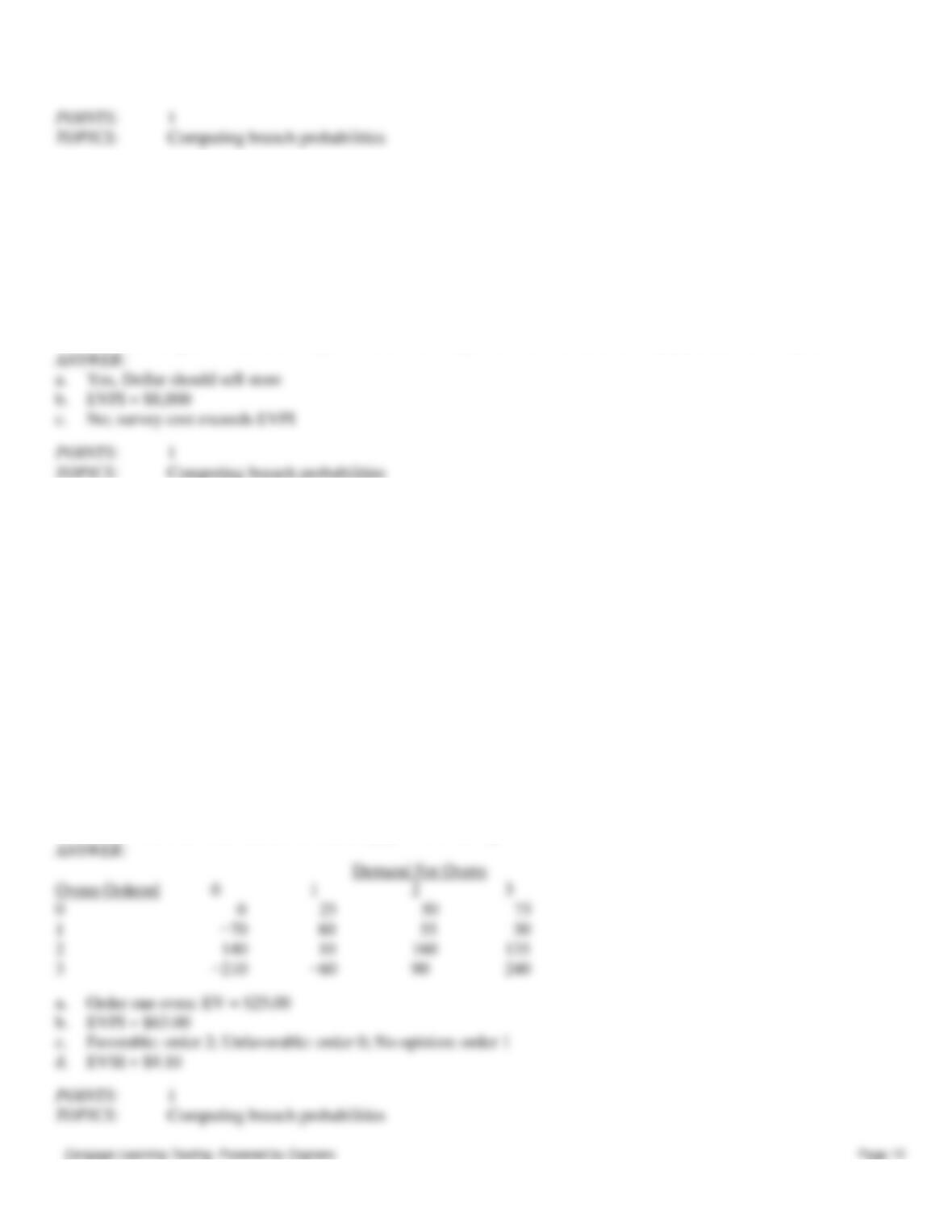
51. Dollar Department Stores has just acquired the chain of Wenthrope and Sons Custom Jewelers. Dollar has received an
offer from Harris Diamonds to purchase the Wenthrope store on Grove Street for $120,000. Dollar has determined
probability estimates of the store’s future profitability, based on economic outcomes, as: P($80,000) = .2, P($100,000) =
.3, P($120,000) = .1, and P($140,000) = .4.
a. Should Dollar sell the store on Grove Street?
b. What is the EVPI?
c. Dollar can have an economic forecast performed, costing $10,000, that produces indicators I1 and I2, for which P(I1 |
80,000) = .1; P(I1 | 100,000) = .2; P(I1 | 120,000) = .6; P(I1 | 140,000) = .3. Should Dollar purchase the forecast?
52. An appliance dealer must decide how many (if any) new microwave ovens to order for next month. The ovens cost
$220 and sell for $300. Because the oven company is coming out with a new product line in two months, any ovens not
sold next month will have to be sold at the dealer’s half price clearance sale. Additionally, the appliance dealer feels he
suffers a loss of $25 for every oven demanded when he is out of stock. On the basis of past months’ sales data, the dealer
estimates the probabilities of monthly demand (D) for 0, 1, 2, or 3 ovens to be .3, .4, .2, and .1, respectively.
The dealer is considering conducting a telephone survey on the customers’ attitudes towards microwave ovens. The results
of the survey will either be favorable (F), unfavorable (U) or no opinion (N). The dealer’s probability estimates for the
survey results based on the number of units demanded are:
P(F | D = 0) = .1 P(F | D = 2) = .3 P(U | D = 0) = .8 P(U | D = 2) = .1
P(F | D = 1) = .2 P(F | D = 3) = .9 P(U | D = 1) = .3 P(U | D = 3) = .1
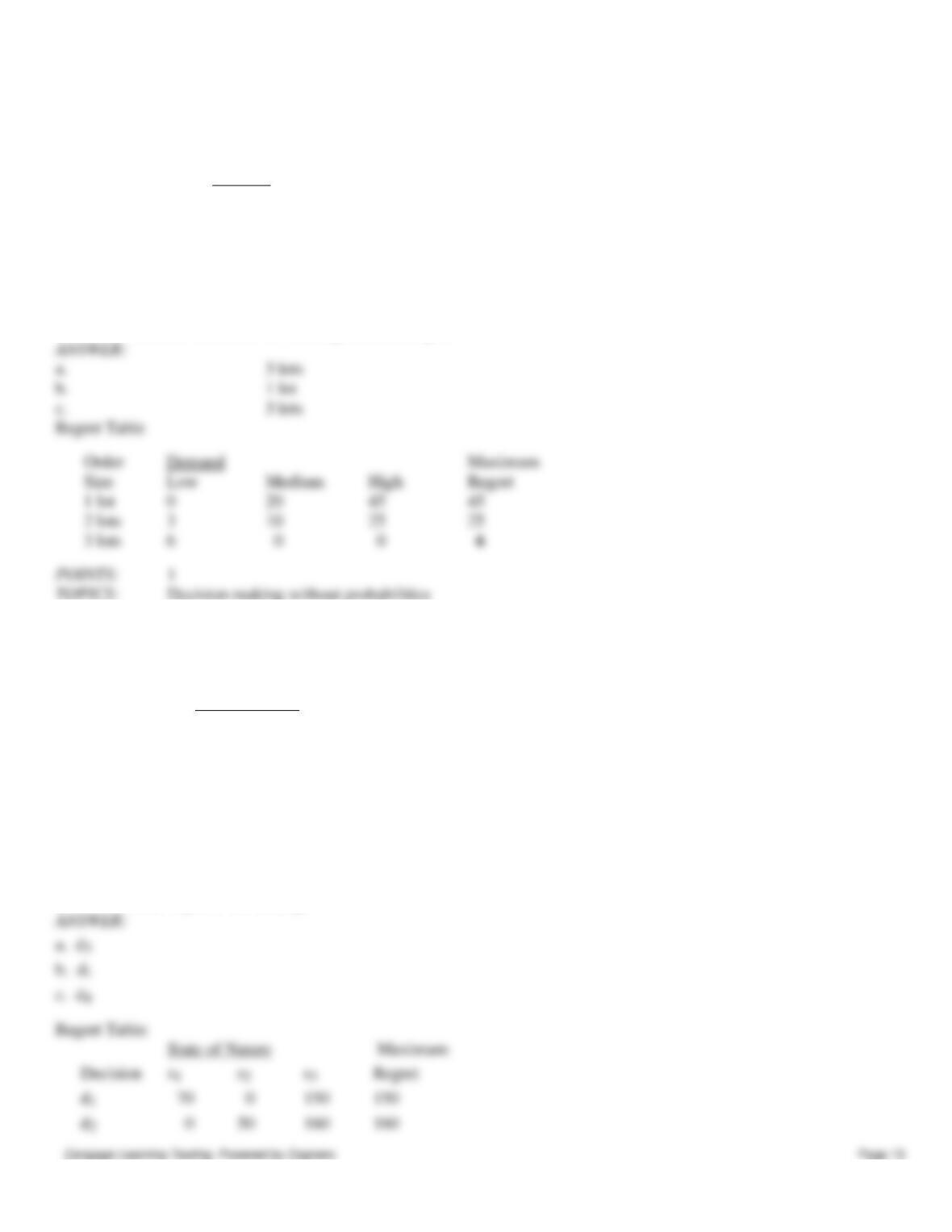
a. What is the dealer’s optimal decision without conducting the survey?
b. What is the EVPI?
c. Based on the survey results what is the optimal decision strategy for the dealer?
d. What is the maximum amount he should pay for this survey?
Chapter 4 – Decision Analysis
53. Lakewood Fashions must decide how many lots of assorted ski wear to order for its three stores. Information on
pricing, sales, and inventory costs has led to the following payoff table, in thousands.
Demand
Order Size Low Medium High
1 lot 12 15 15
2 lots 9 25 35
3 lots 6 35 60
a. What decision should be made by the optimist?
b. What decision should be made by the conservative?
c. What decision should be made using minimax regret?
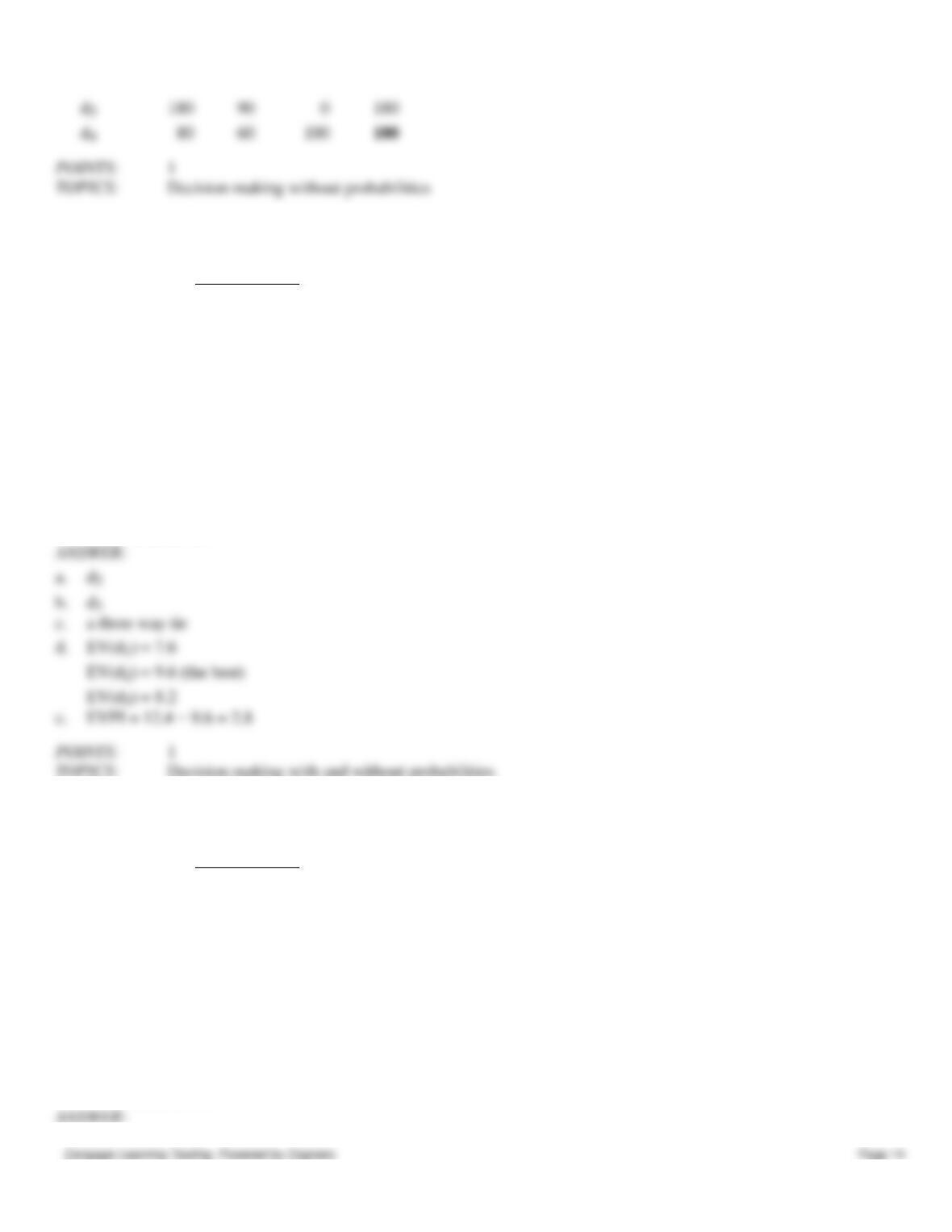
54. The table shows both prospective profits and losses for a company, depending on what decision is made and what
state of nature occurs. Use the information to determine what the company should do.
State of Nature
Decision s1 s2 s3
d1 30 80 −30
d2 100 30 −40
d3 −80 −10 120
d4 20 20 20
a. if an optimistic strategy is used.
b. if a conservative strategy is used.
c. if minimax regret is the strategy.
Chapter 4 – Decision Analysis
55. A payoff table is given as
State of Nature
Decision s1 s2 s3
d1 10 8 6
d2 14 15 2
d3 7 8 9
a. What decision should be made by the optimistic decision maker?
b. What decision should be made by the conservative decision maker?
c. What decision should be made under minimax regret?
d.
If the probabilities of s1, s2, and s3 are .2, .4, and .4, respectively, then what decision should be made under expected
value?
e. What is the EVPI?
56. A payoff table is given as
State of Nature
Decision s1 s2 s3
d1 250 750 500
d2 300 −250 1200
d3 500 500 600
a. What choice should be made by the optimistic decision maker?
b. What choice should be made by the conservative decision maker?
c. What decision should be made under minimax regret?
d. If the probabilities of d1, d2, and d3 are .2, .5, and .3, respectively, then what choice should be made under expected
value?
e. What is the EVPI?